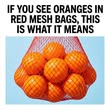
Why Oranges Are Sold in Red Mesh Bags
Walk through the produce section of almost any supermarket and you may notice something peculiar: oranges are frequently packaged in red mesh bags rather than clear plastic or another neutral-colored material.
It is not merely a decorative choice.
The red mesh serves a surprisingly clever marketing function. Because of the way human vision interprets color, the reddish netting can make the oranges appear more uniformly orange, brighter, and more visually appealing than they might look on their own.
Why Red Mesh Makes Oranges Look More Orange
The trick is rooted in a simple optical phenomenon.
When oranges are placed behind red-colored mesh, the red strands partially overlay the fruit’s natural color. The visual system combines the colors it receives, and the resulting impression can make the orange peel appear deeper and more saturated.
This is particularly useful when individual oranges have slightly greenish or yellowish patches.
The fruit itself has not changed. The mesh simply alters the visual presentation.
Think of it as a rudimentary color filter. A shopper glancing at a bag may perceive a collection of intensely orange fruits rather than noticing subtle variations in peel coloration.
That matters because consumers routinely use appearance as a proxy for freshness and quality. A vibrant orange color can subconsciously suggest ripeness, juiciness, and sweetness—even though peel color alone does not reliably determine the eating quality of an orange.
Why Mesh Bags Are Used Instead of Solid Packaging
There is another practical advantage.
Oranges need ventilation. A tightly sealed container can trap moisture, which may accelerate deterioration and encourage mold growth. Mesh allows air to circulate around the fruit while still keeping the oranges together as a convenient retail unit.
The packaging is also lightweight and relatively inexpensive.
And there is a psychological component: the consumer can see the fruit before buying it. The oranges remain conspicuous, colorful, and easy to inspect.
The result is a small piece of packaging with several simultaneous functions: ventilation, containment, visibility, and visual enhancement.
Does the Red Mesh Actually Make Oranges Fresher?
No.
The red mesh does not increase the nutritional value, sweetness, or freshness of the oranges. It primarily affects their presentation.
An orange’s flavor depends on factors such as variety, maturity, growing conditions, storage, and handling. Peel coloration can provide clues, but it is not a definitive freshness meter.
When selecting oranges, look for fruit that feels relatively heavy for its size, has firm skin without extensive soft spots, and does not show signs of mold or significant deterioration.
The red bag may catch your eye.
The fruit itself should make the final decision.
Related Articles from Homemaking
Small household observations often conceal surprisingly useful explanations. From food packaging to cleaning techniques, everyday objects are frequently designed around practical considerations that are easy to overlook.
Editor’s Pick
For more clever household discoveries, explore practical cleaning shortcuts, kitchen insights, food-storage advice, and everyday household techniques.
Surprising Dryer Sheet Hack for Easy Toilet Cleaning
Dryer sheets are traditionally associated with laundry, but their textured surface and antistatic properties have made them a popular household-cleaning hack.
A used dryer sheet can sometimes be repurposed to collect loose dust, hair, and surface debris around bathroom fixtures. For light cleaning, it may help lift particles from surfaces before a conventional bathroom cleaner is applied.
However, it should not be considered a substitute for proper toilet disinfecting. For hygienic cleaning, use an appropriate bathroom or toilet cleaner according to its label.
The trick is best regarded as a pre-cleaning shortcut, not a sanitation method.
Effortless Hack to Remove Gunk from Dirty Racks
Oven racks can accumulate a tenacious amalgam of grease, food residue, and carbonized particles.
One effective approach is to soak the racks in warm water with dish soap for several hours. The prolonged immersion softens accumulated grime, reducing the amount of abrasive scrubbing required.
For particularly stubborn residue, a paste made from baking soda and water can be applied after soaking. Allow it to sit before scrubbing with a suitable non-scratch pad.
Patience does much of the work.
Rather than attacking baked-on residue immediately, prolonged soaking gives water and detergent time to penetrate and loosen the grime.
7 Annoying Things Customers Do at Restaurants That Servers Really Hate
Restaurants operate through coordination. When customers disrupt that rhythm, even seemingly minor behaviors can create disproportionate difficulties for servers.
Here are seven common examples:
Ignoring the server while ordering — Looking at a phone or continuing a private conversation can make taking the order unnecessarily awkward.
Changing the order repeatedly — Constant modifications complicate communication between the dining room and kitchen.
Demanding immediate service during a rush — A busy restaurant has multiple tables competing for attention.
Splitting one bill into an excessive number of separate payments — This can substantially increase the time required to close a table.
Leaving extremely messy tables — Spilled food, scattered napkins, and deliberately excessive messes make cleanup more arduous.
Complaining about prices after ordering — Menu prices are generally available before the meal is purchased.
Ignoring closing time — Staff members may still have cleaning, preparation, and closing duties after the last customer leaves.
Good restaurant etiquette is rarely complicated. Courtesy, patience, and clear communication go a remarkably long way.
Close Car Windows Without the Key: A Handy Trick for Drivers
Many modern vehicles include convenience features that allow windows to be operated after the engine has been switched off.
Depending on the vehicle’s make, model, trim, and market configuration, holding a button on the key fob may open or close the windows. Some cars support a prolonged press of the lock button, while others require a specific sequence.
The important caveat is that there is no universal method.
If a vehicle supports remote window control, the exact procedure should be confirmed in its owner’s manual. Attempting random button combinations is unlikely to damage the vehicle, but it may activate other functions or simply do nothing.
For older vehicles, the feature may not exist at all.
Why You Should Put Socks on Your Ceiling Fan Immediately
Putting socks on a ceiling fan sounds absurd until the purpose becomes clear.
The idea is essentially a dusting technique: a soft fabric covering can help capture accumulated dust from fan blades while preventing loose particles from falling onto furniture or floors.
However, safety matters more than convenience.
Never place socks or any loose material on a fan while it is operating. Turn the fan off completely before attempting to clean it, and make sure the blades have stopped moving.
A microfiber cloth or purpose-designed fan duster is generally a more predictable choice. For regular maintenance, cleaning the blades periodically prevents thick layers of dust from accumulating in the first place.
What Are the Differences Between Yellow Chicken and White Chicken?
Yellow-skinned chicken and white-skinned chicken are not necessarily different species or fundamentally different meats.
The coloration can result from breed genetics and diet.
Some chickens naturally develop more yellow pigmentation in their skin because of their genetic characteristics. Diet can also influence pigmentation, particularly when birds consume feed containing pigments such as xanthophylls.
The distinction therefore does not automatically indicate that one chicken is healthier, fresher, or more flavorful.
What matters more when purchasing chicken is proper storage, handling, freshness, and safe cooking.
Regardless of skin color, poultry should be cooked thoroughly to an appropriate internal temperature to reduce the risk of foodborne illness.
What’s the Hole in a Safety Pin For?
That tiny hole at the rounded end of a safety pin is not merely decorative.
It helps form part of the pin’s mechanical structure and provides a place for the pointed end to rest securely when the pin is closed.
The configuration also helps maintain the tension and positioning necessary for the clasping mechanism to function correctly.
A safety pin is a wonderfully economical piece of engineering. Its apparent simplicity conceals a carefully arranged system of spring tension, alignment, and containment.
That minuscule hole is one component of the mechanism that makes the entire object practical.
What the Numbers on Your Egg Carton Really Mean
Egg cartons can contain several different numbers, and they are not all referring to the same thing.
In the United States, one commonly encountered code is the Julian date, which identifies the day of the year on which the eggs were packed. The number runs from 001 through 365.
For example, a code ending in a number such as 150 represents the 150th day of the calendar year.
Egg cartons may also display a “sell-by” or expiration-related date, depending on regional regulations and labeling practices.
The distinction is important because a packing date and a retail date serve different purposes.
Eggs should still be stored properly and checked for spoilage. When in doubt, discard questionable eggs rather than relying solely on a printed date.
Recipes
Explore recipes designed for everyday cooking, including uncomplicated side dishes, family-friendly meals, seasonal favorites, and practical kitchen techniques.
Homemaking
Discover practical ideas for cleaning, organizing, maintaining a household, and making ordinary domestic tasks a little more manageable.
Do Not Sell or Share My Personal Information
Privacy matters.
Websites may provide visitors with choices concerning the collection, use, or sharing of personal information, depending on applicable privacy laws and the site’s practices.
Look for the site’s privacy settings or “Do Not Sell or Share My Personal Information” option to review available controls.
Privacy preferences can vary by jurisdiction, browser, device, and account status. A site’s privacy policy should provide the most precise explanation of how personal information is collected and used.
Your Use of Our Content
Content published online may be protected by copyright and other intellectual-property laws.
Readers may generally view and use website content for personal purposes according to the site’s terms, but copying, reproducing, republishing, distributing, or commercially exploiting material may require permission.
Always consult the applicable website’s terms of use for the specific rules governing its articles, photographs, graphics, recipes, and other materials.