Many people believe that putting food in the refrigerator is always the best way to keep it fresh for longer. While refrigeration is essential for many perishable foods, it isn’t necessarily the ideal storage method for everything.
In fact, certain fruits, vegetables, and everyday ingredients can lose their flavor, develop an unpleasant texture, or spoil more quickly when stored at very low temperatures.
Some foods are better kept in a cool, dry pantry, while others need room-temperature storage to maintain their natural taste and quality.
Knowing where to store your groceries can help reduce food waste, save money, and make your meals taste better.
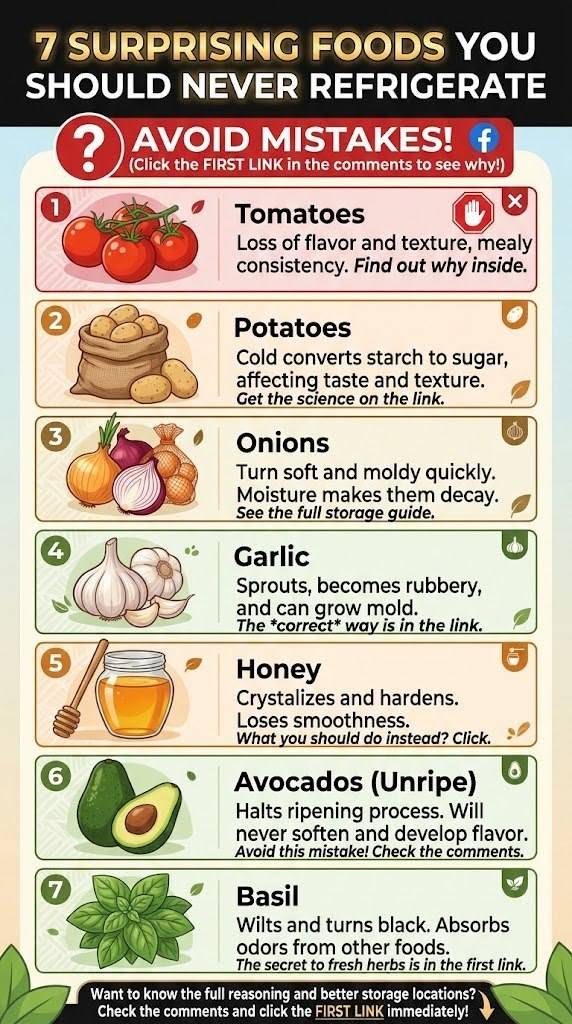
Here are seven common foods you should think twice about refrigerating.
1. Tomatoes
Best stored at room temperature when ripe and eaten soon.
Have you ever noticed that refrigerated tomatoes sometimes taste watery or less flavorful?
Tomatoes are sensitive to cold temperatures. Refrigeration can interfere with the compounds responsible for their characteristic aroma and flavor.
Cold storage can also affect their texture, making them feel less pleasant when eaten fresh.
The better way to store them:
Keep unripe tomatoes at room temperature until they ripen.
Place ripe tomatoes on the counter, away from direct sunlight.
Avoid stacking them too heavily.
If they are fully ripe and you cannot eat them soon, refrigeration can help extend their usable life.
Allow refrigerated tomatoes to return to room temperature before serving for a better flavor experience.
2. Potatoes
Potatoes are another food that generally does better outside the refrigerator.
When stored at very low temperatures, some of the starch in potatoes can convert into sugars.
This can affect their taste and cooking properties, particularly when they are fried.
The better way to store them:
Keep potatoes in a cool, dark, dry place.
Use a breathable paper bag, basket, or cardboard box.
Keep them away from direct sunlight.
Avoid storing them next to onions.
Do not wash them until you are ready to use them.
A pantry or well-ventilated cupboard is usually a better choice than the refrigerator.
3. Onions
Whole, unpeeled onions generally do not need refrigeration.
The moisture inside a refrigerator can encourage softening and mold growth, especially when onions are stored in an enclosed plastic bag.
The better way to store them:
Keep whole onions in a cool, dry, ventilated location.
Use a mesh bag or basket.
Avoid direct sunlight.
Keep them separate from potatoes.
Once an onion has been peeled or cut, however, refrigeration is important. Place the remaining pieces in a covered container and use them within a few days.
4. Garlic
Garlic is a kitchen essential, but storing whole bulbs in the refrigerator is usually unnecessary.
Cold and humid conditions can encourage sprouting and deterioration.
The better way to store it:
Keep whole garlic bulbs in a cool, dry place.
Use a breathable container.
Avoid sealed plastic bags.
Keep the bulbs away from moisture and direct sunlight.
If garlic begins to sprout, it is not automatically unsafe, although its flavor may become more bitter.
Important: Peeled garlic and garlic stored in oil require special care. Homemade garlic-in-oil mixtures must be refrigerated immediately and used within four days or frozen. Never leave them at room temperature because of the risk of botulism.
5. Bananas
Bananas are tropical fruits that are particularly sensitive to cold temperatures.
Putting unripe bananas in the refrigerator can interfere with normal ripening and cause their peel to darken.
Although the inside may remain edible, the appearance and texture can become less appealing.
The better way to store them:
Keep unripe bananas at room temperature.
Place them away from direct sunlight.
Separate overly ripe bananas from other fruit if you want to slow the ripening of nearby produce.
Once fully ripe, refrigerate them if you want to extend their usable life.
Remember that the peel may turn brown or black in the refrigerator even when the flesh remains perfectly edible.
6. Bread
Many people put bread in the refrigerator because they believe it will stay fresh longer.
Unfortunately, refrigeration can actually make bread become stale faster.
The cool temperature encourages starch molecules to reorganize, a process that contributes to the firm, dry texture associated with stale bread.
The better way to store it:
Keep bread in a sealed bread bag or suitable bread container if you will eat it within a few days.
Store it in a cool, dry location.
If you want to keep it longer, freeze it.
Freezing is generally much better than refrigeration for preserving bread’s texture and freshness.
You can freeze sliced bread and take out only the pieces you need.
7. Honey
Honey is one of the most interesting foods to store because it naturally has a very long shelf life when handled properly.
Putting honey in the refrigerator is unnecessary and can cause it to crystallize more quickly.
Crystallization does not mean honey has spoiled. It is a natural process in which glucose separates from the liquid and forms crystals.
The better way to store it:
Keep honey in a tightly sealed container.
Store it at room temperature.
Protect it from moisture.
Use a clean, dry spoon whenever you take some out.
If your honey crystallizes, place the jar in warm water and gently stir until the crystals dissolve.
Never give honey to children younger than 12 months because of the risk of infant botulism.
Bonus: Foods That Actually Need Refrigeration
While some foods benefit from room-temperature storage, others must be refrigerated to remain safe.
These include:
Milk and dairy products.
Raw meat and poultry.
Fish and seafood.
Cooked leftovers.
Cut fruits and vegetables.
Eggs in countries where eggs are sold refrigerated.
Opened perishable sauces and foods.
Keep your refrigerator at or below 40°F (4°C), and refrigerate perishable foods within two hours of purchase or preparation (one hour when the temperature is above 90°F/32°C).
Common Food Storage Mistakes to Avoid
Even when you know which foods belong in the pantry, a few simple mistakes can shorten their shelf life.
1. Keeping potatoes and onions together: They can encourage each other to deteriorate more quickly.
2. Using sealed plastic bags for dry produce: Poor ventilation can trap moisture.
3. Washing fruit before storing it: Excess moisture may encourage mold. Wash produce just before preparation unless the storage instructions say otherwise.
4. Ignoring damaged produce: One spoiled item can affect nearby fruits and vegetables.
5. Leaving perishable food outside too long: Foods requiring refrigeration should not be left at room temperature for extended periods.
Final Thoughts: The Right Storage Makes a Difference!
Refrigeration is one of the most useful ways to preserve food, but it isn’t the answer for every ingredient.
Tomatoes, potatoes, whole onions, garlic, bananas, bread, and honey often benefit from alternative storage methods, depending on their condition and how quickly you plan to use them.
Learning these simple differences can help preserve flavor, maintain texture, reduce unnecessary waste, and save money on groceries.
The next time you unpack your shopping bags, remember that where you store your food can be just as important as what you buy.
A little knowledge about food storage can make your kitchen more efficient and help you enjoy every ingredient at its best!