PART 1 — THE MONEY ON THE FLOOR
“I should tell you about the money,” I said, keeping my voice low enough that the whole cabin would not have to hear it.
The flight attendant, whose name was Naomi Brooks, leaned slightly closer.
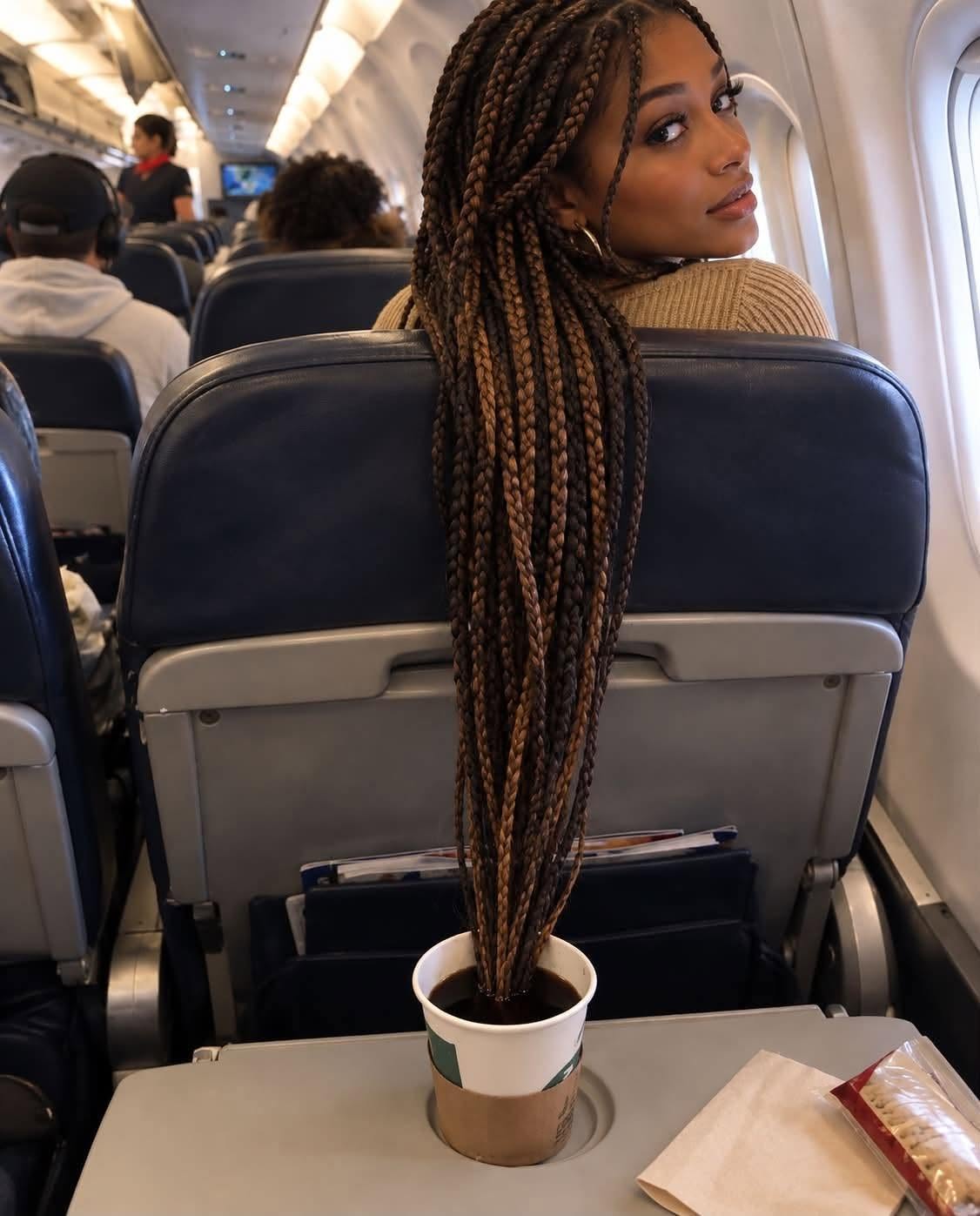
The young woman in front of me stopped tugging at her pink-speckled extensions.
“What money?” she asked.
“The hundred-dollar bill you found near your shoes.”
Her hand went instinctively to her handbag.
Naomi glanced from her to me, waiting.
“I put it there,” I said.
The young woman stared at me as though I had just announced that I was a magician.
“You dropped it on purpose?”
“Yes.”
“Why?”
I looked down at the coffee stain on my tray and considered how foolish the answer sounded.
“Because I was angry, and I wanted to see whether you would pick it up without asking whose it was.”
A passenger
across the aisle gave a soft whistle.
Naomi raised a hand before the cabin could turn into a courtroom.
“Let’s keep this between the people involved,” she said.
I was grateful for that.
“I thought that if you took it, I would have proof you were selfish,” I continued.
“Then I used that judgment to excuse what I did to your hair.”
The young woman blinked twice.
“So you set me up?”
“I did.”
“And you put something in my hair because I picked up money you deliberately dropped?”
“No,” I said, forcing myself to be exact.
“I put something in your hair because you kept dropping it into my food, and I wanted to get even.”
“The money was another petty thing I did while I was upset.”
I could feel the heat rising beneath my collar.
At seventy-three, I had never imagined confessing to such childish behavior in front of strangers at thirty-five thousand feet.
Naomi crouched beside my seat.
“Thank you for telling me,” she said.
“Do you still have the bill?”
The young woman hesitated.
“It’s in my purse.”
“Would you mind taking it out so we can settle that part of this?”
She unzipped a small leather bag and produced the bill, folded neatly into quarters.
She held it out to me with an expression that was half resentment and half embarrassment.
I didn’t reach for it.
“Keep it on the tray for now,” I said.
“I’m not sure I deserve to act like the injured party.”
Naomi looked tired in the way only a person who has spent years keeping peace in narrow aisles can look.
“We’re going to separate the issues,” she said.
“The hair was repeatedly interfering with another passenger’s space and food.”
“The glitter was an inappropriate response.”
“And the money
is something you both need to address honestly.”
The young woman turned away.
“I didn’t steal it,” she muttered.
“No one has used that word,” Naomi replied.
“You found cash and didn’t ask about it.”
“I thought somebody dropped it.”
“That’s exactly why asking would have helped.”
A few rows ahead, a baby began crying.
The ordinary noise was oddly comforting.
It reminded me that the plane was full of people with their own worries, and we were not the center of the universe.
I had spent much of my life believing that age automatically brought perspective.
That morning taught me that experience only helps when we remember to use it.
The young woman had not made me behave badly.
I had made that choice myself.
Recognizing it did not erase the annoyance or the food I could no longer eat.
It simply placed responsibility where it belonged.
There was
a difference between asking for respect and demanding the right to retaliate.
I wished I had remembered it before reaching into my handbag.
Naomi asked the young woman whether the gel had touched her scalp or eyes.
“No,” she answered.
“Only the ends.”
“Are you in pain?”
“No, but these extensions were expensive.”
“Then let’s see whether we can help without making promises about the material,” Naomi said.
She offered clean napkins, a small cup of water, and the option to speak privately with the senior attendant.
The young woman stared at the bill on the tray between us.
“I don’t even know why I took it,” she said.
That was the first sentence she had spoken without a defensive edge.
“I saw it and thought it might cover my ride when I landed.”
I noticed her fingers trembling.
“Are you traveling for work?” I asked.
She gave a short,
humorless laugh.
“Something like that.”
Naomi straightened.
“I’m going to bring fresh napkins and document what happened,” she said.
“I need you both to remain calm and leave each other’s belongings alone.”
We agreed.
As she walked away, the young woman finally gathered her hair into a loose knot over her shoulder.
My tray was clear for the first time in nearly an hour.
I should have felt triumphant.
Instead, I felt ashamed.
I took a sip of cold coffee and studied the back of her seat.
A tiny sticker on her phone case showed a yellow sunflower with one petal missing.
I had seen that symbol somewhere before.
Then I remembered the graduation program my daughter had emailed me the previous evening.
My granddaughter had volunteered for a student organization whose emblem was a sunflower with one petal missing.
I told myself it was coincidence.
There were thousands of sunflowers on phone cases.
Yet something about the young woman’s sudden quietness bothered me more than her earlier rudeness.
After a few minutes, she turned around.
“My name is Tessa,” she said.
“Evelyn,” I replied.
She looked at my hands, folded around the paper cup.
“I’m sorry I called you Grandma like that.”
“I’m a grandmother,” I said.
“It’s not the word that hurt.”
“I know.”
“I’m sorry about your hair.”
She swallowed.
“It’s okay.”
“No,” I said.
“It’s not okay simply because I apologized.”
“Let me help you find out what cleaning it will cost.”
She looked at me for a long moment.
Then she said something I did not expect.
“I can’t afford for anything else to go wrong today.”
PART 2 — THE GIRL BEHIND THE GLITTER
Tessa’s words stayed with me long after Naomi returned with a damp cloth and an incident form.
The gel softened when
touched with water, but some glitter remained caught between the strands.
Naomi suggested leaving the rest for a professional rather than rubbing hard enough to damage the extensions.
Tessa nodded, no longer arguing.
I offered my name and contact information for any reasonable cleaning expense.
Naomi wrote down the facts and reminded us that the airline would follow its own process if a complaint was filed.
I accepted that without protest.
For the next twenty minutes, Tessa sat facing forward.
I read the same paragraph of my book four times.
Eventually, she turned around again.
“Can I ask you something?”
“Of course.”
“Why did you have glitter gel in your bag?”
I almost smiled.
“My younger granddaughter loves making greeting cards.”
“I bought it for her.”
“And you’re going to her graduation?”
“Her older sister’s college graduation,” I said.
“Her name is June.”
Tessa went very still.
“June what?”
“June
Calder.”
The young woman looked down at the sunflower sticker on her phone.
“You’re June Calder’s grandmother?”
“Yes.”
She sank back into her seat so quickly that I wondered if she felt ill.
“Do you know her?” I asked.
For a moment, she said nothing.
Then she nodded.
“We were roommates freshman year.”
I stared at the back of her head.
June had spoken often about her freshman roommate, a bright girl who worked late shifts and sometimes missed meals.
I remembered a Christmas phone call in which June had asked whether she could send an extra care package to a friend.
The friend had been called Tessa.
But surely there were other Tessas.
“Your last name wouldn’t happen to be Moreno?” I asked.
She turned around slowly.
“It is.”
I put my hand over my mouth.
June’s old roommate had sat at our Thanksgiving table during her first year
at college.
She had been nineteen then, with dark hair and a shy smile.
The woman before me looked different in her glossy extensions and fashionable makeup, but her eyes were the same.
“Tessa Moreno,” I said.
“You helped June make the cardboard model of a lighthouse for her design class.”
She gave a startled little laugh.
“It fell apart on the bus.”
“And you rebuilt it at two in the morning with packing tape.”
She looked at me as if a door had opened beneath her feet.
“Mrs. Calder?”
“That’s me.”
“Oh, no.”
She covered her face.
“Oh, no, no, no.”
I waited while she gathered herself.
“June said you were flying in today,” she whispered.
“I didn’t know you were on this flight.”
“Neither did I.”
She lowered her hands.
“Please don’t tell her I acted like this.”
I looked at the glitter still sparkling at the tips of her hair.
“I won’t turn this into a story to embarrass you,” I said.
“But I won’t lie if she asks what happened.”
Tessa nodded miserably.
“I was supposed to be at the ceremony too.”
“Supposed to be?”
She turned her phone toward me.
The screen showed a series of unread messages and a photo of a graduation cap decorated with tiny paper sunflowers.
June had sent the picture that morning.
The last message read, I saved you a seat. Please come if you can.
“Why wouldn’t you go?” I asked.
Tessa stared at the words.
“Because I don’t graduate until next year.”
I remembered June mentioning that her roommate had taken time away from school.
I had not known why.
“My mom got sick,” Tessa said.
“I went home for two semesters and worked while she recovered.”
“I’m sorry.”
“She’s better now.”
“I’m glad.”
Tessa rubbed at a
spot on her wrist.
“Everybody else kept going.”
“June kept going.”
“I was happy for her, but every photo reminded me that I was behind.”
“Behind whom?” I asked.
She shrugged.
“Everyone.”
I thought of how often people measure their lives against a clock that exists only in their own heads.
“When I got invited, I bought these extensions and a dress I couldn’t afford,” she continued.
“I wanted to look like I had everything together.”
“Then my hours got cut, and my landlord said the rent increase starts next month.”
“The ride from the airport was going to cost more than I had.”
She glanced toward the hundred-dollar bill.
“When I saw that money, I told myself it was luck.”
“I knew I should ask.”
“I didn’t want the answer to be no.”
Her confession didn’t excuse her treatment of me.
But it gave that treatment a human shape.
I had seen a rude young woman and decided I knew everything important about her.
She had seen an older woman and decided my comfort didn’t matter.
We had both reduced a stranger to a convenient story.
June had once told me that she and Tessa could sit together for hours without talking.
I had considered that the mark of a rare friendship.
Now I understood that silence can hold affection and still conceal pain.
There were things Tessa had never told June because she feared being pitied.
There were things June had never asked because she assumed her friend would speak when ready.
Neither of them was cruel.
Both had simply missed a chance to be honest.
I thought of all the years my own friends and I had spent doing the same.
“Why did you keep throwing your hair back?” I asked.
She flushed.
“I thought you were judging me before you said anything.”
“I wasn’t.”
“I know that now.”
She swallowed.
“I heard you ask someone about a graduation when we boarded, and I thought you were one of those people who never had to worry about money.”
“That’s a lot to decide from one conversation.”
“I know.”
“I grew up in a house where we counted coins for bus fare,” I told her.
“My husband and I worked for years before we could take a trip like this.”
“I didn’t know.”
“That’s the point,” I said gently.
“We didn’t know each other.”
Tessa wiped at her eyes before any tears could fall.
“I feel stupid.”
“So do I.”
She laughed once through her nose.
“That makes two of us.”
We sat in a quieter kind of silence.
Then she asked whether June knew I was bringing a graduation gift.
“Of course,” I said.
“She’s been guessing
what it is for a month.”
“What is it?”
“A small compass that belonged to my husband.”
Tessa’s expression softened.
“June told me about him.”
“He loved the coast,” I said.
“He always told her that getting lost was not the same as failing.”
Tessa looked out the window.
“That’s a good thing to remember.”
I wondered if the young woman had been waiting years to hear it.
PART 3 — A SEAT AT THE CEREMONY
The captain announced that we had begun our descent, and Naomi returned to collect the last of the cups.
She asked whether either of us needed further assistance.
Tessa shook her head.
I told Naomi I wanted the written record to reflect that I had admitted applying the gel and had offered to address the resulting expense.
Naomi thanked me and said a supervisor could speak with us after landing if necessary.
She also reminded
Tessa to keep her hair clear of other passengers’ spaces on future flights.
Tessa nodded without argument.
When Naomi moved away, I pointed to the bill still resting on Tessa’s tray.
“Please give that back,” I said.
She handed it over immediately.
I tucked it into my purse.
For a moment, her face closed, and I could almost hear her telling herself that the world had confirmed what she already believed.
Then I took out a small envelope and wrote my daughter’s phone number on it.
“If you’re still planning to attend the ceremony, call this number when you land,” I said.
“My daughter is driving from the airport to the university.”
“She has room for one more.”
Tessa stared at the envelope.
“Why would you do that?”
“Because June saved you a seat.”
“After what I did?”
“Offering you a ride doesn’t erase what happened.”
“It just means I
don’t think one ugly hour should decide the rest of your day.”
She touched the envelope but didn’t take it.
“I don’t want June to think I came because somebody felt sorry for me.”
“Then tell her the truth,” I said.
“You came because you wanted to celebrate your friend.”
“She’ll understand.”
Tessa took the envelope.
The plane landed under a gray sky, and everyone stood too early, as airline passengers always seem determined to do.
I waited until the aisle cleared.
Tessa stepped aside so I could reach my bag.
She offered to lift it from the overhead bin, and I accepted.
It was a small courtesy, but after our flight, it felt significant.
At the jet bridge, a supervisor met us near the gate desk.
Naomi had already explained the incident.
I repeated my account without minimizing my behavior.
Tessa explained the repeated hair tossing and the money.