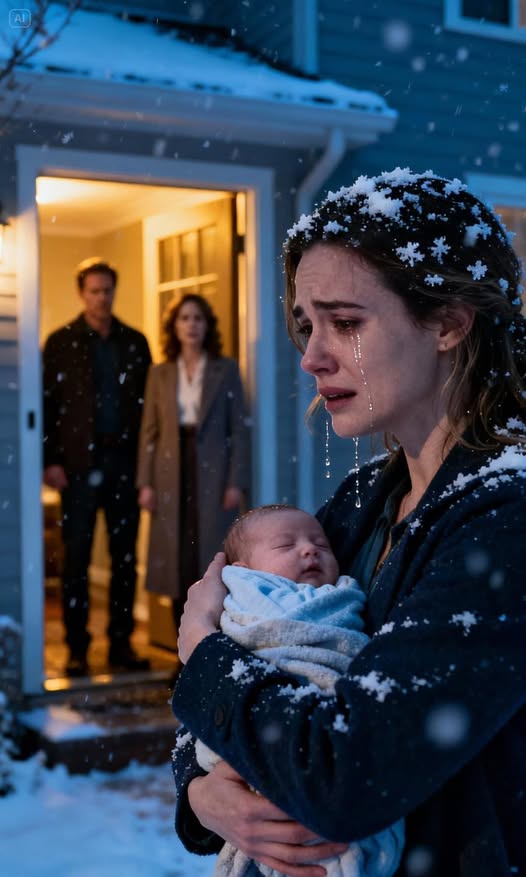
The wind that night didn’t just blow; it screamed, a banshee wail that rattled the frosted windowpanes of the estate I was no longer welcome in. I remember the sound distinctively—a high-pitched, tearing noise, like the sky itself was being ripped open. But even that elemental fury paled in comparison to the frigid silence standing in the foyer of Foster Manor.
My husband, Daniel Foster, stood by the heavy oak door, his hand resting on the brass handle. His jaw was set in a line of tension I used to mistake for strength, but now recognized as cowardice. He wouldn’t meet my eyes. He couldn’t.
Beside him, his mother, Margaret Foster, stood like a statue carved from dry ice. Her arms were crossed over her cashmere sweater, her posture radiating a terrifying, self-righteous certainty.
“You made your choice,” Margaret’s voice sliced through the warm air of the hallway, sharp as a guillotine blade. “Now leave.”
I clutched my son, Noah, to my chest. He was a bundle of three-day-old fragility, wrapped in a knitted yellow blanket that suddenly seemed woefully inadequate against the draft creeping in from the cracked door. My own body was still a ruin; the C-section stitches across my abdomen burned with a white-hot fire every time I shifted my weight.
“He is your grandson,” I whispered, the words catching in a throat raw from holding back tears. “Margaret, please. He’s only three days old. The roads are closed. You can’t do this.”
Daniel didn’t answer. He stared at a spot on the Persian rug, studying the intricate weave as if the secrets of the universe were hidden in the wool.
Instead of my husband, it was Lena who stepped forward from the shadows of the living room. She moved with the fluid grace of a predator that knows the prey is already wounded. She wore a silk robe—my silk robe, I realized with a jolt of nausea—and her smile was soft, victorious, and utterly venomous.
“You really should have known better,” Lena purred, her voice dripping with false sympathy. “When you couldn’t give Daniel the support—or the status—he needed, you made yourself obsolete. This house needs a future, not a charity case.”
I looked at Daniel one last time. “Daniel? You’re going to let them put your son in a blizzard?”
He finally looked up, his eyes glassy and vacant. “It’s Mother’s house,” he muttered, washing his hands of the sin while he was still committing it. “I can’t go against her.”
That was the moment the last tether of my old life snapped.
Margaret stepped forward, her face twisted in a sneer of absolute disgust, and shoved my single, hastily packed suitcase onto the porch. It landed in the snow with a muffled thud.
“Get out,” she hissed.
She grabbed my arm—her grip bruising—and pushed me over the threshold. The cold hit me like a physical blow, a wall of needle-sharp ice.
SLAM.
The sound of the lock turning echoed with the finality of a coffin lid closing.
I stood there for a moment, stunned, the porch light illuminating the swirling flakes before it flickered off, plunging us into darkness. A verdict delivered in silence.
I had nowhere to go. My phone battery was flashing red, dying in the extreme cold. My stitches tore slightly as I hefted the carrier, a warm trickle of blood seeping into my jeans.
But as I turned to face the storm, clutching Noah so tight my knuckles turned white, a strange, hysterical thought bubbled up in my chest.
They thought they had won. They thought they had stripped me of everything—my home, my dignity, my safety.
What they didn’t know—what no one in that house knew—was that just six hours earlier, while I lay in the hospital bed, a lawyer named Michael Reed had called me.
My grandfather, Henry Caldwell, the estranged billionaire who had raised me after my parents died, had passed away.
He had left me everything.
A $2.3 billion estate.
I hadn’t processed it then. I hadn’t told Daniel. I hadn’t told anyone. I was just a tired mother holding a newborn. But as the wind tried to erase us from the doorstep, the shock began to fade, replaced by a cold, hard clarity.
I looked back at the darkened windows of the mansion, where warmth and betrayal lived side by side. “Enjoy the heat,” I whispered into the gale, my voice lost in the wind. “Because tomorrow, you’re going to learn what freezing really feels like.”
The walk to the main road was a blur of agony. Every step sent a shockwave of pain through my abdomen, but instinct is a powerful anesthetic. I shielded Noah with my own body, bending into the wind, murmuring prayers to a God I wasn’t sure was listening.
A passing delivery truck, a miracle in the whiteout, saw my frantic waving. The driver, a burly man with kind eyes, didn’t ask questions. He cranked the heater and drove us to a small urgent care clinic five miles down the road.
An hour later, I was sitting in a plastic chair, wrapped in three heated blankets, sipping tea that tasted like salvation. Noah was asleep in a crib the nurses had improvised, safe and warm.
My phone, now charged, sat heavy in my hand.
I dialed the number for Michael Reed. It was 2:00 AM. He answered on the first ring.
“Mrs. Foster?” His voice was gravelly but alert. “Is everything alright? I didn’t expect to hear from you until after the funeral arrangements.”
“They threw me out,” I said. My voice didn’t shake. The shivering had stopped, replaced by a terrifying calmness. “Daniel and Margaret. They put me and Noah in the snow.”
There was a silence on the other end so profound I thought the line had died. Then, the sound of shuffling papers.
“Where are you?”
“A clinic on Route 9. I’m safe for tonight.”
“I see,” Michael said. The tone of his voice changed. It shifted from condolence to combat. “Then we accelerate the schedule. I need you to meet me at my office at 8:00 AM. Bring the baby. Bring the suitcase. Bring nothing else.”
“Michael,” I asked, staring at the fluorescent lights humming above me. “The inheritance. Is it… real?”
“It is very real,” he replied. “And your grandfather, in his final months, anticipated that your husband’s family might prove… difficult. He structured the estate accordingly.”
I didn’t sleep that night. I watched Noah breathe, his tiny chest rising and falling, the only pure thing left in my world.
The next morning, the city was buried under two feet of snow, but the streets of downtown were plowed. I walked into the law offices of Reed, Sterling & Vance, looking like a refugee—hair matted, coat stained, eyes red-rimmed.
The receptionist didn’t sneeze at me. She ushered me straight into the corner office.
Michael Reed was a man of sharp angles and expensive tailoring. He looked at the baby carrier, then at me, and his expression hardened into something akin to granite.
“They did this,” he gestured to my appearance, “knowing you were three days postpartum?”
“Yes.”
He nodded once, tight and efficient. He slid a thick leather folder across the mahogany desk.
“Your grandfather was a man who believed in contingencies,” Michael explained, opening the file. “The $2.3 billion is held in a trust, fully accessible to you as of yesterday morning. But that includes assets you might find… interesting.”
I looked at the documents.
Trust structures.
International property holdings.
A controlling 51% stake in Foster Development Group, the company Daniel worked for—the company Margaret claimed her late husband built, but which had actually been leveraged by Henry Caldwell’s private equity firm years ago.
And then, my eyes fell on a deed.
1402 Oakwood Drive. The address of the mansion I had been thrown out of.
“Wait,” I pointed at the paper, my finger trembling slightly. “Margaret says the house is in her name. It’s been in the Foster family for three generations.”
Michael allowed himself a very small, very cold smile. “It was. But the Fosters have been leveraged to the hilt for a decade to maintain their lifestyle. Margaret reverse-mortgaged the estate five years ago to a holding company called Apex Ventures to pay off Daniel’s gambling debts.”
He turned the page.
“Apex Ventures,” he said softly, “is a wholly-owned subsidiary of your grandfather’s estate. You don’t just own the company Daniel works for. You own the roof over their heads. And the mortgage payments are three months delinquent.”
I sat back in the leather chair. The realization washed over me, not as joy, but as a heavy, solemn duty.
“I don’t want to just sue them, Michael,” I said, looking at Noah sleeping on the floor. “I want them to understand. I want to expose the rot.”
“We have options,” Michael said, uncapping a fountain pen. “We can evict them. We can fire him. We can freeze every account linked to the Foster name.”
“Do it,” I said. “All of it. But wait until tomorrow noon. Give them exactly 24 hours from the moment they opened that door.”
Michael picked up the phone, his eyes meeting mine. “Consider it done. I suggest you get some rest, Mrs. Foster. Tomorrow is going to be a very busy day for the new Chairman of the Board.”
The clock ticked.
I spent the day in a suite at the Four Seasons, paid for by an account I hadn’t known existed twenty-four hours prior. Nurses came to check on Noah. A doctor came to check on my stitches. I ate warm food. I bathed.
But my mind was across town, visualizing the collapse.
By evening, the first dominoes began to fall, silent and deadly.
At the Foster mansion, the heating system would have shut off around 6:00 PM. Not a malfunction, but a service suspension due to “ownership dispute and non-payment.” I imagined Margaret clutching her cashmere tighter, yelling at a utility worker who could do nothing to help her.
At 8:00 PM, Lena would have tried to buy dinner at her favorite Italian bistro. Her card—a supplementary card linked to Daniel’s corporate expense account—would have declined. Then the backup card. Then the emergency card.
At 9:00 PM, Daniel would have received an automated email. Mandatory Emergency Board Meeting. Topic: Ethics Review and Leadership Restructuring. Attendance Required.
I sat by the window of the hotel, watching the snow fall gently over the city. It looked peaceful from up here, high above the slush and the struggle.
My phone buzzed. A text from an unknown number.
Daniel: Where are you? The accounts are frozen. Mom is freaking out. Pick up the phone.
I didn’t reply. I deleted the thread.
The next morning, I dressed not in the rags of a victim, but in the armor of a survivor. Michael had arranged for a stylist—black trousers, a sharp cream silk blouse, a tailored blazer. I looked in the mirror. The woman staring back wasn’t the scared girl who begged for shelter. She was the storm.
At 11:30 AM, Michael’s town car arrived to take us to Foster Development headquarters.
The building was a glass monolith in the financial district. I had been there only a handful of times, usually to bring Daniel lunch or attend a holiday party where Margaret would introduce me as “Daniel’s little wife.”
Today, the security guards didn’t ask for ID. They stepped aside, heads bowed, as Michael led me toward the private elevator.
“They are all assembled in the main conference room,” Michael whispered as the numbers on the elevator climbed. “They think they are meeting with the investors from Apex Ventures to refinance the house and save Daniel’s job.”
“They are,” I said, adjusting the strap of Noah’s carrier. “Technically.”
The elevator dinged at the top floor.
The hallway was lined with portraits of old men—Daniel’s ancestors—looking stern and important. I walked past them, my heels clicking a rhythm of reckoning on the marble floor.
Outside the double glass doors of the boardroom, I paused. I could hear Margaret’s voice, shrill and demanding.
“It’s a banking error! A glitch! Do you know who we are? When these investors get here, I will have their heads!”
I looked at Michael. He nodded.
I reached out and pushed the doors open.
Every head in the room turned. The silence was instantaneous and absolute. Daniel was halfway out of his chair. Margaret was mid-gesture. But as I walked to the head of the table and placed the baby carrier gently on the mahogany surface, the color drained from their faces so fast it looked like they were dying.
“You?” Daniel stammered, his voice cracking like dry wood. He looked disheveled, dark circles bruising the skin under his eyes. “What… what are you doing here? How did you get past security?”
Margaret stood up, her face flushing a deep, ugly crimson. “This is a private board meeting! Get her out of here! Security!”
She turned to the man at the end of the table—Mr. Henderson, the acting CEO and Daniel’s mentor. “Call security, Arthur! She’s trespassing!”
Arthur Henderson didn’t move. He didn’t look at Margaret. He looked at me, then looked down at his notepad.
“Mrs. Caldwell-Foster,” Arthur said, his voice respectful and terrified, “is not trespassing, Margaret. She is the owner of Apex Ventures. She is the majority shareholder of this company.”
The air left the room. It was as if a vacuum had been activated, sucking the oxygen out of their lungs.
Margaret slumped back into her chair, her mouth opening and closing like a fish on a dock. “That’s… that’s impossible. Her parents were nobodies. She has nothing.”
“My grandfather was Henry Caldwell,” I said, speaking for the first time. My voice was calm, echoing slightly in the large room. “And he left me everything. Including the debt you owe on the house you threw me out of.”
I turned my gaze to Daniel. He was trembling.
“Daniel,” I said softly. “You watched your mother push your son into a blizzard. You stood there.”
“I… I didn’t know what to do,” he whispered, the excuse pathetic and small. “I was scared, Elara. You know how she gets. I was going to call you! I swear!”
“Liar,” I said. “You were going to let me disappear so you could move Lena in. Speaking of which…”
I nodded to Michael. He slid a file toward Daniel.
“Your corporate credit cards have been used to fund a lifestyle your salary doesn’t cover,” Michael stated, reading from a sheet. “Apartment rentals for Miss Lena Vance. Jewelry. Travel. That is embezzlement of company funds.”
“Effective immediately, Mr. Foster,” Arthur Henderson cleared his throat, reading the script we had prepared, “your position is terminated pending a criminal ethics investigation. Security will escort you out.”
“No!” Margaret screamed, slamming her hand on the table. “You can’t do this! That house is my legacy!”
“That house,” I interrupted, leaning forward, “is an asset of my subsidiary. And I am foreclosing. You have 24 hours to vacate. I suggest you pack warm clothes. The forecast calls for snow.”
Margaret looked at me with pure, unadulterated hatred. “You are doing this out of spite. You petty, vindictive little—”
“No,” I replied, cutting her off. “Spite is keying your car. Spite is ruining a dinner party. This? This is justice. I’m doing this because you threw a three-day-old baby into a killing frost.”
I picked up Noah’s carrier. He let out a small, soft coo, the only innocent sound in a room full of guilt.
“We’re done here,” I said.
I turned my back on them.
“Elara, please!” Daniel lunged toward me, grabbing my wrist. “We can work this out! Think of the family! Think of Noah!”
Two large security guards materialized from the hallway, grabbing Daniel by the shoulders and pulling him back.
I stopped and looked at his hand—the hand that hadn’t held me when I was in pain, the hand that hadn’t opened the door to let me back in.
“I am thinking of Noah,” I said. “That’s why you’ll never see him again.”
As I walked toward the elevator, I heard Margaret screaming my name, a sound that quickly faded as the heavy glass doors swung shut. But just as the elevator arrived, my phone buzzed with a notification from the bank. A massive withdrawal attempt had just been blocked. Lena was trying to run.
The dismantling of the Foster dynasty was swift, brutal, and entirely legal.
By nightfall, foreclosure notices were posted on the oak doors of the manor. The locks were changed. The heating was never turned back on for them. Margaret was forced to stay with a distant cousin who loathed her, in a cramped two-bedroom apartment on the edge of town.
Lena, realizing the “sugar daddy” was now broke and facing embezzlement charges, vanished. The blocked transaction was her severance package from the relationship; she left Daniel with nothing but his mother’s recriminations.
I didn’t relish the details. I didn’t watch the news reports. I let the lawyers handle the debris.
I moved into a home my grandfather had kept in the countryside—a sprawling, warm house overlooking a frozen lake. It had radiant heating in the floors and walls thick enough to keep out any storm.
The divorce was a battlefield, but a one-sided one. Daniel had no money for lawyers. I had an army of them. I documented everything—the eviction, the mistress, the embezzlement. He signed the papers with a shaking hand, granting me full custody.
Six months later, winter had melted into a tentative spring.
I was sitting on the porch, watching Noah, now chubby and laughing, trying to grab a sunbeam dancing on the floorboards.
My phone rang. It was a number I didn’t recognize, but I knew who it was. I had unblocked him for emergencies only.
“Elara?” Daniel’s voice was thin, broken. He sounded older. “I saw a picture of him online. He looks like me.”
“He looks like himself,” I corrected gently.
“I’m living in a studio apartment,” he said, the self-pity thick in his voice. “Mom won’t stop talking about the past. Lena is gone. I… I miss you. I miss us. Can’t we just talk? I’ve learned my lesson.”
I looked out at the lake. The ice was breaking up, great sheets of it dissolving into the deep blue water.
“You haven’t learned anything, Daniel,” I said. “You’re only sorry because you’re cold. If the money were still there, if I were still the poor orphan you married, I would still be in the snow.”
“That’s not true!”
“It is,” I said. “And that’s okay. Because I learned something too.”
“What?” he asked, desperate for any connection.
“I learned that power doesn’t belong to those who scream the loudest,” I said. “It belongs to those who can endure the cold long enough to build their own fire.”
I hung up.
People often ask me if I regret how far things went. If I feel guilty for stripping a family of their legacy, for leaving my child’s father destitute.
I don’t.
Because guilt is a luxury reserved for those who make mistakes. I didn’t make a mistake. I made a correction. I protected my child from people who viewed him as leverage rather than a life.
My grandfather once told me, “Never mistake kindness for weakness.” I finally understand what he meant. Kindness is opening the door. Weakness is leaving it unlocked for the wolf to come back in.
If you were standing in the snow with a newborn in your arms—door slammed behind you, the people you loved laughing on the other side—what would you do?
Would you beg to be let back in, to scrape by on their crumbs of affection?
Or would you turn around, walk into the storm, and build a world so strong, so impenetrable, that no one could ever throw you out again?
I look at Noah, safe and warm in the sun. I know my answer.
And somewhere, in a cold, small room, Daniel Foster knows it too.

