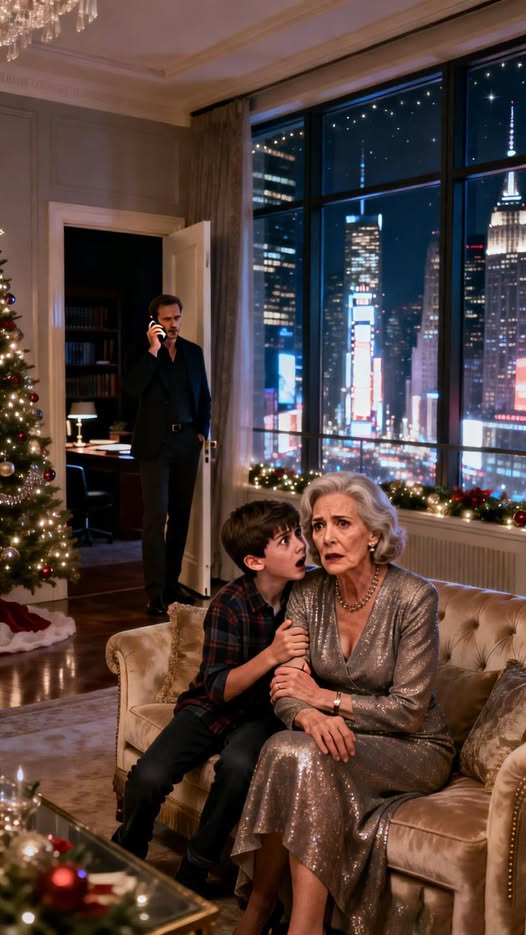
“To a fresh start,” David said, his glass clinking against mine a little too hard.
The crystal rang with a sharp, dissonant sound that seemed to linger in the air longer than it should have, vibrating against the silence of the penthouse. Outside, forty stories below, the world was preparing to scream. The Times Square ball was poised to drop, a glittering diamond suspended in the freezing Manhattan night, waiting to usher in a new year.
Inside, the air was thick with the scent of expensive pine garlands and the dry, recycled heat of the climate control system.
“To a fresh start,” I echoed, forcing a smile that felt tight on my face.
I looked at my son. David was forty-two, dressed in a bespoke tuxedo that cost more than most people’s cars, yet he looked like a man standing on the gallows. His forehead was sheened with a cold, oily sweat that defied the perfectly regulated temperature of the room. His eyes were darting—checking the antique grandfather clock in the corner, checking his phone, checking the hallway.
“Are you alright, Davie?” I asked, instinctively reaching for his hand.
His skin was clammy. He pulled away abruptly, as if my touch were a static shock.
“Just stress, Mom. The market is volatile. You know how it is,” he muttered, turning away to pour more champagne. “Drink up. It’s bad luck to toast with a full glass.”
I watched him. I was Eleanor Vance, the woman who had built Vantage logistics from a single truck into a global empire. I knew what stress looked like. I had eaten stress for breakfast for thirty years. This wasn’t stress. This was terror.
I sat back on the velvet sofa, looking at my grandson, Leo.
Leo was ten, sitting quietly on the ottoman, his knees pulled up to his chest. He was wearing the little suit I had bought him, but he looked small, shrinking into the fabric. He wasn’t playing with his new tablet. He was watching his father with the intense, unblinking gaze of a prey animal sensing a shift in the wind.
“Grandma,” Leo whispered, leaning in close to me. “I don’t like the way Dad is looking at the door.”
I laughed it off, stroking his hair. It was soft, smelling of the peppermint shampoo I kept in the guest bath. “He’s just waiting for the pizza, darling. I ordered the pepperoni you like.”
“He’s not hungry,” Leo said, his voice barely audible. “He’s been sweating since we got in the elevator.”
I looked up. David was standing by the wet bar. He wasn’t looking at the door anymore. He was looking at me. His expression was unreadable, a mixture of profound sadness and a terrifying, hollow resolve. It was the way one looks at a ghost.
“Here, Mom,” David said, walking over. He handed me the flute. The liquid was pale gold, bubbling furiously. “Special vintage. I opened it just for you.”
I took the glass. “Thank you, David. I know things have been tight. I was thinking… at midnight, we can discuss the bridge loan you asked for. I think I can make it work.”
David flinched. A muscle in his jaw jumped. “Midnight,” he repeated, his voice cracking. “Right. Midnight.”
Suddenly, his phone buzzed on the marble coffee table. It was a harsh, aggressive vibration. The screen lit up: RESTRICTED.
David jumped as if he’d been burned. He snatched the phone up, his knuckles white.
“I have to take this,” he stammered, backing away. “It’s… work. A crisis. International shipping.”
“On New Year’s Eve?” I asked, frowning.
“It can’t wait.”
He rushed out of the living room toward the study down the hall, leaving the heavy oak door slightly ajar.
I sighed, looking at the champagne glass in my hand. I was tired. Tired of bailing him out, tired of the excuses, but I loved him. He was my only child.
Leo looked at me, then at the hallway. Without a word, he slid off the sofa. He moved with a stealth that was unnatural for a child his age, his socks silent on the hardwood.
“Leo, come back,” I called out softly, not wanting to disturb David’s call.
But the boy was already gone, vanishing into the hallway shadows like a wisp of smoke.
I sat alone for a moment, the flute of champagne heavy in my hand. Through the floor-to-ceiling windows, the lights of the city pulsed—red, blue, gold. Millions of people were down there, huddled together for warmth, waiting for the magic of the countdown.
Up here, in the silence, I felt a sudden, inexplicable chill.
I swirled the glass. The bubbles rose in a frantic chain. Why was David so insistently nervous? I had bailed him out of gambling debts before. I had covered his failed investments. Why did this feel different?
The sound of footsteps broke my reverie.
Leo scrambled back into the room. He wasn’t walking; he was running, tripping over the edge of the Persian rug.
He scrambled onto the sofa next to me. He wasn’t crying, which scared me more. He was hyperventilating, his chest heaving in short, sharp gasps. His face was the color of old paper.
He grabbed my arm with a grip so tight his fingernails dug into my skin.
“Grandma,” he choked out. “We need to leave right now. I heard Dad talking about you.”
I set the glass down on the coaster, alarmed. “Leo, honey, take a breath. Daddy is just stressed about work. People say things when they are angry—”
Leo shook his head violently, his eyes wide with a terror that no ten-year-old should ever know.
“No!” he hissed. “He wasn’t talking about work. He was talking to a man. A scary man.”
Leo swallowed hard, his voice trembling. “He said, ‘The transfer is set for 12:01. She won’t survive the night. Make sure the medical examiner is on the payroll.’”
The world stopped.
The noise of the city, the hum of the refrigerator, the beating of my own heart—it all vanished into a vacuum of silence.
“What?” I whispered.
“He said…” Leo’s voice broke. “He said, ‘She drank it. It’ll look like a heart attack. Just have the paperwork ready.’”
My eyes snapped to the champagne flute on the table.
The pale gold liquid. The “special vintage.” The way he had insisted on pouring it himself in the kitchen, away from my eyes. The way he had watched me lift it to my lips.
The blood drained from my face, leaving me feeling lightheaded. My heart began to race—a erratic, thumping rhythm. Was it panic? Or was it the poison? I had taken a sip. Just a sip.
I looked at the bubbles. They didn’t look festive anymore. They looked like a chemical reaction. They seemed to hiss at me.
I wasn’t looking at a drink. I was looking at a murder weapon.
Denial is a powerful drug, but Leo’s eyes were a jagged rock shattering the glass house of my illusions. A child doesn’t invent “medical examiner” or “payroll.”
“Oh, my God,” I breathed. My hand went to my chest.
I stood up. The room spun slightly. Adrenaline dumped into my system, cold and sharp.
“Get your coat, Leo,” I said, my voice low and steady. “We are leaving. Now.”
Leo grabbed his parka. I grabbed my purse, leaving the champagne untouched. We moved toward the front door—the heavy steel reinforced door that led to the private elevator.
I reached for the handle.
It wouldn’t turn.
I frowned, trying again. It was locked. Not just the latch, but the heavy deadbolt.
I reached into the small crystal bowl on the console table where the key always sat. It was a safety precaution I insisted on—a key always by the door in case of fire.
The bowl was empty.
My breath hitched. I rattled the handle, panic rising in my throat like bile. Locked from the inside. Trapped.
Behind us, slow, deliberate footsteps echoed on the hardwood floor. They weren’t the frantic steps of a stressed businessman anymore. They were the heavy, measured steps of an executioner.
“Going somewhere, Mother?”
I turned around.
David stood at the end of the hallway. He had taken off his jacket. His sleeves were rolled up. His face was terrifyingly calm, the sweat gone, replaced by a cold, flat emptiness.
In his hand, he held the brass key.
“Open this door, David,” I commanded, channeling every ounce of authority I had used to crush competitors in the boardroom. “This has gone far enough.”
David didn’t move. He tossed the key in the air and caught it. The metallic clink echoed in the silent foyer.
“It hasn’t even started, Mom,” he said softly. He walked into the living room, blocking the only path to the kitchen or the bedrooms. “Why are you rushing? It’s almost midnight. The fireworks are about to start.”
I backed Leo behind me, shielding him with my body. We retreated slowly toward the kitchen island.
“Why, David?” I asked. “Is it the gambling again? The condo project?”
David let out a dry, humorless laugh. He walked to the table and picked up my champagne glass. He looked at the level of the liquid. A flicker of annoyance crossed his face.
“You didn’t finish your drink,” he murmured. “You always finish your drink.”
“You have too much, and I have nothing, Mom!” he suddenly shouted, the calm cracking to reveal the rot underneath. “The loan sharks don’t care about your legacy! They don’t care about your ‘bridge loans’! They want their money by midnight tonight, or they take my hands. They take my life!”
He checked his Rolex—a gift I had given him for his 40th birthday.
“11:45,” he muttered. “You should be feeling tight in the chest by now. Shortness of breath. Confusion.”
I realized then that I had to play the part. If he thought the poison was working, he might wait. He might not attack. I needed time.
I clutched my chest, letting out a jagged gasp. I leaned heavily against the marble counter.
“David…” I wheezed. “It hurts… I… I need to sit down.”
“It’s better if you lie down,” David said, his voice dropping to a soothing, monstrous cadence. “It mimics cardiac arrest. Digitalis derivative. Very hard to trace if you don’t know what to look for.”
“David, please,” I begged, my legs trembling—mostly from fear, but I let him think it was the drug. “Leo is watching. Don’t do this in front of your son.”
David looked at Leo. For a second, I saw a flicker of the boy I used to know—the son I used to read bedtime stories to. But it was extinguished instantly by the darkness of his desperation.
“Leo will understand one day,” David said coldly. “Inheritance is just an accelerated transfer of assets. I’m doing this for him, too. So we don’t end up on the street.”
He stepped closer. He reached into his jacket pocket.
He wasn’t reaching for his phone.
He pulled out a glinting, silver object. A syringe, capped and filled with a clear liquid.
“Just in case the drink was too slow,” he said, flicking the cap off. “We can’t miss the deadline, Mom. 12:01. The wire transfer triggers automatically upon the filing of the death certificate. I have a guy waiting.”
“No!” Leo screamed, trying to lunge around me.
I shoved Leo back. “Run to the pantry, Leo! Lock the door!”
“No one is running!” David roared.
He lunged.
He moved faster than I expected. He wasn’t my son anymore; he was a junkie needing a fix, and the fix was my death.
I didn’t think. I didn’t hesitate. My hand swept across the kitchen counter, searching for a weapon. My fingers closed around the handle of the heavy, cast-iron skillet I had used to make breakfast that morning.
As David raised the needle, I swung.
I swung with thirty years of repressed anger. I swung with the strength of a matriarch protecting her bloodline.
CRACK!
The iron connected with his forearm.
David screamed—a high, animalistic sound. The syringe went flying, skittering across the tile floor and sliding under the refrigerator. He grabbed his arm, stumbling back, his face twisting from shock into a mask of pure, unadulterated hatred.
“You bitch!” he snarled.
He looked at me, and I saw that the last tether to humanity had snapped.
He reached into his waistband at the small of his back.
“Fine,” he hissed, pulling out a matte black pistol. “We’ll do it the messy way. I’ll just tell them you struggled with a burglar.”
He raised the gun.
The barrel of the gun looked like a tunnel to hell. It was shaking slightly in his hand, but at this range, he couldn’t miss.
“David, look at me,” I said, stepping in front of Leo, spreading my arms wide. “I am your mother.”
“You’re a bank account!” he screamed, tears of rage and frustration streaming down his face. “Just die! Why won’t you just die!”
He tightened his finger on the trigger.
I closed my eyes. I didn’t pray for myself. I prayed for Leo. Please, let him hide. Please.
BOOM!
The sound was deafening. But it didn’t come from the gun.
It came from the front door.
The heavy steel reinforced door didn’t just open; it exploded inward. The frame splintered, wood and drywall flying into the foyer like shrapnel.
“POLICE! DROP THE WEAPON! DROP IT NOW!”
The room was suddenly filled with blinding light. Flashbangs detonated in the hallway, filling the air with white smoke and a ringing ear-splitting noise.
David flinched, spinning toward the door, the gun swinging wildly.
“DROP IT!”
Red laser dots danced across David’s white tuxedo shirt. Five, six, seven of them.
He froze. A look of total confusion broke his facade. He looked at the gun, then at the wall of armored officers pouring into the penthouse like a black tide.
He hesitated for a fraction of a second.
That was all they needed.
An officer with a ballistic shield slammed into him, tackling him to the hardwood floor with the force of a freight train. The gun skittered away, spinning harmlessly toward the balcony doors.
“SECURE! SUSPECT SECURED!”
I collapsed to my knees, the adrenaline draining out of me, leaving me shaking uncontrollably. I grabbed Leo, pulling him into my chest, burying his face in my coat so he wouldn’t see his father being zip-tied.
A detective in a flak jacket knelt beside me. He had gray hair and kind eyes.
“Mrs. Vance? I’m Detective Miller. You’re safe.”
I looked at him, bewildered. “How? How did you get in? The locks…”
He helped me stand up. He looked over at David, who was being hauled to his feet, blood trickling from his nose where he had hit the floor.
“We’ve been listening, Mrs. Vance,” Miller said grimly. “We’ve had a wiretap on David’s phone for three weeks. RICO investigation. Money laundering for the Kartsev crime family.”
He pointed to David.
“We heard the call to the chemist this afternoon. We intercepted the delivery. The ‘poison’ in that champagne? It was saline solution. We swapped it out three hours ago. We were just waiting for him to make the move.”
I looked at David. He wasn’t looking at the police. He wasn’t looking at me.
He was staring at Leo with a look of pure venom.
“You little rat,” David spat, struggling against the cuffs. “You knew, didn’t you?”
I looked down at Leo.
Leo pulled his wrist away from his face. He was wearing the smartwatch I had given him for Christmas. The screen was glowing.
It showed an active call to 911. Connection time: 22 minutes.
“I didn’t just hear him, Grandma,” Leo whispered, his voice steady for the first time that night. “I broadcasted him.”
The precinct was a stark contrast to the penthouse. It smelled of stale coffee, floor wax, and misery. Fluorescent lights buzzed overhead, humming a headache into the base of my skull.
It was 11:58 PM.
I sat on a metal bench, a foil emergency blanket wrapped around my shoulders. Leo was asleep, finally, his head resting heavily on my lap. He was exhausted, his small body twitching occasionally in dreams I hoped weren’t nightmares.
Detective Miller walked over, holding a clipboard. He looked tired.
“Mrs. Vance,” he said softly. “I know this is hard. But we need to process this before the arraignment in the morning.”
He placed a document in front of me.
“David is going to try for bail,” Miller said. “He’s already claiming it was a mental health episode. He’s claiming the gun wasn’t loaded. He’s going to try to spin this.”
I looked at the paperwork. Witness Statement.
“If you sign this,” Miller continued, tapping the paper, “he goes away. For a long time. Attempted murder. Conspiracy. Plus the RICO charges. He won’t see daylight for twenty years.”
I looked at the pen.
My hand trembled. I remembered David as a baby. I remembered his first steps. I remembered holding him when he scraped his knee. A mother’s love is a biological imperative; it is designed to protect the child at all costs.
But then I looked at Leo.
I saw the red mark on his arm where David had grabbed him. I remembered the syringe sliding across the kitchen floor. I remembered the gun pointed at my chest.
David had made his choice. He chose money over blood. He chose the loan sharks over his own son.
The clock on the wall clicked.
12:00 AM.
Outside, muffled by the thick brick walls, I heard the faint pop and boom of fireworks. The city was cheering. A new year had begun.
“Happy New Year,” I whispered to the sleeping boy on my lap.
I picked up the pen.
“I have no son,” I said, my voice cracking but my hand steady. “I only have a grandson.”
I signed my name. Eleanor Vance. The signature was sharp, angular. It was a severance. I wasn’t just signing a statement; I was amputating a limb to save the body.
“Thank you, Eleanor,” Miller said quietly. He took the clipboard. “You can go. We’ll have a squad car take you to a hotel.”
We stood up. I woke Leo gently. He rubbed his eyes, looking around the bleak station.
“Is he gone?” Leo asked.
“Yes,” I said. “He’s gone.”
We walked out of the precinct into the biting cold of the January air. My phone buzzed in my pocket.
I pulled it out. It was an automated text message from David’s lawyer, triggered by a pre-set timer David must have arranged earlier.
URGENT: Mr. Vance has instructed the immediate liquidation of the Vance Family Trust. Please confirm wire transfer authorization.
He was still trying. Even from a holding cell, even in handcuffs, his greed was reaching out like a zombie’s hand from the grave.
I looked at the phone. Then I looked at the trash can on the corner.
I didn’t delete the text. I forwarded it to Detective Miller.
Then, I turned off the phone and dropped it into my purse.
One Year Later
The fire crackled in the stone hearth, popping and spitting sparks that drifted up the chimney like fireflies.
We weren’t in Manhattan. We weren’t anywhere near a penthouse or a ballroom or a glass-walled cage. We were in a small A-frame chalet deep in the woods of Vermont. The snow outside was piled four feet high, a blanket of pure, silent white that muffled the world.
There was no champagne tonight.
I sat in a leather armchair, holding a mug of hot cocoa topped with marshmallows. Leo was on the rug, reading a book. He was eleven now, taller, his shoulders broadening.
He looked up from his book, his eyes darting to the heavy wooden door.
“Grandma?” he asked.
“Yes, Leo?”
“Is the door locked?”
It was a habit he hadn’t broken yet. Every night, before bed, he asked.
I smiled, setting my mug down. I didn’t tell him to stop worrying. Trauma doesn’t disappear; it just changes shape. You have to accommodate it, respect it, and eventually, outgrow it.
“Let’s check,” I said.
We walked to the door together.
It was a solid oak door, three inches thick. I had installed a heavy-duty deadbolt, a steel reinforcement plate, and a biometric alarm system.
“Locked,” I said, tapping the deadbolt.
“Alarm?” Leo asked.
“Armed,” I pointed to the green light on the keypad.
“Gate?”
“Shut and electrified,” I reminded him gently.
Leo let out a breath he seemed to have been holding. His shoulders relaxed. He looked up at me, and for the first time in a long time, I saw the shadow of the boy he was before that night recede, replaced by the young man he was becoming.
“We’re safe,” he said.
“We are the fortress,” I replied, squeezing his shoulder.
“Happy New Year, Grandma,” he smiled.
“Happy New Year, Leo.”
He went back to his book. I walked to the window, looking out at the falling snow. Somewhere, hundreds of miles away in a federal penitentiary, David was sitting in a cell. I wondered if he was watching the clock. I wondered if he regretted it.
But then, I looked at Leo, safe and warm by the fire.
It didn’t matter what David felt. He was the past. Leo was the future.
My new phone rang on the table. A blocked number.
It was the prison. They allowed inmates one call on holidays.
I stared at the phone. It rang. And rang. And rang.
Leo looked up, watching me.
I didn’t reach for it. I just watched the screen light up the dark room, vibrating against the wood.
Eventually, it stopped. The screen went black.
Silence returned to the cabin. Just the sound of the wind, the fire, and the steady, rhythmic breathing of my grandson.
It was the most beautiful sound in the world.

