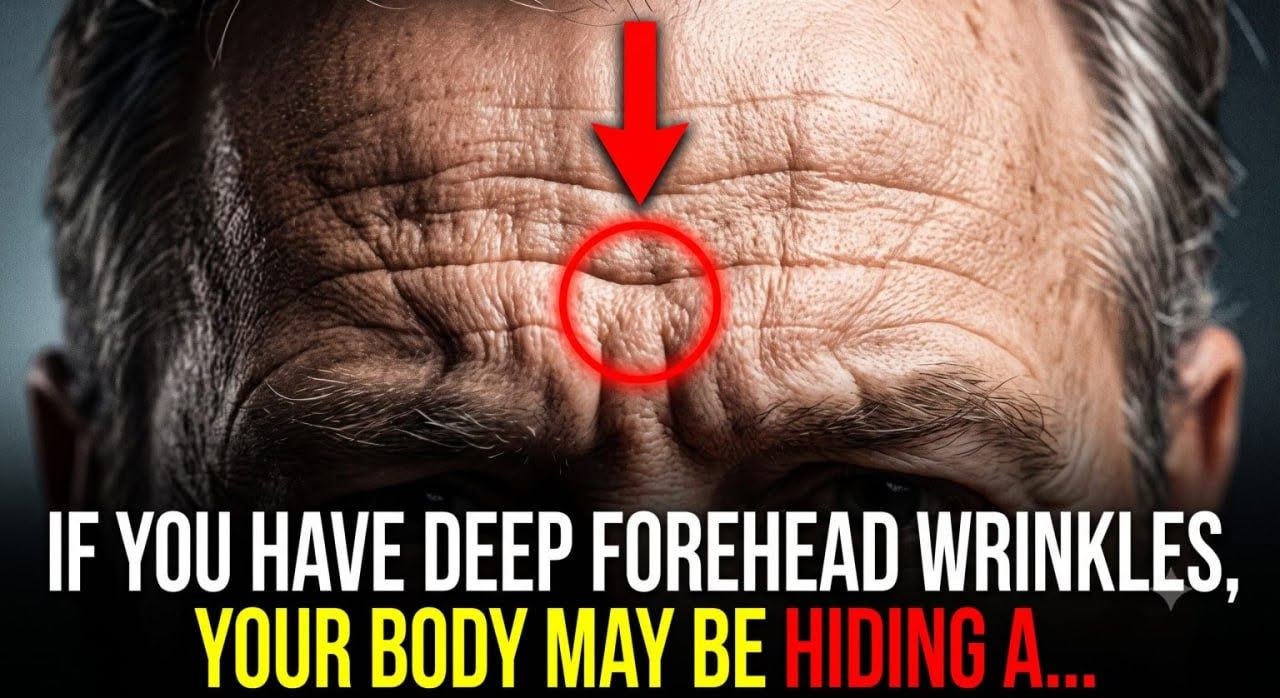
When we look in the mirror and notice a new wrinkle, our immediate reaction is usually vanity-driven. We rush to buy expensive anti-aging creams, book Botox appointments, or research collagen supplements. Wrinkles, particularly those on the forehead, are universally accepted as the inevitable badges of time, stress, and repeated facial expressions. However, groundbreaking medical research has recently uncovered that the deep grooves etched into your forehead might be telling a story far more serious than how many times you’ve raised your eyebrows.
According to a massive, long-term study presented at the European Society of Cardiology (ESC) Congress, deep, premature vertical and horizontal forehead wrinkles are strongly linked to a significantly higher risk of dying from cardiovascular disease.
The ESC Landmark Study
The research that shifted the medical community’s perspective on facial wrinkles was not a small, isolated observation. The study tracked over 3,200 healthy working adults for a period of 20 years. At the beginning of the study, researchers assessed the participants’ forehead wrinkles, assigning them a score from zero (no wrinkles) to three (numerous deep wrinkles).
Over the next two decades, the researchers monitored the participants’ cardiovascular health. The results were staggering. Participants with a wrinkle score of two or three had almost 10 times the risk of dying from a cardiovascular event compared to those with a score of zero, even after adjusting for age, gender, education, smoking status, blood pressure, heart rate, diabetes, and lipid levels.
The Shared Pathway: Collagen and Plaque
How could a crease on your skin possibly predict a heart attack or a stroke? The answer lies in the microscopic building blocks that make up both our skin and our blood vessels.
The primary structural proteins in our bodies are collagen and elastin. They are responsible for keeping our skin firm, plump, and smooth. Coincidentally, collagen and elastin are also the exact same proteins that keep our blood vessels flexible, strong, and capable of expanding and contracting with every heartbeat.
When a person suffers from oxidative stress, chronic inflammation, or poor metabolic health, these proteins undergo a process called glycation and degradation. In the blood vessels, this degradation leads to endothelial dysfunction—the inner lining of the arteries becomes stiff and damaged. This damage allows cholesterol plaques to build up rapidly, leading to atherosclerosis (hardening of the arteries).
Because the blood vessels in the forehead are incredibly small and delicate, they are highly susceptible to plaque build-up and decreased blood flow. When these tiny vessels stiffen and narrow, they fail to deliver adequate oxygen and nutrients to the skin. The lack of blood flow accelerates the breakdown of collagen in the forehead rapidly. Therefore, the deep wrinkles you see on the outside are essentially a mirror image of the arterial stiffness happening on the inside.
Wrinkles vs. Normal Aging
It is critical to distinguish between normal, age-appropriate fine lines and the type of wrinkles that signal cardiovascular risk.
Fine Lines: Shallow, superficial lines that appear around the eyes (crow’s feet) or mouth are generally tied to sun exposure, smiling, and standard aging.
Deep Furrows: The study specifically highlighted deep, permanent, prominent furrows across the forehead that appear disproportionate to a person’s age. If a 40-year-old presents with the deep forehead ridges typically seen in a 75-year-old, it is a significant clinical marker.
Taking Action: From Vanity to Vitality
The discovery that forehead wrinkles can act as an early warning system for heart disease is actually incredibly empowering. It provides a visual, zero-cost diagnostic tool that you can check every single morning. If you notice unusually deep furrows developing on your brow, it is time to shift your focus from cosmetic fixes to internal cardiovascular repair.
Reduce Oxidative Stress: Stop smoking immediately, as tobacco smoke is the number one destroyer of systemic collagen. Increase your intake of dietary antioxidants found in dark leafy greens, berries, and omega-3 rich fish to combat free radicals in the bloodstream.
Manage Blood Pressure: Chronic high blood pressure acts like a sandblaster against the inner lining of your blood vessels, accelerating arterial stiffness. Monitor your blood pressure regularly and keep sodium intake in check.
Prioritize Endothelial Health: Exercise is the most powerful tool for improving the flexibility of your arteries. When you engage in cardiovascular exercise, your body produces nitric oxide, a molecule that relaxes and repairs blood vessels.
Consult a Cardiologist: If you have deep premature wrinkles coupled with a family history of heart disease, request a comprehensive cardiovascular screening, including a Calcium Scoring CT scan to check for hidden plaque.
The next time you examine your forehead, look past the surface. Those lines might just be the early warning system you need to change your lifestyle and save your heart.
2. FB Caption (The Curiosity Hook)
The Hook:
If you have deep, permanent wrinkles across your forehead, you need to read this immediately. 🛑
The Body:
Most of us buy expensive creams to hide forehead wrinkles, assuming they are just caused by stress, aging, or making too many facial expressions.
But a massive, 20-year medical study just uncovered a terrifying link. Researchers found that deep furrows across your forehead are actually caused by the exact same microscopic protein breakdown that happens when your arteries begin to harden. If your forehead lines are unusually deep for your age, your body is flashing a major internal warning sign that has absolutely nothing to do with your skin…