At seventy-two years old, I believed my capacity for surprise had been exhausted by the sheer weight of time. I had spent thirty-five years in a marriage so solid and luminous that when my husband, Daniel, passed away, the world felt like it had been plunged into a permanent, grey twilight. For years, I moved through my house like a ghost, touching the spines of books he had read and breathing in the faint, lingering scent of cedar in his closet. I didn’t expect a second act. I certainly didn’t expect a thriller.
My restoration began in the quiet pews of our local church. It was there I met Arthur. He was a man who carried his silence like a heavy coat, often found sitting with his head bowed and his hands clasped so tightly that his knuckles turned white. One Sunday, moved by a sudden impulse of empathy, I sat beside him. Our first conversation was brief, but it led to a year of gentle discovery. We shared coffee, long walks through the park, and the kind of deep, resonant conversations that only people who have survived great loss can truly navigate.
Arthur told me he was a widower who had raised his daughter, Linda, alone after his wife died in a tragic car accident. He spoke of his devotion to his family and the isolation of his grief. I saw in him a mirror of my own soul. When he proposed a year later, telling me that we shouldn’t waste the precious time we had left, I said yes with a heart that felt dangerously light.
However, there were shadows I chose to ignore. Happiness at seventy-two is a fragile thing, and I was terrified of shattering it with questions. There was the time an old acquaintance clapped Arthur on the shoulder at a restaurant, calling him by name and mentioning they hadn’t seen each other in twenty-five years. Arthur had turned pale, his eyes darting like a trapped animal, before abruptly demanding the check and ushering me to the car. Then there was Linda.
When I finally met Arthur’s daughter, she didn’t greet me with the warmth I expected. She was a woman made of sharp angles and guarded expressions. She looked at Arthur not with affection, but with a scrutinizing, almost fearful intensity. On the day of our wedding, held in the lush, blooming garden of Arthur’s home, that tension finally snapped.
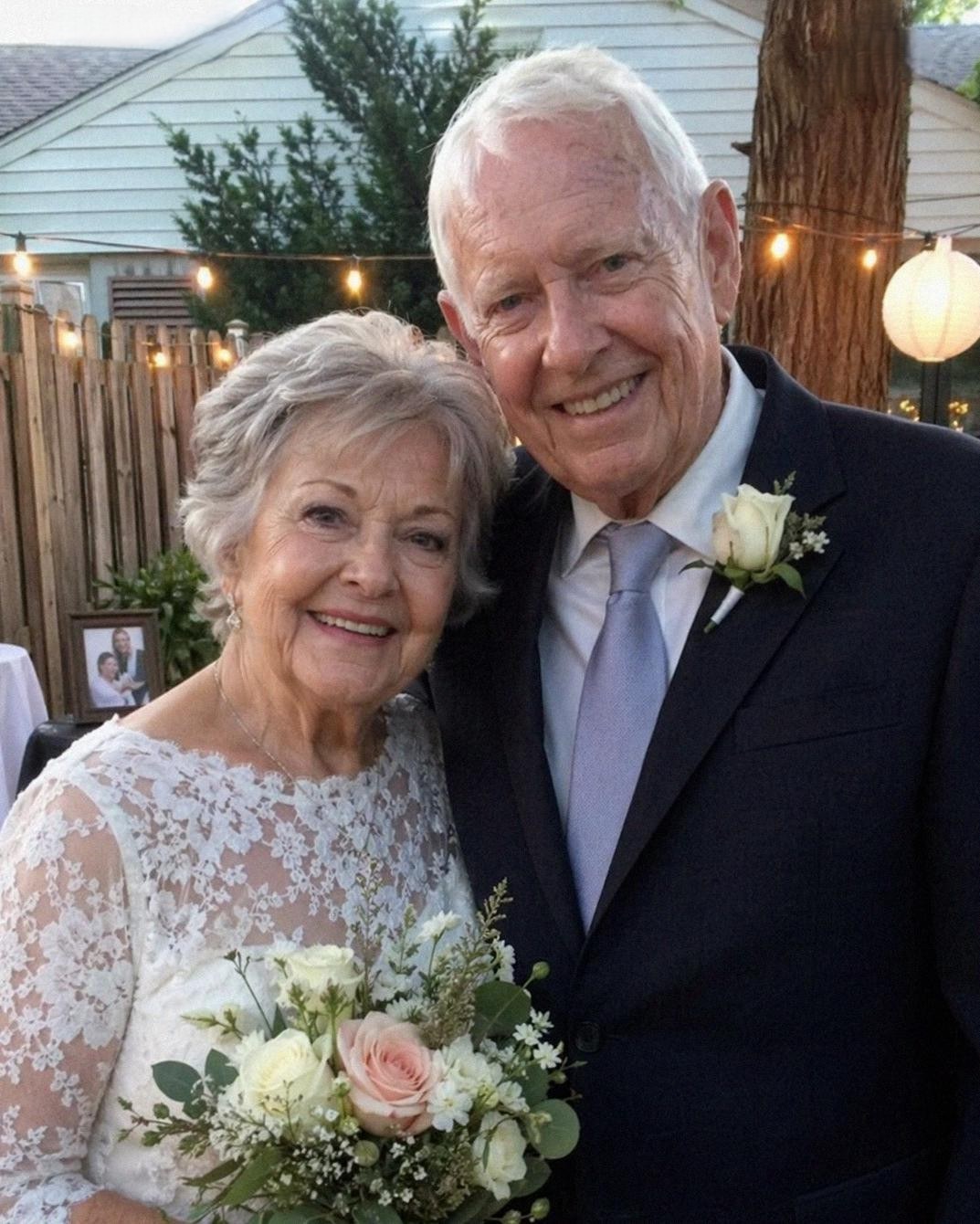
I was radiant in cream silk, feeling like a girl again as I exchanged vows. But throughout the reception, I could feel Linda’s eyes on me. She stood apart from the celebrating crowd, her face a mask of misery. Finally, she approached me and whispered that we needed to talk. She led me away from the music and the laughter, down into the cool, damp darkness of the basement.
In the corner of the room sat a rusted metal lockbox. Linda’s hands trembled as she opened it, pulling out a collection of yellowed documents and old polaroids. She handed me a photo of two young men. They were identical twins, yet their spirits seemed worlds apart. One had the gentle, open smile of the man I thought I knew; the other had a hardened, restless look in his eyes.
“That is Arthur and Michael,” Linda whispered, her voice cracking. “My father and his twin brother. Michael was the black sheep, a man who got involved with dangerous people and was eventually cast out of the family. We never spoke of him.”
She then handed me a final document. My breath hitched in my throat. It was a death certificate for Arthur Vance, dated twenty years ago. The room seemed to spin. If Arthur had died two decades ago, who was the man upstairs wearing a wedding ring and dancing to our favorite song?
“When I was eighteen,” Linda continued, “my father went away on a business trip. When he came back, he was different. He didn’t remember our private jokes. He developed new habits overnight. He looked like my father, but his soul was a stranger’s. Whenever I questioned him, he told me I was grieving my mother too hard, that I was losing my mind. I spent twenty years wondering if I was crazy. Then I found this box.”
The betrayal hit me with the force of a physical blow. Every memory of the last year—every kiss, every shared secret, every plan for the future—was suddenly tainted. I took the documents and marched back up the stairs, the cool basement air replaced by the stifling heat of the reception.
I found him near the buffet, laughing with a neighbor. When he saw my face, the color drained from his skin. I didn’t cause a scene; I simply held up the death certificate. The silence that followed was deafening. The music seemed to fade into the background as the guests realized something was terribly wrong.
“I need you to explain how I just married a dead man,” I said, my voice steady despite the roar of blood in my ears.
He didn’t fight it. The mask he had worn for twenty years simply fell away, leaving behind a man who looked profoundly exhausted. He sat down heavily in a folding chair and gestured for the few people nearby to give us space.
“I am Michael,” he admitted, his voice a low rasp. “Twenty years ago, Arthur found me. I was in trouble, running from debts and dangerous men. Arthur was sick—he was dying of a heart condition he hadn’t told anyone about. He knew Linda couldn’t handle losing both parents so close together. He begged me to take his place, to give his daughter a father and protect his legacy. I did it for him. I became him.”
Linda stepped forward, her eyes flashing with a mix of grief and rage. “You didn’t do it for him. You did it to hide. You let me live a lie for two decades. You let me mourn a man who was standing right in front of me, pretending to be someone else.”
Michael looked at me, his eyes pleading. “Caroline, I never lied about how I feel for you. The love I found with you is the only real thing I’ve had in forty years.”
I looked at the man I had just sworn to spend the rest of my life with. I saw the twin who had stolen a life, who had gaslighted a child, and who had built a sanctuary out of a graveyard. I realized then that love cannot exist in a vacuum of truth. To love a lie is to erase yourself.
“You didn’t just lie to me, Michael,” I said, sliding the gold band off my finger. “You asked me to stand before God and marry a ghost. You stole twenty years of the truth from your daughter, and you tried to steal the rest of my life to validate your cover story. I won’t be an accessory to this.”
I dropped the ring into his palm and walked out of the garden, leaving the flowers and the champagne and the wreckage of a false life behind me. The aftermath was a whirlwind of legal battles and police statements. The marriage was annulled, and Michael faced charges for identity fraud and several other long-buried indiscretions from his past.
Today, my life is quiet again, but it is an honest quiet. Linda and I meet for coffee every week. We are a strange sort of family, bound together by the man who deceived us both. She told me recently that I was the only good thing to come out of the entire ordeal. It was a bittersweet sentiment, but as I sit in the sun and watch the world go by, I feel a sense of peace that Arthur—or Michael—could never truly provide. At seventy-two, I have learned that while love is a gift, the truth is the only thing that allows you to keep it.