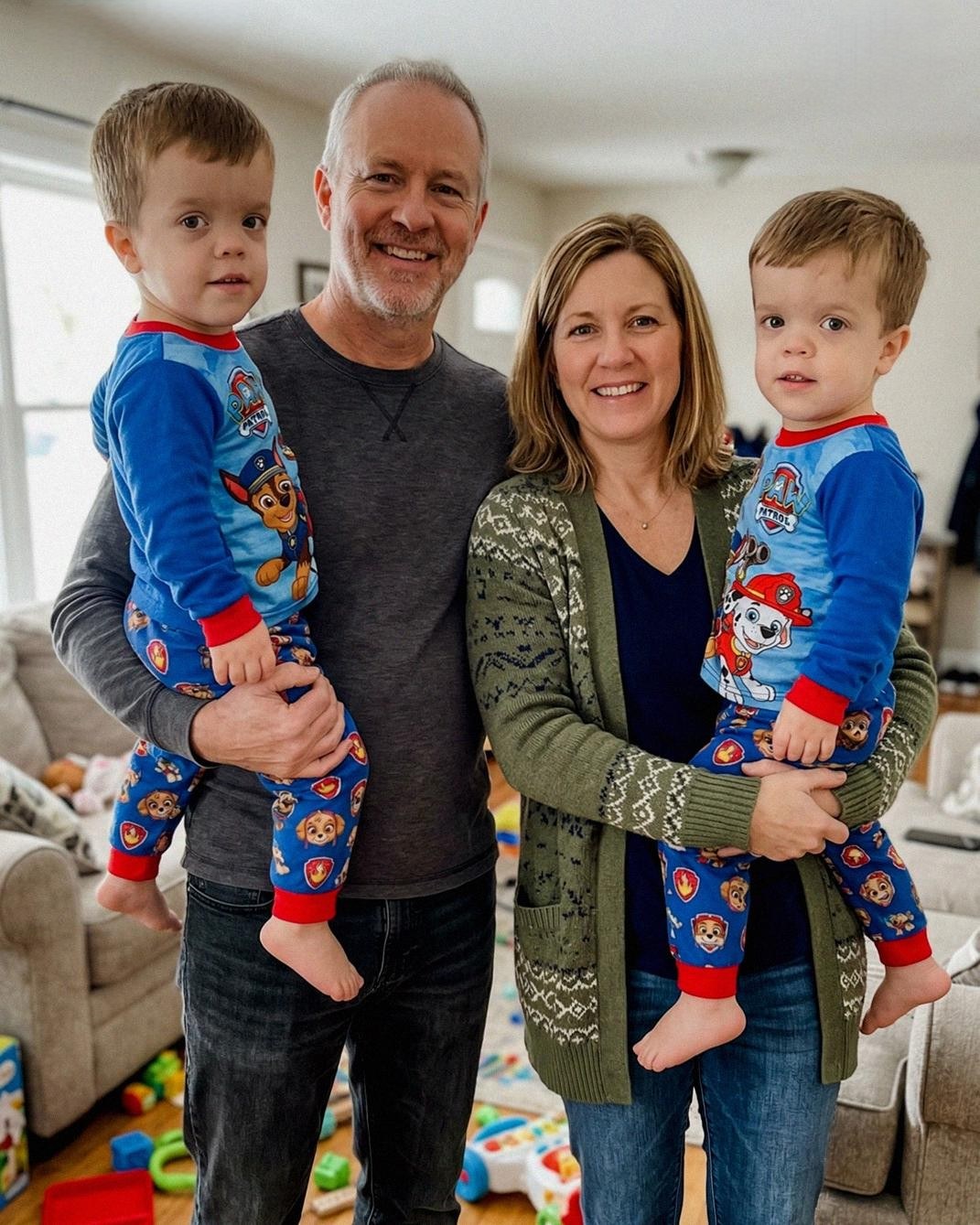
For ten years, my husband Joshua and I lived in a house defined by its quietness. We had weathered the storm of infertility, eventually reaching a place of somber acceptance. We filled our lives with careers and hobbies—I threw myself into my executive role, and he took up fishing. We were a team of two, navigating a world that seemed built for four. Or so I thought, until Joshua’s acceptance shattered almost overnight. Suddenly, he was obsessed with the idea of a family. He started stopping at playgrounds, watching children with a hunger in his eyes that bordered on desperation. He began sliding adoption brochures across the breakfast table, begging me to try one more time. He even convinced me to quit my high-pressure job, arguing that being a stay-at-home mother would increase our chances with the agency. I was hesitant, but I loved him, and I wanted to believe that our “too-quiet” house was finally ready for noise.
When Joshua found the profile of four-year-old twins, Matthew and William, he was relentless. He saw a family where I saw two terrified little boys who had already been let down by the world. We moved forward at a lightning pace, driven by Joshua’s frantic energy. When the twins finally moved in, the transition was a whirlwind of LEGO towers, pancake dinners, and the slow, agonizing process of earning the trust of two children who still called me “Miss Hanna.” Joshua was the perfect father at first, crouching down to play with dinosaurs and promising them a forever home. But three weeks into our new life, the man I thought I knew began to evaporate.
It started with late nights at the office and muffled phone calls behind locked doors. Joshua, once the driving force behind the adoption, became a ghost in his own home. He would avoid my eyes at dinner and disappear into his office before the boys were even in bed. I was left alone to navigate the tantrums, the spilled juice, and the heartbreaking moments when William would cry for his stuffed bear and ask if I was still going to be there in the morning. I felt like I was drowning in a life he had forced upon me, while he watched from the shore.
The breaking point came on a Tuesday afternoon. The boys were napping, and I was tiptoeing down the hall when I heard Joshua’s voice coming from his office. He was crying. I pressed my ear to the door, expecting to hear about a work crisis. Instead, his words turned my blood to ice. He was speaking to a man named Dr. Samson, saying, “I can’t keep lying to her. She thinks I wanted a family with her, but I didn’t adopt the boys because of that. I can’t watch her figure it out after I’m gone.” My heart stopped. He wasn’t planning on leaving me for another woman; he was planning on leaving the world. I heard him ask, “How long did you say, Doc? A year? That’s all I have left?”
The world tilted. Joshua had been diagnosed with terminal lymphoma, and instead of trusting me with the truth, he had engineered a family to replace him. He had convinced me to give up my career and my financial independence so that I would have “someone” after his death. He had used those two innocent boys as a consolation prize, treating them like a life insurance policy rather than human beings. I felt a rage so pure it surpassed grief. He had made the most fundamental choices of my life for me, robbing me of the chance to fight by his side or to even say goodbye to the life we had.
I didn’t confront him then. I couldn’t look at him. I packed a bag for myself and the boys and fled to my sister Caroline’s house. For forty-eight hours, I existed in a state of suspended animation, my mind circling the betrayal. I eventually hacked into Joshua’s laptop and found the medical records he had hidden. There it was: Stage IV lymphoma. But there was also something else—a note from Dr. Samson about a specialized clinical trial. It was risky, and it wasn’t covered by insurance, which is likely why Joshua had given up.
I looked at the twins coloring on my sister’s rug, and a new resolve took hold. I called the doctor and told him to put Joshua’s name on the list. I had my severance money, my savings, and my anger to fuel me. I wasn’t going to let him die just so he could be right about his plan.
When I returned home the next evening, Joshua looked like a shell of a man. I didn’t soften. I told him exactly what I had overheard. “You let me quit my job, Joshua. You let me fall in love with these boys. You let me believe this was our dream, but you were just shopping for my future replacement.” He crumbled, sobbing that he was only trying to protect me. I told him that wasn’t love—it was a lack of faith. I told him that Matthew and William needed a father, not a martyr, and that if he wanted to be part of this family, he had to live in the truth.
The following months were a descent into a different kind of hell. We told our families, who were rightfully horrified by his secrecy. Joshua’s sister was livid, and my mother was heartbroken that he hadn’t trusted me. We liquidated our savings to pay for the trial. I watched Joshua’s body shrink inside his clothes as the treatment took hold. I was the one who shaved his head while the boys giggled, unaware that their father was fighting for his life. There were nights I screamed into my pillow, and nights I held his hand as he shook with fever. We lived in the raw, ugly truth, and for the first time in our marriage, there were no secrets between us.
The clinical trial was grueling, but slowly, the markers began to change. One spring morning, Dr. Samson called with the news that seemed impossible: Joshua was in remission. I dropped to the kitchen floor and finally let myself cry for all the versions of the future we had almost lost.
Today, our house is no longer quiet. It is a chaotic mess of soccer cleats, LEGO bricks, and the constant chatter of two boys who now call us “Mom” and “Dad.” Joshua is healthy, though he carries the humility of a man who realized that his “protection” was actually a betrayal. He tells the boys every day that I am the bravest person he knows, but I always correct him. Being brave isn’t about enduring a secret; it’s about having the courage to tell the truth when everything is on the line. Joshua tried to give me a family so I wouldn’t be alone in his death, but by fighting for the truth, we gave each other a family that could finally live together. Our home isn’t perfect, but it is honest, and that is the only foundation that can truly hold a family together.