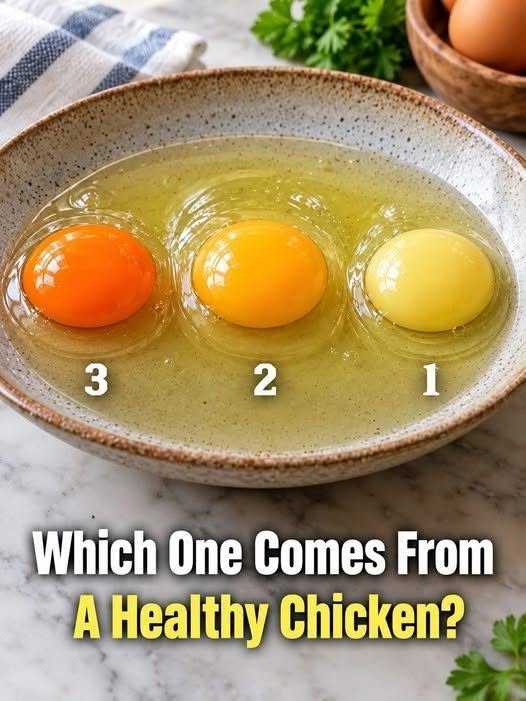
When you crack open a fresh egg into a bowl, the color of the yolk immediately catches your eye. Some are a pale, creamy lemon yellow, others are a classic golden hue, and a select few boast a rich, fiery sunset orange.
Look closely at the three eggs pictured above—labeled 1, 2, and 3—and make your guess: Which one comes from the healthiest chicken?
The Answer: Number 3 (With an Important Catch!)
If you picked Number 3—the deep, vibrant orange yolk on the left—you chose the egg most commonly associated with a pasture-raised, nutrient-rich diet. However, poultry scientists and nutritionists say the full story behind yolk color is a little more nuanced than most shoppers realize.
What Each Yolk Color Reveals About a Hen’s Diet
Yolk color isn’t determined by the breed of the chicken or the color of the eggshell. Instead, it is a direct reflection of what the hen eats—specifically, natural pigments called carotenoids (the same fat-soluble antioxidants that give carrots, marigolds, and leafy greens their color).
Egg #1 (Pale Yellow Yolk): A very light, lemon-colored yolk typically comes from hens fed a predominantly grain-based diet heavy in wheat, barley, or white corn. While these eggs still contain the same core protein and basic fats, they are lower in fat-soluble vitamins and antioxidants because the hen consumed fewer pigment-rich plants.
Egg #2 (Medium Golden-Yellow Yolk): This is the standard grocery store yolk, usually produced by hens raised on a conventional yellow corn and soybean meal diet . Yellow corn contains moderate levels of xanthophylls (a type of carotenoid), resulting in a familiar golden color.
Egg #3 (Deep Orange Yolk): A rich, sunset-orange yolk is the classic hallmark of a pasture-raised hen that spends its days foraging outdoors. Hens with access to fresh grass, clover, wildflowers, insects, and worms consume high concentrations of diverse carotenoids, omega-3 fatty acids, and vitamins A, D, and E—all of which transfer directly into the yolk.
The Catch: Can Yolk Color Be Faked?
While a deep orange yolk often signals a healthier, free-foraging bird, color alone isn’t a 100% guarantee.
Because consumers strongly associate dark orange yolks with superior nutrition and flavor, some commercial egg producers add natural color enhancers—such as marigold petal extract, paprika, or algae—directly to standard chicken feed. These additives create a dramatic orange hue even if the hens are kept indoors without access to fresh pasture.
How to Spot a Truly Healthy Egg at the Store
To make sure you are getting eggs from genuinely healthy, well-nourished hens—and not just clever feed additives—look beyond the yolk color and check these clues:
Read the Carton Labels Carefully: Look for “Certified Humane Pasture-Raised” or “Animal Welfare Approved.” Unlike vague terms like “natural” or “farm fresh,” these certifications verify that hens actually spend time outdoors foraging on real pasture.
Check the Yolk’s Firmness: When cracked into a pan, an egg from a healthy, young hen will have a thick, compact egg white that holds together tightly and a firm, rounded yolk that stands up tall rather than spreading out flat.
Inspect the Shell Strength: A thick, sturdy shell that requires a solid tap to crack indicates the hen received plenty of calcium, vitamin D, and balanced minerals.
Ultimately, Egg #3 is the visual winner when backed by genuine pasture access—offering richer flavor, higher antioxidant levels, and better overall nutrition on your breakfast plate.