My mother never talked about her work at home.
This is the first thing you need to understand, because it explains almost everything else: the worn slippers, the silence, walking with my head down, the way I learned to navigate rooms without taking up much space. My mother wasn’t home much, and when she was, she wasn’t the type to bring her work through the door. She deliberately left it somewhere between the baseboard and the front step, and what came through the door was the version of her who asked me about my homework, cooked rice the way I liked it, and slept on the sofa watching the nature channel because she was always, always tired.
I didn’t know exactly what I was doing.
She knew she was a pilot. She’d known it since she was little: the flight suit, the photograph she kept on her dresser of herself on a runway she couldn’t identify, her walk with a certain controlled awareness that she would later understand better as the posture of someone trained to maintain focus at all times and in any environment. She knew she piloted something fast and important. She knew it required years of training, periodic recertifications, and that kind of mental concentration that sometimes made her wake up in the middle of the night and sit in the kitchen with a glass of water and an expression on her face that she had learned to never lose.
She never publicly told me she was proud of me. She never asked me to tell anyone, or even let them know. That wasn’t her way. But she also didn’t ask me to keep quiet about it, and Heroes Week was Heroes Week, and she was my hero, and when I stood in front of Mr. Reynolds’ third-grade English class with the photograph neatly folded in my notebook, I told the truth because it was the truth.
The laughter started even before he finished the sentence.
I need to describe Mr. Reynolds as he was, because stories about teachers who misjudge their students sometimes turn them into caricatures, and he wasn’t a cartoon character. He was a real person with his own belief system about the world, one of which was that he could accurately interpret a situation from superficial information, and another was that the appropriate response to a student who seemed to be overstepping boundaries was a public, kind correction before the arrogance became embarrassing for everyone.
I thought I was being nice.
This worsened the situation.
—Lucas —he said, with the patience of someone explaining something to a child who has made an understandable but significant mistake—, let’s try to keep the stories believable in these times.
The classroom did what classrooms do when an authority figure gives permission to laugh: they laughed. Not everyone, not everyone; there were children who stared blankly at their desks and didn’t join in the laughter, something I noticed and noted, because in those moments you can tell who stays silent. But the laughter was so loud it filled the room, and I stood at the front with my photograph and my notebook, my face so hot I could feel the heat rising to my ears.
I didn’t argue.
Years ago, after another humiliation in another room, my mother told me that those who need to shame others often feel insignificant inside, and that I shouldn’t lower myself to be like them. I kept those words like a tool, something you keep in your pocket for when you need it. And now I used them. I stayed where I was. I held my notebook. I didn’t argue.
Mr. Reynolds said, “There’s nothing wrong with ordinary jobs. Not everyone needs to invent dramatic stories just to impress.”
Invent.
Don’t exaggerate. Don’t exaggerate. Makeup. The expression that places what was said in the category of invention, of dishonesty, of a child who invents things because reality is not enough for him.
I reviewed the words in my notebook, the ones I had written on the kitchen table the night before, while my mother washed the dishes in the sink and, from time to time, leaned over my shoulder to correct my grammar without looking at me, just because of the sound of the pen when I made a mistake.
Every word was true.
By lunchtime, the joke had already reached the characteristic speed of things that spread in a school: it was replicated, acquiring new details and finding new listeners. Someone near the lockers asked if my mother had parked the car at Walmart. A group of boys laughed with the nonchalance of those who have found a surefire source of entertainment and intend to take advantage of it while it lasts.
I kept walking.
That’s what I mean about that lunchtime that day, the hour I spent in the cafeteria with my tray and notebook, and the accumulated weight of the morning: not reacting didn’t mean not feeling. My mother taught me that they were different things. She taught me that control isn’t the same as absence, that what you choose not to show is still something you carry with you, and that carrying it is a task in itself.
I accepted.
I thought about calling her. She had a cell phone, but it was almost always off; the nature of her work made communication irregular and unpredictable, and I had learned not to expect her to answer. I remembered the photograph in my notebook, the one where she was on the tarmac in her flight suit, one hand near the cockpit ladder, wearing her sunglasses, and that expression that seemed expressionless to others, but that I knew was the one she wore when she was completely relaxed. She never liked posing for photos because posing required acting, and my mother didn’t act.
I thought about the assembly.
Read more on the next page.
Heroes Week at Northwood always culminated in an assembly: the entire school gathered in the auditorium, along with honored guests from the community. It was primarily an administrative event, but occasionally, when the guest list was just right, it became something more.
I had seen the program. I hadn’t paid much attention to it.
I went back to my tray.
See the rest on the next page.
Admiral William Carter. Even at a school where most students divided the world into what directly affected them and what didn’t, Admiral Carter’s name held a powerful pull. He appeared in the news, not in the constant, frenetic way of celebrities, but as someone whose actions had far-reaching consequences, who made decisions in instances where those decisions mattered, and whose name appeared in sentences that also contained words like command, operations, and distinction.
He was tall, like some people, not only physically, but also because of the imposing presence one senses even before they speak. He had gray hair. He had the bearing of someone who had worn a uniform for decades, whose body had so completely embodied its demands that this posture remained even in civilian clothes. He sat on the stage during Director Harris’s welcoming address with the quiet attention of someone who always listens.
I was in the freshman section, in the middle of the row. I chose the middle on purpose because middle seats don’t attract attention from either the front or the back, a calculation I automatically make in large groups.
Director Harris spoke about courage and community, and about the importance of recognizing those who serve.
I was looking at my notebook.
Admiral Carter was watching the program.
And then it stopped.
I didn’t see it in real time; I wasn’t looking directly at it. What I noticed was a change in the atmosphere, the same way you perceive it when a large mass of air moves, the atmospheric sensation of something unexpected. I looked up.
The admiral remained motionless.
It wasn’t the stillness of someone reading, but rather that of someone who had stumbled upon something that had temporarily suspended other functions. His eyes were fixed on a specific point in the program and then slowly scanned the audience, with the deliberate observation of someone who knows how to locate a specific target in a complex environment.
They fell on top of me.
My stomach did something for which I don’t have a precise word.
Recognition.
That was what her expression reflected, before she returned to the serene neutrality of her public image. Recognition: the look of someone who stumbles upon something familiar, something expected, something she may have been anticipating.
He stood up.
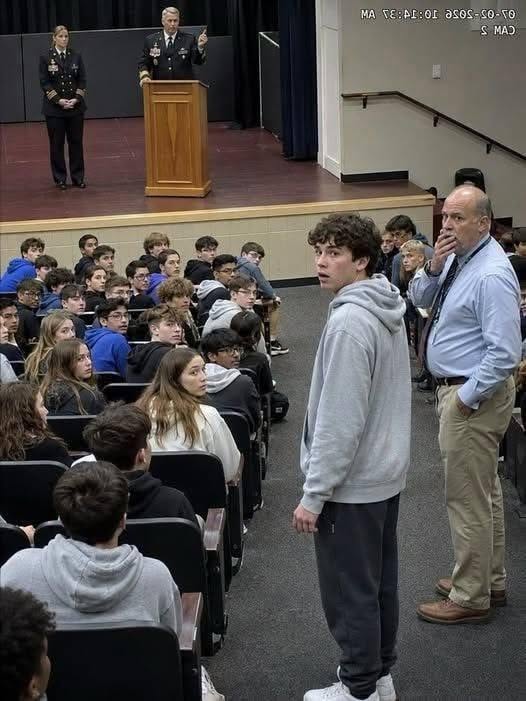
When Admiral Carter stood up, the auditorium—which had been operating at the typical noise level of nine hundred teenagers in a large, enclosed space—fell silent, in that involuntary way that happens even before you decide it to. The professors straightened up. The students stopped whispering. The atmosphere changed.
He approached the microphone.
“Lucas Miller,” he said. His voice was one that didn’t need amplification, but they used it anyway out of courtesy to the audience. “Would you and your mother please come up on stage with me?” asked
Admiral William Carter.
Even at a school where most students divided the world into what directly affected them and what didn’t, Admiral Carter’s name held a powerful pull. He appeared in the news, not in the constant, frenetic way of celebrities, but as someone whose actions had far-reaching consequences, who made decisions in situations where those decisions mattered, and whose name appeared in sentences that also contained words like command, operations, and distinction.
He was tall, like some people, not only physically, but also because of the imposing presence one senses even before they speak. He had gray hair. He had the bearing of someone who had worn a uniform for decades, whose body had so completely embodied its demands that this posture remained even in civilian clothes. He sat on the stage during Director Harris’s welcoming address with the quiet attention of someone who always listens.
I was in the freshman section, in the middle of the row. I chose the middle on purpose because middle seats don’t attract attention from either the front or the back, a calculation I automatically make in large groups.
Director Harris spoke about courage and community, and about the importance of recognizing those who serve.
I was looking at my notebook.
Admiral Carter was watching the program.
And then it stopped.
I didn’t see it in real time; I wasn’t looking directly at it. What I noticed was a change in the atmosphere, the same way you perceive it when a large mass of air moves, the atmospheric sensation of something unexpected. I looked up.
The admiral remained motionless.
It wasn’t the stillness of someone reading, but rather that of someone who had stumbled upon something that had temporarily suspended other functions. His eyes were fixed on a specific point in the program and then slowly scanned the audience, with the deliberate observation of someone who knows how to locate a specific target in a complex environment.
They fell on top of me.
My stomach did something for which I don’t have a precise word.
Recognition.
That was what her expression reflected, before she returned to the serene neutrality of her public image. Recognition: the look of someone who stumbles upon something familiar, something expected, something she may have been anticipating.
He stood up.
When Admiral Carter stood up, the auditorium—which had been operating at the typical noise level of nine hundred teenagers in a large, enclosed space—fell silent, in that involuntary way that happens even before you decide it to. The professors straightened up. The students stopped whispering. The atmosphere changed.
He approached the microphone. “Lucas Miller,” he said. His voice was one that didn’t need amplification, but they used it anyway out of courtesy to the audience. “Would you and your mother please come up on stage with me?”
“This afternoon I received a program,” he said, “with a note attached to the student introductions section. The note was from a teaching assistant who wanted to highlight, in his own words, ‘a student who might need guidance on the difference between fact and fiction.’” He paused. “The student’s name was Lucas Miller. The fact in question is that his mother pilots an F-22.”
The auditorium was very quiet.
“Captain Rachel Miller,” Admiral Carter said, “has been flying F-22 Raptor fighters for nine years. She is honored to be one of the most decorated active-duty fighter pilots in the United States Air Force. She has flown operational missions in three different theaters of operation. Two years ago, she received the Distinguished Flying Cross for actions I cannot fully describe, but I can say they required a level of judgment, precision, and courage that very few people in any profession achieve.”
He looked towards the auditorium.
“The F-22 Raptor is the most advanced air superiority fighter in the world,” he stated. “There are fewer than two hundred pilots certified to fly it in combat conditions. Captain Miller is one of them.”
I was on the stage next to my mother, looking out at the freshman section, in the middle of the row where she was sitting, in the general admission area where the boys who had imitated airplanes at lunch were occupying the seats. From that distance, I couldn’t see their expressions. It wasn’t necessary.
I looked at the wall where the teachers were.
Mr. Reynolds was in the second group from the left.
He wasn’t smiling like he had during his third term. He had the characteristic expression of a man who has made a serious public mistake and is trying to grasp all its implications.
My mother spoke for four minutes.
He didn’t make a scene. He didn’t comment on what had happened that morning, the laughter, or the professor’s remark, because that wasn’t his style. He spoke about service: what it demanded and what it offered in return. He said that the job wasn’t about impressing, which surprised me, though I understood it later. He said that the job was about being useful, and that being useful sometimes required doing things that others couldn’t see, understand, or verify, and that that was okay, because the purpose of doing something useful was the usefulness itself, not the recognition.
She said she had a son who had learned to accept that lesson and that she was proud of him.
He didn’t look at me when he said that. He was looking at the audience. But I knew he wanted me to hear it, and I did.
The audience applauded.
I’m not referring to the polite, obligatory applause of an assembly. I’m referring to another kind of applause.
Later, in the hallway outside the auditorium, we ran into Mr. Reynolds.
This was a real person making a real decision, and I believe some real decisions deserve to be accurately recorded, rather than altered.
First, he went to speak with my mother, introduced himself, and said he owed her and her son an apology. Then, he looked at me and said he had made an assumption and acted accordingly, that the assumption was wrong, and that his action had been unfair.
He said, “I’m sorry, Lucas. I should have listened to you.”
My mother looked at him with the expression she used when evaluating something: neither cruel nor affectionate, simply precise. Then she said, “He handled the situation with more dignity than I would have had at fifteen.”
Mr. Reynolds looked at me.
“I know,” he said. “I realized that.”
The apology wasn’t the dramatic capitulation of a story that demands the complete destruction of its antagonist. It was a person acknowledging a mistake and identifying it, which is the most useful form that acknowledgment can take.
I said to him, “Thank you, sir.”
We went back inside.
The course continued after that day, as it often does in school: that day became an anecdote, the anecdote faded into the background, and the underlying issues simply took their course. I spent the rest of the semester in Mr. Reynolds’s third class, and he never considered my contributions as requiring verification; occasionally, he would ask me questions about aviation or military service with the genuine curiosity of someone who had brushed up on the subject and was interested in understanding it better.
I responded as soon as I could.
My mother returned home in December.
She came in through the door as usual, leaving her work somewhere between the ground floor and the stairs, the same person who asked about homework and cooked rice exactly the way I liked it. She was tired, as always, with that kind of tiredness that takes days to fully manifest.
The night she arrived, I prepared dinner for her at her house.
I wasn’t a good cook—I was fifteen years old and only knew how to prepare three things, and this was the easiest—but I prepared everything, set the table, she sat down, we ate, and she asked me about school, as she always did.
I told her about the semester.
Not about the horseback riding part—she already knew that. The rest. The things that happened afterward, the subtle changes in the atmosphere of the dorms when I walked in, the guys apologizing in that typical way, like teenagers who decide they need to apologize but don’t quite know how. The girl who came to talk to me the following week and whispered, “I didn’t laugh. I just want you to know I didn’t laugh.”
My mother listened with rapt attention.
When I finished, he said to me, “How are you?”
“Great,” I said. “Better.”
“You handled the situation well,” he said.
“I didn’t do anything,” I said. “The admiral…”
“Before that,” he said, “in the classroom, you just stood there without backing down.” He looked at the rice. “That’s something I was proud of.”
“How did you find out about the classroom?”
He looked at me like that.
“I called his director,” he said. “When I saw the email, I wanted to understand the whole situation before deciding what to do about it.”
“Did you plan the setup?” I asked.
“Admiral Carter planned the meeting,” he said. “I took the initiative.”
I looked at her.
“You never told me you knew Admiral Carter,” I said.
“You never asked me,” he said.
“I didn’t know I should ask.”
“Now you know,” he said.
He ate the rice.
Outside, the December darkness had settled over the neighborhood with the total stillness of a cold night, and the house was warm like houses where someone has just arrived, and my mother was tired as always, and I was fifteen years old and that year I learned something about the price of truth, its value and what happens when someone who knows the truth finally decides it’s time to know it too.
The lesson was not about impressing people.
It never was.
It was about standing in front of a room with a photograph, a notebook, and every sincere word, without backing down while waiting for the world to catch up with you.
My mother had shown it to me before the assembly.
Before Mr. Reynolds.
Before Heroes Week.
He showed it to me at the kitchen table, correcting my grammar without looking down on me, simply because he knew something.
That’s what I’ve always been proud of.
That has always been the goal.
END