Have you ever wondered why some people seem to build muscle effortlessly while others struggle to gain a pound? Or why certain diets work wonders for one person but leave another feeling sluggish?
The answers may lie in a concept developed in the 1940s by psychologist William H. Sheldon: somatotypes, or body types . While the theory that these types determine personality has been largely dismissed by the scientific community, the classifications themselves offer a practical framework for understanding how your body naturally responds to food and exercise .
The three primary body types are ectomorph, mesomorph, and endomorph. No one fits perfectly into just one category—most people are a unique blend of all three, often referred to as a hybrid body type . However, understanding your dominant type can be an excellent starting point to tailor your fitness and nutrition plan for better results .
Here is how to identify your type and make the most of it.
How to Identify Your Body Type
🔎 The Ectomorph: The “Hard Gainer”
If you naturally have a slim, lean build with narrow shoulders and hips, small joints, and long limbs, you likely lean toward the ectomorph type . This “hard gainer” physique is characterized by a fast metabolism, making it difficult to gain both muscle and fat . If you’ve ever felt like you can eat anything without gaining weight, you might be an ectomorph .
Key traits: Lean and tall, fast metabolism, struggles to gain weight/muscle, narrow frame.
💪 The Mesomorph: The “Natural Athlete”
Mesomorphs are the picture of an athletic build. They typically have a medium frame with broad shoulders, a narrow waist, and an efficient metabolism . This body type is genetically predisposed to build muscle and lose fat with relative ease . If you respond well to exercise and see results quickly, you’re likely a mesomorph.
Key traits: Muscular and athletic, broad shoulders and narrow waist, builds muscle easily, efficient metabolism.
⚖️ The Endomorph: The “Powerhouse”
Endomorphs tend to have a larger bone structure, a wider waist and hips, and carry more body fat . They often have a slower metabolism, which means they can gain weight—particularly fat—more easily and find it more challenging to lose it . This body type is powerful and often excels in sports that require strength.
Key traits: Rounder and stockier build, larger waist/hips, stores fat easily, gains muscle easily, slower metabolism.
🔄 Hybrid Types
Since most people are a combination, understanding the blends is also helpful .
Ecto-Mesomorph: You have the lean frame of an ectomorph but are also muscular and athletic. This is often considered a “fitness model” look .
Meso-Endomorph: You can build muscle easily like a mesomorph but are also prone to carrying more body fat, giving you a more powerful, “stocky” build .
Ecto-Endomorph: You have a slender frame but are carrying excess body fat, often around the midsection. This is often a behaviorally acquired type .
Take a Quick Self-Assessment
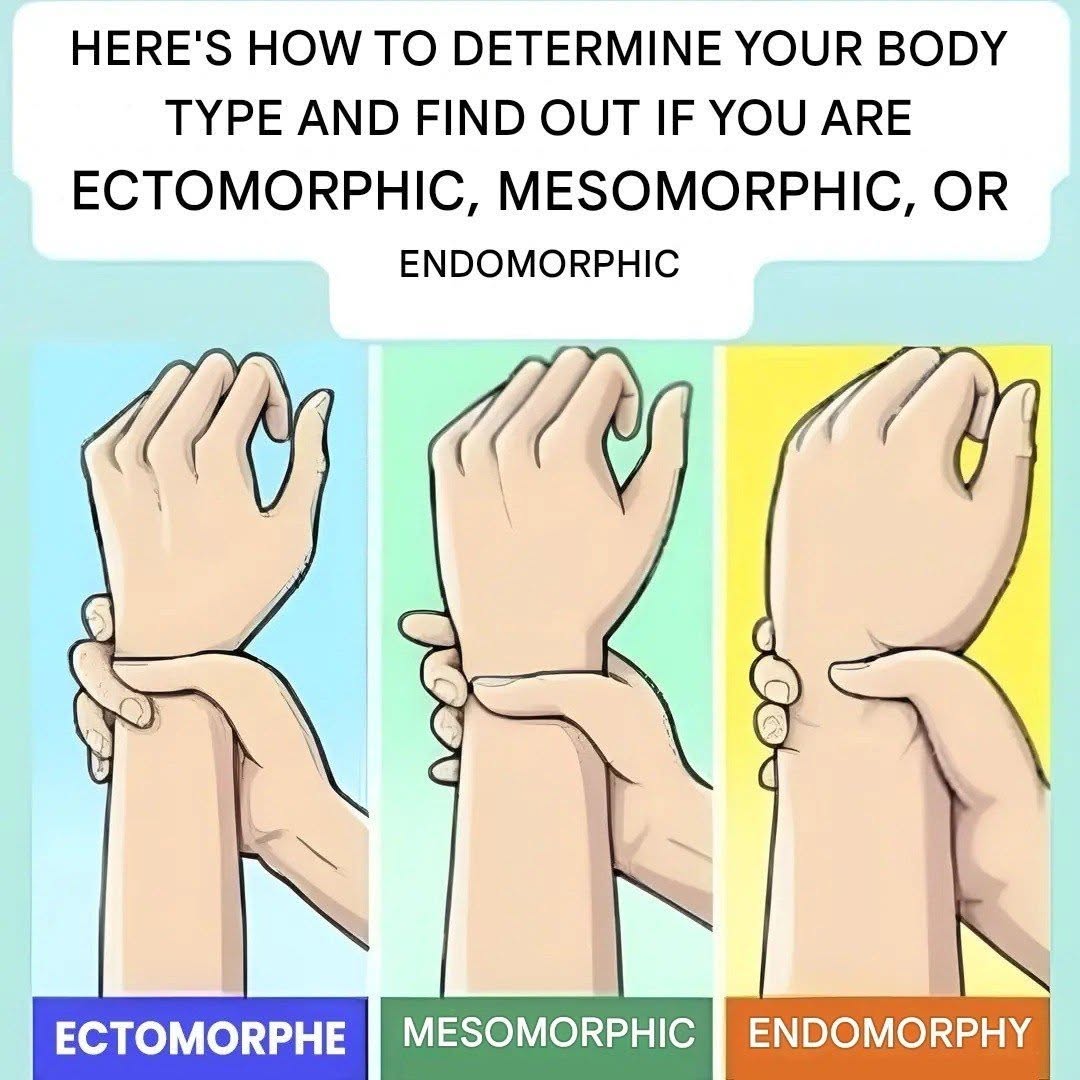
While a professional can give you a precise assessment, a simple quiz can help you pinpoint your type . For a quick, rough estimate, consider your frame:
Small frame? You may be an ectomorph.
Medium frame? You may be a mesomorph.
Large frame? You may be an endomorph.
Ask yourself:
Do I gain weight easily? (Yes: endomorph; No: ectomorph; Sometimes: mesomorph)
Is it easy for me to build muscle? (Yes: mesomorph; No: ectomorph; Moderate: endomorph)
What is my metabolism like? (Fast: ectomorph; Slow: endomorph; Balanced: mesomorph)
How to Make the Most of Your Body Type
Once you have an idea of your dominant type, you can adjust your diet and exercise approach for better results.
🏃♂️ For Ectomorphs: Build Mass
Your goal is to build muscle, and you’ll need a strategic approach to overcome your fast metabolism .
Training Tips:
Focus on Strength Training: Prioritize heavy compound lifts like squats, deadlifts, and bench presses to stimulate muscle growth .
Limit Cardio: Too much cardio burns calories you can’t afford to lose. Keep sessions short and limited to 2-3 times a week .
Use Long Rest Periods: Take 90-120 seconds of rest between sets to maximize recovery and avoid overtraining .
Nutrition Tips:
Eat a Caloric Surplus: You need to consume more calories than you burn to gain weight. Focus on calorie-dense, nutrient-rich foods .
High Carbohydrate Diet: Fuel your workouts with a higher proportion of carbs (around 50% of your diet). Aim for 1.2-1.6 grams of protein per kilogram of body weight .
Eat Frequently: Try 5-6 smaller meals a day to keep your energy levels up .
🏋️♂️ For Mesomorphs: Maintain and Refine
You have a natural advantage. Your goal is to maintain your muscle and refine your physique based on your personal goals .
Training Tips:
Blend Strength and Hypertrophy: Mix heavy lifting with moderate rep ranges (6-12 reps) to keep your body challenged .
Include Cardio: Maintain a lean physique with regular cardio—moderate-intensity sessions 2-3 times a week—to balance your training .
Train Frequently: You can handle 4-5 training sessions a week due to your efficient recovery .
Nutrition Tips:
Balanced Macros: Eat a balanced diet (roughly 40% carbs, 30% protein, 30% fat). Adjust your calorie intake based on your goal (bulking or cutting) .
High Protein: To support your muscle mass, aim for 1.4-2.0 grams of protein per kilogram of body weight .
Focus on Food Quality: Ensure your diet is built around whole, unprocessed foods .
🔥 For Endomorphs: Maximize Fat Loss
Your primary focus should be on losing body fat and improving metabolic conditioning .
Training Tips:
High Frequency: Train 4-5 days a week, mixing strength training and cardio .
Metabolic Conditioning: Use circuit training, supersets, and high-intensity interval training (HIIT) to boost your calorie burn .
Regular Cardio: Aim for 3-5 sessions of cardio a week, including both moderate-intensity steady-state (like walking) and HIIT .
Nutrition Tips:
Manage Carbohydrates: Be mindful of your carb intake. Focus on low-GI carbs and consume them around your workouts when your insulin sensitivity is highest .
High Protein, Moderate Fat: To regulate appetite and maintain energy, aim for a high protein intake (up to 2.2g/kg) with moderate healthy fats .
Lower Carb Approach: A macronutrient split of lower carbs (30-35%), moderate protein (30-35%), and higher fat (30-40%) can support fat loss .
A Final Word on Body Types
Your body type is not a life sentence . While your genetics do play a large role in your bone structure and frame, your body composition can change significantly . An endomorph can achieve a leaner physique with a dedicated plan, and an ectomorph can build impressive muscle mass.
However, it’s also important to be aware of health risks. Ectomorphs who struggle to maintain a healthy weight may face issues like low bone density . Endomorphs, on the other hand, are at a higher risk for conditions linked to obesity, such as hypertension, heart disease, and type 2 diabetes . Understanding your body type isn’t just about aesthetics—it’s about health.
By understanding the framework of somatotypes, you can stop fighting your body’s natural tendencies and start working with them. Use these guidelines to build a personalized plan that sets you up for success.