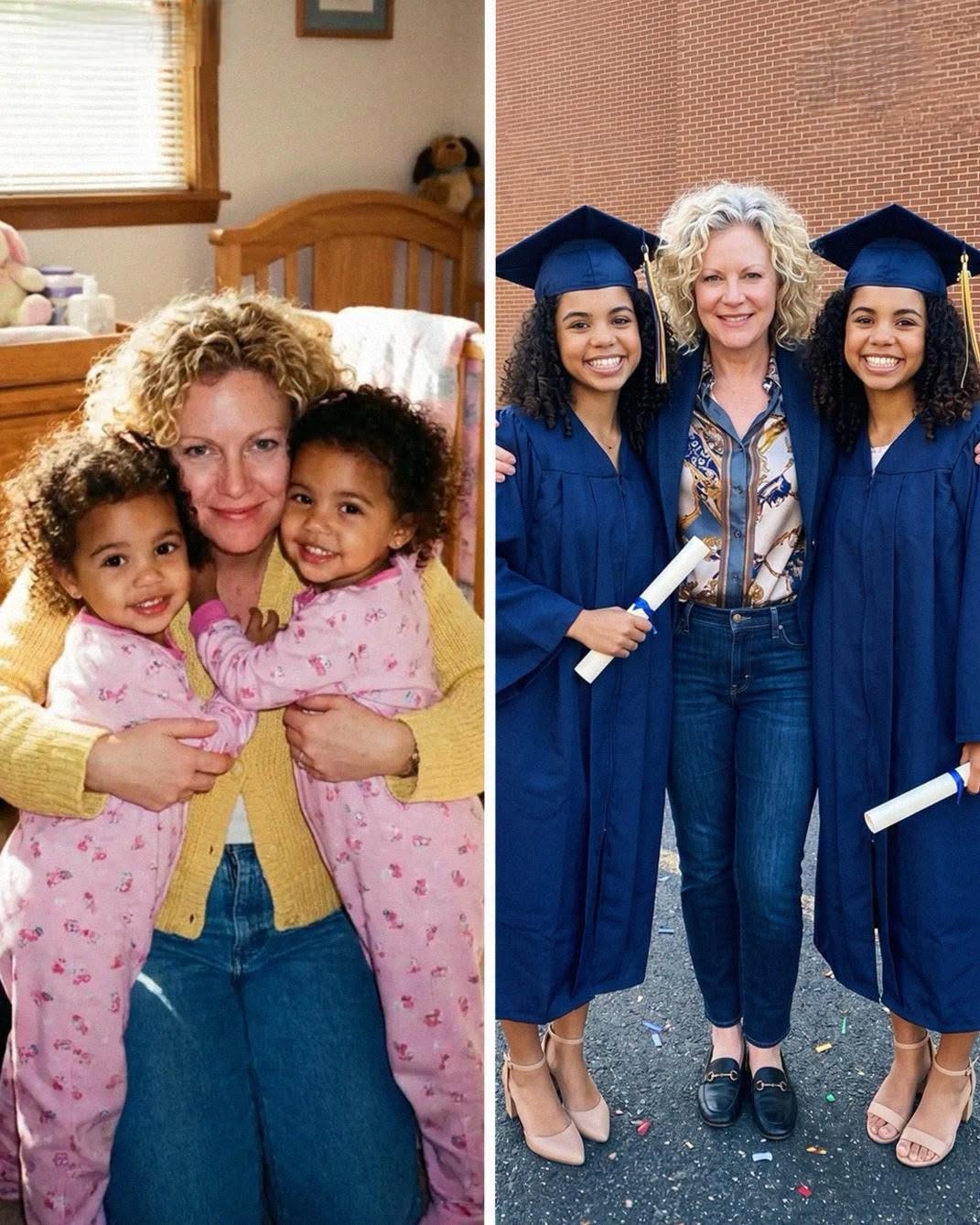
The morning after my daughters’ high school graduation should have been a period of quiet reflection and celebration, a moment to finally exhale after nearly two decades of solo parenting. Instead, it became the day the earth shifted beneath my feet for the second time. I was standing on my front porch, still feeling the lingering warmth of watching Lily and Nora cross the stage in their caps and gowns, when a gray-haired stranger in a navy suit approached. He spoke my ex-husband’s name and handed me a thick, heavy folder. Eighteen years after Sam had supposedly abandoned us in a hospital room filled with the scent of bleach and newborn hope, I was forced to realize that the history I had lived was not the history that had actually happened.
The original version of my story was simple and devastating. On the day our twin daughters were born via surrogate, Sam had vanished. One moment he was standing by the hospital window, looking pale and hollowed out, and the next he was gone, leaving behind nothing but a paper bag of cold food and a note that read like a death sentence. He claimed he couldn’t do the life we had planned. He told me he was caught up in my excitement, not his own, and that he was leaving so we could be better off without him. For eighteen years, I carried that rejection like a physical weight. I raised Lily and Nora to believe their father was a man of spectacular cowardice—a ghost who had opted for an easy exit while I stayed behind to figure out how to pay for diapers and electricity on a single income.
I spent those years navigating the brutal reality of the early years alone. I learned to survive on four hours of sleep, I returned to work far too early because heartbreak doesn’t pay the mortgage, and I answered the girls’ heartbreaking questions about their father with a practiced, cynical honesty. When they were six and asked if he had died, I told them he had made a selfish choice. I watched them grow from whimpering infants into brilliant, independent young women, all while harboring a deep, quiet resentment for the man who had missed every milestone, every birthday, and every tear.
But the folder Matthew handed me on my porch contained a different reality. As I sat at my kitchen table with the girls, I began to peel back the layers of a eighteen-year-old conspiracy. Inside were trust documents, bank records, and college accounts in Lily and Nora’s names. There were copies of mortgage payments that had been mysteriously covered during the weeks I thought we were going to lose the house. There were medical payments for the time Nora had injured her knee. I had always called those moments “luck,” but the paperwork showed they were actually Sam. He had been a silent, invisible architect of our security, providing for us from the shadows while maintaining a distance that felt like a betrayal.
The most shocking revelation, however, was a legal memo detailing the actions of my mother-in-law, Gia. According to the documents, Gia had prepared a ruthless legal strategy the very day the twins were born. She intended to challenge the surrogacy, using my history of miscarriages and the resulting grief to question my mental stability. Her goal was to push for family-controlled guardianship, effectively stripping me of my daughters and bringing them under her absolute control. She had lawyers ready before the girls were even out of the hospital, viewing them not as grandchildren, but as leverage and assets for her empire.
Sam had discovered his mother’s plan in that hospital hallway. He knew Gia’s power, her resources, and her absolute lack of empathy. He understood that if he fought her openly, she would drag me through a devastating, public court battle at a time when I was physically and emotionally exhausted. He realized that the only way to protect the girls—and me—was to remove himself from the equation entirely. By leaving, he broke Gia’s leverage. He cut himself off from her money, put legal distance between himself and her influence, and led her to believe he had lost interest in the family. He sacrificed his reputation and his relationship with his children to ensure that Gia had no legal standing to pursue them.
Matthew, who had been Sam’s legal representative and the conduit for the support, delivered the final blow: Sam had passed away four months earlier. He had waited until the girls were eighteen, the age where Gia could no longer legally challenge their custody, to have his story told. My letter from him was a painful admission of the cost of his silence. He admitted that his choice was a mixture of protection and cowardice, confessing that he had been raised to fear his mother more than he trusted me. He apologized for building our lives around a wound he had created, but he insisted that he had loved Lily and Nora from the second he saw them.
The truth led us directly to Gia’s doorstep that evening. Standing in her opulent, cold sitting room, I watched her try to spin the narrative, claiming she was only trying to “protect the family.” But the girls weren’t having it. Nora brushed past her with a sharp wit, and Lily stood tall, telling her grandmother that their father had loved them enough to leave her behind. We saw the predator for who she was—a woman who had been willing to use my greatest tragedies against me. Seeing her flinch as her granddaughters rejected her was the closest I would ever get to justice.
That night, back in the quiet of our kitchen, the three of us sat with the weight of the new truth. Lily asked if I could forgive him, and I realized that forgiveness wasn’t quite the right word. I understood him now. I understood that he had been a man caught between a monster and the people he loved, and he had chosen the only path he saw as safe. But understanding the sacrifice didn’t erase the eighteen years of absence. It didn’t give the girls a father to walk them down the aisle or a husband to hold my hand during the hard nights.
Sam had been a hero in the shadows, but a ghost in the light. He had protected us from a storm we never even saw coming, but in doing so, he had left us to navigate the world without him. As I looked at my daughters, vibrant and strong, I knew that while Sam had provided the safety, I was the one who had provided the life. He had paid the bills, but I had raised the souls. We would carry his secret and his support into the future, but we were the ones who had rewritten the ending. Sam had loved us in a way that broke us first, and while I finally found peace in the truth, I knew that the strongest thing in that kitchen wasn’t the money in the folder—it was the three of us, whole and unapologetic, standing together despite the lies.