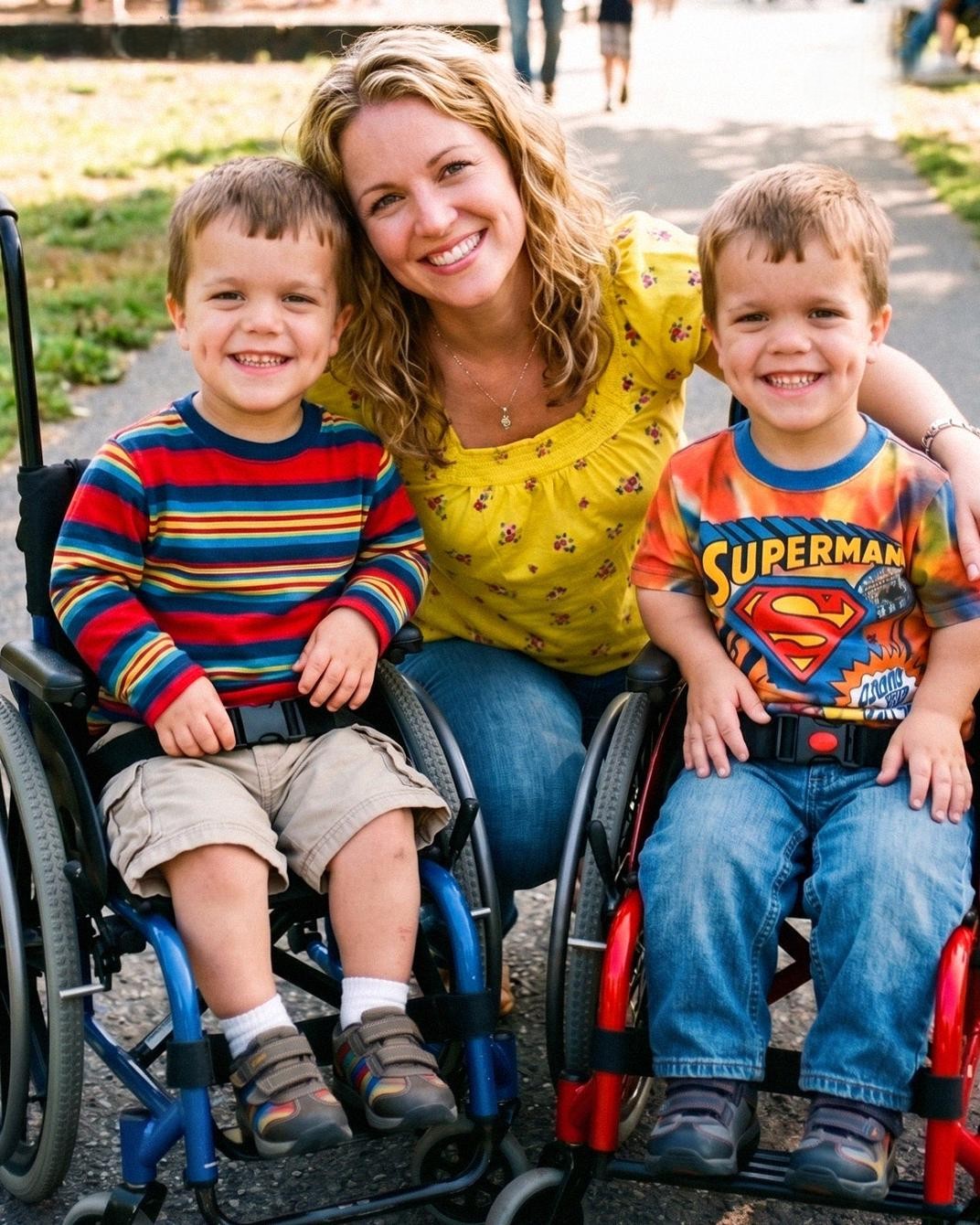
Eighteen years ago, the trajectory of my life snapped in two. At twenty-six, I was the definition of a rising star in the architectural world. I lived for the scent of fresh blueprints and the thrill of seeing a skyline change because of my designs. I was ambitious, perhaps even a bit selfish, and I had every reason to believe my future was paved in gold. Then came the phone call that silenced the music. Elena, my soul sister since our freshman year of college, was gone. She left behind a world of grief and two four-year-old twin boys, Leo and Sam.
The boys were vibrant, beautiful, and bound to wheelchairs due to a degenerative condition that required constant, specialized care. In the wake of the tragedy, I watched as Elena’s extended family shuffled their feet. They spoke in hushed, practiced tones about “limitations” and “unfortunate circumstances.” They looked at those two boys and saw a burden they weren’t willing to carry. I looked at them and saw the only pieces of Elena left on this earth. Without a second thought, I stepped into the gap.
The pushback was immediate and relentless. My parents pleaded with me not to “throw my life away.” My boss offered me a sabbatical, certain I would come to my senses once the reality of diaper changes and physical therapy sessions set in. But I knew that if I didn’t take them, they would be swallowed by a system that couldn’t love them the way they deserved. Within thirty days, I resigned from my firm, packed up my dreams, and became a full-time mother.
For nearly two decades, my identity was defined by service. My hands, once used for drafting intricate elevations, became skilled in the mechanics of heavy lifting and the precision of medical regimens. There were nights of bone-deep exhaustion where I wondered if I had truly “ruined” my future as my friends had warned, but then Leo would crack a joke or Sam would show me a poem he’d written, and the doubt would vanish. They grew into remarkable young men—kind, observant, and fiercely protective of the woman who had chosen them.
When the boys were fifteen, Mark entered our lives. He was a steady, quiet man who understood from day one that we were a package deal. He didn’t try to be their father, but he became their anchor. He was the person I leaned on when the boys turned twenty-two and the reality of their adulthood began to set in. Our life was peaceful, or so I thought, until a Tuesday night three days ago.
I was propped up in bed when Mark walked in, his face a ghostly shade of pale. He wasn’t carrying his usual warmth; he was carrying Sam’s laptop like it was a live explosive. He told me he had found a hidden folder while helping Sam fix a technical glitch. He spoke of missing money from our joint accounts—small amounts I had noticed but ignored—and secret hushed conversations that ended the moment I entered a room. My heart hammered against my ribs. Had I raised boys who were capable of deception? Had the boys I sacrificed everything for been taking advantage of my devotion?
Mark pressed play on a series of audio files. They were recordings the twins had made, initially as part of a therapy exercise to track their emotional progress, but they had evolved into something else entirely. As the first clip played, I heard Leo’s voice, thick with emotion. He was talking about me. He spoke of how I used to talk in my sleep about buildings and bridges, a habit I hadn’t realized I still had. Then Sam’s voice joined in, noting with a heartbreaking clarity that I had stopped talking about those things years ago.
As we listened to months of recordings, the “deception” began to unravel into a narrative I never could have imagined. My sons hadn’t been stealing money for selfish gain; they had been pooling every cent they could find to hire a private investigator and a career consultant. Their mission was singular: to find David, my old mentor from the architectural firm I had left eighteen years prior.
They had tracked down my old portfolio, which had been archived on a dusty corner of the internet. They had reached out to David, navigating the corporate world from their bedrooms, pitching my talent as if they were my agents. They were convinced that the world had been robbed of my vision, and they were determined to give it back to me. The whispers I had heard were them coordinating emails and legal consultations to ensure that if David offered me a job, the contract would be ironclad and accommodate my life at home.
The “missing” money had gone toward a consultant who helped them draft a professional pitch that David couldn’t ignore. In one recording, Sam said, “She always chooses us. It’s time we make her choose herself.”
I was still reeling, tears blurring my vision, when I heard the front door open. The twins were home. I didn’t wait for them to settle in. I walked into the living room, Mark following with the laptop, and I confronted them with the truth of what we had heard. The room went silent. The boys didn’t look ashamed; they looked resolute. Sam told me to listen to the final recording—the one they had made just that afternoon.
On the tape, David’s voice was clear. He remembered me. He remembered my “instincts.” He told the boys that his firm was looking for a senior-level consultant for a massive municipal project—a role that could be done entirely remotely, focusing on oversight and design rather than grueling site visits. He said the position was mine if I wanted it.
I broke down. For eighteen years, I had viewed my career as a sacrifice I made for them, a closed chapter in a book I had long ago put on the shelf. I never realized that they had been watching the silhouette of the woman I used to be, grieving for her even as I celebrated them. They didn’t want a martyr; they wanted a mother who was whole.
The following week, I sat at the kitchen table with Sam’s laptop. My hands were shaking as I logged into the video call. When David’s face appeared on the screen, he looked older, but his eyes had the same spark. He didn’t ask why I had been gone for so long; he simply asked what I thought about the sketches he’d sent over.
For the first time in nearly two decades, I didn’t answer as a caregiver or a widow’s best friend. I answered as an architect. I found my voice again, discovering that while I had been busy raising two men, they had been busy preserving the soul of the woman who raised them. I signed the contract a few weeks later. My life didn’t revert to what it was at twenty-six; it became something better. I have my sons, I have Mark, and now, I have the blueprints of a future I thought was lost forever. They told me they lied because they knew I would have said no to spending the money on myself. They were right. But in their “betrayal,” they gave me the greatest gift of all: the permission to be myself again.