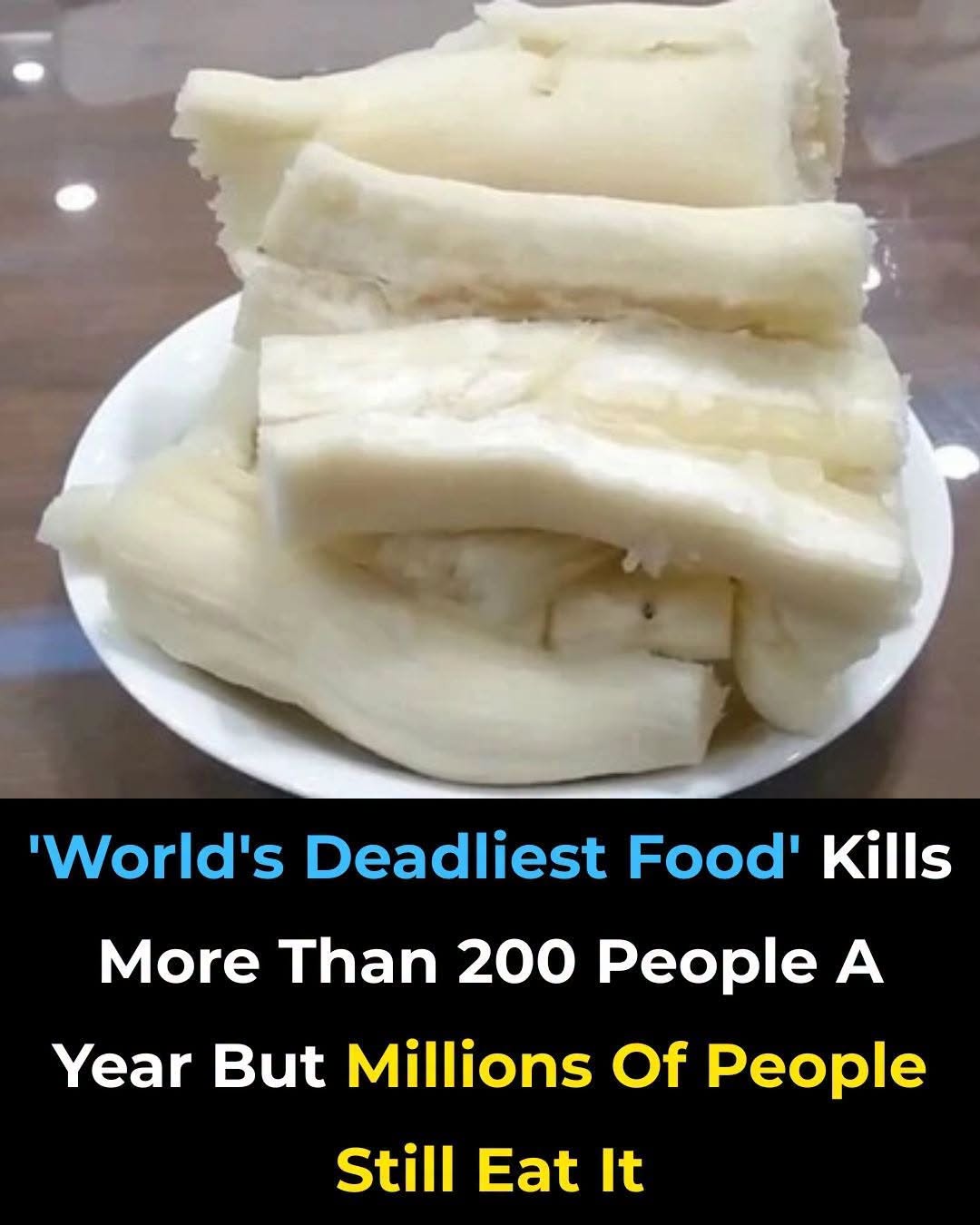
It looks innocent enough, a humble root found in kitchens across the globe, but hidden within its fibers lies a chemical so lethal it has been responsible for hundreds of agonized deaths every single year. You might have eaten it yourself, blissfully unaware that you were playing a high-stakes game of Russian roulette with your own biology. This isn’t a rare, exotic poison found in the depths of a forbidden jungle; it is a staple of the modern diet for nearly 500 million people. Prepare to be shocked as we reveal the terrifying truth about the “world’s deadliest food” that might just be sitting in your pantry right now.
The plant in question is cassava, a starchy, tuberous root that serves as a fundamental caloric pillar for vast populations across Africa, Asia, and South America. To the casual observer, it is a versatile miracle crop—drought-resistant, hardy, and capable of thriving in nutrient-poor soil where other staples would wither and die. It is the invisible backbone of food security for some of the world’s most vulnerable communities. Yet, beneath its dusty, unassuming brown skin, cassava harbors a dark and deadly defense mechanism. It is a biological booby trap designed by nature to deter insects and animals, but one that can prove fatal to humans if the proper, rigorous preparation steps are skipped or misunderstood.
The culprit is the plant’s ability to produce cyanogenic glucosides. When the stems, leaves, or tubers of the cassava plant are damaged or eaten raw, these glucosides break down and release hydrogen cyanide—a potent, fast-acting poison that interferes with the body’s ability to use oxygen at the cellular level. This is not a subtle toxin that takes years to manifest; it is an acute, life-threatening threat. According to the World Health Organization, hundreds of people lose their lives annually due to improperly processed cassava. The science is stark: if these glucosides are not neutralized through correct processing, the cassava becomes a vehicle for high-level dietary cyanide exposure.
The grim reality of this poisoning is most cruelly felt in regions plagued by poverty, famine, or the devastating chaos of war. In these desperate scenarios, when food sources are scarce and survival instincts override safety protocols, people are often forced to consume “bitter” cassava without the necessary preparation. The consequences are catastrophic, leading to a condition known as konzo. This is a devastating, irreversible neurological disorder characterized by the sudden and permanent paralysis of the legs. It typically emerges in populations that rely almost exclusively on inadequately prepared bitter cassava, exacerbated by diets that are dangerously low in protein. The protein deficiency is a critical factor, as the human body requires sulfur-containing amino acids to help neutralize and detoxify the cyanide consumed through the root. Without that protective nutritional shield, the poison takes hold with heartbreaking efficiency.
The history of cassava consumption is a masterclass in the necessity of indigenous knowledge and rigorous tradition. For generations, communities that have relied on cassava have developed sophisticated, time-consuming methods to render the tuber safe. This is not a task of minutes, but of days. The tubers must be peeled, washed, and then subjected to extended soaking—often for as long as 24 to 48 hours—to allow the cyanogenic compounds to leach out into the water. In many cultures, the process also includes fermentation, grating, and thorough cooking, all of which act as crucial layers of defense against the lingering toxins. When these traditional rituals of preparation are ignored or abandoned due to time constraints, economic hardship, or a lack of education, the transition from “nourishing staple” to “lethal poison” is instantaneous.
The danger of cassava is a sobering reminder that our modern relationship with food is often far more fragile than we care to admit. In affluent Western supermarkets, we are accustomed to food that is sanitized, processed, and guaranteed to be safe by rigorous government regulation. We rarely have to consider the molecular defense mechanisms of our vegetables. But for hundreds of millions of people, eating is a literal negotiation with nature. The story of cassava is not a cautionary tale intended to incite fear or demonize a vital food source; rather, it is a call to recognize the immense importance of food safety literacy.
As global food systems become more interconnected, the lessons learned from the traditional processing of cassava are becoming increasingly relevant. International health organizations are working tirelessly to promote improved agricultural practices, such as the cultivation of “sweet” cassava varieties that naturally contain lower levels of cyanogenic glucosides, and the dissemination of simple, effective processing technologies to rural communities. Education is the ultimate antidote to the dangers hidden in this root. By teaching and standardizing the methods of peeling, soaking, and fermenting, we can ensure that cassava continues to provide life-sustaining energy to the millions who depend on it, rather than continuing to claim lives through misunderstanding and neglect.
The next time you see a recipe calling for cassava flour, or you encounter this starchy root on a plate, remember the journey it has taken to get there. It is a plant that holds the power to both feed a nation and extinguish a life. The “world’s deadliest food” remains a staple not because it is inherently evil, but because humanity has learned—through centuries of trial, error, and painful experience—how to harness its power while discarding its poison. It stands as a testament to human resilience, an example of our unique ability to take the dangerous offerings of the natural world and, through patience and science, turn them into the very things that sustain our existence. We are only as safe as our knowledge, and in the case of cassava, knowledge is not just power—it is the difference between a meal and a tragedy.