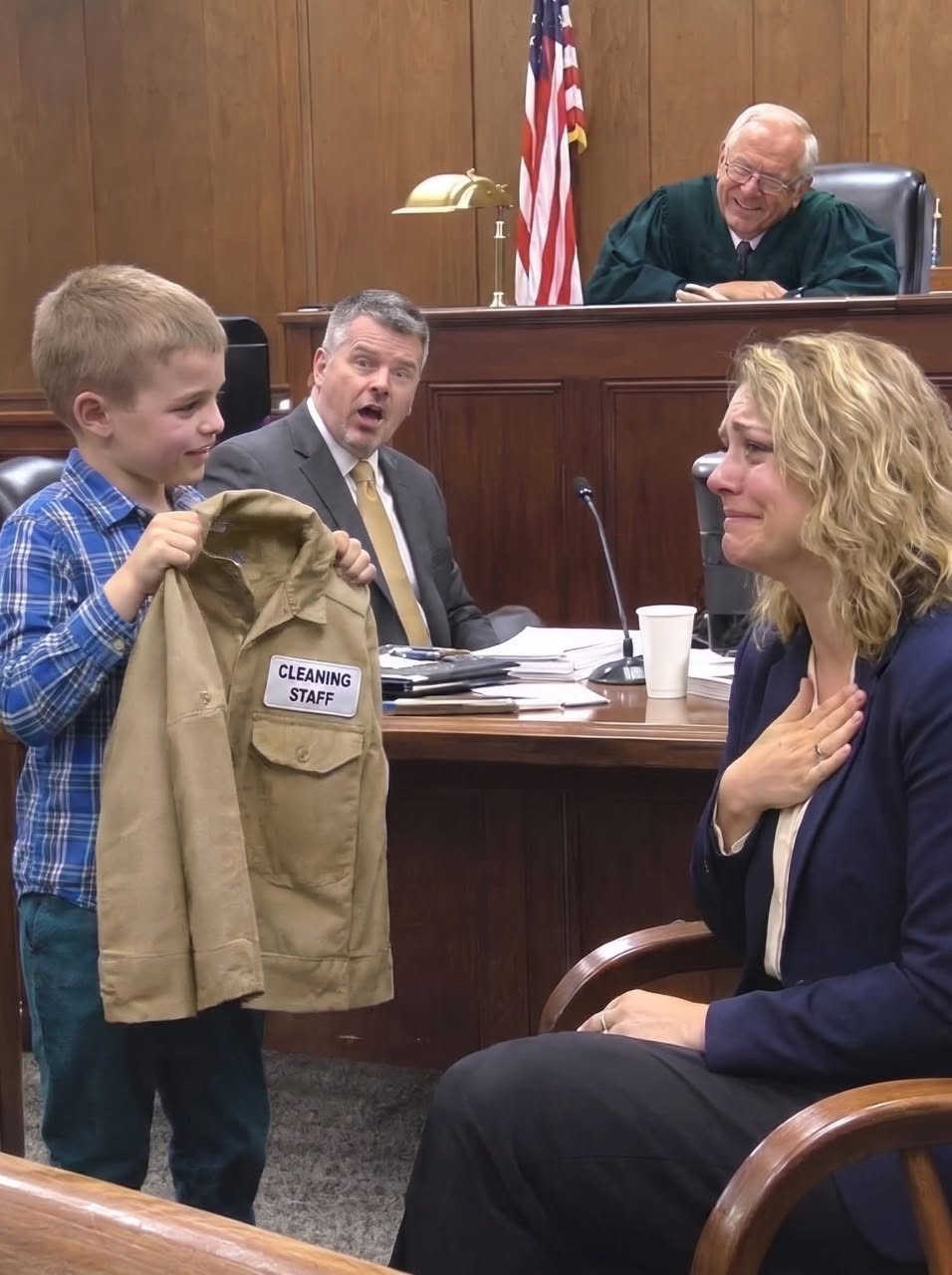
The courtroom fell silent as Nolan lifted the front of his navy shirt.
At first, I didn’t understand what he was doing.
Then I saw the small rectangular patch of fabric sewn into the inside of the shirt, just beneath the embroidered silver moon.
Nolan carefully pulled it outward.
Something white slipped from the tiny pocket.
A folded piece of paper.
Grant’s smile disappeared.
His lawyer immediately stood.
“Your Honor, I must object. The child shouldn’t be displaying personal items in court without prior notice.”
But Judge Reynolds raised one hand.
“Sit down, Mr. Carroway. I would like to hear what the boy has to say.”
Nolan looked at me.
I nodded gently.
He unfolded the paper with both hands.
“My dad told me this shirt was dirty,” he began, his voice trembling. “But my grandma helped me put something inside it. She said I should keep it safe until today.”
I turned toward my mother, Ruth, who was sitting quietly behind us.
She had known.
I had no idea.
Nolan held up the paper.
“It’s a letter from Grandma. She said it would help everyone understand why I wear this shirt.”
Judge Reynolds leaned forward.
“Would you like to read it, Nolan?”
He nodded.
His small voice echoed through the courtroom.
“Dear Judge, my name is Ruth Miller. I am Nolan’s grandmother. I have watched my daughter work two jobs to give my grandson a safe and loving home. I have also watched her sacrifice things that mattered to her so Nolan would never feel that he was less important than other children.”
Nolan paused and looked at the judge.
Then he continued.
“The stains on his shirt are not because his mother doesn’t wash his clothes. They are from the medicine and food I spilled on him when I became sick one afternoon. Nolan was helping me when I couldn’t hold my hands steady. He didn’t want to change because he said he wanted to finish helping me.”
I felt my throat tighten.
I remembered that afternoon.
My mother had suffered a dizzy spell while I was at work. Nolan had found her sitting on the kitchen floor, frightened and unable to stand.
He had brought her water, helped her reach the telephone, and stayed beside her until a neighbor arrived.
When I came home, his shirt was stained with soup and medicine.
I had offered to buy him another one.
He had refused.
“It’s okay, Mom,” he had said. “Grandma needed me.”
I hadn’t realized how much that moment had meant to him.
Nolan continued reading.
“The shirt was a birthday present from his mother. He loves it because it reminds him that she always tries to make him happy, even when money is difficult. Please don’t judge a mother’s love by the condition of one child’s shirt.”
There was a long silence.
Then Nolan looked up.
“There’s something else, Your Honor.”
The judge nodded.
He reached into the little pocket again and removed a second folded paper.
“This one is from my dad.”
Grant suddenly stood.
“Nolan, that’s enough.”
The judge’s voice sharpened.
“Mr. Bellamy, sit down. Your son is speaking.”
Grant slowly lowered himself into his chair.
Nolan unfolded the second paper.
It was a printed message.
He couldn’t understand every word, but he recognized his father’s name and the date.
“I found this in Grandma’s kitchen,” he explained. “She said I should give it to the judge if someone said Mom didn’t have enough money to take care of me.”
Judge Reynolds asked Ruth to approach.
My mother stood carefully and handed the judge a folder.
Inside were copies of messages, payment records, and a letter from the manager of the office building where I had once worked.
The first message was from Grant to an acquaintance who managed the building.
It read:
“Can you make sure she doesn’t keep that evening contract? I need the court to see that she can’t manage financially. Don’t put anything in writing that connects it to me.”
The courtroom seemed to lose its air.
Grant’s lawyer quickly took the document from the judge’s clerk and examined it.
“Your Honor, we have not had an opportunity to verify these materials.”
“Then you will have an opportunity,” the judge replied. “But I will not ignore what has just been presented.”
My mother explained that she had received the messages from the building manager, who had become uncomfortable with the situation and eventually admitted what had happened.
He had also provided a signed statement.
The next document was a record of payments.
It showed that Grant had repeatedly failed to provide the court-ordered child support.
In contrast, his lawyer had just argued that my financial circumstances proved I was unable to care for Nolan.
The judge studied the records carefully.
“Mr. Bellamy,” she said, “are you disputing that these messages came from you?”
Grant’s face had turned pale.
“My intention was to make sure Nolan had a better life.”
“By arranging for his mother to lose her employment?”
“I didn’t arrange anything.”
My mother spoke up.
“The building manager has agreed to confirm what happened.”
Grant turned toward her.
“You have no idea what you’re talking about.”
Ruth didn’t flinch.
“I know what my daughter has endured. And I know what my grandson has seen.”
The judge asked for a brief recess so the documents could be reviewed.
During the break, Grant approached our table.
“You’re making a huge mistake,” he whispered.
I looked at him.
“No, Grant. I made a mistake when I believed your promises.”
He glanced at Nolan.
“Son, come over here. We need to talk.”
Nolan moved closer to me.
“I’m staying with Mom.”
Grant’s jaw tightened.
For the first time that morning, he seemed to understand that his son’s love could not be purchased with an expensive watch or a beautiful house.
When the hearing resumed, Judge Reynolds addressed the court.
She explained that custody decisions were not contests between wealthy parents and struggling parents. The court had to consider the child’s safety, stability, emotional needs, and relationship with each parent.
She also made it clear that a child’s clothing, by itself, could not establish neglect.
The photograph presented by Grant’s lawyer had shown a stained shirt.
It had not shown the circumstances behind those stains.
It had not shown a mother working long hours, a child helping his grandmother, or the love that existed inside our small apartment.
The judge then turned to Grant.
“Your financial resources may allow you to provide certain material advantages. But they do not automatically establish that a change in custody would serve your son’s best interests.”
Grant’s lawyer attempted to argue that the messages were unrelated to the custody question.
Judge Reynolds disagreed.
“If a parent deliberately interferes with the other parent’s employment and then uses the resulting financial hardship to question that parent’s fitness, the court must take that conduct seriously.”
She ordered the parties to submit additional financial records and directed that the alleged interference with my employment be investigated further.