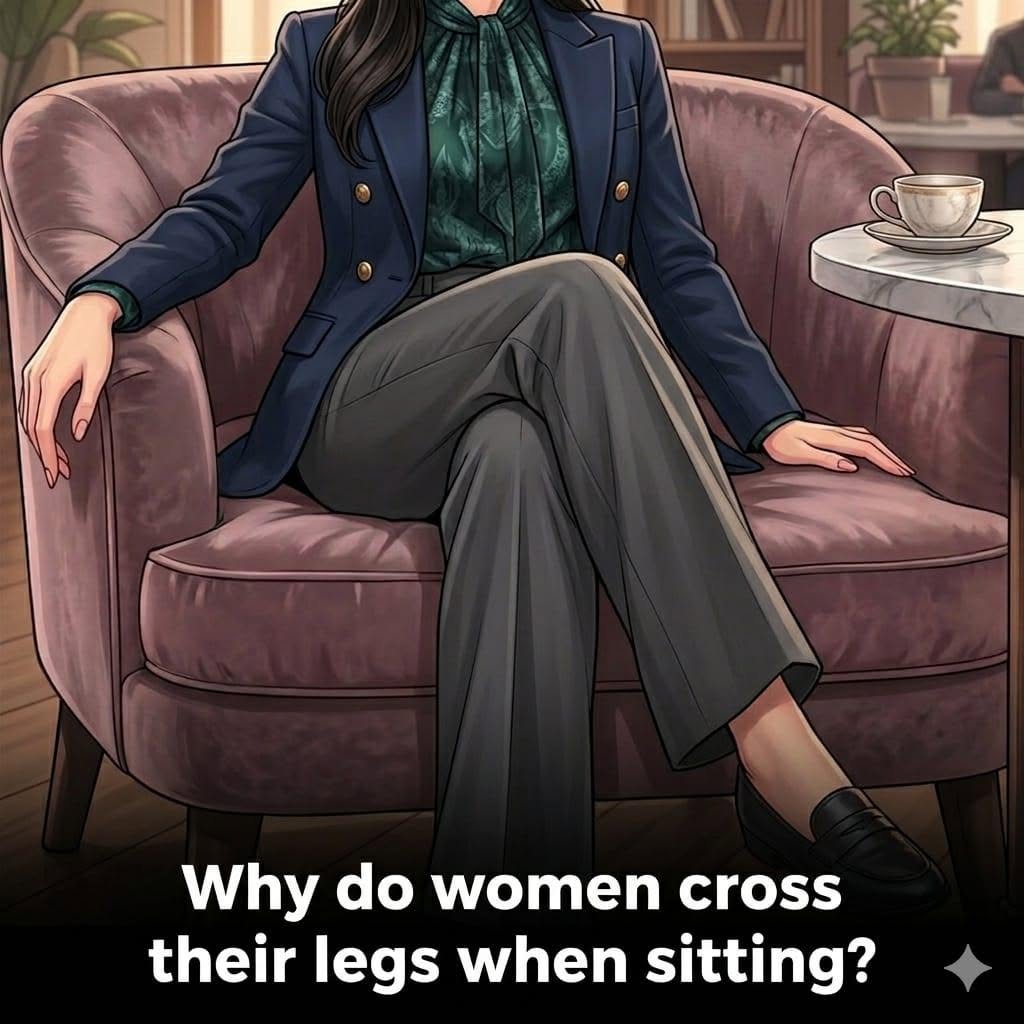
Wait a moment. If you’re sitting right now, chances are your legs are crossed, or your ankles are carefully touching. You probably didn’t consciously decide to do this. It’s an automatic, almost instinctive gesture. Yet, behind this seemingly innocuous posture lies a surprising story, a blend of ancient traditions, deeply ingrained habits, and signals our bodies sometimes try to send us.
A posture inherited from history… more than from comfort
For centuries, the way a woman sat was not just a matter of comfort, but a true social code. In the days before women’s trousers existed, long dresses imposed a certain restraint. Crossing the legs or bringing the ankles together allowed women to preserve their modesty while remaining “well-bred” in the eyes of society.
This posture also reflected a way of occupying space. Where a broad and assertive presence was valued in men, women learned, often unconsciously, to be discreet. Even today, in jeans or a suit, this reflex persists, like a silent echo of rules more than two centuries old.
Why does this seem so natural to many women?
Beyond education and social norms, there’s also the question of sensation. For some women, crossing their legs gives a feeling of stability, particularly in the pelvic area. This position can, in the moment, seem reassuring and comfortable, especially when sitting for long periods.
There is also an emotional dimension. Folding the limbs is often associated with a form of protection. Without even thinking about it, the body adopts a posture that provides a feeling of security, particularly in formal or stressful environments.
What the body can feel in the long term
While this position may feel comfortable at first, maintaining it for hours isn’t always ideal. Crossing your legs for extended periods can create subtle postural imbalances. One hip may end up slightly higher than the other, which can lead to lower back tension or discomfort on one side of the body.
Some women also notice tingling or numbness after sitting for a long time, a sign that their body would like to change position. These are not alarm signals, but rather invitations to move, stretch, or simply vary your posture.
The “queen” pose: simple and effective
Our grandmothers sometimes had very sensible sayings. “Put your feet firmly on the ground” wasn’t just a polite remark. Sitting with both feet flat, hip-width apart, allows for better weight distribution and promotes a more balanced posture.
This position also helps you stay more stable, gently engage your core muscles, and feel grounded. Today, we would simply call it ergonomics, but the idea remains the same: respecting the way the body is naturally designed.
How to change without rushing things
If you’ve always crossed your legs, there’s no need to force yourself to stop overnight. The most important thing is to alternate. You can, for example, cross your ankles instead of your knees, which reduces tension while maintaining an elegant posture.
Remember to listen to your body. If you feel the need to move, get up for a few minutes, stretch, change position. Sometimes, crossing your legs is simply a sign that the chair is too high. A small footrest can then make all the difference.
What if we reclaimed the way we sit?
Crossing your legs is neither a fault nor an obligation. It’s a habit, shaped by history, culture, and our personal feelings. But today, we have the freedom to choose what truly makes us feel good.
In a daily life where we spend so much time sitting, perhaps the simplest gesture — placing both feet on the ground and breathing deeply — is also a small act of daily well-being and of a self-respectful feminine sitting posture .