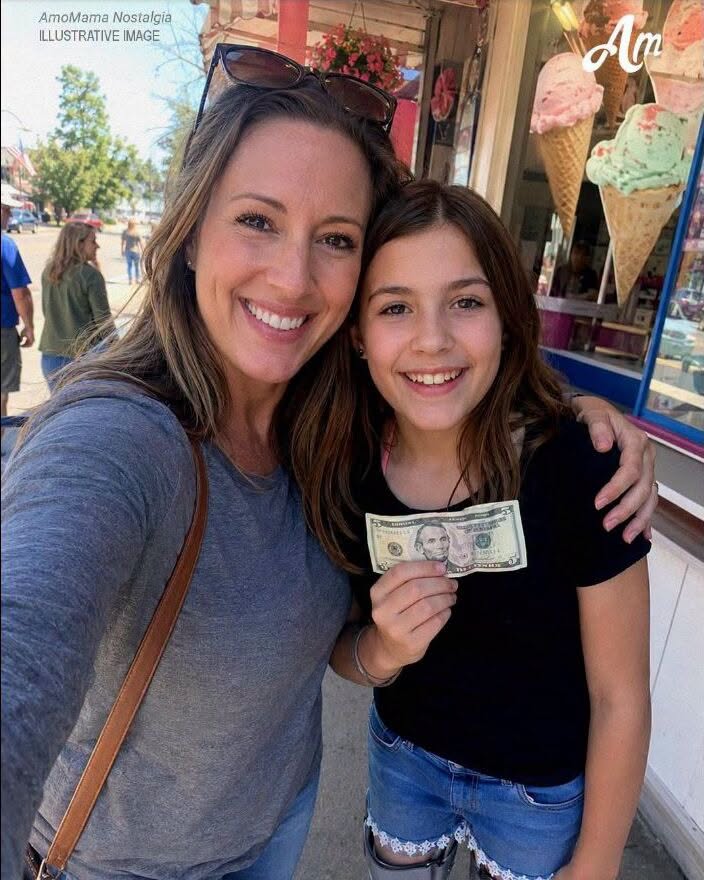
After six exhausting weeks of physical therapy, thirteen-year-old Lily wanted one simple reward: a mint-chip ice cream cone she could order by herself. She entered the shop proudly wearing the leg braces she called her “silver boots.” Minutes later, an older girl copied the way she walked and called her a robot while the girl’s mother watched without intervening.
Lily has cerebral palsy, and standing for long periods requires concentration and effort. Her therapist had suggested the ice cream outing because Lily had reached an important milestone. She rehearsed her order all morning and held a five-dollar bill tightly as we waited in line.
The first laugh came from behind us. A teenager named Sara stared at Lily’s braces, made a cruel remark, and exaggerated a stiff walk for her friend. Lily’s smile vanished.
I confronted her calmly. Sara denied doing anything, while her mother briefly looked up from her phone and told her to stop “messing around.” She treated the incident as a minor inconvenience instead of acknowledging what her daughter had done.
Lily whispered that she did not want everyone staring. I swallowed my anger and faced the counter again. This was supposed to be her achievement, not a public argument led by me.
The line moved forward. Lily unfolded her money and quietly practiced her order. Behind us, Sara complained about waiting and copied Lily’s walk again.
This time I warned her directly. Her mother became defensive and accused me of threatening her daughter. She insisted Sara had already been told to stop and said I was making the situation larger than necessary.
Lily asked me to let it go so she could order. When we finally reached the register, she opened her mouth—but Sara stepped forward once more, swung her legs stiffly, and loudly requested a “robot cone.”
The entire shop went silent.
Lily’s shoulders collapsed. The sentence she had practiced disappeared, and she asked me to order for her. Six weeks of hard work had been undone in seconds because one teenager wanted a laugh and one parent refused to provide a real consequence.
The cashier told Sara she would not be served after behaving that way. Her mother reacted with disbelief, demanding to know whether the shop was truly refusing her daughter ice cream.
I looked at her and said that Lily had spent six weeks learning to stand at that counter and speak for herself. Sara needed only thirty seconds—and her mother’s silence—to make Lily afraid to try.
For the first time, the woman looked at Lily’s face rather than her braces.
I told her, “Your daughter humiliated mine, and your silence taught her she was allowed to.”
A customer farther back assured Lily that nobody was in a hurry. Sara’s confidence faded when she realized the room was no longer amused. Her mother took her arm and headed toward the door.
Before they left, I said one final thing: “Don’t make this about the ice cream she missed. Make it about the girl she humiliated.”
The mother stopped, lowered her eyes, and walked out without another word.
I asked Lily whether she wanted to leave. She looked at the counter and shook her head. She was not trying to prove anything to Sara, she said. She had practiced for herself.
The cashier waited patiently. Lily tried again and ordered a small mint-chip cone with extra rainbow sprinkles. Her voice trembled, but everyone heard it.
Outside, while she ate, Lily admitted that students at school sometimes copied her walk and made noises in the hallway. She had not told me because she feared I would take control before asking what she wanted.
That was harder to hear than anything said in the shop.
I asked what she needed. Lily wanted the bullying documented and adults to watch the hallway, but she did not want a forced apology or to be treated as helpless. She wanted me beside her, not in front of her.
On Monday, we planned to approach the school together. Sara had tried to make Lily ashamed of her braces. Instead, the encounter helped my daughter finally explain what she had been carrying alone.
Her silver boots were still hers. Her voice was still hers too.

