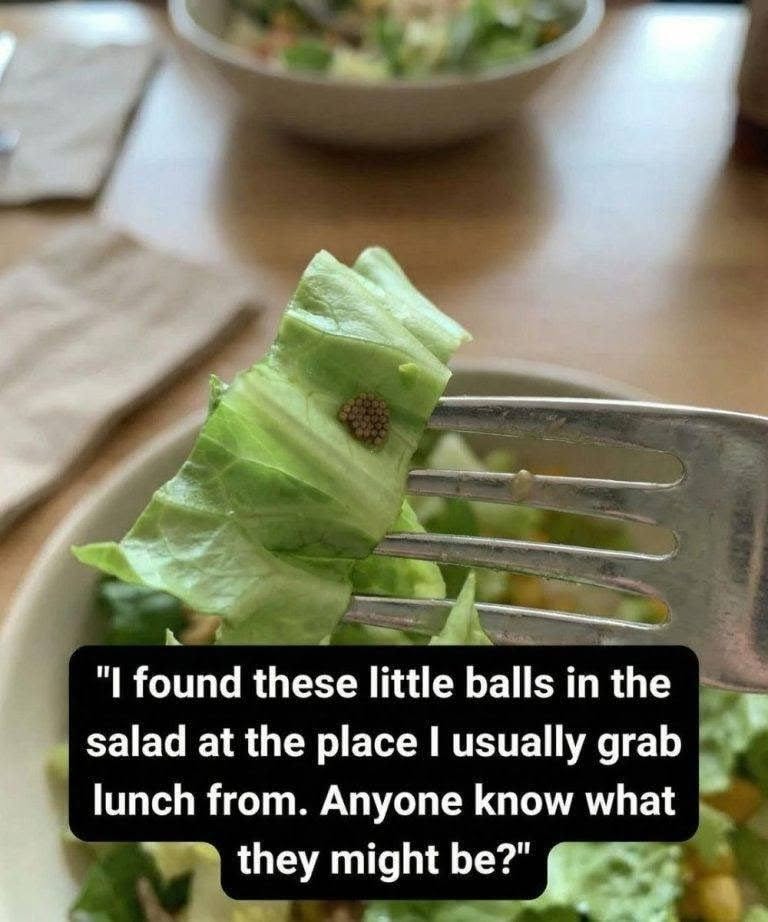
Have you ever been enjoying a fresh salad when you suddenly notice a cluster of tiny balls attached to a lettuce leaf? It is an unexpected discovery that can quickly make you lose your appetite. Many people immediately wonder whether they are insect eggs, plant seeds, or something that should never have been in their food.
The photograph shows a small cluster of rounded, brownish objects attached to a piece of lettuce. Although insect eggs are one possible explanation, the image alone is not sufficient to identify them with certainty. Understanding what these objects might be and how to respond can help you make safer decisions about your food.
What Are the Tiny Balls on the Lettuce?
One possibility is that the objects are insect eggs. Various insects lay eggs on the leaves of plants, including vegetables grown outdoors. Some species deposit their eggs in organized clusters, while others lay them individually.
Stink bugs, for example, can lay groups of eggs on plant surfaces. However, their eggs often have recognizable shapes and patterns, and the objects in this photograph cannot confidently be identified as stink bug eggs.
Other explanations are possible, too. The objects could be another form of biological material or foreign matter that became attached to the lettuce during growing, harvesting, processing, or storage.
Without a clearer close-up or examination of the actual sample, it would be misleading to claim that their identity is known.
How Can Insect Eggs End Up in Food?
Lettuce grows outdoors and can come into contact with insects and other organisms throughout its growing cycle.
Although commercial farms and food-processing facilities use procedures intended to reduce contamination, small foreign objects can occasionally escape detection. Lettuce leaves have folds, overlapping edges, and uneven surfaces that can make careful inspection more difficult.
This does not automatically mean that the farm, restaurant, or food supplier was negligent. It does mean that inspecting produce and following proper food-handling practices are important steps in reducing unwanted contaminants.
Are These Tiny Objects Dangerous to Eat?
The presence of suspected insect eggs does not automatically mean that food is poisonous. However, their safety cannot be established from a photograph, and the possibility of other contamination cannot be ruled out.
If you discover unfamiliar objects attached to lettuce, the safest approach is to stop eating the affected portion. Do not taste the objects or handle them unnecessarily in an attempt to identify them.
If the salad was purchased from a restaurant, supermarket, or food counter, take a photograph and notify the business. If it came in a package, keep the packaging and batch information when possible.
If you have already eaten some of the salad, do not panic. Finding a suspicious object does not mean you will necessarily become ill. Seek medical advice if you develop concerning symptoms after eating the food.
How to Wash Lettuce Properly at Home
Washing fresh vegetables can help remove dirt and some contaminants, although it cannot guarantee that every harmful microorganism or foreign object will be eliminated.
Follow these simple steps when preparing lettuce:
Inspect the leaves. Look for insects, unusual clusters, damaged areas, and foreign objects.
Remove damaged leaves. Discard leaves that are spoiled or visibly contaminated.
Separate the leaves. This makes it easier to inspect areas that might otherwise remain hidden.
Rinse under running water. Gently rub the leaves with clean hands while rinsing them.
Drain and dry carefully. Use a clean salad spinner or clean paper towels.
Keep prepared lettuce refrigerated. Follow the storage instructions on the package and avoid leaving cut vegetables at room temperature for extended periods.
Never use dish soap, bleach, or household cleaning products to wash lettuce. These substances are not intended for direct application to food.
What Should You Do If You Find Something Similar in a Restaurant Salad?
If you discover unusual objects in a salad served at a restaurant, stop eating it and inform the staff.Order Fresh Salads
Take a clear photograph that shows both the objects and the surrounding lettuce. If possible, keep the receipt and note when and where the food was purchased. These details may help the business investigate the issue.
Avoid making a definite identification based solely on appearance. A photograph can document what you found, but an accurate identification may require closer examination.
If several customers report similar findings or the business cannot adequately address a potential food-safety concern, consider contacting the relevant local food-safety authority.
How to Reduce the Risk of Contaminated Produce
A few everyday habits can make food preparation safer:Try New Foods
Buy fresh produce from reliable suppliers.
Check packaged vegetables for visible damage or foreign material.
Wash your hands before handling food.
Use clean knives, cutting boards, and preparation surfaces.
Keep raw vegetables separate from raw meat and other sources of cross-contamination.
Follow the storage instructions provided on packaged salads.
Prewashed lettuce labeled ready-to-eat should be handled according to its packaging instructions. Washing it again is not always necessary and can introduce contamination if the sink, hands, or utensils are not clean.
Frequently Asked Questions
Are the objects definitely insect eggs?
No. Insect eggs are one possibility, but the photograph does not provide enough information to confirm their identity.Get Fresh Dairy
Can washing lettuce remove insect eggs?
Rinsing and gently separating leaves may remove some foreign material, but washing cannot guarantee that every object or contaminant will be removed.
Should I throw away the entire salad?
If the objects are unexplained and the salad is already prepared, the safest choice is to stop eating it and contact the food provider. Do not assume that the remaining salad is safe simply because the visible objects have been removed.
Should I worry if I accidentally ate some?
Not necessarily. The discovery alone does not mean that illness will occur. Monitor how you feel and seek medical advice if concerning symptoms develop.
Final Thoughts
Discovering tiny balls on a lettuce leaf can be surprising, particularly when the salad comes from a restaurant or is sold as ready to eat. Insect eggs are a possible explanation, but it is important not to mistake a possibility for a confirmed identification.Get Produce Boxes
The sensible response is to stop eating the affected portion, document what you found, and inform the food provider. At home, careful inspection, proper washing, and good food-handling practices can help reduce the risk of unwanted contaminants.
Sometimes, an unusual discovery in everyday food is simply a reminder to pay attention to what we eat and to handle fresh produce carefully.