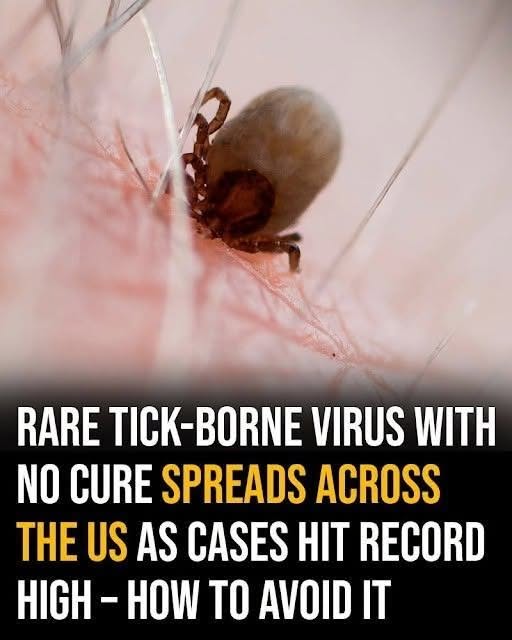
Health officials are raising concerns after a rare tick-borne virus reached its highest number of reported U.S. cases on record.
The Powassan virus, which has no specific treatment or cure, infected 76 Americans in 2025 – the highest annual total ever documented. By comparison, the disease has historically been extremely rare, averaging just seven reported cases per year, according to VT.
The virus was first identified in 1958 after a four-year-old boy developed unexplained symptoms.
According to Cleveland Clinic, the virus comes “from the bite of an infected Ixodes tick. Ixodes scapularis, commonly called blacklegged or deer ticks, are the most likely to spread it to people. Ixodes cookei (groundhog tick) and Ixodes marxi (squirrel tick) also carry Powassan virus, but they rarely bite people. Unlike some other tick-borne illnesses, a tick only needs to attach to you for a few minutes to infect you with Powassan virus.
Dr. Jorge Parada, medical advisor at the National Pest Management Association in Chicago, told Fox News, said: “Powassan can be transmitted in as little as 15 minutes after the infected tick bites, while Lyme disease usually requires a 36- to 48-hour attachment time for transmission.”
Although transmission can happen rapidly, symptoms may not appear for as long as four weeks after a tick bite.
According to the U.S. Centers for Disease Control and Prevention (CDC), “symptoms can include fever, headache, vomiting, and weakness.” It “can cause severe illness, including inflammation of the brain (encephalitis) or the membranes around the brain and spinal cord (meningitis). Symptoms of severe illness include confusion, loss of coordination, difficulty speaking, and seizures.””
There is currently no medication that specifically treats or cures Powassan virus.
What to do if you’re infected
The CDC says people with mild illness need “rest, fluids, and over-the-counter pain medications,” to help manage symptoms. More serious infections, however, may need hospitalization, “to receive support for breathing, staying hydrated, or reducing swelling in the brain.”
Dr. Michael Smith of WebMD also warned about the virus, saying: “This is a rare virus you catch from a tick bite, same way Lyme disease is spread.
“While only 60 people have gotten the Powassan virus in the past 10 years, it’s caused seven deaths. About half of survivors have permanent neurological symptoms like memory problems.”
“The disease is extremely rare”
Smith also emphasized that “there are no medicines to treat or cure this virus right now.”
Instead, he recommends focusing on prevention by avoiding tick bites. That includes using insect repellent, wearing long sleeves and pants outdoors, checking your body for ticks after spending time outside, and showering within two hours to help wash away any ticks that have not yet attached, as well as being aware of where they might be.
Even with the recent increase in reported cases, Smith urged people not to panic.
“Remember the disease is extremely rare, so no need to worry– just be aware.”
If You See Someone with a Three-Dot Tattoo, Run as Far as You Can
The warning spreads fast: “If you see a three-dot tattoo, run.” It sounds urgent, almost absolute, turning a tiny symbol into something dangerous. But what if that fear oversimplifies something far more human?
A small cluster of three dots can carry many meanings. It isn’t a single story—it’s a collection of personal ones, shaped by the person wearing it.
For some, it represents “mi vida loca,” or “my crazy life,” a phrase tied to surviving chaos and hardship. It can reflect resilience more than threat.
For others, the meaning is deeply personal. Three dots might stand for children, loved ones, or defining moments they want to carry with them forever.
Sometimes it’s about faith, balance, or life’s journey. Other times, it’s simply an aesthetic choice—something that felt right without needing explanation.
It’s true that in certain contexts, the symbol has been linked to gangs. But context matters, and not every person with this tattoo shares that connection.
Judging someone based on a single symbol removes their individuality. A tattoo doesn’t define actions, character, or intentions—people do.
When we replace curiosity with fear, we risk misunderstanding others. The real story is rarely visible at a glance.
Before assuming the worst, it’s worth remembering that symbols don’t carry meaning alone—people give them meaning through their lives and choices.
Where to Dispose of Dirty Mop Water: Toilet or Bathtub?
You’re standing there with a bucket of dirty mop water, facing a simple but oddly stressful choice: where do you dump it? Toilet or tub? What seems like a small decision can quickly turn into a question of hygiene, plumbing, and basic household rules.
Dirty mop water isn’t just water. It carries dust, hair, cleaning chemicals, and bacteria collected from your floors. Pouring it in the wrong place can create more problems than it solves.
In most cases, the toilet is the safest option. Toilets are designed to handle waste and move it efficiently into the sewer or septic system. They can handle small debris without clogging.
A bathtub, on the other hand, is more delicate. Its drain is narrower and more prone to blockages. More importantly, it’s where people bathe, meaning any leftover residue can affect hygiene.
If you pour mop water into the tub, you’ll need to clean and disinfect it afterward. Otherwise, you risk leaving behind a layer of unseen grime where someone will later stand barefoot.
The best option, if available, is a utility or laundry sink. These are designed for cleaning tasks and can handle dirty water without the same hygiene concerns.
No matter where you dump it, it’s smart to remove hair and debris first. This helps prevent clogs and keeps your plumbing system working properly.
At the end of the day, the rule is simple: utility sink first, toilet second, bathtub only if necessary—and never the kitchen sink. It’s not just about convenience, but keeping your home clean and functional.
The Mystery of Lobster’s Green Goodies
The first time you crack open a cooked lobster and notice a bright green substance inside, it can be surprising. Many people immediately wonder whether it’s safe to eat, a delicacy, or something that should be avoided altogether. That green material is called tomalley, and it serves as the lobster’s digestive gland, functioning much like a combination of a liver and pancreas. It helps the lobster digest food, store nutrients, and filter substances from its body.
Tomalley has long been considered a delicacy by some seafood enthusiasts. Its rich, creamy texture and intensely briny flavor make it a favorite ingredient for spreading on toast, stirring into seafood sauces, or enhancing lobster dishes. Many chefs appreciate its distinctive taste, while others prefer to leave it out, knowing that not everyone enjoys its strong flavor.
However, tomalley is also the part of the lobster where certain contaminants can accumulate. Because it filters and processes what the lobster consumes, it may contain higher concentrations of environmental pollutants, naturally occurring toxins, or harmful compounds produced during algae blooms. For this reason, several food safety agencies advise limiting or avoiding its consumption, especially during periods when shellfish advisories are in effect.
If you choose to eat tomalley, it’s best to ensure your lobster comes from reputable sources and waters that are regularly monitored for safety. Even then, moderation is generally recommended. Many people simply remove the green substance and enjoy the sweet, tender lobster meat instead.
Ultimately, there is no single right answer. Some diners consider tomalley one of the best parts of the lobster, while others prefer not to eat it at all. The decision comes down to personal preference and comfort level. Understanding what tomalley is, how it functions, and why experts sometimes recommend caution allows you to make an informed choice. After all, the true enjoyment of seafood comes not just from its flavor, but from knowing exactly what’s on your plate and deciding what’s right for you.
Elvis Presley hid a heartbreaking secret while filming Blue Hawaii and secret behind the scenes footage reveals the tragic truth about his final paradise vacation
Released in 1961, Blue Hawaii became one of Elvis Presley’s biggest film successes and helped define the formula for many of his later Hollywood movies. Combining tropical scenery, romance, comedy, and memorable music, the film showcased Elvis at his most charismatic. Although critics didn’t consider it his finest acting performance, audiences embraced its lighthearted charm, making it a major box-office hit.
In the film, Elvis plays Chad Gates, a soldier returning home to Hawaii after military service. Unlike many musical films, Chad isn’t a professional singer, yet he frequently breaks into song throughout the story. Rather than questioning the realism, fans loved the spontaneous performances, which became one of the movie’s most recognizable features.
The soundtrack proved just as successful as the film itself. It included “Can’t Help Falling in Love,” one of Elvis’s most beloved songs, which became a worldwide classic and remains closely associated with his legacy decades later.
Despite its popularity, eagle-eyed viewers have spotted several amusing continuity mistakes. During certain driving scenes, characters suddenly switch positions between camera cuts, and Elvis’s ukulele playing doesn’t always match the music being heard. Another fun detail occurs during the airport arrival scene, where the screams of real Elvis fans who had gathered during filming can actually be heard in the final audio.
Behind the scenes, Joan Blackman replaced Juliet Prowse as Elvis’s leading lady after contract negotiations fell through. Blackman later recalled sharing a genuine connection with Elvis, though she preferred building her career independently. While audiences saw a carefree paradise on screen, Elvis privately wished for more serious acting roles and often felt frustrated by being typecast in musical comedies.
Even so, he kept the cast entertained with practical jokes and purchased the bright red MGA sports car featured in the film, which remains at Graceland today.
Filmed at several beautiful Hawaiian locations, Blue Hawaii strengthened Elvis’s lifelong connection to the islands. More than sixty years later, the movie remains a beloved classic, remembered for its unforgettable music, stunning scenery, and timeless glimpse of the King of Rock ‘n’ Roll at the height of his fame.