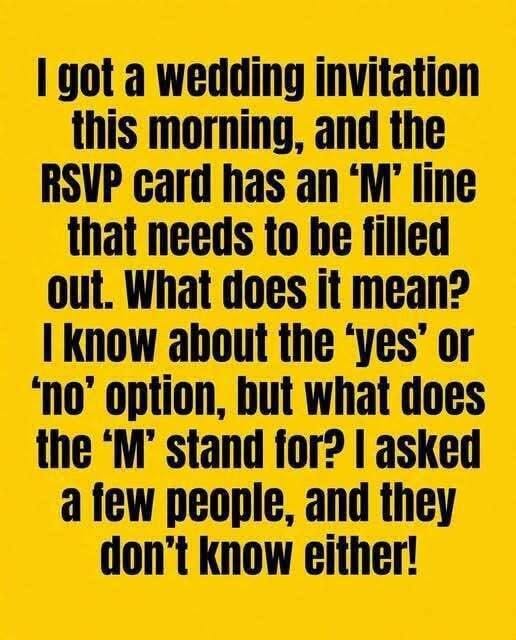
If you have ever received a wedding invitation with an RSVP card, you may have noticed a small letter that seems strangely out of place:
M __________________
At first glance, it can be confusing. Is the “M” asking for your first name? Does it stand for “meal”? Is it asking whether you are married? Or perhaps it simply means that your name should begin with the letter M?
Fortunately, the answer is much simpler.
The “M” is traditionally the beginning of a courtesy title, such as Mr., Mrs., Ms., or Miss. It is an old-fashioned piece of wedding stationery etiquette that has survived on some modern RSVP cards.
What Are You Supposed to Write After the “M”?
The printed “M” is meant to be completed with the rest of your title and then your name.
For example, a guest named John Smith might write:
Mr. John Smith
A guest named Sarah Johnson might write:
Ms. Sarah Johnson
Someone who uses Mrs. could write:
Mrs. Emily Brown
Traditionally, the guest simply completed the printed “M” and then added their name.
The purpose was to provide the couple with the guest’s name in a formal format.
Why Is There an “M” Instead of a Simple “Name” Line?
Modern forms usually make things much easier. They might simply say:
Name: __________________
So why would a wedding invitation use only the letter “M”?
The explanation comes from older formal invitation customs. Wedding stationery was traditionally much more formal, and courtesy titles were commonly used when addressing guests.
Because Mr., Mrs., Ms., and Miss all begin with “M,” stationery designers could print the first letter and leave guests to complete the title themselves.
At the time, people familiar with formal invitation etiquette generally understood what the line meant.
Today, however, many people have never encountered the tradition before. That is why the little “M” can look like a mysterious question on an otherwise straightforward RSVP card.
Does the “M” Mean “Meal”?
No.
This is one of the common misunderstandings surrounding the RSVP card.
If the couple wants guests to choose a meal, that information will normally appear in a separate section. For example, the card might ask guests to select chicken, beef, vegetarian, or another option.
The “M” line is connected to the guest’s name, not the menu.
Does It Ask Whether You Are Married?
No.
Although the traditional titles include Mrs. and Miss, the “M” itself is not asking about your marital status.
It simply provides the beginning of a title.
Modern guests may use Ms., which does not indicate whether someone is married. Some people may use another title altogether, while others may prefer not to use a title.
The important thing is that the hosts can clearly identify who is responding.
What If You Don’t Use Mr., Mrs., Ms., or Miss?
Modern invitation etiquette is more flexible than the traditional format suggests.
Not everyone uses one of the conventional M titles. Some people use titles such as Dr., Professor, or Mx., while others prefer no title at all.
If the printed “M” does not fit the way you normally identify yourself, you can generally write your preferred title and name clearly on the line rather than forcing yourself into a title you do not use.
The purpose of the line is ultimately to identify the person responding—not to create a complicated etiquette test.
What About Couples?
If the RSVP is for more than one invited person, the names of the people actually invited should be clearly provided.
For example:
Mr. and Mrs. John Smith
Or:
Ms. Sarah Johnson and Mr. David Brown
The exact wording depends on the people involved and the style of the invitation.
If the invitation specifically names one guest and does not include a plus-one, you should not automatically add another person’s name simply because there is space on the RSVP card.
The RSVP is meant to confirm the attendance of the people who were invited.
Why Does This Old Tradition Still Exist?
Wedding invitations have preserved many formal customs even though everyday communication has changed dramatically.
People now commonly RSVP through wedding websites, online forms, email, text messages, or QR codes. Yet some couples continue to choose traditional printed invitations because they like the classic appearance and formality.
The “M” is one of those small details that has survived from an older style of correspondence.
For someone familiar with the tradition, it may seem perfectly normal. For someone seeing it for the first time, however, it can look completely mysterious.
What Does RSVP Actually Mean?
There is another small detail on the card that is worth understanding.
RSVP comes from the French expression “Répondez, s’il vous plaît,” meaning “Please respond.”
When an invitation asks you to RSVP by a particular date, the hosts are asking you to tell them whether you will attend.
Your response helps the couple organize important details such as:
The number of guests
Seating arrangements
Catering
Meal selections
Tables and venue space
Other wedding preparations
That is why responding on time is important.
The Simple Answer
So, the next time you see:
M __________________
on a wedding RSVP card, there is no secret code to solve.
The “M” traditionally represents the beginning of a courtesy title, such as Mr., Mrs., Ms., or Miss. You complete the title and provide your name so the hosts know exactly who is responding.
It has nothing to do with your meal, the number of guests, or whether you are married.
It is simply a small reminder of an older tradition in formal wedding stationery.
And while many modern couples have replaced the traditional “M” with a straightforward “Name” line, the little letter continues to appear on invitations around the world.
Once you know what it means, that mysterious “M” suddenly becomes much less mysterious.