Chapter 1: The Gang Markings
My eight-year-old son was suspended from school for looking like a gang member.
That’s what his principal called him.
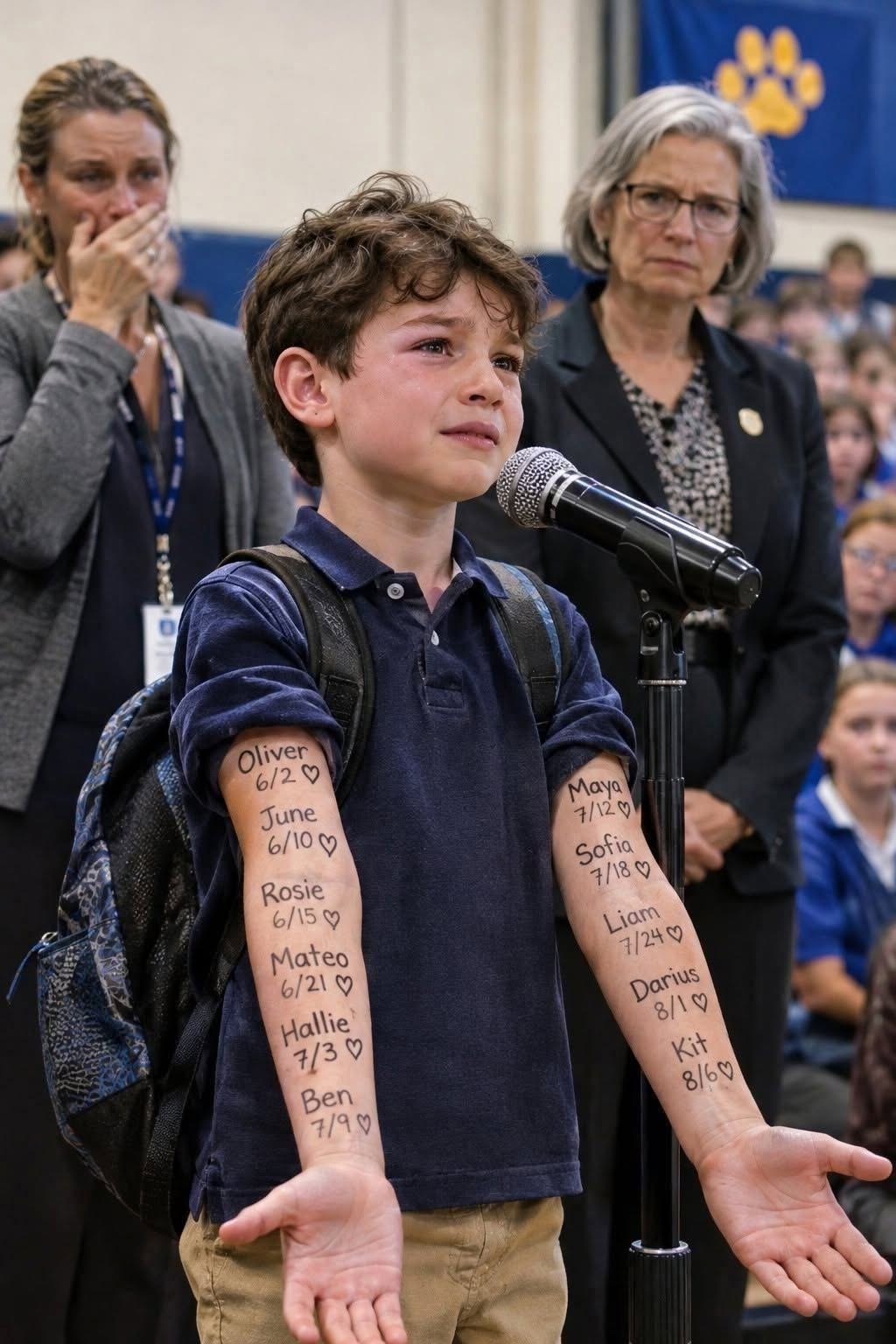
Eleven names were written across Ethan’s arms, hands, and neck in black marker. Beside each name was a date and a tiny crooked heart.
“We have a zero-tolerance policy for gang-related markings,” Principal Harris told me.
“He’s eight,” I said. “He doesn’t even know what a gang marking is.”
“Then perhaps you can explain why he refused to remove them.”
I turned toward my son.
Ethan sat in the plastic chair beside me, his sleeves pulled over his hands.
“Sweetheart, why won’t you wash them off?”
His bottom lip trembled.
“Because I promised Caleb.”
Caleb is my twelve-year-old son.
He has leukemia.
And he’d spent the last three weeks at St. Mary’s Children’s Hospital.
I thought Ethan had made a terrible decision.
I had no idea how wrong I was.
The school had called me at 9:40 that Monday morning.
I was standing in the hospital cafeteria, trying to decide whether a stale blueberry muffin counted as breakfast, when the secretary told me Ethan needed to be picked up immediately.
“Is he hurt?”
“No, Mrs. Parker. It’s a disciplinary matter.”
I almost laughed.
Ethan had once apologized to a mailbox after accidentally kicking it.
He wasn’t exactly a troublemaker.
When I arrived, I found him sitting outside the principal’s office with his backpack between his shoes.
His usually messy brown hair was still damp from his morning shower.
But his arms looked like someone had used them for a coloring book.
Black letters stretched from his wrists to his elbows. More writing peeked out beneath his T-shirt collar.
Names.
Dates.
Little hearts.
I recognized Ethan’s handwriting immediately. He still made his lowercase a’s too large and sometimes wrote his e’s backward.
Principal Harris invited us inside.
She was a woman in her late fifties who wore neat gray suits and spoke as though every sentence belonged in a school handbook.
“Ethan arrived this morning displaying what appeared to be gang-related symbols,” she explained. “His teacher asked him to remove them. He refused.”
“They’re names,” I said.
“We don’t know what the names represent.”
“Did anyone ask him?”
“Of course.”
I looked at Ethan.
“What did you tell them?”
“They’re my friends.”
Principal Harris folded her hands.
“Unfortunately, he wouldn’t provide any additional explanation.”
“Because you told me to stop talking,” Ethan whispered.
The principal’s expression tightened.
“Your teacher asked you to stop arguing.”
“I wasn’t arguing.”
“Ethan,” I said quietly.
He lowered his eyes.
I was tired enough to feel angry at everyone in that room, including my own child.
For three weeks, I’d been sleeping in hospital chairs, washing clothes between appointments, and trying to remember which bills were due.
My mother had taken Ethan to school that morning because I’d left the house before sunrise to be with Caleb.
I hadn’t noticed the marker.
I hadn’t even seen my younger son before school.
Now I was sitting in a principal’s office discussing gangs.
Principal Harris pushed a form toward me.
“Given his refusal to follow staff instructions, this will be recorded as a one-day out-of-school suspension. He may return tomorrow.”
I stared at the paper.
“You’re suspending him for writing names on himself?”
“For refusing a reasonable instruction and displaying markings that raised a safety concern.”
“He’s never been disciplined before.”
“We apply our expectations consistently.”
Ethan looked at me.
“Mom, am I a bad kid?”
Something inside me cracked.
“No, baby.”
“But she said—”
“You’re not a bad kid.”
I signed the form because I wanted to get him out of there.
Outside, Ethan climbed into the passenger seat and buckled himself in.
Neither of us spoke until we reached the second traffic light.
Then I said, “Ethan, I need you to tell me what happened.”
“I already did.”
“Why did you draw all over yourself?”
He rubbed his sleeve between his fingers.
“I wanted people to see.”
“See what?”
“The names.”
“You could’ve written them on paper.”
“Paper stays in my backpack.”
I sighed.
“That doesn’t explain why you couldn’t wash them off when your teacher asked.”
He turned toward the window.
“Because then Caleb wouldn’t get to see.”
I loosened my grip on the steering wheel.
“Caleb knows about this?”
Ethan nodded.
“Can we please go to the hospital first?”
“Ethan—”
“Please, Mom. I promised him I wouldn’t erase anybody.”
I looked at the writing on his small hands.
There were eleven names.
Eleven dates.
And beneath one name, he’d drawn a heart so carefully that he’d gone over its outline three times.
“Who are these people?” I asked.
Ethan pressed his lips together.
Then he said something that made my anger disappear.
“They’re the people Caleb doesn’t want to lose.”
And suddenly, getting him to wash his arms didn’t seem nearly as important as finding out why.
Chapter 2: Eleven Names
The first thing Caleb said when he saw his brother was, “You did it.”
Ethan practically ran to his bed.
“Every single one!”
“Did you spell Mateo right?”
“Yes!”
“What about Hallie?”
“Two L’s. I checked.”
Caleb laughed.
It was the first real laugh I’d heard from him in days.
I’d almost forgotten what it sounded like.
My older son was pale and thinner than he’d been a month earlier. His hair had begun falling out again, so he’d asked me to shave the rest.
He was wearing the blue knit cap my mother had made him.
That morning, he’d been too tired to finish half a pancake.
But now he was sitting upright, studying his little brother’s arms as though Ethan had brought him the best present in the world.
“Look at Oliver,” Ethan said.
He pushed back his sleeve.
“I made his heart bigger.”
“Oliver would like that.”
“Because he’s the funniest?”
“Because he thinks everything should be bigger.”
They both started laughing.
I stood beside the bed, completely lost.
“Ethan,” I said. “Can somebody please explain what’s going on?”
Caleb looked up.
“Mom, didn’t he tell you?”
“Your brother just got suspended from school.”
Caleb’s smile vanished.
“What?”
“For these markings.”
I watched him look from Ethan’s arms to my face.
Then back again.
“He got in trouble for the names?”
Ethan shrugged.
“They thought it was gang stuff.”
Caleb stared at him.
“Are you serious?”
“That’s what she said.”
For a moment, Caleb looked angrier than I’d seen him since his diagnosis.
Then he reached toward the little spiral notebook on his bedside table.
“Mom. Look.”
The cover was covered in stickers.
Inside were pages of drawings, unfinished crossword puzzles, and terrible jokes Caleb had written when he couldn’t sleep.
He flipped to a page near the middle.
Eleven names had been written in blue pen.
Oliver.
June.
Rosie.
Mateo.
Hallie.
Ben.
Maya.
Sofia.
Liam.
Darius.
Kit.
Ana.
Beside each name was a date.
They matched the ones on Ethan’s arms.
“These are kids I’ve met here,” Caleb explained.
“All of them?”
He nodded.
“Some were in the activity room. Some I met when we were waiting for appointments. Oliver used to come by my door when he was allowed to walk around.”
“Oliver’s the one who makes up dinosaur jokes,” Ethan added.
Caleb grinned.
“They’re really bad.”
“They’re awesome.”
I pulled a chair closer.
“And the dates?”
“The days we met,” Caleb said.
Ethan pointed to the notebook.
“Caleb started writing them down after Rosie left.”
I looked at him.
“What happened to Rosie?”
“She went home.”
My shoulders relaxed.
Caleb noticed.
“Mom, not everything bad happens here.”
I blinked.
He wasn’t being cruel.
He was reminding me that I’d started treating every piece of hospital news as a possible disaster.
“You’re right,” I said softly.
Caleb turned the notebook around.
“Rosie was supposed to say goodbye before she left, but her parents came early. One day she was here, and the next day her room was empty.”
He traced her name with one finger.
“I couldn’t remember the exact day we’d met. So I started writing everything down.”
“Everything?”
“Just the people.”
Ethan leaned forward.
“Some of the kids don’t get visitors every day. And some go home before we get to say bye.”
Caleb nodded.
“It’s weird. You see somebody in the hallway almost every day, then suddenly they’re not there anymore.”
I watched him turn another page.
There were sketches beside several names.
A dinosaur wearing sunglasses.
A basketball with legs.
A tiny cat labeled The Boss.
“That’s June’s cat,” Caleb said. “She showed me pictures.”
“And I drew the hearts,” Ethan announced.
“I noticed.”
“Because everybody gets one.”
Caleb looked down at his brother’s arms.
“Ethan wanted to take the names to school.”
I swallowed.
“Why?”
Caleb hesitated.
“Because I said I was scared I’d forget people.”
Ethan shook his head.
“That’s not exactly what you said.”
Caleb gave him a warning look.
“Ethan.”
“You said you were scared everybody would forget them.”
Silence.
Caleb looked away.
I waited.
Finally, he said, “It’s just that everybody has their own stuff going on.”
His voice was small.
“People go home. They go back to school. Things change. And you don’t always know if you’ll see somebody again.”
Ethan took his brother’s hand.
“So I told him I could remember them too.”
My throat tightened.
I had spent three weeks worrying about medication, blood counts, insurance paperwork, and how much weight Caleb had lost.
I had never once asked him whether he was afraid of being forgotten.
“Sweetheart,” I whispered, “you could have told me.”
Caleb shrugged.
“You were busy.”
Those three words hurt more than anything Principal Harris had said.
Ethan carefully counted the names on his left arm.
Then his right.
“Eleven,” he said proudly.
Caleb counted them too.
His expression changed.
“Ethan?”
“Yeah?”
“What about the twelfth name?”
Ethan immediately pulled his sleeves down.
My eyes moved between them.
“What twelfth name?”
Neither boy answered.
Then Caleb said quietly, “You promised me you wouldn’t write that one.”
And Ethan whispered, “I didn’t. Not yet.”
Chapter 3: The Name He Left Off
I didn’t ask about the twelfth name again until Ethan went downstairs to get a snack.
Caleb had asked for apple slices, and Ethan had insisted on choosing the ones without brown spots.
I stayed beside the bed.
“Caleb, who’s missing from the list?”
He stared at his blanket.
“Nobody.”
“Your brother said there’s another name.”
“He’s eight. He talks a lot.”
“Caleb.”
He looked at me.
For a moment, I saw the little boy who used to crawl into my bed during thunderstorms.
Then he looked away again.
“It’s not a big deal.”
I wanted to push.
Instead, I picked up the spiral notebook and set it beside him.
“Can I look at the rest?”
He hesitated, then nodded.
A few pages later, I found another list.
This one had names I recognized.
Marcus.
Tyler.
Josh.
Emma.
Kids from Caleb’s middle school.
His friends.
Next to several names were dates.
Under Marcus, he’d written:
Last text: 19 days ago.
Under Tyler:
Asked if I was coming back for basketball.
Under Josh:
Sent a meme. Didn’t answer after that.
I felt my stomach sink.
“Caleb,” I said. “Why are you keeping track of when your friends text?”
He reached for the notebook.
I let him take it.
“I don’t know.”
“Are you upset with them?”
“No.”
“Then what is it?”
He stared at the page.
“At first, everybody texted me.”
His voice was matter-of-fact.
“Like, a lot. People from school. Some teachers. Everybody wanted to know how I was doing.”
I nodded.
“I remember.”
“Then after a week, it slowed down.”
“Maybe they don’t want to bother you.”
“That’s what I figured.”
He rubbed the notebook’s bent corner.
“But I don’t know what they think I’m doing here.”
“Getting better.”
He gave me a tired look.
“Mom.”
I stopped.
“Sorry.”
“I’m here all day. I miss stuff. Marcus probably has another best friend now. Everybody’s playing basketball without me.”
“Caleb, being sick doesn’t make you less important to your friends.”
“I know.”
But he didn’t sound as though he believed it.
He leaned against his pillow.
“Sometimes I think I’m going to come back, and everybody will have gotten used to me not being there.”
I opened my mouth.
Nothing came out.
He continued.
“And when people do talk to me, they only ask how I feel. Or what the doctors said. Or whether I’m getting better.”
“Because they care.”
“I know that too.”
He sounded frustrated now.
“But I used to do other stuff.”
He looked toward the window.
“I used to be funny.”
I reached for his hand.
“You’re still funny.”
“Then why does nobody send me funny things anymore?”
I couldn’t answer that.
Not honestly.
Ethan returned with apple slices in a paper cup and half a packet of crackers he’d already eaten.
Caleb immediately stole one.
“Hey!”
“Hospital tax.”
“That’s not a real thing.”
“Prove it.”
Ethan laughed.
There he was.
My older son.
The kid who used to invent ridiculous rules for board games and convince his little brother they were official.
For a few minutes, the hospital room felt almost normal.
Then a nurse came in to check Caleb’s temperature, and the moment passed.
I watched him hold out his arm without being asked.
He knew the routine better than any twelve-year-old should.
When the nurse left, Ethan climbed onto the visitor chair and put his head near Caleb’s pillow.
“Are you still gonna tell Mom about the other name?”
Caleb shook his head.
“No.”
Ethan frowned.
“But what if—”
“Just don’t.”
The edge in Caleb’s voice surprised us both.
Ethan sat back.
“Okay.”
I knew something had been decided between them long before that morning.
But I also knew Caleb needed to feel he had some control over what happened in his life.
So I didn’t press.
At four, my mother arrived to stay with Caleb while I took Ethan home.
He stopped at the door.
“Caleb?”
“Yeah?”
“Do you still want me to do the other thing?”
Caleb glanced at me.
Then at his brother.
“Only if Mom says it’s okay.”
I looked at Ethan.
“What other thing?”
He took a breath.
“I was supposed to tell people about the names.”
“At school?”
He nodded.
“I was gonna ask if anybody wanted to know who they were.”
“Why didn’t you just tell your teacher?”
“I tried.”
“What happened?”
“She said I was making excuses.”
I went still.
Ethan twisted the strap of his backpack.
“And when I said Caleb helped me, she told me family problems weren’t an excuse for breaking school rules.”
I closed my eyes.
My son had spent his morning trying to explain something deeply important to him.
And the adults had decided what his answer meant before he finished giving it.
“Mom?”
I opened my eyes.
“Yeah, baby?”
“Can I go back tomorrow?”
“Of course.”
He swallowed.
“Even if everybody thinks I’m bad?”
I crouched in front of him.
“Ethan, what happened today wasn’t fair.”
“But they all heard.”
That was the part I hadn’t considered.
He wasn’t just worried about his suspension.
He was worried about what the other children had been told.
And I suddenly realized that removing one disciplinary mark from his record wasn’t going to fix that.
Chapter 4: The School Already Knew
By the time I got home, three parents had messaged me.
The first was from a mother whose daughter sat beside Ethan in math.
Hey, Sarah. Is everything okay with Ethan? My daughter said he got sent to the office because he had gang symbols on his arms.
The second message was less kind.
I heard there was an incident in third grade. Is there anything the rest of us should be worried about?
I read that one twice.
Then I looked toward the kitchen.
Ethan was standing at the sink, running water over his hands.
Black ink curled toward the drain.
My heart dropped.
“Ethan?”
He shut off the faucet.
He had washed the name from his left palm.
Not all of it.
The first two letters were still visible.
“Why are you doing that?”
He wouldn’t look at me.
“Because I don’t want the kids to be scared of me.”
I crossed the kitchen and turned off the dripping tap.
“Look at me.”
He raised his head.
“I know you didn’t mean to do anything wrong.”
“But they think I did.”
I dried his hands with a dish towel.
“That’s something the grown-ups need to fix.”
He glanced at the sink.
“Do you think Caleb will be mad that I erased one?”
I had to wait a moment before answering.
“No, sweetheart. Caleb loves you. He isn’t going to be mad.”
Ethan nodded, but he still looked ashamed.
I walked into the hallway and called the school.
Principal Harris agreed to see me at two-thirty.
I brought the suspension form, a photograph of Caleb’s notebook, and the messages I’d received.
I left Ethan with my mother, who had come home from the hospital when I explained what happened.
This time, I wasn’t sitting in the principal’s office alone.
Mrs. Dalton, Ethan’s teacher, was there.
So was Ms. Rivera, the school counselor.
I placed my phone on the desk.
“Before we talk about the suspension, I want you to read these.”
Principal Harris studied the messages.
Her mouth tightened.
“I’m sorry other parents are discussing your son.”
“They’re discussing him because children heard him being described as dangerous.”
Mrs. Dalton looked uncomfortable.
“I didn’t use that word.”
“Did you say the markings looked like gang symbols?”
She hesitated.
“Yes.”
“In front of his classmates?”
“I pulled him aside.”
“How far aside?”
She looked down.
“Near the classroom door.”
“Where other children could hear.”
“I suppose so.”
I felt the anger rise again.
Ms. Rivera spoke gently.
“Mrs. Parker, can you tell us what the writing actually represents?”
So I did.
I told them about Caleb’s leukemia.
About the second round of chemotherapy.
About the eleven children he’d met during treatment.
About the notebook.
About Ethan practicing the spelling because he wanted to get every name right.
Mrs. Dalton pressed a hand against her mouth.
“Oh, my goodness.”
Principal Harris stared at the photograph.
“Those dates are the days your son met these children?”
“Yes.”
“Not birthdays?”
“No.”
“And Ethan did this because his brother asked him to?”
“Because he loves his brother.”
No one spoke for several seconds.
Then Mrs. Dalton said, “He told me they were his friends.”
I turned toward her.
“Yes.”
“He said they were people he didn’t want to forget.”
“Yes.”
Her eyes filled.
“I thought he was trying to avoid the conversation.”
I leaned forward.
“He was trying to have the conversation.”
Mrs. Dalton lowered her head.
“You’re right.”
Principal Harris cleared her throat.
“Mrs. Parker, with this additional information, I believe the suspension can be removed.”
“Good.”
“And we’ll address the misunderstanding with his teacher.”
“That’s not enough.”
Her eyebrows rose.
“What would you like us to do?”
I showed her the second parent’s message.
“Someone is asking whether the other children are safe around my eight-year-old.”
“The school cannot control everything parents say.”
“No. But the school can correct what it started.”
Principal Harris set the phone down.
“We certainly don’t want Ethan to feel stigmatized.”
“He already does.”
My voice shook.
“He was washing those names off in my kitchen because he thought his classmates were afraid of him.”
Mrs. Dalton began to cry.
I wasn’t trying to make her cry.