By the time most people are pouring their first cup of coffee, my day is already halfway gone.
That morning was no different. I had burned toast—again—signed permission slips I didn’t remember receiving, and somehow found Sophie’s missing shoe in the freezer. Jason and Evan were arguing about whether a spoon counted as a weapon, and Katie was yelling about her hair like it was a national emergency.
This is my life now. Loud, chaotic, exhausting—and the only thing that’s ever felt right.
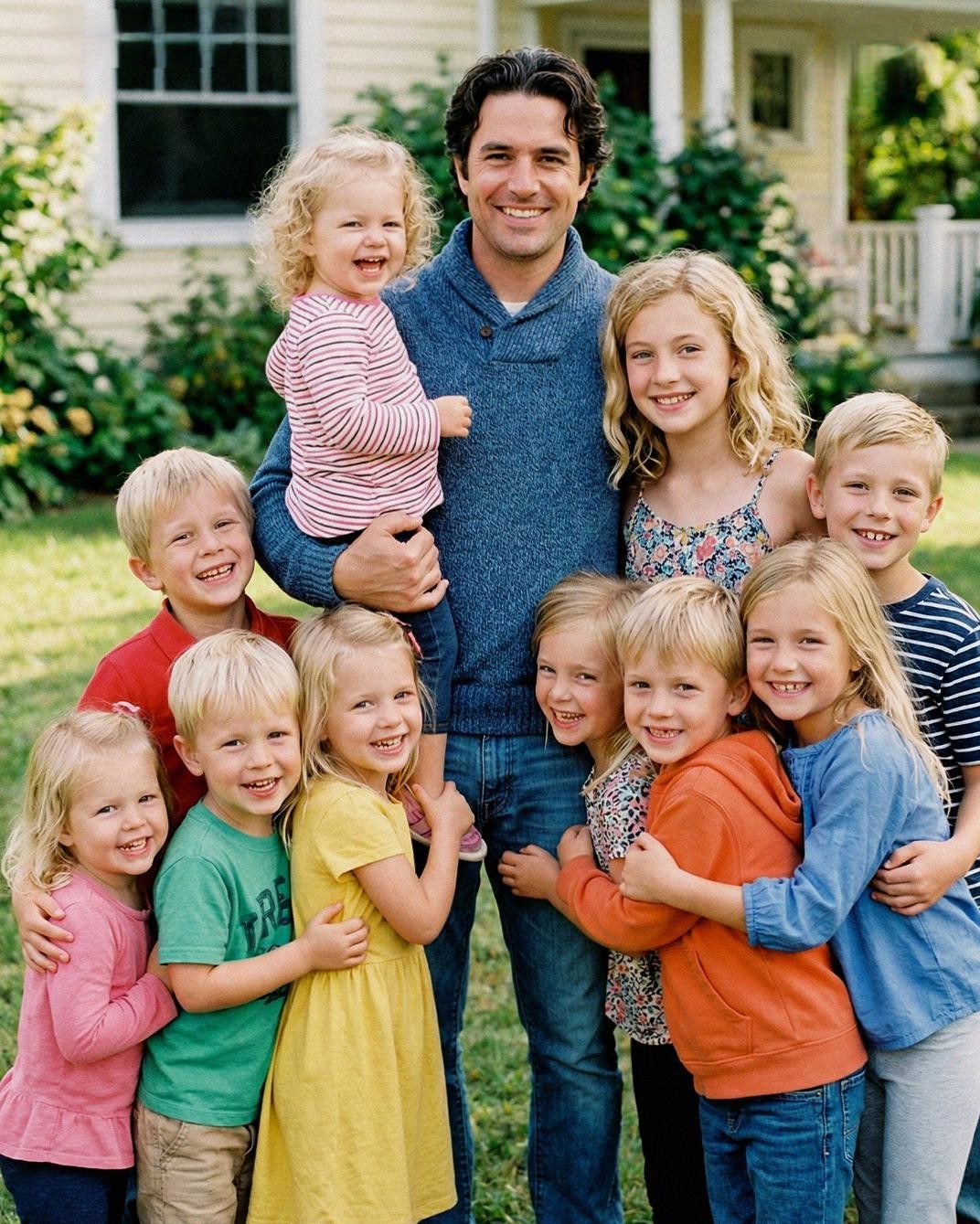
I’m forty-four, and for the past seven years, I’ve been raising ten kids who don’t share my blood but somehow became my entire world.
It wasn’t supposed to happen like this.
Calla was supposed to be my wife.
Seven years ago, she was the center of everything. She had this way of holding the house together—calm where I was scattered, steady where I was overwhelmed. She could quiet a crying toddler with a song and end a fight between teenagers with just a look. She made it all seem manageable.
Then one night, she disappeared.
They found her car by the river. Driver’s door open. Purse still inside. Her coat folded neatly on the railing above the water, like she had taken it off on purpose.
Mara, the oldest, had been eleven. They found her hours later, barefoot on the side of the road, shaking so badly she could barely stand.
She didn’t speak for weeks.
When she finally did, she said the same thing every time.
“I don’t remember, Dad.”
The police searched for ten days. They dragged the river, questioned neighbors, followed every lead they could find.
Nothing.
We buried Calla without a body.
And just like that, I was left standing in the middle of a broken house with ten kids who needed someone to stay.
People told me I was out of my mind for taking them on. My own brother said loving them was one thing—but raising ten kids alone? That was something else entirely.
Maybe he was right.
But walking away wasn’t an option.
So I learned everything. How to braid hair. How to cut it. How to manage ten different schedules, ten different personalities, ten different ways of falling apart. I learned which kid needed quiet when they cried and which one needed to be held tight until the storm passed. I learned how to survive on very little sleep and even less certainty.
I didn’t replace Calla.
I just stayed.
Years passed like that—messy, loud, imperfect, but ours. The grief never fully left, but it softened around the edges. We built something new out of what was left behind.
Or at least, I thought we had.
That morning, Mara stopped me while I was packing lunches.
“Dad, can we talk tonight?”
There was something in her voice—too steady, too careful.
“Of course,” I said. “Everything okay?”
She held my gaze a second longer than usual. “Tonight,” she repeated.
And then she walked away.
The feeling stayed with me all day. Not panic, not fear—just something heavy sitting under my ribs, waiting.
That night, after the house finally quieted down, she found me.
“Can I borrow Dad for a minute?” she asked from the doorway.
I finished tucking in the younger ones and met her in the laundry room. She was sitting on the dryer, like she needed something solid beneath her just to stay upright.
“Okay,” I said. “What’s going on?”
She looked at me, and I saw it immediately—that same strength she used when she was trying not to fall apart.
“This is about Mom.”
My chest tightened. “What about her?”
She took a slow breath. “Not everything I said back then was true.”
Something in the air shifted.
“What do you mean?”
Her fingers twisted in her sleeve. “I didn’t forget, Dad.”
I felt the ground tilt.
“I remembered. The whole time.”
For a second, I couldn’t speak.
“Mara… tell me what you mean.”
Her voice didn’t shake, but her eyes did.
“She wasn’t in the river,” she said quietly. “She left.”
The words didn’t just land—they hit.
“No,” I said automatically. “No, that’s not—”
“She drove to the bridge. She left her things there on purpose. I asked her why, and she told me she needed me to be brave.”
Every word felt like it was breaking something open inside me.
“She said she made too many mistakes. That she was drowning in debt. That she met someone who could help her start over somewhere else. She said the younger kids would be better off without her dragging them down.”
I couldn’t move.
“She made me promise not to tell,” Mara said, her voice finally cracking. “She said if people knew she chose to leave, they’d hate her. She said I had to protect everyone.”
She was eleven.
Eleven years old, carrying a secret that could have shattered everything.
“I thought if I told the truth, it would destroy them,” she whispered. “Every time they cried for her, every time they asked where she was… I wanted to tell you. But I couldn’t break that promise.”
I crossed the room and pulled her into me before I even realized I was moving.
She collapsed against me like she had been holding herself together for seven years and finally ran out of strength.
“You shouldn’t have had to carry that,” I said. “Not for one second.”
But Calla had made sure she did.
She hadn’t just left.
She handed her guilt to a child and called it protection.
“When did you find out she’s alive?” I asked.
“Three weeks ago,” Mara said. “She reached out to me.”
She pointed to a box on the shelf.
Inside was a letter. And a photo.
Calla—older, thinner, smiling next to a man I didn’t recognize.
Like none of us had ever existed.
The next day, I sat in a lawyer’s office and told our story as quickly as I could without breaking. Within hours, we had a plan. If Calla wanted back into their lives, it would be on our terms—not hers.
Three days later, I met her.
A church parking lot. Neutral ground. Far from my house.
She stepped out of her car and said my name like she hadn’t destroyed everything attached to it.
“I know you hate me,” she said.
“Hate would be easier,” I told her.
She tried to explain it away—said she thought we’d move on, that I’d give the kids a better life than she ever could.
I laughed, and it sounded wrong even to me.
“You didn’t sacrifice anything,” I said. “You left ten kids behind and taught one of them to lie for you.”
That shut her up.
When she admitted she wasn’t even sick—that it was just another lie to get Mara to respond—I knew there was nothing left to salvage.
She didn’t come back for them.
She came back because she wanted something.
And that was never going to be enough.
That night, I told the kids the truth—carefully, honestly, in a way they could carry without it breaking them.
“Adults can fail,” I said. “They can leave. They can make selfish choices. But none of that is because of you.”
Evan asked if she was coming back.
“Not unless it’s good for you,” I said.
And for the first time, that felt like the only truth that mattered.
Later, Mara sat beside me in the kitchen.
“If she tries to come back,” she asked quietly, “what do I say?”
I looked at her—the girl who had carried too much for too long.
“The truth,” I said.
She swallowed. “Which is?”
I held her gaze.
“She gave birth to you,” I said. “But I raised you. Those are not the same thing.”
And by then, all of us knew which one made a parent.