Grief is a silent architect, reshaping the spaces we live in until they feel unrecognizable. Since the sudden passing of my husband, Marcus, our home has felt less like a sanctuary and more like a vast, echoing chamber of what used to be. The quiet early mornings, once filled with the rhythmic click of the coffeepot and the heavy tread of his footsteps, were now occupied only by the heavy weight of his absence. Left alone with three children and Marcus’s mother, Linda, I found myself navigating a reality where every day was a calculated effort to keep the walls from closing in.
Linda moved in shortly after the funeral. We were bound together by a shared, devastating loss—she had lost her only son, and I had lost my partner. Far from the stereotypical friction of mother-in-law dynamics, our relationship became one of deep, mutual reliance. Linda was a woman of extraordinary grace; she was the one who quietly folded the laundry before I realized it had piled up, and the one who sat with me at the kitchen table late at night, drinking tea and keeping Marcus’s memory alive through stories. But while love and loyalty were abundant, money was dangerously scarce. Since Marcus’s death, every grocery trip was a lesson in compromise, and every bill was met with a prayer that the numbers would somehow align.
The anniversary of Marcus’s passing was approaching, and the air in the house was thick with the anticipation of that difficult milestone. Linda stood in the kitchen doorway one afternoon, her hands wringing a dish towel—a tell-tale sign that she was hesitant to ask for something. She quietly requested a trip to the grocery store; she wanted to bake Marcus’s favorite custard cake, a recipe she had made for him since he was a small boy. Despite the tightening knot of anxiety in my chest regarding our bank balance, I didn’t hesitate. We were going to get those ingredients.
The grocery store was bustling with a mid-morning rush, a stark contrast to the somber mood of our household. We moved through the aisles with the slow, deliberate pace of people who have to check every price tag. We gathered flour and sugar, and finally, we reached the refrigerated section. Linda carefully selected two dozen eggs—”Just in case,” she whispered. As we joined the checkout line, the cart wobbling and squeaking with every inch forward, we saw Martha, a cashier who had become a fixture in our lives over thirty years. Her warm smile provided a brief moment of normalcy in an otherwise grueling week.
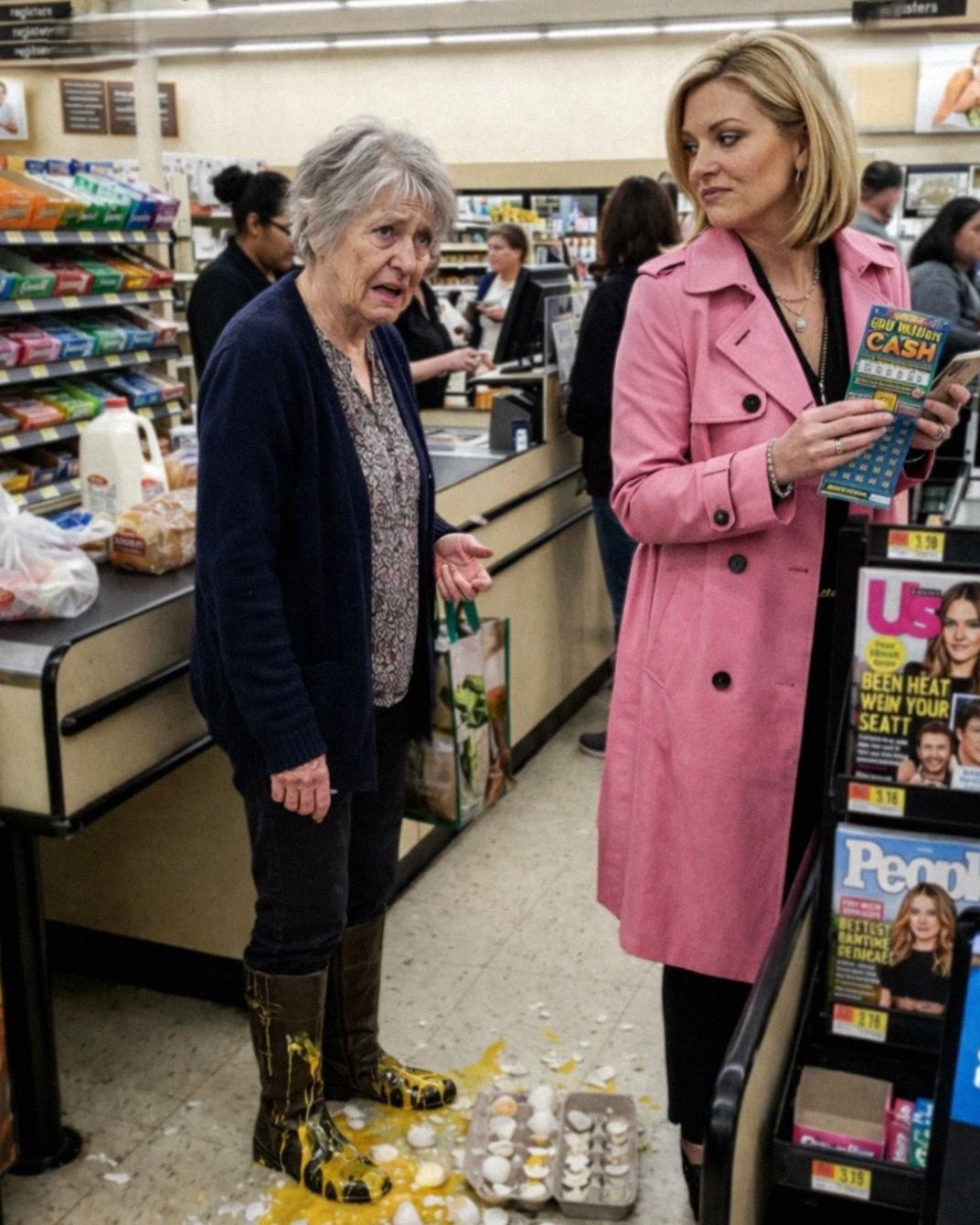
We were next in line when the atmosphere of the store shifted from mundane to aggressive. Without warning, a sharp elbow slammed into Linda’s arm. The force was intentional, a calculated shove that sent both cartons of eggs flying from her grasp. They hit the linoleum floor with a sickening crunch, yolk exploding in bright yellow puddles and shells shattering under the feet of the crowd. Linda froze, her shoulders hunching as if she were the one who had committed a transgression.
I spun around, my blood beginning to boil, ready to confront whoever had been so reckless. My anger turned to cold disbelief when I saw her: Brenda, Marcus’s sister. Brenda had severed ties with the family years ago, fueled by a disdain for our lack of “social ambition.” She stood there, perfectly coiffed and utterly indifferent to the mess at her feet, and slapped a crumpled fifty-dollar bill on the counter. Her focus was entirely on the lottery display. “The last Golden Holiday scratch-off,” she demanded, her voice sharp and entitled.
The interaction that followed was a masterclass in narcissism. When I confronted her for shoving her own mother, she didn’t offer an apology; she offered an insult, suggesting that if Linda couldn’t hold onto groceries, it wasn’t her problem. She dismissed the destruction as “just eggs,” ignoring the fact that those eggs represented a significant portion of our weekly budget. Brenda grabbed the shiny ticket like a trophy, a smug smile playing on her lips, convinced she had once again steamrolled her way to what she wanted.
However, she hadn’t accounted for Martha. The veteran cashier folded her arms, her eyes hard as she looked at Brenda. “Clean that mess,” Martha said, her voice a calm, low vibration that silenced the entire lane. Brenda’s laughter was short and brittle, claiming it wasn’t her job, but Martha didn’t budge. The store manager, Carl, emerged from his office to investigate the commotion. After Martha relayed exactly what had happened—the deliberate elbow, the shattered eggs, and the rush for the lottery ticket—Carl decided to consult the high-definition security footage.
The tension in the store became palpable. Brenda’s confidence began to crack as she realized her actions had been recorded from multiple angles. She tried to dismiss the shove as an accident, but the cameras told a different story. When Carl returned, his face was set in a grim line. He confirmed that the footage showed a clear, aggressive shove. When Brenda refused to pay for the damage or apologize to her mother, Carl took a decisive stand. He reached out, took the lottery ticket from the counter before she could claim it, and informed her that she was no longer welcome in his establishment.
Brenda stormed out of the store, hurling insults and vowing to take her business elsewhere, jumping over the egg yolk without so much as a glance at Linda. The silence she left behind was quickly filled by Martha’s kindness. She refused to let Linda pay for the broken eggs, insisting we only pay for the fresh ones. And then, in an act of spontaneous generosity, Martha handed Linda the Golden Holiday ticket. “Maybe it’ll bring a little luck,” she said softly.
That evening, the house was filled with the bittersweet scent of vanilla and warm sugar as the custard cake baked in the oven. After dinner, with Marcus’s photo watching over us from the fridge, the kids gathered around as Linda sat with her tea and the lottery ticket. She was hesitant, having never played before, but with the children’s encouragement, she took a coin and began to scratch.
The silence that followed was different from the silence of grief; it was the silence of a miracle. Linda froze, her eyes wide as she looked at the numbers. We had won enough to cover several months of our mounting bills—a lifeline thrown to us just as we were starting to drown. The kitchen erupted in cheers and tears, a release of months of pent-up pressure. Linda looked at Marcus’s photo and whispered a soft thank you.
The following evening, the news of the win had evidently traveled through the neighborhood grapevine. Brenda appeared at our door, her face a mask of indignation. She demanded a share of the winnings, claiming the ticket was rightfully hers. I looked at her, remembering the yolk on Linda’s boots and the coldness in Brenda’s eyes at the store. I told her the simple truth: if she had just said she was sorry, we likely would have shared it with her. But as it stood, she was finally facing the consequences of her own cruelty. I gently closed the door, leaving her on the porch with her anger.
Inside, the house felt lighter, the air easier to breathe. The money provided more than just financial security; it provided a sense of hope that we hadn’t felt since Marcus left us. We weren’t just surviving anymore; we were starting to live again.