They say that a woman’s worth is measured by the fruit of her womb—a cruel, archaic metric designed by those who have never known the weight of a broken heart. For three agonizing years, I lived under that suffocating yardstick in a mansion that was supposed to be a sanctuary but felt more like a high-stakes courtroom. My name is Katherine, and before I became the woman the world knows today—the woman who commands the global trade of diamonds and fine jewelry—I was a ghost haunting the halls of a marriage that had already turned to ash.
Julian was the sun around which my entire universe revolved. Or so I believed. He was the man I had promised my life to, the one whose hand I held when we exchanged vows in a sun-drenched chapel in the Hamptons, believing that our love was an impenetrable fortress. But every fortress has a flaw, and ours was his mother, Eleanor Sinclair. To her, I was not a daughter-in-law; I was a faulty investment. I was a vessel that refused to fill, a garden that would not bloom, a stain on the prestigious Sinclair legacy.
“Three years, Katherine,” she would hiss over breakfast, her voice a sibilant blade. “Three years of my son’s prime wasted on a dry field. A man of Julian’s stature needs an heir. A legacy needs a future. What do you provide? Silence and empty cradles.”
I would look to Julian, my eyes screaming for a word of defense, a shield against her venom. But he would only stare into his coffee, his silence a slow-acting poison that paralyzed my soul. He was a man made of wax, melting under the oppressive heat of his mother’s disapproval.
The breaking point didn’t come with a conversation; it came with a storm that mirrored the chaos in my heart.
The Night the Sky Fell
I returned from the local market one Tuesday evening, my arms heavy with groceries for a dinner I hoped would soften the jagged edges of our domestic life. The sky over our Connecticut estate had turned a bruised, sickly purple, and the first fat drops of a cold New England rain were beginning to lash against the pavement. When I reached the wrought-iron gates of our home, I stopped. My breath hitched, a jagged shard of ice in my throat.
There, piled on the wet gravel like discarded refuse, were my suitcases. My books, my designer clothes, the lace veil from our wedding—all of it lay scattered, soaking up the filth of the gutter.
The heavy oak front door creaked open. Eleanor stood there, draped in cashmere, her eyes gleaming with a terrifying, cold triumph. Beside her stood Julian, his head bowed, and clinging to his arm was a woman I recognized from old social columns and bitter whispers. Lindsey. Julian’s high-school sweetheart. She was wearing one of my silk robes, and her hand was pointedly resting on the slight but unmistakable curve of her stomach.
“Stay away from my son, Katherine!” Eleanor’s voice cut through the thunder. “You’re barren! Your womb is a desert! Look at Lindsey—she’s already accomplished in weeks what you couldn’t do in years. She’s carrying a Sinclair. She’s the one who deserves this name, not a hollow shell like you!”
I felt the rain soak through my blouse, chilling me to the very marrow of my bones. I looked at Julian, my voice trembling with a final, desperate hope. “Julian, please… look at me. You promised. You said we were enough. You said you loved me.”
He finally looked up, but there was no love in his eyes—only a pathetic, cowardly exhaustion. “I’m sorry, Katherine. My mother is right about the legacy. We need an heir. And… Lindsey is pregnant. It’s the right thing to do. I have to be a father.”
The “right thing.” Those words felt like a physical execution. They didn’t just throw me out; they erased me. As the gates clicked shut and their car splashed through the puddles to take them to a celebratory dinner, I collapsed onto my soaked suitcases.
What they didn’t know—what Julian didn’t deserve to know—was that for three days, I had been carrying a secret of my own. I was two weeks pregnant. I had been planning to surprise him on his birthday, to present him with a tiny pair of knit booties as the ultimate gift of love.
But as I sat in the gutter, the rain washing away my tears, the grief hardened into something else. It turned into a cold, glittering resolve. I touched my belly, the skin still flat, and made a vow to the life growing inside me.
They will never see you. They will never claim you. From this night on, you are mine and mine alone.
The Chicago Resurrection
Exile is a lonely road, but I was fortunate enough to have a compass. My Aunt Evelyn, a woman who had built an empire of steel and real estate in Chicago, didn’t ask questions when I showed up at her door like a drowned rat. She simply handed me a warm towel, a bowl of broth, and a purpose.
“Grief is a luxury we cannot afford, Katherine,” she told me as we sat in her glass-walled penthouse overlooking Lake Michigan. “You have two lives to build now. The one you lost is dead. Let it stay buried in the mud.”
I worked with a ferocity that frightened even me. During the day, I managed the accounts for her regional offices. At night, I studied. I went back to school for business administration and gemology, a passion I had suppressed to be a “dutiful housewife.” I learned the anatomy of stones, the chemistry of gold, and the brutal physics of the global market.
When Lucas and Liam were born—two perfect, screaming miracles with their father’s dark eyes but my iron chin—I didn’t feel a pang of longing for the man I had lost. I felt a surge of absolute power. They were my twins, my dual suns. They were the living evidence that I was never the problem. The soil was always fertile; the farmer was simply unworthy.
I started small, designing bespoke pieces for Aunt Evelyn’s wealthy associates. I called the brand Katherine’s Eternal Gold. I didn’t want a fancy French name; I wanted my name on every velvet box, a signature of my survival. I learned that gold is most beautiful after it has been through the furnace, and diamonds are only formed under unbearable pressure.
I was the gold. I was the diamond.
By the fourth year, my designs were being worn on red carpets in Los Angeles and New York. My small Chicago studio had expanded into a flagship store on Fifth Avenue. I wasn’t just a business owner; I was a titan. I moved with a grace that came from financial absolute security and the knowledge that I owed no man a single cent.
But as the fifth year approached, a restlessness took hold. I wanted my sons to have the best education in the country. I wanted them to walk the halls of power as princes, not as the “abandoned” children of a broken marriage.
I decided to return to Manhattan. I enrolled the twins at The Sterling Academy, the most prestigious and expensive private school in the city. It was a place for the elite, a place where surnames carried the weight of history.
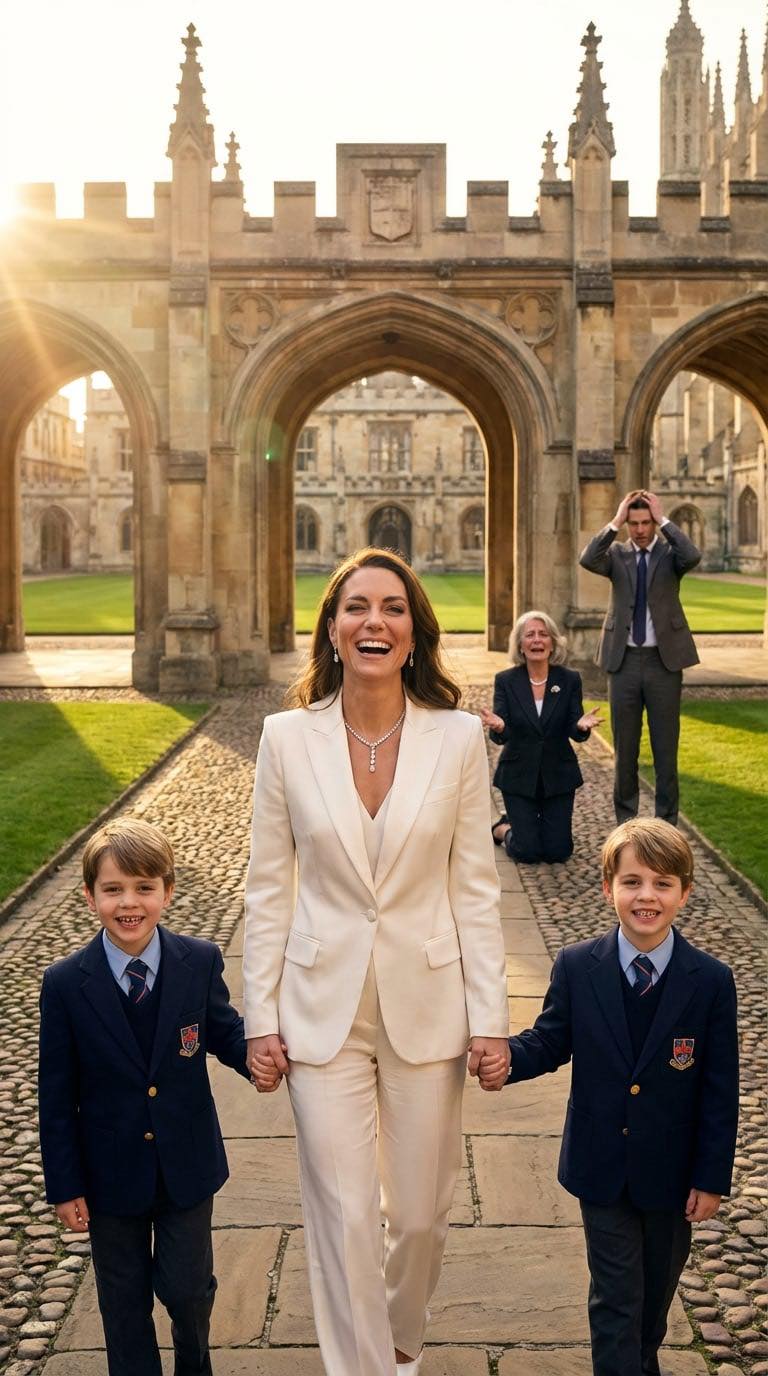
As I drove my sleek, black SUV toward the school for the first day of orientation, I caught my reflection in the mirror. I was wearing a crimson silk suit, my hair swept back in a sophisticated chignon, and the Aurora Star—a five-carat yellow diamond necklace of my own design—resting against my collarbone.
I looked like a queen returning to a kingdom that had once exiled her.
“Mommy, are we there yet?” Lucas asked, kicking his legs in the back seat, his designer school blazer crisp and perfect.
“Almost, my love,” I replied, my voice smooth as vintage wine. “Remember what I told you. Hold your heads high. You are mine. You are everything.”
I stepped out onto the sidewalk of the Upper East Side, the morning air greeting me like an old friend. I walked toward the main hall, one twin on each side, their hands in mine. We were a portrait of untouchable success.
Then, the universe, in its twisted sense of humor, decided to orchestrate a collision.
The Collision of Worlds
Lucas, ever the energetic soul, pulled away from my hand to point at the new digital library wing. He ran a few paces ahead, but in his excitement, he didn’t see the smaller, scruffier boy coming around the corner of the marble fountain.
CRASH.
The two children collided, tumbling onto the floor. Lucas hopped up immediately, dusting off his knees, but the other boy burst into tears, his uniform—clearly a hand-me-down that was fraying at the sleeves—becoming stained with dust.
“Hey! Don’t you watch where your brats are going?!” a shrill, familiar voice shrieked from behind the fountain.
The sound sent a cold shiver of recognition down my spine. It was a voice that had haunted the corridors of my memory for half a decade. I turned slowly, my heart a steady, frozen drumbeat.
Standing there, clutching a tattered handbag and looking twenty years older than the last time I’d seen her, was Eleanor Sinclair. And behind her, holding the crying child’s hand with a look of utter, soul-crushing defeat, was Julian.
The air in the hallway seemed to turn to glass.
Julian was a hollowed-out version of the husband I had once adored. His hair was thinning, his skin sallow and etched with the deep lines of chronic stress and failure. He was wearing a cheap, off-the-rack suit that didn’t fit his slumped shoulders. He looked like a man who had spent the last five years losing a war he didn’t realize he was fighting.
Beside him, Eleanor’s eyes were wide, her mouth hanging open in a silent “O” of absolute shock. Her gaze travelled from my red silk suit to my diamond necklace, and finally, inevitably, to the two boys standing at my side.
Lucas and Liam.
They were five years old, glowing with health and the effortless confidence of the well-loved. They were carbon copies of Julian—the same arch of the brow, the same deep-set, soulful eyes—but they carried themselves with a dignity Julian had never possessed.
“K-Katherine?” Julian stammered, his voice a gravelly, pathetic rasp. He took a half-step forward, his eyes filling with a sudden, desperate moisture. “Is that really you?”
I didn’t move. I didn’t even blink. I stood there like a statue of marble and ice. “It’s Katherine Thorne now, Julian. But you can call me Ms. Thorne if you’ve forgotten how to address your superiors.”
Eleanor’s hand went to her throat, her fingers trembling as she pointed at the twins. “These children… those faces… Julian, look at them. They look exactly like your baby pictures. They’re… are they…?”
I felt a surge of primal, cold satisfaction so intense it nearly took my breath away. I placed my hands on my sons’ shoulders, pulling them close to my sides. “Hello, Eleanor. It’s been a long time. These are my sons, Lucas and Liam.”
Eleanor didn’t wait for another word. She let out a strangled cry and rushed forward, her arms outstretched, her greed and desperation overriding any sense of shame. “My grandchildren! Oh, praise God! My grandchildren! They’re so handsome! They look so rich! Look at their blazers! Julian, look, we have heirs! The legacy is saved!”
She tried to reach for Liam, her face contorted in a grotesque smile of “ownership.”
I stepped in front of her with the speed of a striking cobra. I didn’t scream. I didn’t lose my temper. I simply raised one gloved hand and pushed her arm away with a force that made her stumble back against the fountain.
“Excuse me,” I said, my voice dropping to a temperature that could frost glass. “Who exactly do you think you are touching?”
“Katherine! It’s me! I’m Julian’s mother! I’m their grandmother!” Eleanor insisted, her voice rising to a frantic pitch as she noticed the curious, judgmental glances of the other billionaire parents in the hall. “I have the right to see my flesh and blood! Look at them, they’re Sinclairs through and through!”
I let out a soft, melodic laugh that was as sharp as a diamond edge. The sound seemed to pierce Julian like a physical blade.
“Grandmother?” I asked, tilting my head. “That’s strange. I remember a very specific conversation five years ago. I remember standing in the freezing rain while you screamed at me that I was BARREN. I remember you telling me my womb was a desert. I remember you throwing my life into the mud because I couldn’t give you what you wanted.”
They both flinched as if I’d struck them.
“So tell me, Eleanor,” I continued, stepping into her personal space, my presence overwhelming her. “How could a barren, useless woman possibly provide you with grandchildren? By your own logic, these boys cannot be yours. They belong to me. They belong to the ‘desert’ you abandoned.”
“K-Katherine, please,” Julian said, stepping closer, his eyes streaming now. “We were wrong. Everything went wrong. Lindsey… she wasn’t who we thought she was. She had the baby, but she left us three years ago. She took what little money was left in the estate and ran off with an Italian photographer. We’re drowning in debt, Kat. The Sinclair properties were foreclosed. Mom is sick. We’re… we’re struggling just to pay for this school, we’re here on a hardship grant for the boy…”
I looked at the child standing behind them—the boy Julian had chosen over me. He was pale, his eyes darting around in fear, wearing a uniform that was clearly a donation. I felt a pang of pity for the innocent child, but none for the adults who had failed him.
“Please, Katherine,” Julian whispered, reaching for my hand. “Let’s rebuild. For the sake of the children. They need a father. We can be a family again. I still love you. I never stopped.”
I looked at his hand—dirty, shaking, and weak. Then I looked at the man standing a few yards away, who had been watching the encounter with a sharp, protective gaze.
Marcus Sterling. My fiancé. The man who owned the very ground we stood on. He was the benefactor of this academy, a man of immense wealth and even greater character. He was tall, impeccably dressed in a charcoal suit, and possessed the kind of quiet, genuine power that Julian could only dream of.
“Katherine, is everything okay over here?” Marcus asked as he strolled over. He didn’t wait for an answer. He saw the distress on my face—or perhaps the cold fire—and immediately wrapped a firm, supportive arm around my waist. He reached down and effortlessly lifted Liam into his arms, the boy giggling as he settled against Marcus’s broad shoulder.
I turned my gaze back to Julian, whose face had collapsed into a mask of utter, irreparable devastation. He saw the way my sons looked at Marcus—with trust and adoration. He saw the way Marcus looked at me—with respect, equality, and a love that wasn’t transactional.
“Everything is fine, Marcus,” I replied, my voice sounding like a silver bell in the quiet hallway. “Just some beggars asking for alms. I think they’ve mistaken me for someone they used to know in a past life.”
Julian’s knees actually buckled. He grabbed the edge of a nearby trophy case to keep from falling. He looked like a man who had just realized he’d traded a diamond for a piece of coal, and now he was watching the diamond shine in the crown of a king.
“Come on, Lucas, Liam,” I called to my sons. “We have an orientation to finish.”
“Bye-bye!” the children waved happily to the strangers, their innocent voices trailing behind us as we walked toward the dean’s office.
As the heavy mahogany doors of the administration wing closed behind us, the last thing I heard was the sound of Eleanor Sinclair’s wailing sob echoing off the marble floors of the hallway.
“My grandchildren… we could have been Sinclairs again… Katherine! Please!”
I didn’t look back. Not even once.
The Alchemy of Happiness
Revenge is a word people use when they are still hurting. They think it’s about a grand explosion, a dramatic moment of ruin for their enemies. But as I sat in the dean’s office, signing the final papers with a steady, elegant hand, I realized that true revenge is much quieter.
It is the weight of a gold fountain pen in your hand. It is the sound of your children’s laughter in a home that has never known the sound of a raised voice. It is the sight of a man like Marcus, who sees you as a partner rather than a trophy or a problem.
That afternoon, after the orientation was over, we went to a small, Michelin-starred bistro on Madison Avenue for lunch. The sun was shining, and the city felt vast and full of incandescent possibility. Lucas and Liam were busy coloring on the paper tablecloth, and Marcus was telling me about a new gallery opening he wanted us to attend in London.
I thought about the woman I was five years ago. The housewife who lived for a man’s meager approval. The girl who cried in the mud. She was dead, and I had been the one to bury her.
Julian and Eleanor would continue to haunt the fringes of their own choices. They would spend the rest of their lives looking at the boys who shared their blood but would never share their name. They would live in the “what if” while I lived in the “what is.”
My life wasn’t just better because I was wealthy. It was better because I was whole. I had taken the lead of my betrayal and, through the alchemy of grit and grace, I had turned it into gold.
I reached across the table and took Marcus’s hand.
“You’re very quiet today,” he said, his eyes smiling. “Everything okay?”
I looked at my sons, then at the man beside me, then at the bright, open sky through the window.
“Better than okay, Marcus,” I said. “I’m exactly where I was always meant to be.”
As for Julian and his mother? They were just a footnote in a story that had long since moved on to a much better, much brighter chapter. Sometimes the most painful thing you can do to those who hurt you is simply to let them watch you be happy without them.
And as the sun set over the Manhattan skyline, painting the world in shades of amber and gold, I knew that my vow had been kept. The furnace had done its work. The jewelry was finished. And it was more beautiful than I had ever imagined.
10 Lessons from Katherine’s Journey
Your value is not determined by your utility to others. Eleanor saw Katherine as a “machine,” but Katherine proved she was the architect of her own fate.
Silence in the face of injustice is a betrayal. Julian’s silence was the first crack in the marriage; his mother’s voice was just the hammer.
Success is the most elegant form of closure. You don’t need to shout to be heard; your results will do the talking for you.
The “Barren” label is often a projection of the accuser’s heart. Katherine’s fertility wasn’t the issue; Julian’s lack of character was.
Grief can be converted into grit. The energy spent crying can be used to build a business if you channel it with precision.
Blood makes you related, but loyalty makes you family. Lucas and Liam belong to those who fought for them, not those who shared their DNA.
Never let your past define your ceiling. A “housewife” can become a “jewelry mogul” if she refuses to stay in the box society built for her.
True love respects your independence. Marcus loved Katherine because she was strong, not because she was “useful.”
The best revenge is being “unrecognizable” to your enemies. When Julian saw the new Katherine, he realized he hadn’t just lost a wife; he’d lost a queen.
A “Dry Field” just needs a better farmer. Sometimes you have to leave the land that refuses to let you grow to find the soil where you can truly flourish.