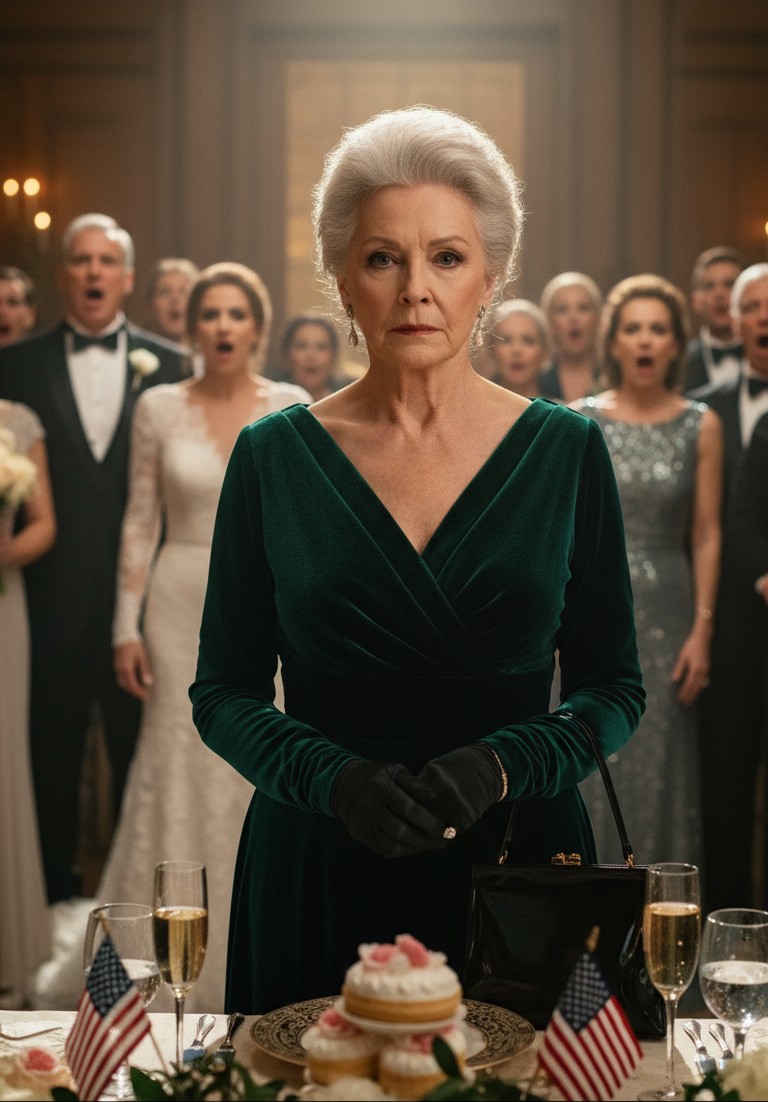
I still remember the exact texture of the silence that followed her words—not the kind of silence you hear when someone makes a beautiful toast at a wedding, but the jagged, breathless void that follows an assassination.
It was a Saturday in mid-September. The Bates Hall of the Boston Public Library had been transformed into a sanctuary of obscene wealth. Crystal chandeliers dripped like frozen tears from the high ceilings, casting a shimmering glow over silk tablecloths and floral centerpieces that cost more than a mid-sized sedan. I had paid for every petal, every vintage bottle of champagne, every string of the quartet playing softly in the background. My total investment in my son’s happiness stood at exactly four hundred and twenty-five thousand dollars.
I was standing near the dessert table, adjusting the lace of my burgundy dress, feeling the faint, vestigial ache of a mother watching her only child slip into a new life. Daniel was dancing with Samantha, his new bride, a woman with hair like spun silk and a heart I was only just beginning to realize was made of flint.
That’s when Samantha’s voice sliced through the ambient hum of the reception. She was standing barely fifteen feet away with a circle of her bridesmaids, all of them clutching champagne flutes as if they were scepters.
“I’m telling you, the woman is a leech,” Samantha said, her voice dripping with a casual, practiced cruelty. “She’s been hovering since the engagement, calling every week with ‘opinions’ Daniel never asked for. It’s exhausting.”
One of her friends giggled, a sharp, tittering sound. “The classic clingy mother-in-law. Does she have a life of her own?”
“Hardly,” Samantha replied, her voice rising, clearly emboldened by the alcohol and the adoration of her clique. She gestured toward me with her flute, that perfectly manicured finger pointing like a loaded gun. “Ladies and gentlemen, look closely. This is the Clingy Old Fat Pig we’re stuck with for the rest of our lives.”
The laughter that followed was genuine, delighted. It wasn’t the laughter of people who were uncomfortable; it was the laughter of people who felt superior.
I looked for Daniel. I found him standing near the head table, his tuxedo fitting him perfectly—a suit I had bought him. He had heard. I saw his shoulders tense, his jaw lock, and then, most devastatingly, I saw him drop his gaze to the marble floor. He didn’t defend me. He didn’t even look at me. He simply chose to be a spectator to my evisceration.
In that moment, the world slowed to a crawl. I felt the cold sweat on my palms and the roar of blood in my ears. But beneath the humiliation, a different heat began to stir—a cold, calculated clarity.
They had no idea who I really was. To them, I was just Helen Coleman, the quiet widow from the suburbs who wrote checks and stayed in the shadows. They didn’t know about Helen Ashford, the CEO who had systematically acquired fifty-one percent of their world while they were busy laughing at her dress.
———
The laughter was still echoing when George Worthington, Samantha’s father, joined the circle. He was the quintessential Boston patriarch—silver hair, an expensive tan, and a smile that had been bought and paid for by generations of old money. He held a glass of scotch, looking every bit the victor of the day.
He’d likely only caught the tail end of his daughter’s “joke,” but he was nodding along, his eyes crinkling with amusement. Then, his gaze drifted toward the woman at the dessert table. He looked at me, and I watched the muscles in his face freeze.
The color drained from his skin with a terrifying velocity. The glass in his hand began to tremble, the amber liquid rippling against the crystal.
“Wait,” George whispered, his voice cracking like a dry branch.
The circle went quiet. Samantha turned to him, her smile still plastered on her face, though it was beginning to fray at the edges. “Dad? What’s wrong? I was just telling the girls how much of a nightmare—”
“Be quiet, Samantha,” George snapped. He wasn’t looking at her. He was staring at me as if I were a ghost that had just walked out of a graveyard. “Aren’t you… you’re Helen Ashford.”
The name landed like a bomb. Ashford. My maiden name. The name I used for every corporate filing, every hostile takeover, every strategic acquisition I had made in the twenty years since my husband died.
“Helen Coleman,” I corrected him, my voice steady, carrying a resonance that silenced the entire corner of the room. “But in boardrooms, I prefer Ashford. It prevents people from making the mistake of thinking I’m just someone’s mother.”
George swallowed hard, his throat working convulsively. “You… the merger. The majority share of Worthington Holdings. The silent partner who bought out the creditors last quarter… that was you?”
I took a slow sip of my water, my eyes locked on his. “I found your company’s portfolio quite interesting, George. A bit over-leveraged, perhaps. A bit too much reliance on family names rather than actual assets. I thought it needed a firmer hand.”
Samantha was staring at us, her mouth hanging open. The champagne flute slipped from her hand, shattering on the marble floor with a sound that felt like the beginning of the end.
“You own… us?” she stammered.
“I own the company that pays for your lifestyle, Samantha,” I said, my voice dropping to a whisper that felt louder than a scream. “I own the roof over your father’s head. And as of tonight, I’m the one who decides if your family name stays on the building or ends up in a bankruptcy filing.”
I set my plate down with careful precision. I didn’t wait for George to find his breath. I didn’t wait for Daniel to finally find his courage. I turned and walked toward the exit, the burgundy lace of my dress trailing behind me like a battle flag.
As I reached the heavy oak doors, I felt a hand on my arm. I turned, expecting a plea for mercy, but instead, I found someone I never expected to see.
To understand the coldness in my heart that night, you have to understand the heat that forged it.
September 23rd, 2005. The day my universe collapsed.
I was forty-two years old, sitting in a hospital chair that smelled of antiseptic and dying hope. My husband, Henry, was slipping away. Cancer had hollowed him out in six months, leaving behind a man who looked like a charcoal sketch of the person I loved.
“Helen,” he whispered, his hand a bundle of dry sticks in mine. “The business… Ashford Hospitality. Don’t let them take it. George… George Worthington… he knows the truth. Remember the debt.”
He had drifted off before he could explain. At the time, I thought it was the morphine talking. George Worthington was a distant business associate, a man Henry had helped years prior. I didn’t have time to decipher riddles; I was too busy trying to figure out how to tell our twelve-year-old son that he was about to be an orphan.
When Henry died, the vultures didn’t wait for the funeral to conclude. His brother, his partners, they all told me to sell. “You’re a widow, Helen. You’re a mother. This is too much for a woman alone.”
But I remembered the way Henry looked when he talked about the hotels we had built. I remembered the pride in his voice. So, I didn’t sell. I went into his office, sat in his leather chair, and I began to learn.
I spent nineteen years building Ashford Hospitality Group into an empire. I worked sixteen-hour days, hiding my successes behind shell companies and my maiden name. I wanted to be the shield for Daniel. I wanted him to have the childhood I never had—one of security, of ease, of never having to worry about the balance in a checkbook.
But in protecting him from the world, I had accidentally protected him from his own character.
I gave him everything. An MBA from Harvard—paid for in cash. An apartment in Back Bay with a view of the Charles—I covered the rent. Car payments, designer suits, vacations to the Amalfi Coast—I was the invisible hand that funded his every whim.
I thought I was being a good mother. I didn’t realize I was building a pedestal for a son who didn’t know how to stand on his own feet.
And then he met Samantha.
The Worthingtons were everything we weren’t: loud, flashy, and obsessed with a pedigree that was rapidly losing its value. When Daniel told me he wanted to marry her, I saw the way he looked at her—the desperation for approval. I saw the way her family looked at us—with a polite, thinly veiled condescension.
“Her father has some cash flow issues,” Daniel had told me six months ago, his eyes pleading. “The wedding… Samantha’s sister had a half-million-dollar ceremony at the Four Seasons. If we don’t match that, I’ll look like a failure to them, Mom. Please.”
I should have said no. I should have told him that a marriage built on a lie is a house built on sand. But I looked at Henry’s photograph, remembered his final words about George, and I wrote the check.
Four hundred and twenty-five thousand dollars.
I paid for the very stage upon which I would be mocked.
But the debt Henry mentioned—the one George Worthington owed us—wasn’t just financial. It was a secret that had been buried for twenty years, and the shovel was finally in my hand.
The night of the wedding, I didn’t go home to cry. I went home to my office.
I poured myself three fingers of Henry’s favorite whiskey and sat on the floor, surrounded by the archives of 2004—the year before everything broke. I pulled out a box I hadn’t opened in a decade, labeled simply: Worthington / Private Partnership.
Inside, beneath layers of yellowing legal pads and old receipts, I found it.
A loan agreement. Five hundred thousand dollars, transferred from Henry Coleman’s private account to George Worthington. The interest rate was negligible, but the collateral was absolute: thirty percent of Worthington Holdings.
Beneath the agreement was a letter, dated two months after Henry’s funeral. It was from George’s lawyers. It stated that because the loan had been “informal” and lacked certain modern filing signatures, they were disputing the debt in its entirety. George had known I was grieving, known I was overwhelmed, and he had used that vulnerability to steal thirty percent of his own company back from a widow.
I stared at the paper until the words blurred.
He hadn’t just moved on; he had built the last two decades of his “success” on a foundation of theft. He had used my husband’s kindness to save his skin and then spit on his memory.
And then, I found the second folder. This one was more recent.
For the past three years, I had been quietly buying up the distressed debt of Worthington Holdings. I knew they were failing. I knew they were desperate. I had been waiting for the right moment to strike, to reclaim what was stolen.
I hadn’t planned to do it during the wedding. I had planned to be the “clingy mother-in-law” until the papers were finalized in October. But Samantha’s cruelty had moved the timeline forward.
My phone buzzed on the desk. It was a text from an unknown number.
“Mrs. Coleman, this is Clare Worthington. Samantha’s sister. I saw what happened tonight. I am so ashamed. Please, can we meet? There is more you need to know about what my father is planning.”
I looked at the whiskey in my glass. Clare Worthington. The younger sister. The one who had looked at me with pity while the others laughed.
I typed back: “My house. Beacon Hill. 2:00 PM tomorrow. Don’t tell your father.”
The coup d’état was no longer a corporate strategy. It was a moral imperative.
Clare Worthington arrived at my doorstep looking like she hadn’t slept in forty-eight hours. She was twenty-six, with the same blonde hair as her sister, but her eyes held a weariness that didn’t belong on a face so young.
I led her into the library, where the documents from 2004 were still spread across the mahogany table.
“My father is a fraud, Mrs. Coleman,” she said, her voice trembling as she sat on the edge of the velvet chair. “He’s been bankrupt for three years. The house in Louisburg Square? It’s mortgaged to the hilt. The lifestyle Samantha flaunts on Instagram? It’s all built on credit cards and lies.”
I leaned back, my expression unreadable. “I know about the bankruptcy, Clare. I’m the one who owns the debt.”
She looked up, startled. “Then you know about the ‘Investment Fund’?”
“Tell me.”
“My father and my brothers… they’ve been using Daniel,” Clare whispered, her face flushed with shame. “They knew you had money, but they didn’t know how much. They thought you were just a lucky widow with a decent portfolio. They’ve been coaching Samantha to get Daniel to ‘borrow’ from your company accounts. They told him it was for a family investment that would make him a hero in your eyes.”
I felt a cold dread coil in my stomach. “Daniel wouldn’t steal from me.”
“He thinks he’s investing, Mrs. Coleman. My father showed him fake ledgers. He convinced Daniel to sign over power of attorney for several of your secondary holdings in exchange for a ‘guaranteed return.’ They needed the wedding to be big to prove to their creditors that they were still flush with cash. You didn’t just pay for a wedding; you paid for their smoke and mirrors.”
The room felt suddenly very small. My son. My Daniel. He hadn’t just ignored the insult; he had been the architect of his own betrayal. He had traded his mother’s legacy for the approval of a man who was using him as a human shield.
“Why are you telling me this, Clare?”
“Because I’m tired of the lies,” she said, tears finally spilling over. “I’ve watched them destroy people for years. My father thinks he’s found a way to bridge his debt by liquidating your assets through Daniel. If you don’t stop him by Monday, the transfer goes through.”
I looked at the clock. It was Sunday afternoon.
“Monday morning, George Worthington has a meeting with his ‘new CEO’,” I said, my voice like iron. “I think it’s time he realized that the pig he was laughing at is the one who’s been holding the leash all along.”
But as I prepared for the boardroom, a final piece of the puzzle fell into place—one that involved a name I hadn’t heard in nineteen years.
Monday morning in Boston was gray and rain-slicked. I walked into the headquarters of Worthington Holdings wearing a charcoal suit that cost more than Samantha’s wedding dress. I didn’t go through the front; I went through the executive garage, using the keycard I’d received as the majority stakeholder forty-eight hours prior.
The boardroom was a temple of mahogany and ego. George was there, along with his sons, Derek and Trevor. They were laughing, drinking coffee, looking at a series of documents spread out on the table. Daniel was sitting in the corner, looking pale and nauseous.
“Ah, George,” I said, stepping into the room.
The silence was instantaneous. George stood up, his face shifting from confusion to a desperate, oily smile.
“Helen! We weren’t expecting you until later. We were just finalizing some… internal restructures.”
“Internal restructures?” I walked to the head of the table. “Is that what we’re calling embezzlement these days?”
George’s smile faltered. “I don’t know what you mean.”
I tossed the 2004 loan agreement onto the table. “Let’s start with the five hundred thousand you stole from my husband. Then let’s move on to the fake ‘Investment Fund’ you’ve been using to manipulate my son.”
Derek, the oldest brother, scoffed. “You’re out of your league, Helen. Daniel signed those papers. Everything is legal. You’re a minority partner at best.”
“Am I?” I looked at Daniel. “Daniel, look at me.”
My son looked up, his eyes rimmed with red. “Mom, I… I was trying to help. They said the hotels needed a capital influx and that George’s fund was the only way to save the Portland property.”
“They lied to you, Daniel,” I said softly. “The Portland property is at ninety-eight percent occupancy. We have no debt. You didn’t save us; you gave them the keys to the vault.”
I turned back to George. “But here’s the problem for you, George. I acquired Mass-Tech Acquisitions last month. They hold the primary mortgage on this building and your home. And as of 8:00 AM this morning, I’ve called the loans.”
George went from pale to gray. “You can’t do that. There’s a grace period.”
“Not when there’s evidence of fraud,” I said. I gestured toward the door. Two men in dark suits stepped in—my legal team and a private investigator. “We’ve spent the weekend tracing the ‘investments’ you’ve made with Daniel’s signatures. It turns out, moving money between shell companies to pay off personal gambling debts is a felony.”
Samantha burst into the room then, her face a mask of fury. “What is she doing here? Dad, kick this fat pig out!”
George turned and slapped his daughter across the face. The sound echoed like a gunshot.
“Shut up, Samantha!” he roared, his voice cracking. “She owns us. She owns everything.”
Samantha crumbled into a chair, her hand over her cheek, staring at me with a horror that was finally, deliciously earned.
“I have two documents here, George,” I said, sliding two folders across the table. “One is a full confession of the debt you owed Henry, along with a voluntary liquidation of your shares to cover the damages. You sign it, and I don’t send the PI’s files to the District Attorney. You walk away with your freedom, though you’ll be living in a two-bedroom apartment in Quincy for the rest of your life.”
“And the second?” George whispered.
“The second is your arrest warrant. Choose.”
George reached for the pen with a shaking hand. But the real confrontation wasn’t with the Worthingtons. It was with the man sitting in the corner, crying into his hands.
The boardroom cleared out. George and his sons were escorted out by my security, their legacy dismantled in less than twenty minutes. Samantha had vanished, likely already looking for a new benefactor.
Daniel and I were left alone in the wreckage of the Worthington empire.
“Mom,” he started, his voice a broken thing.
“Don’t,” I said. I sat across from him. “For nineteen years, I thought I was protecting you. I thought if I handled the world, you could just… be happy. But I realized on Saturday that I hadn’t raised a man. I had raised a coward who watched his mother be insulted and said nothing because he was afraid of losing his seat at a table that didn’t even belong to him.”
“I was scared,” he whispered. “I didn’t know how to stop it.”
“You stop it by standing up,” I said. “You stop it by having a spine. You let that woman call me a pig. You let her mock the life I built for you. And for what? For a family of thieves?”
I stood up and pulled a final envelope from my bag.
“This is your severance, Daniel.”
He looked up, panicked. “Severance? From what?”
“From the company. From my life. I’ve paid off the loans you took out in your name—I won’t let you go to prison for being a fool. But the apartment? The car? The expense accounts? They’re gone. As of today, you are exactly what you were at that wedding: a man with nothing of his own.”
“You’re disowning me?”
“I’m giving you a gift,” I said, and for the first time, I felt the weight of nineteen years of grief lift. “I’m giving you the chance to find out who you are when you’re not ‘Daniel Coleman, the heir.’ Find a job. Pay your own rent. Learn the value of a dollar you actually earned. And maybe, in five years, if you’ve grown a soul, we can have a cup of coffee.”
I walked toward the door.
“Where are you going?” he cried out.
“To have lunch with Clare Worthington,” I said. “She’s the only person in that entire building who had the courage to do what was right. I think I might make her my new Vice President.”
As I walked out of the building, the sun finally broke through the Boston clouds. I felt lighter than I had in two decades.
It has been six months since the wedding that ended a dynasty.
Worthington Holdings no longer exists. It was absorbed into Ashford Hospitality, its assets liquidated and repurposed. The building on Louisburg Square was sold to a developer who’s turning it into affordable housing for seniors—a bit of irony I think Henry would have appreciated.
George Worthington is living in a small condo, working as a consultant for a firm that doesn’t know about his past. Samantha? I heard she moved to Miami, looking for a billionaire who doesn’t check his credit reports.
Clare is my right hand now. She’s brilliant, honest, and the daughter I never knew I needed. She’s helping me build a foundation that supports young widows starting their own businesses. We call it The Henry Fund.
And Daniel?
I got a letter from him last week. It wasn’t a request for money. It was a photo of a paycheck from a property management firm in Worcester. He’s an entry-level assistant. He’s living in a studio apartment above a bakery.
“I’m tired every night, Mom,” the letter read. “My back hurts. My boss is a jerk. But for the first time, when I look in the mirror, I don’t see a ghost. I see a man. Thank you for saying no.”
I didn’t cry when I read it. I just smiled and put it in the box with Henry’s photograph.
People often ask me how I survived that night at the library. How I didn’t crumble when the world laughed at me. I tell them the same thing every time:
You can call me a pig. You can call me clingy. You can call me old. But you can never call me defeated. Because a woman who knows her worth doesn’t need a seat at your table—she owns the building you’re sitting in.
I am Helen Ashford. I am a widow, a CEO, and finally, a mother of a man.
And the ledger is officially balanced.