For nine years, I told myself my marriage was solid. Not perfect, not movie-worthy, but stable in that quiet, unremarkable way that makes you stop questioning things. If someone asked, I’d smile and say, “Yeah, nine years. We’re good.” And at the time, I believed it.
Mark and I lived in a comfortable house in a quiet neighborhood. Neutral walls, furniture bought on sale, a kitchen that always smelled faintly of coffee and whatever candle I was pretending would fix my mood. On the outside, it all worked. We both had full-time jobs, split the bills, hosted holidays without drama. From the outside, we looked like adults who had figured it out.
Mark especially played the part well. He wore crisp button-downs, kept his shoes clean, and knew exactly how to turn on the charm when it mattered. He could be kind to strangers, polite to coworkers, attentive in public. At home, though, that charm often curdled into small dismissals—comments brushed off as jokes, comparisons framed as honesty. If I said something hurt my feelings, I was “too sensitive.” If I cooked, his mother did it better. If I dressed up, it was “fine,” never more than that.
I carried more of the weight in our marriage, and I told myself that was normal. Someone always does. I worked, cleaned, planned, remembered birthdays, scheduled appointments. He nodded along, agreed in theory, forgot in practice. I convinced myself that love was about patience.
The one thing that hovered over us, unspoken but constant, was children. People asked. I smiled and said, “We’re trying.” Mark would squeeze my hand like we shared a secret. The truth was uglier. I tracked cycles, took vitamins, downloaded apps. He said we were trying. I was the only one actually doing it.
Sometimes he’d say things like, “Maybe if you relaxed, it would happen,” as if my body were the problem and not his indifference. Still, I held onto hope. I wanted to believe in the version of him I married.
My younger sister, Lila, was everything I wasn’t. Effortlessly magnetic. Loud laughter. Easy confidence. She could walk into a room and draw attention without trying. She posted photos like she belonged in them. People gravitated toward her, and she knew it.
She was also my sister, which meant my brain never once considered that she could be a threat. She came over for holidays, random weekends, borrowed clothes, stole snacks. She perched on my counters like she owned the place. Mark was always nice to her—too nice, in hindsight—but I didn’t want to be suspicious. I wanted to be secure. I told myself I was imagining things.
Until one Tuesday evening shattered everything.
I’d had a long day, the kind where every email feels aggressive. I came home exhausted and decided, stupidly, to make Mark’s favorite dinner. Homemade meatballs. Two hours of chopping, mixing, simmering. I cleaned the counters like I was trying to prove something.
Mark sat on the couch watching TV. I set the plate down, sat across from him, waiting for the moment where effort was acknowledged.
He took a bite. Chewed. Sighed.
“They’re okay,” he said. “But my mom’s are better.”
Something in me tightened, worn thin by years of swallowing comments like that. I opened my mouth to respond—and then his phone buzzed on the counter. Once. Then again. Sharp, impatient.
I stood, still operating on autopilot, and reached for the phone. The screen lit up. A photo preview appeared in the notification.
It was my sister.
She was smiling the way she did when she felt safe. Intimate. Familiar.
Before I could process that, a message slid down beneath the image. I only needed to read the first line.
“No. I’ll keep this child. It will remind me of you, babe.”
The room didn’t change. The TV kept playing. Mark kept eating. And I stood there holding his phone, feeling the exact moment my life split in two.
I don’t remember putting the phone down. I don’t remember walking to the bathroom. I just remember locking the door and sitting on the edge of the tub, fully dressed, shaking so hard my teeth clicked.
My first thought was denial. This can’t be real. My second was terror. If it is, I don’t know how to survive it.
I tried to rationalize. Maybe it was a joke. A nickname. A misunderstanding. I laughed once, out loud, and it sounded wrong. When I looked in the mirror, my face looked almost normal. That scared me more than hysteria would have.
Mark knocked on the door, annoyed. I said I had a headache. He told me to hurry up—the game was almost over.
That was the moment I knew confronting him immediately would get me nowhere. He would deny, deflect, blame. I needed proof. I needed control.
I washed my face, walked back out, and picked up his phone again. My hands moved without hesitation. Messages. Her name.
The truth spilled out in a flood. Weeks of conversations. Photos. Hotel confirmations. Inside jokes. Her calling him “babe” like she owned the word. The pregnancy message sat there like a crater.
I typed from his phone, carefully.
“Come over tomorrow night. She’ll be on a work trip. Wear something hot.”
The reply came almost instantly.
“Finally 😘 I couldn’t wait.”
I deleted everything. Every message, every photo. Put the phone back exactly where it had been. Mark glanced over, suspicious for half a second, then went back to his show.
That night, he slept beside me like a man with nothing to hide. I stared at the ceiling and planned.
The next day passed in a haze of normalcy. Emails, small talk, routines. By the time I got home, I was eerily calm. I cleaned the house not because it needed it, but because I needed something steady.
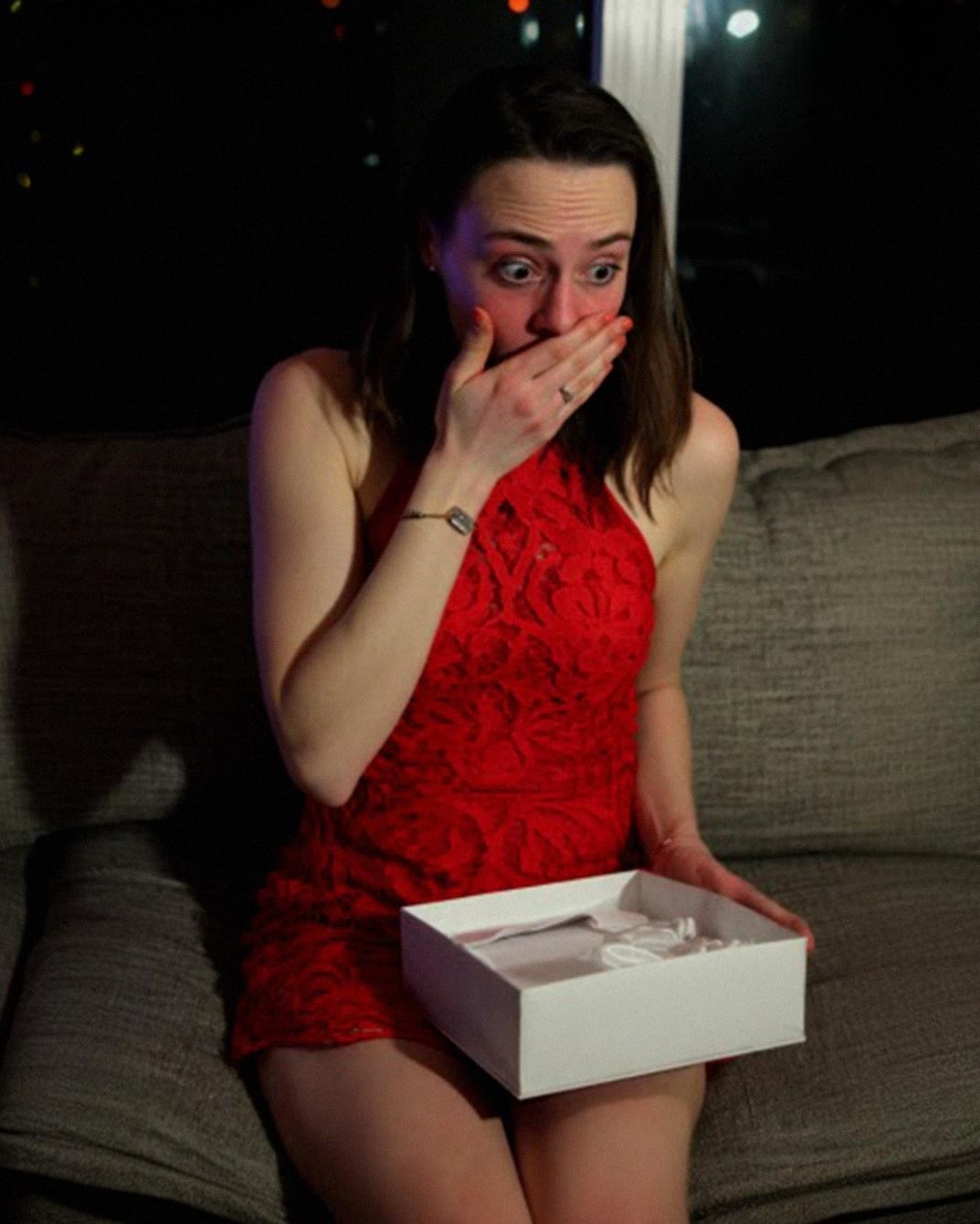
I placed a small box on the coffee table and waited.
Mark came home cheerful. Kissed my cheek. Asked about my “work trip.” I played my part. Told him I’d leave early in the morning. When the doorbell rang, he went to answer it.
I stayed seated.
I heard Lila’s laugh drift in. “Finally. I thought she’d never leave. I’ve been dying to kiss you.”
I stood.
“Surprise.”
Silence crashed into the room. Lila’s smile collapsed. Mark turned white.
I walked to the table and nudged the box toward them. “A gift.”
Inside were printed screenshots. Messages. Photos. Dates. On top, a photo of a positive pregnancy test. Beneath it, divorce papers—already filled out, already signed.
Lila cried the way she always had when she wanted saving. Mark shouted about privacy. I opened the door.
“Get out. Both of you.”
They left together.
The door closed softly behind them.
I stood alone in the quiet, surrounded by the wreckage of a life I thought I had. Then I picked up a suitcase.
That chapter was over.
And the next one was mine.

