The decision to welcome a foster child into one’s home is rarely born from a desire to be a hero; more often, it is born from a quiet, persistent ache for companionship. For Sylvie, the choice to take in nine-year-old Alan was not an attempt to “fix” a broken soul, but a recognition of a shared language. Having endured the hollow grief of three miscarriages and the eventual departure of a husband who could no longer bear the weight of their collective disappointment, Sylvie knew the architecture of silence. Her house had been too still for too long. When the social worker, Estella, warned her that Alan was “selectively mute” and that most families had passed on him due to the difficulty of his case, Sylvie didn’t hesitate. She didn’t need a child who could fill the rooms with noise; she needed a soul who understood that sometimes, the world is too heavy for words.
Alan arrived with a single backpack and a gaze that was far older than his nine years. He didn’t flinch, he didn’t cry, and he certainly didn’t speak. He simply stood in the threshold of Sylvie’s living room, methodically scanning the exits as if preparing for the inevitable moment he would be asked to leave. Sylvie greeted him with a warmth that demanded nothing in return. She offered cocoa and cookies, which he accepted with a small, ghostly nod, and she began the long, patient process of building a sanctuary.
For months, their relationship existed in the spaces between sounds. Sylvie lived her life out loud for him, narrating the mundane details of her day while she chopped vegetables or tended to the garden. She told him self-deprecating stories about her own mishaps—the time she accidentally dyed her hair a garish shade of orange or her failed attempts to outsmart the local squirrels. She never paused for a response, never leaned in to catch a whisper that wasn’t there. She simply left the air open for him, a standing invitation to exist without the pressure of performance.
Her love manifested in the small, tactile details of a mother’s care. Every morning, she packed his school lunch with a handwritten note. Some were silly jokes, others were simple affirmations: “I’m proud of you, sweetheart” or “You are the light I’ve always dreamed about.” For weeks, these notes were either returned crumpled or vanished into the trash. But one afternoon, Sylvie found one of the most sentimental notes carefully smoothed out and left on the kitchen counter. It was a silent acknowledgement, a bridge built of paper and ink.
As the years passed, the silence between them transformed. It was no longer a wall of defense; it was a blanket of comfort. Alan, now entering his teenage years, began to communicate through gestures of service. If Sylvie was struggling to reach a high shelf, he was there to move the item. If she forgot her scarf on a brisk morning, he would hand it to her before she could even ask. When Sylvie fell ill with a debilitating flu, she woke to find a glass of water and a note in Alan’s careful, angular script: “For when you wake up.” It was in that moment Sylvie realized that while she had been busy loving him, he had been busy learning how to love her back.
Despite the skepticism of neighbors and the constant questioning from acquaintances who wondered why she “settled” for a child who wouldn’t speak, Sylvie remained his fiercest protector. To her, Alan’s silence wasn’t a deficit; it was a symptom of a world that hadn’t been kind to him. She knew he would speak when the world felt safe enough to hear him. By the time Alan turned fourteen, he had grown taller than Sylvie, and the bond between them had become so profound that the lack of legal standing felt like a clerical error. Sylvie filled out the adoption paperwork and presented it to him with a simple request: “If you want me to be your mother officially, just nod.” Alan’s nod was firm and immediate.
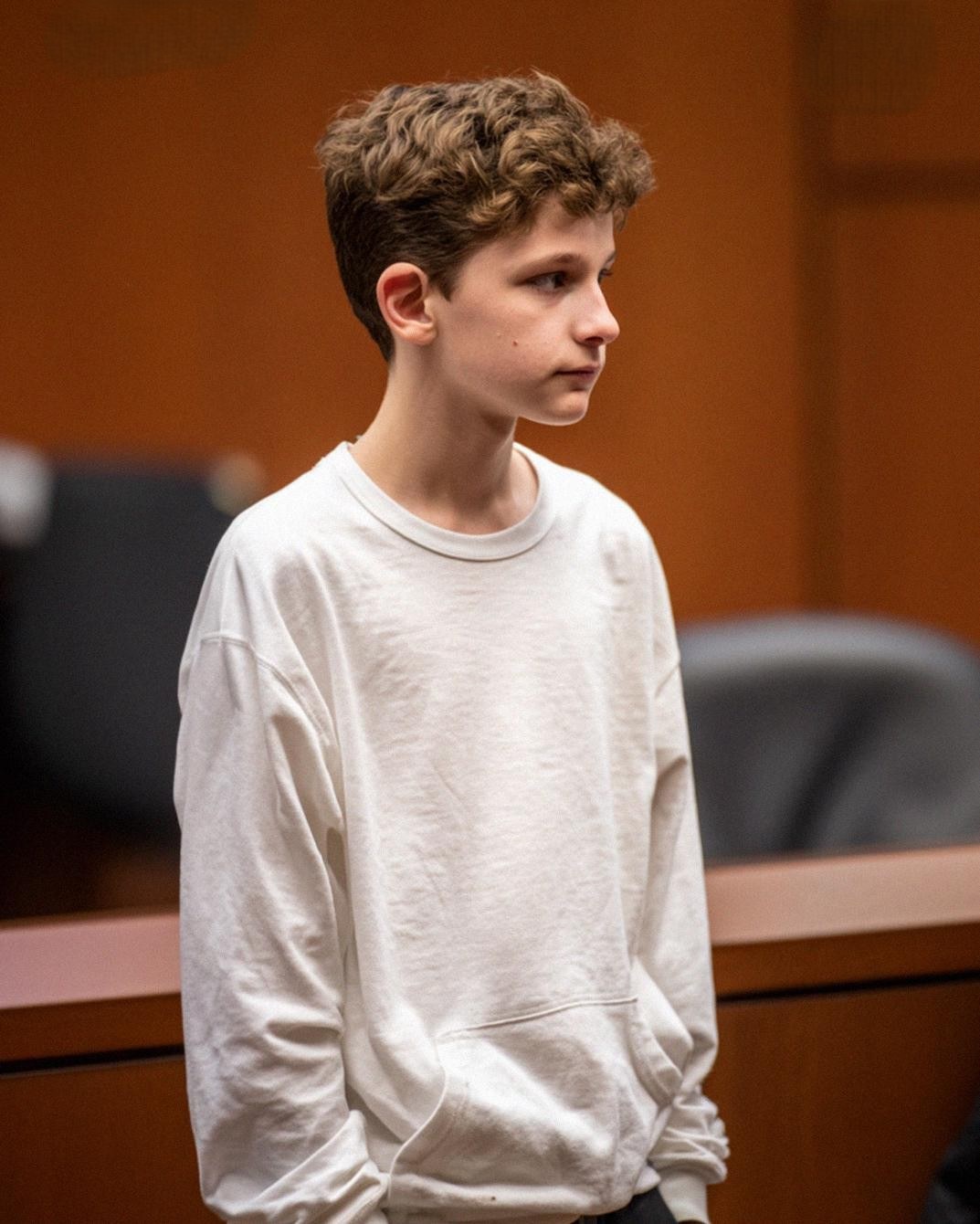
The morning of the final adoption hearing was thick with tension. In the sterile, bright environment of the courtroom, Alan seemed to shrink back into the guarded boy who had first stood in Sylvie’s doorway. Judge Brenner, a man with a reputation for empathy, leaned over his bench and spoke directly to the teenager. He assured Alan that he didn’t have to speak—that a nod, a shake of the head, or a written note would suffice to confirm his desire to be adopted. Sylvie held her breath, her hand resting near Alan’s on the table, offering a silent anchor.
When the judge asked the final, life-changing question—”Do you want this woman to be your mother, legally?”—the silence that followed was agonizing. Seconds stretched into what felt like hours. Sylvie felt a cold prickle of fear. Had she misread him? Was the weight of the courtroom too much? Then, the silence was broken not by a nod, but by the rough, unused sound of a voice clearing its throat.
Alan sat up straight, his thumbs pressing together as he gathered the courage to do what he hadn’t done in seven years. He didn’t just give a yes; he gave a testimony. In a voice that was low and raspy but gainfully certain, he recounted the trauma of being abandoned at a grocery store at age seven and the subsequent years of being treated like an unwanted commodity in the foster system. He spoke of the families who called him “creepy” or “difficult” because of his silence.
“When Sylvie took me in, I didn’t trust her,” Alan said, his eyes finally meeting the judge’s. “I thought she’d give me back too. But she didn’t. She let me exist in my own bubble, waiting at the edge for the moment it popped. She never forced me to speak. She just stayed.” He looked at Sylvie then, and the room seemed to fade away. “I didn’t speak because I thought if I said the wrong thing, I’d be sent away. But I want her to adopt me. Not because I need a place to live, but because she’s already been my mom all this time.”
The courtroom, usually a place of rigid procedure, was momentarily hushed by the sheer weight of his honesty. Even the court reporter paused, and Estella, the social worker, was seen dabbing at her eyes. Judge Brenner’s voice was thick with emotion as he declared the adoption final, officially weaving their lives together in the eyes of the law.
Outside in the afternoon sun, the world looked different. The heavy burden of the “silent child” had been lifted, replaced by a young man who had finally found his footing. When Sylvie’s hands shook too much to adjust her shoe, Alan didn’t just watch; he offered a tissue and a quiet, “You’re welcome, Mom.” It was the first time he had used the word, and it landed with the force of a prayer.
That night, the house was the same, yet entirely new. During their evening routine, Sylvie reached for the fantasy novel she had been reading to him for years—a tradition they had never outgrown. But before she could begin the first chapter of the final volume, Alan reached out and touched the cover. “Can I read it tonight?” he asked. Sylvie handed the book over, her heart overflowing as she listened to the boy who nobody wanted read her into a world of magic and light. She realized then that she hadn’t fixed him; they had simply found a way to heal each other through the power of staying.