By the time the first drop of wine hit the paper, I already had a headache.
The cabin was too warm, the kind of heavy, stale warmth that smelled like old wood, leftover gravy, and the ghosts of a thousand arguments no one ever acknowledged. The ceiling fan hummed lazily above us, pushing the same tired air around, rattling a loose chain every few seconds. Outside, the lake was a sheet of dull silver under the bruised sky, Labor Day weekend pressing at the windows in the form of distant boat motors and the occasional shout from the neighboring dock.
Inside, our family did what it always did best: pretended.
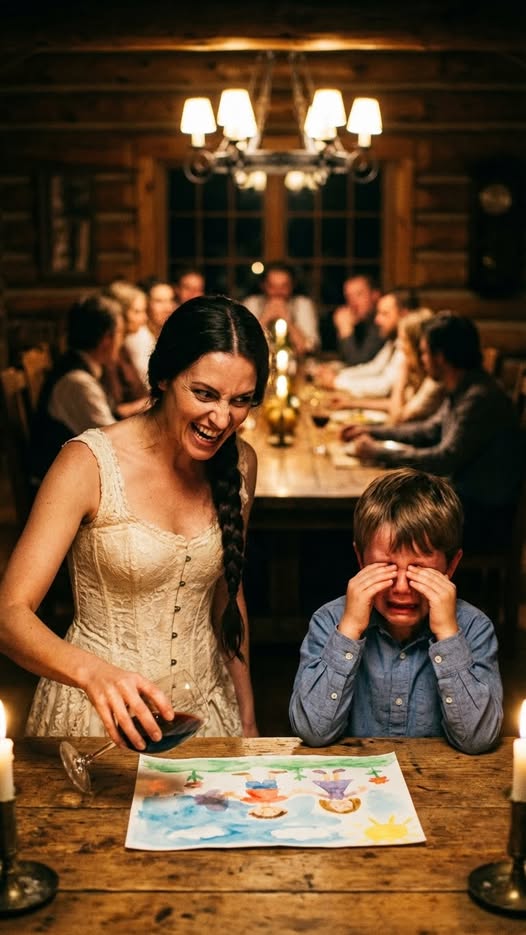
My son Jacob sat at the far end of the table, his legs swinging, his thin shoulders hunched forward in concentration. His tongue poked out between his teeth in that way he did when he was completely absorbed. In front of him lay the painting—his painting—taped carefully at the corners to a piece of cardboard, the cheap watercolor paper bowed just slightly from layers of blue and green.
He had been working on it for three days.
Three days of waking up early in the cabin’s tiny guest room, tiptoeing so he wouldn’t wake me, sneaking to the deck with his little plastic palette and that battered brush set we bought at the craft store. Three days of staring at the lake, eyes narrowed, trying to mix the exact shade of blue that captured the way the water went dark near the dock and lighter where the sun hit it.
“Do you think Grandpa’s going to like it?” he’d whispered to me that morning, while the coffee machine sputtered and coughed in the kitchen.
“He’s going to love it,” I’d said, pressing a kiss to the top of his messy hair. “He loves anything you make.”
But that wasn’t quite true.
My father, David, did love Jacob. I never doubted that. But he didn’t love “anything” the way people say in movies. He loved things that were careful. Thought-out. Solid. He was a structural engineer, and he trusted weight, numbers, plans. He loved the tiny Lego bridge Jacob had made last Christmas and refused to let anyone disassemble. He loved the school report Jacob had rewritten twice because he’d spelled “engineer” wrong the first time.
This painting? Jacob wanted it to be the first thing my father ever hung on the walls of the cabin. “Right there,” Jacob had said, pointing at a blank stretch of pine paneling near the window. “So when he reads, he can look up and see the lake, even if the curtains are closed. It’ll be like having two lakes.”
He’d laughed at his own idea, delighted.
Now, at 4:15 in the afternoon, he sat at the same table where we’d eaten rubbery scrambled eggs that morning, carefully adding tiny strokes with that cheap brush, unaware that the predator had already chosen its prey.
Jessica stood beside him, swirling her glass of pinot noir like she was hosting a tasting instead of loitering at a cramped cabin dinner table. My older sister. Thirty-three years old and still somehow the loudest presence in any room, like the world existed as background noise for her monologue.
She leaned over him, her perfume—something expensive and aggressively floral—mixing with the smell of wine and roast chicken. Her phone lay face-up on the table beside his painting, screen dark for once. Her nails were fresh, glossy red, the exact shade of the wine in her glass.
I noticed all of this in pieces, disjointed details that didn’t yet form a pattern in my mind.
Jacob looked up at her, his expression careful, hopeful. He always watched Jessica with a wary fascination, the way some children watch big dogs. Half attracted, half afraid.
“What are you working on, kid?” she asked, already bored before he answered.
“It’s the lake,” he said softly, his voice barely carrying over the murmur of conversation from the living room. “For Grandpa. For his birthday tomorrow.”
“Oh,” she said, her eyes flicking down. “That.”
That. Like it was something stuck to the bottom of her shoe.
I opened my mouth to intervene, but before I could, she tipped her glass.
It wasn’t a stumble. It wasn’t an accident that could be brushed off with an “Oops” and a laugh and a napkin. She tilted the glass slowly, deliberately, watching with dead, polished interest as the wine rolled to the lip and spilled over, a thick crimson arc.
The first drop hit the bright blue sky Jacob had painted—a water-logged, heavy stain—and then the rest followed, a small, dark waterfall crashing down into his careful brushstrokes.
The sound was soft. Just a patter. And then the paper made a quiet, pathetic crackle as it absorbed the liquid.
Jacob flinched like he’d been slapped.
I watched the dark red spread, veins of color bleeding through the blue, drowning the distant suggestion of trees on the far shore. The pigment separated as it ran, leaving ugly, bruised streaks. The paper buckled, curling up at the edges, its fragile structure surrendering.
Jacob’s hand hovered in the air, still holding his brush. A dot of blue trembled on the tip but never fell. His breath hitched.
Jessica let the last of the wine drip out, then turned the empty glass upside down and planted it right in the middle of the painting. The glass made a dull, wet thud.
“He needs to learn that the world doesn’t care about his little doodles,” she said, her words slurring but disturbingly steady. “It’s taking up space on the table.”
She wasn’t looking at my son when she said it. She was looking at me.
“And honestly,” she added, reaching for the bottle on the sideboard, “Jacob needs to toughen up.”
She refilled her glass. Behind her, Uncle Mark slapped his knee and wheezed out a laugh.
“That’s a fifty-dollar lesson right there, kid,” he crowed. “Toughen up or get eaten.”
The others joined in. The laughter rolled through the cabin, sharp and ugly, bouncing off the wood paneling and framed photos like something physical, like hail.
The air changed.
It went tight, dense, pressurized. The way it feels right before a summer storm, when the clouds are swollen and ready to split open.
I didn’t scream.
I didn’t rush to wipe up the wine or snatch the painting away like I wanted to, like my body screamed at me to do. I didn’t even breathe. For a few seconds, my lungs simply forgot how.
I watched my son.
Jacob’s shoulders shook once, a tiny tremor, like an animal suppressing a shiver. His eyes were locked on the painting, on the spreading red stain, but he didn’t make a sound. His face turned an alarming, mottled pink, then red. His bottom lip shook, then vanished as he bit down on it, hard enough to turn it white.
He didn’t look at me.
He didn’t look at anyone.
He ducked his head, pulled his elbows close to his sides, made himself smaller in the chair, his whole body shrinking in on itself. He was trying to melt into the wood, to disappear into the pattern of the knots.
He wasn’t looking for comfort.
He was looking for invisibility.
He was waiting out the laughter, like an animal waiting out the predator. Hoping if he stayed very, very still, it would get bored and go away.
And in that moment, in the space between one heartbeat and the next, I saw it. Clearer than I’d ever seen anything.
I saw the invisible chain wrapping around his small neck. The chain I knew intimately. The chain made of tiny, invisible lessons:
Don’t make a fuss.
Don’t upset anyone.
Don’t cry, even when it hurts.
Be grateful. Be quiet. Be small.
I had worn that chain for twenty-nine years.
The realization hit so hard it felt like the floor dropped out from under me. I was dizzy with it. The room blurred at the edges. The fan’s rattling became a roar, the laughter a distant, cruel echo.
I wasn’t just watching him be bullied.
I was watching him inherit my trauma like it was a family heirloom.
I was passing down a legacy of silence. Of fawning. Of swallowing every protest until they calcified somewhere behind my ribs. I was watching my son learn, right in front of me, that his pain was a joke. That his job was to endure the humiliation with a smile, so the adults wouldn’t get uncomfortable.
He was learning to be me.
If I didn’t break that chain in this exact second, I knew with awful certainty that he would carry it for the rest of his life. He would grow up apologizing for taking up space. He would become an expert at disappearing in plain sight.
I couldn’t let that happen.
I looked at my father.
David sat at the head of the table, as he always did—his place by default and by design. His plate was empty, his knife and fork aligned neatly. Other people dug into the roast chicken and potatoes, the green beans, the store-bought rolls. His hands were folded, fingers laced together so tightly his knuckles had gone white.
His face was carved into something flat and expressionless. To anyone else, he probably looked bored. Detached. The quiet man in a noisy family.
But I knew him.
I saw the small, betraying twitch in his jaw where a muscle jumped. I saw the way his eyes had gone slightly unfocused, the way they did when he was running calculations in his head. Stress loads. Support beams. Angles of collapse.
He’d been a structural engineer for forty years. He knew what a building looked like right before it failed.
The cabin felt like that now.
The air vibrated with all the things unsaid. Years of them. Decades.
My chair scraped back suddenly, a harsh grinding sound that cut through the laughter like a blade. Every head turned. Even the fan seemed to hesitate.
I stood.
I didn’t reach for napkins. I didn’t say, “It’s fine, it’s just paper,” like part of me had been trained to. I didn’t apologize for the noise or make a joke to smooth things over.
For the first time in my life, I didn’t slip into the role of fixer, of peacekeeper.
I walked around the table, each step strangely loud on the worn wooden floor, and placed myself between Jessica and Jacob. My body became a wall, a shield, my back to my son, my face to my sister.
I didn’t look down at the ruined painting.
I looked at her.
Jessica’s smirk widened as if she were waiting for my scolding, the performance she loved: me tightening my voice and saying her name like a warning, her shrug and dramatic apology, the whole thing folded into some self-deprecating joke for the group.
But the apology never came.
What rose inside me wasn’t rage, not in the way I’d always imagined it might feel. It wasn’t hot or wild or out of control. It was colder than the lake in October, colder than the wind that came slicing off the water in January. It was clear.
It was accounting.
I was done paying interest on a debt I hadn’t incurred.
“You enjoyed that,” I said.
My voice surprised me. It wasn’t loud, but it was steady. No quiver. No upward swing at the end, no softness to invite negotiation. It lay flat between us like a ledger.
“You enjoyed watching a six-year-old work for three days,” I went on, “and you enjoyed destroying what he made.”
Jessica’s eyes narrowed. She tipped her head and laughed, a dismissive huff, one shoulder lifting in an elegant shrug as she reached for the bottle.
“Oh, Sarah.” She dragged out my name like it embarrassed her to share DNA with me. “Don’t be so dramatic. It’s paper. I did him a favor. Now he can learn to do something useful instead of making messes.”
Useful.
That word slid into my chest like a thin blade. We both knew what it meant. Useful like bringing Jessica water when we were kids, so she didn’t have to get up from the couch. Useful like giving up my turn at the TV remote because “your sister had a hard day.” Useful like rearranging my shifts at the restaurant to watch her dog while she went on a brand-deal trip.
The room went dead silent. Even the distant buzz of a boat engine outside seemed to disappear. Everyone felt the shift, even if they didn’t understand it.
Jessica’s smirk faltered.
My mother gasped from the other side of the table, a sharp, scripted intake of breath that always signaled the same thing: Don’t. Don’t say it. Don’t break the illusion.
I didn’t look at her.
I kept my eyes on Jessica, and somewhere behind my sternum, something old and rusted finally snapped apart.
Before I could speak again, my mother rushed in, like always.
“Oh, Jessica, you’re so clumsy,” she trilled, already bustling to the wreckage. She grabbed a handful of paper napkins and started blotting the table with frantic, breathless energy, carefully avoiding Jacob’s painting as though it didn’t exist. “Look at this mess. It’ll stain the wood.”
She laughed, too high, too fast.
“Sarah, don’t make that face,” she scolded, not looking up at me. “It was an accident. We can buy him a coloring book, a nice one, with stickers. Jacob loves stickers, right, sweetheart?”
She didn’t wait for his answer. She was scrubbing the table like it was a crime scene and her life depended on erasing every trace of what had just happened.
“Let’s just have a nice dinner,” she pleaded, finally glancing up, eyes wide and shiny. “Please. It’s Labor Day. We’re family.”
For most of my life, that line had been a spell. “We’re family” was the incantation she used to get us to swallow hurt, to forgive unforgivable things, to sit through apologies that weren’t really apologies.
But something was wrong with the spell now. The words just lay there, old and exhausted. They did nothing.
I watched her wipe and wipe, ignoring the crumpled, bleeding paper at the center of the table, and the pity I had always felt for her—poor, anxious Mom, caught in the middle, always begging for peace—evaporated.
She wasn’t caught in the middle.
She was maintaining a system.
My mother wasn’t helpless. She was invested. Addicted to the image of the happy family she’d curated like her Pinterest boards. Dinner at the cabin. Matching sweaters for the Christmas photos. Jessica’s successes trumpeted on Facebook, my life summarized in polite bullet points.
She would pay any price to keep that picture intact.
She just never paid it herself.
She taxed us—the quiet ones, the good ones, the ones who wouldn’t scream. She taxed our self-esteem to keep Jessica calm. She sacrificed our dignity to keep Jessica from burning the house down.
Susan would let Jacob bleed if it meant the carpet stayed clean.
Jessica, emboldened by the performance, leaned back in her chair, swirling her wine, her confidence slinking back over her shoulders.
“Exactly,” she said. “He’s too soft. Sarah babies him. I’m doing him a favor, teaching him how the real world works.”
That was the final thread.
I heard it snap inside me.
My father stood.
He didn’t slam his chair back or shout. He rose with the slow, grinding inevitability of an old building finally shifting under its own weight. The movement drew every eye more effectively than any outburst could have.
He stepped away from the table and walked to the stone fireplace, to the mantel where a wooden sign hung—one of those mass-produced rustic plaques my mother loved. FAMILY IS FOREVER, it read in curling script.
He stared at it for a long moment.
Then he turned to my mother.
“You wiped the table,” he said.
His voice was low, so low I barely heard it, but it cut through the room like a dark tide. Susan went still, a wine-soaked napkin frozen in her hand.
“You didn’t check on the boy,” he continued. “You worried about the wood.”
She opened her mouth in a familiar automatic protest. “David, stop being dramatic. I’m just trying to—”
“You’re trying to keep the peace,” he interrupted.
He took a step toward the table, toward the spreading stain, toward me, toward Jacob behind me. The light from the window caught the lines on his face, the grooves carved by years of swallowing thoughts.
“There is no peace, Susan,” he said. “There is just silence. And I am done paying for it.”
He looked down at his left hand.
The gold wedding band had been there for forty years. I’d only ever seen it off once, when he’d had a skin rash and needed to apply cream. It had seemed wrong then, his finger pale and indented, as if the ring were still there in ghost form.
Now he twisted it.
The band didn’t move at first. It had sunk deep into the soft flesh. His knuckles were swollen, the skin grown around the metal with time.
He walked to the kitchen sink, every step heavy, and pumped dish soap onto his finger. The sound of the plastic bottle squeaking was absurdly loud.
He worked the ring back and forth, teeth gritted. I saw the tendons in his wrist stand out, the tension in his forearm. For a second, I thought it might not come off.
Then it slid over the joint with a wet, painful pop.
He held it between his thumb and forefinger, the soap shining on the gold, then walked back to the table.
No one spoke.
He stood over Jacob’s ruined painting, over the puddle of wine spreading into the ripples of blue and green, and held his wedding ring over it.
My mother whispered, “David—” like a prayer.
He dropped it.
The ring hit the wet paper with a dull, heavy tap, sinking into the soaked fibers. Red splashed up in tiny droplets, spotting the white tablecloth and my mother’s hand.
“I am done keeping your peace,” he said. “And I am done protecting you.”
The silence that followed wasn’t just absence of noise. It was a vacuum. It pulled at the edges of everything, sucking the air out of the room.
My mother stared at the ring as if it were a grenade. Jessica laughed, a sharp, barking sound that cracked and broke in the middle.
“Dad, are you senile?” she scoffed, though her eyes darted around the room like she was looking for an exit that wasn’t there. “It’s a painting. You’re going to divorce Mom over a five-dollar watercolor set? That is pathetic.”
David didn’t look at her.
He didn’t look at Mom.
He walked past them both to his travel bag in the corner—the gray canvas one he’d had since I was a teenager, the one with the worn leather handle and the tiny embroidered initials. He knelt, unzipped it, and pulled out a black, leather-bound notebook. Thick. Heavy. The edges of the pages were frayed and soft, the spine deeply creased.
I’d seen that notebook my whole life, but never inside it. It lived in his office, or sometimes by his recliner. He’d written in it on airplanes, during long commercials, at the kitchen table when everyone else went to bed.
He carried it to the head of the table and set it down with a thud that made the glasses tremble.
“I have been a structural engineer for forty years,” he said, placing his palm flat on the cover. “My job is to track stress fractures. To find cracks before the building collapses. I track failures.”
He opened the book.
The pages were dense with his handwriting. Small, neat, precise. Columns of dates and numbers and short notations. It didn’t look like a diary. It looked like a log.
“Three years ago,” he said, letting his finger run down the margin, “you told me you needed five thousand dollars for a business loan.”
He looked at Jessica.
“You said your influencer career was taking off, but you needed new equipment.”
Jessica rolled her eyes, crossing her arms, leaning back like this was all a tedious inconvenience.
“Yeah, and I paid you back. Mostly. What is this, an audit?”
“You didn’t pay back a dime,” David said. His voice never rose. That made it worse. “But that’s not the point. The point is that’s when I started tracking. Not just the big loans. Everything.”
He turned the book around so the pages faced us.
“Every time your mother said she needed extra cash for groceries,” he went on. “Every time she withdrew for ‘house repairs’ that never happened. Every time our savings dipped for an emergency that didn’t have a corresponding bill.”
He tapped the columns.
“I tracked the dates. The amounts. And then I hired a forensic accountant to track where the money actually went.”
Mom made a sound then—small and strangled, somewhere between a gasp and a sob. Her hand reached toward the book like she might slam it shut, but she dropped it halfway, fingers curling back to her chest.
“David, please don’t do this,” she whispered. “Not in front of everyone.”
“Everyone needs to know,” he said. “Because everyone has been laughing at Sarah. Everyone has been laughing at Jacob. Everyone thinks they’re weak. But they’re not weak.” His gaze found mine, and I saw something in his eyes I had never seen there before: raw, undiluted remorse. “They are the ones who have been paying the bill.”
My throat tightened.
He looked at me, really looked, like he was seeing me for the first time, not as the quieter daughter who could be relied upon to need less, but as a ledger entry. As a cost.
“I let this happen, Sarah,” he said. “I let you grow up believing you were less than her. I let you think she was special and you were just…there. But I was watching. I was counting.”
He turned the page.
Receipts were taped to the paper—bank transfer slips, printed email confirmations, photocopies of checks. Some were highlighted. Some had notes scribbled beside them in red pen.
“This isn’t an allowance, Jessica,” he said. “This is a ransom.”
He found one entry with his finger and read, “August fourteenth, two years ago. Twelve thousand dollars. You said it was for a brand partnership buy-in.” He flipped another page. “April third, last year. Eight thousand. You said it was for medical bills.”
Mom’s shoulders hitched. Her lip quivered. The napkin in her hand was a shredded mess now.
“But the biggest one,” David said quietly, “was three years ago. Labor Day weekend. The party we didn’t attend, because your mother told me you were sick.”
He looked at Susan. Her eyes went round and wild, shining with tears.
“David, stop,” she begged. “Please. Don’t—”
“You told me she had food poisoning.” His voice hardened. “You said she was too sick to call me herself. Too weak. So I wired the money. One hundred and seventy-four thousand dollars.”
He turned another page.
This time there was no receipt. Instead, taped carefully to the paper, was a copy of an official document—a police report. The black-and-white logo at the top, the neat lines of type below.
“The money wasn’t for business loans, Jessica,” he said. “It wasn’t for gifts. It was hush money.”
Jessica went very still. For the first time since he started talking, she looked afraid.
“Three years ago,” David continued, addressing the whole room now, his voice gaining weight with every word, “my daughter drove home drunk from a party. She hit a parked car.”
I remembered the phone call that night. Mom’s tight voice saying, “Jessica’s okay, she just had a little scare. Nothing to worry about. She’s taking some time to herself. Europe, maybe.”
“And then,” David said, “she hit a pedestrian. A nineteen-year-old girl walking her dog.”
The room tilted.
I gripped the back of Jacob’s chair so hard my knuckles hurt. The image my mind conjured was mercifully blurred—rain on asphalt, headlights, a flash of movement—nothing clear enough to be a memory. But I felt sick anyway.
“She didn’t stop,” David said. “She fled the scene. Hit and run.”
Mom broke like glass.
She sobbed into her hands, shoulders shaking, whole body trembling in her chair. “I was protecting her,” she moaned. “I was protecting our name—”
“You took our retirement money,” David said, his voice shaking now, too. “One hundred and seventy-four thousand dollars. You used it to pay for a lawyer to bury it. You paid a settlement to the girl’s family to keep it out of civil court. You paid off the auto shop to fix the damage off the books. And then you told me it was a parking dispute. You told me it was handled.”
He slammed the book shut.
The sound ricocheted around the cabin like a gunshot.
“You stole our future,” he said, “to cover up her crime. And then you let her sit at this table, year after year, mocking my grandson for painting. Destroying his work because you taught her that destruction has no consequences.”
He looked at Jessica, whose painted face now looked chalky, the color leached from her lips.
“You aren’t a businesswoman,” he said. “You aren’t an influencer. You are a liability. And your mother is your accomplice.”
Silence again. Heavy. Crushing.
Jessica pushed her chair back and stood, her motions abrupt, jerky. She smoothed her dress with hands that shook. She lifted her chin, the familiar mask scrambling back into place.
“So what?” she spat. “It was an accident. Mom helped me. That’s what mothers do. They help. Unlike you.”
She turned that glare on David, eyes glittering with fury.
“You’re just jealous,” she said. “Because Mom loves me more.”
The words were childish, ridiculous, and yet utterly sincere. She believed them, the way she’d believed them when we were kids and Mom cut her crusts off her sandwiches and forgot mine entirely.
“I don’t need your money,” she went on. “I have my own brand. My own followers. I don’t need this dusty old cabin. I don’t need any of this.”
David looked at her with a kind of cool, exhausted pity. Not as a father anymore, but as an engineer inspecting a condemned building. Measuring the cracks, the displacement, the bowing of the beams, and knowing there was no saving it.
“You have nothing,” he said.
He reached into the back pocket of the ledger and pulled out a folded document. Thick paper. Official. He unfolded it and laid it on the table next to his wedding ring and Jacob’s ruined painting.
“This cabin is in my name,” he said. “It was my inheritance from my father. Your mother’s name is not on the deed.”
He smoothed the paper flat with his palm, the ring glinting dully beside it.
“You have one hour to vacate these premises,” he said. “All of you. Susan included. I am listing it for sale tomorrow morning to recoup the retirement funds you stole.”
Mom let out a strangled cry.
“You can’t kick us out,” she wailed, clutching at her chest like an actress in a melodrama. “Where will I go? It’s pouring rain.”
“I don’t know,” David said, his voice almost gentle. “Maybe you can stay with the daughter you invested so much in.”
He turned back to Jessica.
“As of ten minutes ago,” he said, “while you were pouring wine on my grandson’s art, I called the bank. I’ve reported the transfers as fraud, pending investigation. The joint accounts are frozen. Our savings are locked. The business account you’ve been funneling money through is being reviewed.”
Jessica lunged for her phone, manic. Her fingers flew across the screen as she opened her banking app, her lips moving silently as she typed her password.
We watched the color drain from her face.
“It’s—” she choked out. “It’s declined.”
I saw it then—that thin, brittle structure she’d built her persona on—crumble. Without the steady drip of other people’s money, without the invisible scaffolding of parental bailout, she shrank. The expensive clothes, the manicure, the curated Instagram feed—none of it could hold her up without funding.
She wasn’t a powerful woman.
She was a child in a borrowed costume.
“Your power was rented,” David said quietly. “And the landlord is closing the building.”
He walked to the front door and opened it.
The storm had broken while we were inside unraveling. Rain poured down in thick sheets, hammering the porch roof. The wind drove it sideways, bringing in a fine spray that dampened the welcome mat and sent a chill into the cabin.
“Get out,” he said.
The words were simple. Flat. Final.
Jessica looked around the room, desperate.
“Uncle Mark,” she said, laughing a little, as if this were a prank that had gone too far. “Tell him he can’t do this. You’re a lawyer. Tell him.”
Mark stared at his beer bottle with sudden fascination. The man who had roared with laughter minutes before now shrank into his seat, shoulders hunched.
She turned to our mother.
“Mom,” she cried. “Say something. Tell him he’s overreacting.”
Susan’s face was ruined by tears and mascara streaks. Her mouth opened and closed, but nothing came out. For the first time, her ability to spin a story, to rearrange reality into something she could live with, failed her entirely.
Finally, Jessica looked at me.
“Sarah,” she whispered.
My name had never sounded like that in her mouth before. Not like a weapon. Not like an insult. Like a plea.
“Tell him he’s crazy,” she said. “Tell him he can’t do this to me. I’m your sister.”
I thought of every time she’d said those words as justification. I’m your sister. Of course you’ll watch my dog. I’m your sister. Of course you’ll lend me money. I’m your sister. Of course you’ll let me take the bedroom with the window.
I thought of the way Jacob’s shoulders had folded in on themselves when the wine hit his painting.
I thought of my own childhood, of Jessica tearing my science fair project to pieces and Mom saying, “She didn’t mean it, she’s just under stress. Don’t make such a big deal.”
I looked at my sister.
The girl who had terrorized me for three decades. The woman who had never once apologized for the harm she’d caused, only demanded more cushioning from the world when she fell.
I felt something heavy and sharp in my chest. Not hate. Grief, maybe, for what could have been. For the sister I’d once hoped she might become.
“You should hurry,” I said.
My voice sounded like someone else’s. Calm. Cold. Clean.
“Traffic is going to be terrible.”
She stared at me like I’d slapped her. Her lips parted, then pressed together. For a moment, I thought she might throw her glass, or scream, or push past me toward Jacob like a cornered animal.
Then she turned.
She grabbed her coat in jerky, angry motions. My mother followed suit, sobbing, protesting, grabbing at random items—her purse, a cardigan, a framed photo off the mantel without even looking at which one it was.
The door slammed behind them.
The rain roared in their wake.
For a long time, no one moved.
The cabin felt so different without their noise, without my mother’s nervous chatter and Jessica’s constant commentary. The silence was deep and raw and ringing.
Jacob moved first.
He slid off his chair and came around to my side, pressing his face into my hip. I rested a shaking hand on his head. Only then did I realize my own cheeks were wet.
My father walked slowly back to the table and picked up the soaked painting, wedding ring still sunk in its center like a sunken coin in a dark sea.
“I think,” he said quietly, “we might be done with family holidays.”
Six months later, the light in my father’s new apartment was different.
It was bright and clean, coming in through wide windows that overlooked the city park—bare trees in winter, now beginning to fuzz green around the edges in early spring. It was the kind of pale, generous light that made the scuffed floors look warmer than they were.
The apartment was smaller than the house David and Susan had shared for forty years, much smaller than the cabin. Two bedrooms, one bathroom, a galley kitchen. The furniture was a strange mix of old and new: his worn recliner, my grandmother’s side table, a sleek secondhand couch he’d bought online.
But it was peaceful.
No one raised their voice. No one sighed heavily from the other room to signal displeasure. No one slammed cabinets or stomped down the hall to make a point.
There was no need to walk on eggshells because there were no landmines hidden under the floorboards.
I sat on the living room floor, my back against the wall, watching my father and my son.
They were kneeling on a tarp spread over the floor, surrounded by sawdust and thin, raw wood. The sharp, clean smell of freshly cut pine shavings mingled with the faint tang of coffee.
David held a measuring tape, the metal glinting as he pulled it out, reading the tiny lines without squinting. Jacob watched him with rapt attention, a pencil poised over his little notebook where he had carefully drawn a rectangle and written measurements beside each side.
“You have to measure twice,” David told him, handing him the tape. “Because if you cut too short, you can’t add wood back.”
“Measure twice,” Jacob repeated, solemn. “Cut once.”
“Exactly.” David smiled. There was something softer in his face now, some tension gone from around his eyes. “Precision matters. If the frame is strong, the art is safe.”
They had decided, together, to build custom frames for Jacob’s paintings. It had been Jacob’s idea, after my father commented one day that his latest painting “deserved a real frame, not a plastic one.”
“We can make one,” Jacob had said. “Like your bridges. Strong.”
Now they were on their second frame, Jacob handling the cheap miter box saw with surprising care, his fingers kept well away from the blade, his brow furrowed with concentration.
“Like this, Grandpa?” he asked, starting the cut slowly.
“Just like that,” David murmured. “Nice and steady. Let the saw do the work. You’re just guiding it.”
Jacob’s tongue stuck out between his teeth again, but it was a different concentration than the tight, careful focus I’d seen at the cabin. He wasn’t afraid of making a mistake. He was just trying.
A month after the Labor Day disaster, I’d found a therapist—someone who specialized in childhood emotional neglect and generational trauma. I sat on her gray couch and told her about chains and cabins and wine and paint. I told her about being the “easy child,” the one who didn’t need as much.
It took me three sessions to say the words “abuse” and “neglect” without flinching.
In the fourth session, I told her about the moment Jessica poured wine on Jacob’s painting, and my therapist said, “Your father finally chose you.”
That made me cry harder than anything.
I started bringing Jacob once a month too—not because he was broken, but because I refused to wait until he was thirty-five and exhausted from carrying invisible weight to offer him help. He drew pictures in the therapist’s office. He talked about school and about Grandpa’s apartment and about the “old cabin” in precise, observant language that made my heart ache.
“I thought they would yell at me,” he said once, about the wine incident, legs swinging under the chair. “So I tried to be quiet.”
“What do you think now?” the therapist had asked gently.
He thought for a long time.
“I think,” he said finally, “grown-ups shouldn’t laugh when kids are sad.”
“That’s a good thought,” she said. “What did your mom do?”
“She stood up,” he said, glancing at me. His small hand had crept over and found mine. “She didn’t clean the mess.”
We framed that painting later—what was left of it. The warped paper, the bleeding colors, the wine stain. The ring mark in the center. We mounted it in a deep shadow box my father built, the glass set back from the paper so it wouldn’t touch.
It hung in my father’s apartment now, above his old recliner.
Not as a shrine to suffering.
As evidence. As proof that something had broken and we had survived.
My mother lived in a small condo two towns over, in a building with manicured shrubs and a communal laundry room. She had sent letters at first. Pages and pages on expensive stationery that smelled faintly of her perfume. The slant of her handwriting was familiar and jarring.
The first one was four pages long. The first line said, I don’t understand why you and your father had to make a spectacle and embarrass me in front of everyone. I stopped reading there. I watched the elegant blue ink swallow the word “embarrass” and felt something like nausea.
I didn’t need to read her script again. I knew it by heart.
I burned the letter in my kitchen sink, watching the paper curl and blacken, the words twisting into ash. Jacob sat at the table drawing quietly, and I told him we were getting rid of something that hurt us.
Every letter after that—some long, some brief, some pleading, some furious—met the same fate. The fire turned them all into the same gray dust.
She wasn’t apologizing. She was trying to reassert the old order. To tax us for peace again.
We weren’t paying anymore.
Jessica didn’t write.
I heard about her through a cousin’s social media post at first, a blurry photo of her in a mall kiosk, surrounded by glittering phone cases. The caption read, “Come visit Jessie at her new job!”
Her influencer career had shriveled without the constant injection of new designer clothes, trips, and tech. The fraud investigation had snowballed into a tangle of tax questions. She’d had to sell her car. The condo she’d been renting downtown with that rooftop pool had evaporated when she couldn’t keep up with payments.
She moved into a studio apartment over a dry cleaner. The one time I drove past—on my way to somewhere else, I told myself, though I’d taken a detour—I saw curtains that didn’t quite fit the window, hanging slightly crooked.
I didn’t stop.
I didn’t hate her, not exactly. Hate would have required more energy than I was willing to spend. Mostly, when I thought of her at all, I felt a distant, tired sadness. And a cold, firm conviction that I would never again invite her into my child’s life.
Breaking the chain meant guarding the door.
“Mom!” Jacob called, pulling me back to the present.
He held up the piece of wood he’d just cut. The edge was a little rough, but the angle was solid.
“Look,” he said. “We did the corner.”
“You did,” I corrected, smiling. “I didn’t do anything. Grandpa supervised, and you did the work.”
David glanced up, meeting my eyes over Jacob’s head.
There was an apology there still, deep and quiet, but there was also something like relief. He had told me, one late evening after Jacob was asleep and dishes were done, about the night he found out the truth about Jessica’s hit-and-run.
“I knew something was wrong,” he’d said, staring into his coffee. “Your mother’s story didn’t add up. But I let it go. I let her talk me out of asking too many questions. I wanted to believe her. I wanted to keep the peace.”
He had looked at me then, eyes wet.
“I watched you girls grow up in that house,” he’d said. “I watched Susan pour everything into Jessica and…take you for granted. I told myself you were stronger, that you didn’t need as much. That was my story. It kept me from having to do the hard thing. I’m so ashamed of that.”
He had paused, then said, very softly, “I watched the cracks forming, and I did nothing. That’s not what I do. Not at work. Not ever.”
“It’s what you did at home,” I had said.
I hadn’t said it to hurt him. Just to make it true.
He had nodded.
“And now?” I’d asked.
“Now,” he’d said, taking a breath, “I’m trying to be the man you thought I was.”
Watching him with Jacob now, patient and present and deliberate, I believed him.
Jacob clambered to his feet and came over, collapsing into my lap despite being almost too big for it now. His legs dangled long and bony over mine.
“After this one,” he said, “can we make a frame for the lake painting?”
My arms tightened around him.
“We already did, baby,” I said. “Remember? It’s at Grandpa’s.”
He shook his head, hair flopping into his eyes.
“No,” he said. “I mean the new one.”
I blinked.
“The new one?” I echoed.
He nodded, eyes bright.
“I want to paint the lake again,” he said. “But this time, with the storm. Like, half sunny, half dark? With the rain on one side and the cabin on the other.”
He paused, thinking.
“And maybe,” he added softly, “me and you and Grandpa in the window. Just little dots. Not them. Just us.”
Emotion swelled under my ribs so fast it hurt.
“Yeah,” I said, my voice thick. “Yeah, we can absolutely make a frame for that one.”
He nodded, satisfied, then wriggled free and ran back to the tarp, to the wood and the sawdust and my father’s careful instructions.
I watched them, and the weight of the past six months settled into something more solid. Less like a stone crushing my chest and more like a foundation being poured.
The price of this peace had been high.
We’d shattered the family myth. Sold the cabin. Accepted that my mother might never speak to us any way but through accusations. Accepted that Jessica might never say sorry. That there would be holidays with just three place settings instead of ten. That some people would call us cruel for “abandoning” blood.
But looking at my son laughing as he spilled a little wood glue and reached cheerfully for a rag to wipe it up, not flinching, not freezing, not bracing for a scream—looking at my father’s relaxed shoulders as he guided little hands instead of clutching a fork until his knuckles went white—I knew, with a clarity that felt like fresh air, that it had been worth it.
We hadn’t broken the family.
We had broken the cycle.
We had burned down a structure that was already rotten, and we were standing now on the charred earth, building something better. Something real.
For the first time in my life, I didn’t feel like a problem to be managed, or a background character in someone else’s dramatic story. I felt like the main character of my own life.
A woman who had chosen her child over the illusion of family. A daughter who had finally demanded better from her father—and gotten it. A sister who had stepped out of the shadow and refused to reenter it.
A mother who had broken the chain.
Jacob glanced back at me and grinned, sawdust dusting his hair like pale glitter.
“Mom!” he shouted. “When we’re done, can we hang it over the couch? So when we sit here, we can look up and see the lake?”
Two lakes, I thought. The real one we left behind and the one we were painting now, framed by hands that knew how to measure and cut and build.
“Yes,” I said. “We’ll put it right where we can see it.”
Because this time, I wasn’t going to let anyone pour wine on his world and tell him it was a lesson.
This time, if anyone tried, they would find out very quickly that I was not quiet anymore.