The sanctuary of St. Jude’s did not feel like a place of comfort; it felt like a vacuum, a hollowed-out space where the air had been replaced by the cloying, suffocating scent of white lilies and ancient varnish. It was a smell that coated the back of your throat, a sensory memory that I knew would haunt me for the rest of my life, clinging to my black dress like a second skin of sorrow.
Soft, mid-morning light filtered through the stained-glass apostles, casting fragmented pools of ruby and sapphire across the wooden pews, but the colors offered no warmth. Nothing could penetrate the glacial cold that had settled in the center of my chest.
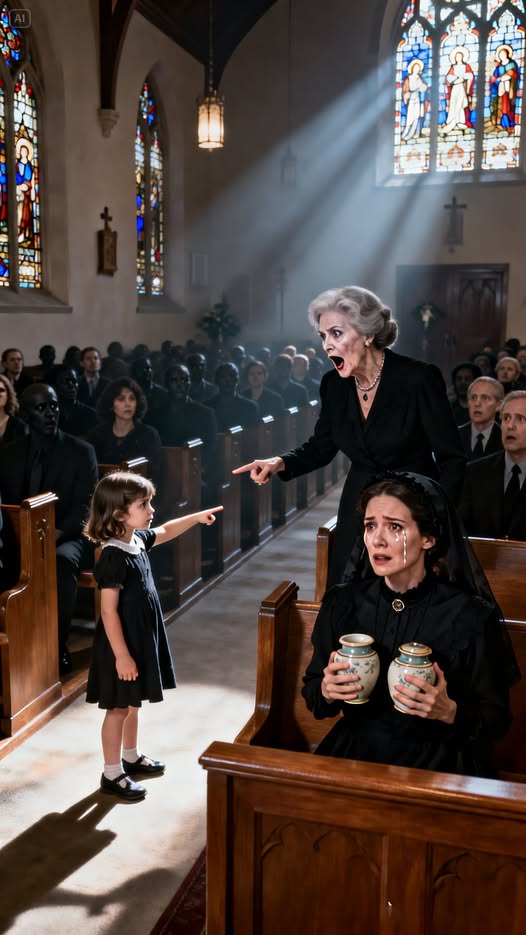
I sat in the front row, my spine rigid, pressed against the hard wood. My hands, trembling with a fine, uncontrollable vibration, cradled two small urns. They were ceramic, cool to the touch, and devastatingly light.
My twins. Oliver and Miles.
They should have been six months old today. They should have been rolling over, making those wet, bubbling sounds that pass for laughter, reaching for my hair with chubby, grasping fingers. Instead, they were ash. They were dust resting against my sweating palms, the entirety of their short, beautiful existence reduced to a weight I could hold in one hand.
Beside me, my husband, Nathan, was a statue carved from grief. He stared straight ahead at the altar, unblinking, his face a mask of grey pallor. His jaw was clenched so tightly that a muscle feathered violently beneath his ear. He hadn’t cried. Not when the hospital called us at 3:00 AM. Not when the doctors pronounced the time of death. Not when we walked out of the nursery for the last time. Grief had not just broken him; it had stolen his voice and left him stranded on an island where I could not reach him.
Behind us, the church was full. Relatives, friends, neighbors—they filled the pews, a sea of black wool and pitying glances. I could hear their murmurs, low and careful, buzzing like flies. Phrases like “God’s plan” and “Heaven needed angels” drifted through the stale air, landing on my skin like tiny, paper-thin cuts. I nodded when necessary. I performed the pantomime of the grieving mother, because that is what society demands: a dignified unraveling.
Then, the silence broke. Not with a hymn, but with a throat clearing that sounded like a gavel strike.
Eleanor, my mother-in-law, sat two rows ahead of us. She was dressed in impeccable mourning attire, a black hat with a small veil that did nothing to hide the steely set of her eyes. She sat with her back straight, hands folded in her lap, possessing the air of a woman attending a board meeting rather than the funeral of her only grandchildren.
She leaned slightly toward her sister, Aunt Martha, but in the acoustically perfect silence of the church, her whisper was a shout.
“God took those babies because He knew what kind of mother they had.”
The sentence hung in the air, suspended in the dust motes. It was calm. It was certain. It was delivered with the factual cadence of a weather report.
A few people nearby stiffened. Some looked down at their shoes, studying the scuffs in the leather to avoid my gaze. No one spoke. No one challenged her.
The words slammed into me with the force of a physical blow. My vision swam, the stained glass blurring into a kaleidoscope of nausea. My breath hitched in my throat, a ragged gasp that sounded too loud in the quiet. I felt a sudden, violent urge to stand up and scream, or perhaps to simply collapse onto the floor and let the earth swallow me whole.
I looked at Nathan. I waited for him to turn, to snarl, to defend the woman who had birthed his children. But he didn’t move. His shoulders slumped forward a fraction of an inch, as if Eleanor’s words were just another stone added to the cairn burying him alive.
I was alone. In a room of two hundred people, I was utterly, terrifyingly alone.
And then, I felt a tug.
A small, persistent pull on the sleeve of my black cardigan.
I looked down. Rosie, my daughter, barely four years old, was looking up at me. Her dark curls were pulled back with a navy ribbon I had braided into her hair that morning with fingers that felt like numb blocks of wood. Her eyes were not filled with tears. They were wide, clear, and terrifyingly observant. They held the kind of ancient wisdom that children sometimes possess when they are forced to watch the adults around them fail.
She slipped off the pew, her patent leather shoes making a soft tap-tap-tap on the hardwood floor. Before I could reach out to stop her, before I could even process what was happening, she walked into the aisle.
She walked straight up to Pastor Miller, who was adjusting his spectacles at the pulpit. She tugged gently on the heavy fabric of his robe.
The pastor looked down, startled. The organist stopped playing. The room held its breath.
“Excuse me,” Rosie said. Her voice was high and bell-clear, carrying to the back of the vaulted ceiling. “Should I tell everyone what Grandma put in the baby bottles?”
The world stopped spinning.
It wasn’t a dramatic halt with screeching brakes; it was a sudden, absolute cessation of time. There was no gasp from the congregation, no rustle of fabric. Just a silence so thick and heavy it felt like the air pressure before a tornado touches down.
Pastor Miller froze, his hand hovering mid-air over the Bible. Every head in the church swiveled. First to the small girl in the white dress standing at the altar, and then, slowly, inevitably, to Eleanor.
My mother-in-law’s face, usually a mask of powdered composure, drained of all color. Her mouth opened and closed, a fish gasping on a dock.
“What did you say?” a voice whispered from the back—my cousin, Sarah.
Eleanor stood up abruptly, her chair legs screeching against the floorboards, a harsh, violent sound that made everyone flinch.
“That’s enough!” she snapped, her voice pitching up into a register of panic I had never heard before. She stepped into the aisle, her hands reaching out as if to grab Rosie. “She’s confused. She’s grieving. She’s just a child with an active imagination.”
Rosie didn’t flinch. She didn’t back away. She looked at her grandmother with a steady, unblinking gaze that chilled my blood.
“I’m not confused,” Rosie said simply. “You said it would make them sleep longer. You said Mommy was too tired and the medicine would help.”
I felt the blood drain from my head. My knees turned to water. The urns in my lap felt suddenly heavy, like lead weights dragging me down into the ocean. My heart hammered against my ribs, a frantic bird trying to escape, but beneath the panic, a cold, crystalline clarity began to rise.
The bottles.
The memory flashed in my mind—fragmented, blurry, but sharpening now. Weeks ago. The twins crying. Eleanor visiting. Her insistence on taking the night feed so I could sleep. “Go to bed, Emma. You look dreadful. I know how to handle colicky babies.”
Pastor Miller finally found his voice. It was gentle, trembling slightly. “Perhaps… perhaps we should pause the service for a moment.”
“No.”
The word came out of me before I realized I had spoken. I stood up. My legs shook violently, but I locked my knees. I clutched the urns to my chest with one arm and steadied myself on the pew with the other.
“No,” I repeated, my voice gaining strength, echoing off the stone walls. “We have paused long enough.”
Nathan turned to me then. His eyes were wide, the grey fog lifting, replaced by a dawning horror. “Emma… what is she talking about?”
I looked at him, and for the first time in weeks, I didn’t see a stranger. I saw my husband, waking up from a nightmare only to find himself in a worse one. Tears spilled freely down my cheeks, hot and scalding.
“Our daughter isn’t lying, Nathan.”
Eleanor let out a laugh—a brittle, unnatural sound that grated on the ears like glass grinding in a disposal. “This is absurd! This is hysteria! You’re all grieving, looking for a scapegoat because you can’t accept that these things happen. Sudden Infant Death Syndrome is a tragedy, not a conspiracy!”
“You blamed me,” I said quietly, stepping out into the aisle. “Five minutes ago, you sat there and told this church that God killed my children because I was a bad mother.”
The murmurs in the pews grew louder. People were shifting, standing, whispering. The veneer of the polite funeral was cracking, revealing the ugly, jagged truth beneath.
Rosie walked back to me. She didn’t go to her father; she came to me. She slipped her small, warm hand into mine and squeezed. It was a gesture of protection. She was protecting me.
“I saw her,” Rosie continued, her voice cutting through the noise like a knife. “She put the blue liquid in the milk. She told Mommy not to use those bottles anymore, but when Mommy went to the bathroom, Grandma switched them. She said she knew better.”
Nathan inhaled sharply, a sound like a drowning man breaking the surface. He stood up, towering over the pew, his hands balling into fists at his sides.
“Mother,” he said, his voice a low rumble. “What blue liquid?”
Eleanor took a step back, clutching her pearl necklace. “It was nothing! Just a little… a little something to help them settle. Antihistamine. We used it all the time when you were a baby! It’s harmless!”
Pastor Miller raised a hand, looking pale. “I think… I think it would be wise to involve the authorities immediately.”
Eleanor’s composure shattered completely. Her face twisted into a snarl. “You can’t be serious! You’re going to call the police over a grandmother trying to help? Over a child’s fantasy?”
I reached into my oversized handbag. My fingers brushed against the cold plastic of a sealed evidence bag I had stashed there that morning—a hunch, a terrible, gnawing suspicion I hadn’t dared to voice until this very moment.
I pulled it out.
Inside were two baby bottles. We had found them hidden in the back of the guest room cabinet three days after the twins died. They still contained a residue of formula, separated and curdled, with a distinct, unnatural blue tint at the bottom.
“We had them tested,” I lied. We hadn’t yet. I had been too scared. But in that moment, I needed her to believe I knew everything. “We just didn’t want to believe it was you.”
The lie landed like a grenade.
Nathan stared at the bottles. Then he looked at his mother. The look on his face wasn’t anger anymore. It was revulsion.
“I should have protected them,” he whispered, his voice cracking into a sob. “I let you into our house. I let you hold them.”
The police arrived quietly. There were no sirens, just the heavy, authoritative presence of officers entering the sanctuary. They moved with a respectful solemnity, but their eyes were sharp, taking in the scene: the weeping mother, the defiant grandmother, the stunned congregation.
The funeral service was never finished.
Eleanor protested as they asked her to step outside. She cried. She clung to Nathan’s arm until he gently, firmly, peeled her fingers off his jacket.
“I only wanted to help!” she wailed, her voice echoing in the vestibule. “They were crying! Emma couldn’t handle them! I just wanted some peace!”
Intent. That was the word she clung to. She hadn’t meant to harm them. She just wanted control. She wanted to prove she was the matriarch, the one who knew how to soothe the babies when I couldn’t. But intent doesn’t change chemistry. Intent doesn’t bring back the dead.
Rosie sat on my lap in the front pew while the officers took our statements. She didn’t cry. She took a crayon from her pocket and drew circles on the back of my hand, grounding me, her breathing steady against my chest.
“You were very brave, Rosie,” the female officer said gently, kneeling down to her level.
Rosie looked up. “Grandma told me it was our secret. But secrets make your tummy hurt.”
The days that followed were a blur of greyscale nightmare. Interviews. Autopsy addendums. Toxicology reports.
The investigation moved with terrifying speed once the bottles were analyzed. They contained a lethal dose of an old-school sedative mixed with adult-strength antihistamines—a concoction Eleanor had apparently sworn by in the 80s, completely ignorant or indifferent to the fact that medical science—and dosage for six-month-old infants—had changed.
She hadn’t poisoned them out of malice, per se. She had poisoned them out of arrogance. She believed she knew better than the doctors, better than the parents, better than the safety warnings.
Nathan and I spent the nights staring at the ceiling of our bedroom, the silence of the house amplified by the empty nursery down the hall.
“I hated her,” Nathan confessed one night, his voice thick in the dark. “Growing up. She always had to be right. She always had to control everything. But I never thought… I never thought she was dangerous.”
“She blamed me,” I said, the anger finally breaking through the numbness. “At the funeral. She knew what she had done, and she stood there and blamed me.”
That was the part that severed the last thread of pity I might have felt. It wasn’t just the mistake. It was the cover-up. It was the willingness to let me carry the guilt of my children’s death for the rest of my life, just to save her own reputation.
Eleanor was charged with two counts of involuntary manslaughter and child endangerment. The community, once whispering about “God’s plan,” now recoiled in horror. The same people who had avoided my gaze at the funeral now left casseroles on the porch and hurried away, unable to face the reality of what had happened in their midst.
The trial was short. Eleanor’s defense was weak—a mix of denial and feigned ignorance. She never apologized. Not truly. Even at sentencing, she stood before the judge and said, “I raised three children and they all survived. I don’t understand why this happened.”
She was sentenced to ten years.
When the gavel banged down, I expected to feel triumph. I expected relief. Instead, I just felt a heavy, exhausted calm. The monster was locked away, but the nursery was still empty.
After the sentencing, life had to resume. But how do you restart a machine when the main gears are missing?
We were a broken family. Nathan carried a guilt so heavy it bowed his spine. He felt he had brought the predator into the den. I carried a rage that simmered just beneath my skin, ready to boil over at the slightest provocation.
We went to counseling. Not the kind where you sit and nod, but the kind where you scream. We learned to speak again. We dissected the resentment, the silence, the years of Eleanor’s subtle abuse that we had tolerated in the name of “keeping the peace.”
“We can’t keep the peace anymore,” Nathan said one evening, holding my hand across the kitchen table. “We have to make our own peace.”
We cried together for the first time three months after the funeral. We sat on the kitchen floor, surrounded by takeout containers, and just wept until our throats were raw. It was the most intimate moment of our marriage.
Then there was Rosie.
Our brave, truthful, observant girl. She had saved me. She had saved Nathan. If she hadn’t spoken up, Eleanor would have walked free, and I would have spent eternity believing I was a failure who had somehow caused my babies’ deaths.
“Did I do the right thing, Mommy?” Rosie asked me one night as I tucked her in. The moonlight filtered through her curtains, painting her face in silver.
“Yes, baby,” I said, smoothing her hair. “You told the truth. That is always the right thing.”
“Even when Grandma got mad?”
“Especially when people get mad,” I said firmly. “The truth is more important than anyone’s feelings.”
Spring arrived slowly in our town. The snow melted, revealing the brown, scarred earth beneath, but eventually, the green began to push through.
We decided to repaint the nursery. For months, the door had been closed, a shrine to the twins. But we realized that keeping it sealed was preserving the death, not the life.
We didn’t erase them. We kept their photos on the mantle. We kept the urns in a beautiful wooden box Nathan built. But we reclaimed the room.
Rosie helped choose the color. “Green,” she decided, pointing to a swatch. “Like the park.”
We painted the walls a soft, sage green. We turned it into a playroom for Rosie, a space filled with light and books and art.
Nathan started volunteering at a local family advocacy center. He used his construction skills to fix up homes for foster families. He needed to protect children, to make up for the ones he couldn’t save. It was his penance, and his healing.
I joined a support group for bereaved parents. I shared my story—not for pity, but to warn others. To tell them to trust their instincts. To tell them that “grandmother knows best” is a myth that can be deadly.
Summer came, bringing with it a heat that burned away the last of the winter’s chill.
We hosted a barbecue in July. It was small—just close friends, the ones who had stood by us, the ones who hadn’t looked away when things got ugly.
I stood on the back porch, watching Nathan laugh near the grill. It was a rusty sound, unused for a long time, but it was there. Rosie was running through the sprinkler with the neighbor’s kids, her shrieks of delight echoing off the fence.
The air smelled of charcoal and cut grass—a stark contrast to the lilies and varnish of that terrible morning in the church.
A friend, Sarah, came up beside me and handed me a glass of lemonade.
“You made it,” she said softly.
I looked at my family. The scars were there. They always would be. There were two empty spaces at the table that would never be filled. But we weren’t broken anymore. We were a mosaic—shattered pieces glued back together with gold, stronger at the broken places.
“We made it,” I agreed.
Grief still visited us. It came on birthdays, on holidays, on random Tuesday afternoons when the light hit the floor in a certain way. But it didn’t own us. It was a guest, not the landlord.
I walked down the steps into the yard. Rosie saw me and came running, her wet arms wrapping around my legs.
“Mommy, look! A butterfly!” she squealed, pointing to a monarch landing on the hydrangea bush.
I knelt down, ignoring the damp grass soaking into my jeans. I pulled her close, smelling the chlorine and sunshine in her hair.
“It’s beautiful, Rosie,” I said.
“Mommy?” she asked, her face suddenly serious. “When I grow up, I want to be a doctor. I want to help babies.”
I smiled, tears pricking my eyes—not of sadness, but of overwhelming pride.
“I think you already have, baby,” I whispered.
In the end, Eleanor was wrong. God didn’t take my children because of me. The tragedy was human, born of arrogance and pride. But the redemption? That was human too. It was born of a four-year-old girl who tugged on a robe and refused to let a lie stand.
Sometimes, the loudest voice in the room is the one that whispers the truth when everyone else is shouting to cover it up. And sometimes, the smallest person is the only one strong enough to carry the weight of justice.
The End.