During shopping, my eight-year-old clutched my hand and said, “Mom, quickly to the bathroom.” Her voice wasn’t whiny; it was sharp, brittle. In the stall, she didn’t use the toilet. She locked the door and whispered, “Don’t move. Look.”
I bent down. I froze. I didn’t cry. I took action.
Three hours later, my mother-in-law went pale because I used to laugh at kids’ fears. Not out loud, not cruelly, just that quiet, adult kind of amusement. Monsters under the bed, shadows in the hallway, the feeling that someone is watching me. “Sure, honey,” we say, turning on the nightlight. We check the closet to prove it’s empty. We outsource the fear to imagination.
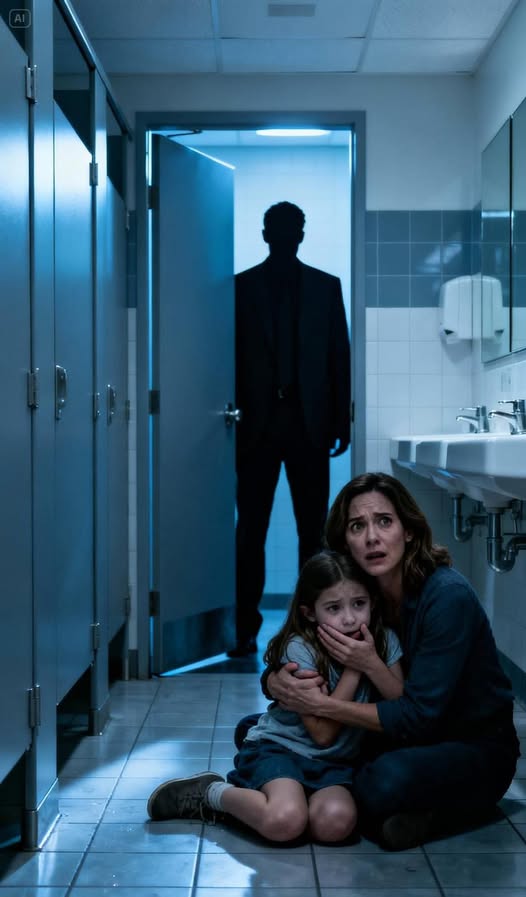
Then one Sunday, I was crouched on a sticky bathroom floor in a mall outside Columbus, Ohio, holding my daughter’s hand so tight my knuckles turned white, while a pair of polished black shoes stopped in front of our stall.
And a man’s voice, low and calm, said into his phone, “Yeah, mother and daughter. The girl’s about eight. They’ve got shopping bags. Blue dress.”
My blood turned to ice water. The Blue Dress. My daughter had picked it out ten minutes earlier. It was currently stuffed in the shopping bag pressed against my knees. This wasn’t a vague description. This was a confirmed sighting.
That’s when the “cute childhood fears” category died.
Abby’s grip on my fingers was crushing. She didn’t look at me. She didn’t need to. She put a trembling finger to her lips like we were in a movie. Except in movies, the bathroom floor isn’t tacky with spilled soda, and your heart doesn’t try to climb out through your throat, battering against your tonsils.
“Don’t move,” she mouthed.
So, I didn’t. I watched the shoes through the gap under the stall door. Slow steps, stop. Slow steps, stop. Like he was checking each stall one by one. Like he had time. Like he owned the fear in the room.
The shoes paused right in front of ours.
Abby’s breath disappeared. Mine, too. The silence in that stall was heavy, a physical weight pressing down on our shoulders. I could hear the hum of the ventilation system, the distant murmur of the food court, and the thundering drum of my own pulse.
Then the shoes moved on again, and the voice continued like he was giving a weather report. “They should have come this way if they didn’t leave already. Yeah, I’ll keep looking.”
My brain tried to catch up, scrambling for logic in a situation that defied it. A man in a women’s restroom looking for us, describing our specific purchases. This wasn’t a misunderstanding. This wasn’t a pervert looking for just anyone.
This was a hunt.
I pulled my phone out with shaking hands and hit record because if there’s one thing working in healthcare teaches you, it’s this: If it isn’t documented, it didn’t happen.
The shoes circled once more, the leather creaking softly. Then they stopped. A stall door creaked. Another creaked. He was opening them. Checking the empty ones. Abby’s eyes went huge, reflecting the fluorescent lights above.
That’s when I did the only thing I could do without giving us away. I texted 911.
Not a dramatic call. No screaming. Just typed words, my thumbs flying over the glass screen: Woman’s restroom. North side Mall. Man inside following us. 8-year-old with me. Please.
The response came fast, a digital lifeline. Stay where you are. Officers are on the way. Notify mall security if you can safely.
Mall security. Bless the American tradition of outsourcing panic to a guy in a polo shirt. But at least it was something.
When the shoes finally drifted toward the sinks, the sound of running water masking the noise, I grabbed Abby. We slipped out of the stall like smoke. Fast, quiet, bags clutched tight against our chests to stop the crinkle of paper. We didn’t wash our hands. We didn’t look back. We ran straight to the security office like our lives had a loyalty card.
The guard looked skeptical. Of course he did. Two women bursting in with shopping bags and wild eyes isn’t credible; it’s Black Friday energy.
“What’s going on?” he asked, already bracing for a complaint about a coupon or a parking spot.
Abby, trembling but articulate beyond her years, described the man perfectly. “The shoes, the suit, the camera strap around his wrist.”
And then I played the audio.
…Blue dress. They’ve got shopping bags…
The guard’s face changed in real time. The boredom evaporated, replaced by the sharp alertness of a man realizing this was above his pay grade. “That’s not normal,” he said.
No kidding.
He pulled up the cameras. We watched the footage like it was a horror film with a budget. And there he was: mid-40s, dark suit, neat hair, holding a small camera like it was an accessory, not a weapon. He walked with the confidence of someone who believed rules were for other people. He checked the trash cans. He checked the exits.
“He’s methodical,” the guard muttered. “Who is this guy?”
We watched him on the grainy monitor as he moved toward the south exit, phone pressed to his ear. He looked like a businessman closing a deal. But the deal was us.
“We have eyes on him,” the guard said into his radio. “Do not let him leave the perimeter.”
I squeezed Abby’s hand. We were safe in the office, but the dread wasn’t gone. It was just shifting shape. Because strangers don’t hunt you down for a blue dress. Strangers don’t know what you bought ten minutes ago.
“Mom,” Abby whispered, staring at the screen. “He looks like the man outside grandma’s house.”
My blood ran cold. I turned to her, the room spinning slightly. “What man, Abby?”
“The one who watches from the car,” she said softly. “The one Uncle Mike talks to.”
To understand the fear, you have to understand the grief.
Two years earlier, my husband David died in a car crash. It’s a cliché tragedy until it happens to you. One minute you’re arguing about whether to buy name-brand cereal or the generic stuff; the next, you’re signing forms you can’t read through tears that feel like acid.
After that, everything in my life became a schedule. Shifts, bills, school pickup, survival with occasional spaghetti. I’m a nurse. 12-hour shifts. The kind where you come home and your bones feel borrowed, like you have to give them back in the morning.
Abby and I made a routine out of the wreckage. Homework at the kitchen table. Cartoons after dinner. Spaghetti Night. Whenever we needed comfort, we could chew. David loved tomato sauce. He used to grow basil in a little planter box on our balcony like it was a sacred ritual.
One evening at the grocery store, months before the mall incident, Abby said casually, pushing the cart like she owned the place, “I have a math test tomorrow.”
“Are you ready?” I asked, because that’s what moms do when they’re trying not to think about the mortgage.
“I’m fine,” she said. Then quieter. “But Grandma Maggie keeps asking if school is hard. Like… like she wants me to say yes.”
I paused in the rice aisle. My mother-in-law, Margaret Louise Miller—Grandma Maggie to Abby—had been interested lately. Not the normal grandma interested. The measuring kind.
Does your mom help you? Is she home much? Does she leave you alone?
She always said it like concern, but it tasted like lemon juice in a cut. Margaret had never liked me. I was too loud, too career-focused, not “nurturing” enough for her golden son. When David died, her grief seemed to curdle into blame.
When we got home that night, Abby helped me with dinner, peeling tomatoes while I tried not to drown in memories.
“Dad would like this,” she said softly.
I swallowed the lump in my throat. “Yeah, he would.”
“Let’s buy basil next time,” she added. “The kind Dad grew.”
I nodded because saying no to that would have felt like erasing him. We were finally sitting down to eat when the doorbell rang. It was around 8:00 PM—late enough that you don’t expect company unless it’s trouble.
I opened the door and found Mike standing there with a small bouquet of flowers, like this was normal.
“Hey,” he said gently, stepping in before I really invited him. “I just wanted to check on you two.”
Mike was David’s younger brother, recently divorced, still carrying that lonely look like a heavy coat he couldn’t take off. Abby squealed because she loved people before she learned they could be complicated. Mike lifted her into his arms and handed her a little box. Inside was a plush character from her favorite cartoon.
She lit up. I didn’t. Because we hadn’t told Mike her favorite character. Not really. Not enough for him to know exactly which variation to buy.
That night, after Abby fell asleep, I sat alone with my coffee and tried to be fair. He’s lonely, I told myself. He misses his brother. He misses having a family.
But then his visits became scheduled. Every day around 6:00 PM, the doorbell rang. Like Mike had set an internal alarm. He always brought something. Candy, school supplies, another toy. At first, I was grateful. Then I was tired. By the second week, Abby started sighing when the bell rang.
“He’s here again,” she’d whisper, and her smile would dim just a little.
Mike would sit on the couch and talk about how empty his apartment felt, how we were a “bright spot,” how David would have wanted him to watch over us. That line—“David would have wanted”—became his master key. He used it on every locked door.
I tried once, carefully. “Mike, maybe not every day,” I said, aiming for kind instead of harsh. “We’re exhausted sometimes. Abby has homework.”
He blinked like the idea offended him. Then he apologized profusely. “Of course, Kate. I just worry. I’ll back off.”
He showed up the next day anyway. “Just dropping off milk,” he said. “I noticed you were low.”
I hadn’t told him we were low on milk.
One night, he said casually, like he was reading off a calendar, “Can I come watch Abby rehearse her class presentation next Thursday? 2:00 PM, right?”
My skin went cold.
“How do you know the day and time?” I asked. I hadn’t even signed the permission slip yet.
“Abby told me,” he said, smiling.
I looked at Abby. She looked confused. “I didn’t,” she said slowly.
Mike laughed awkwardly, a sound that didn’t reach his eyes. “Oh, maybe I heard it another way. Or maybe I guessed. You know me.”
Another way? Sure.
He showed up at the school anyway. He sat in the auditorium among the parents like he belonged there, like he was filling David’s seat. After Abby presented, Mike handed her a tiny bouquet. She said, “Thank you.” Politely.
In the car on the way home, Abby stared out the window and whispered, “Mom, I get tired when Uncle Mike comes.”
“Why, honey?”
She hesitated. “It feels like he’s watching me. Like… like he knows everything I love, but I don’t remember telling him.”
Kids don’t have a filter. They also don’t have a reason to lie about that feeling in their gut.
So, I started watching Mike. The way his eyes moved around our living room. The way he picked up framed photos and held them a second too long. The way he looked at Abby’s schoolwork like it was evidence.
One afternoon, he mentioned something that hadn’t even been discussed in our house yet. “Oh, Abby must be excited for the zoo field trip next month,” he said with a grin. “Packing lunches will be a challenge, huh?”
I froze. The zoo flyer had been handed out the day before. It was on Abby’s desk under a stack of papers. I hadn’t even read it yet.
“Where did you hear that?” I asked carefully.
“From Abby,” he said quickly.
Abby’s head snapped up from the TV. “I didn’t tell him. I forgot about it.”
Silence filled the room. Thick. Suffocating.
Mike laughed, forced and brittle. “I must have mixed it up with something else.”
He stood up to leave, sensing the shift in the air. “Well, I better get going.”
The next day, I watched from the second-floor window as Mike left. He paused outside, turned, and stared up into our living room window. He wasn’t smiling. He was taking notes on his phone. And for the first time, I realized he wasn’t looking at us with love. He was looking at us with inventory eyes.
Back in the security office, thirty minutes felt like thirty years.
The guard’s radio crackled. “Subject detained near the South Entrance. He’s… calm. Says he has ID.”
They brought him in. Seeing him up close was worse than seeing him on the camera. He was aggressively normal. Mid-40s, neat suit, the kind of face you forget five seconds after seeing it.
He didn’t run. He didn’t even look surprised. When the guard questioned him, the man calmly flashed a plastic card.
“I’m Brian Douglas Hartman,” he said. “Licensed Private Investigator. I’m conducting an investigation.”
“What investigation?” the guard asked, crossing his arms.
“I can’t disclose that,” Hartman replied smoothly. “Confidentiality.”
And then he said something that should have been funny, except it wasn’t. “But I’m not doing anything illegal. A PI in a public space, searching for a subject. Standard procedure.”
“You were in a women’s restroom,” I snapped, stepping forward. “You were hunting an eight-year-old child.”
He looked at me then. Cold. Assessing. “I was verifying the location of the subjects.”
Security called the police anyway because, even in America, a badge you bought online doesn’t magically excuse you from common sense or harassment laws.
A cruiser arrived about twenty minutes later. An officer took one look at Abby, who was now clinging to my leg, and softened visibly. Then he looked at Hartman and didn’t soften at all.
Hartman was escorted out in handcuffs, protesting about his “client’s rights.”
That’s when my phone rang.
Mike.
“Kate,” he said, breathless. “Are you okay? I heard something happened.”
I blinked, the phone feeling hot against my ear. “Mike, how do you know?”
“I… I saw it online,” he said quickly. “People were posting about a suspicious guy at the mall. I thought… I thought it might be you.”
It had been less than an hour. Maybe in the age of neighborhood apps and local Facebook groups, that wasn’t impossible. But it still landed wrong because Mike always seemed to know things before I told him.
“I’m coming,” he said. “Where are you?”
“We’re with police,” I answered, my voice flat. “They want statements at the station. I can drive myself.”
“I’m coming anyway.” He hung up before I could argue.
We drove to the precinct. The fluorescent lights made everything look worse, specifically my own shaking hands. Abby sat beside me, quiet, holding my sleeve like it was the only stable thing in the room.
Hartman sat across the hallway in an interrogation room. Still calm. Still polished. Like this was an appointment, not a crime.
Mike showed up before we were even done giving our statement. His face was pale. He rushed to Abby first, crouching to her level. “Are you okay?” he asked.
Abby nodded, but she didn’t move toward him. She pressed herself harder into my side. That was new.
A detective, a sharp-eyed woman named Detective Vance, interviewed Hartman. At first, Hartman didn’t want to talk. Then, Vance explained calmly what entering a women’s restroom to pursue a child looks like in court—predatory behavior, endangerment, harassment.
Hartman’s confidence cracked. He realized his “professional immunity” was a myth.
Finally, he said it. “I was hired,” he admitted.
“Hired by who?” Detective Vance asked.
“A woman named Margaret Louise Miller.”
My ears rang. The world tilted on its axis. My mother-in-law.
My hands went numb. “Why would she hire you?” I whispered, though I wasn’t in the room with him. I was watching through the one-way glass with Mike.
Hartman swallowed. “To document Catherine Miller’s daily life,” he said. “To assess parenting. Whether the child is being neglected because the mother works too much.”
I stood up so fast my chair scraped the floor with a screech that made Mike jump. “What does that even mean?” I snapped at the glass.
Hartman looked down at his hands. “She believed the mother was unfit. She wanted evidence for a custody petition.”
Custody? For my daughter? From me? Because I work? Because I’m tired? Because my husband died and I didn’t fall apart politely enough for her taste?
Mike stared at the glass like he’d been punched in the gut. “No,” he said. “No, my mom wouldn’t. She just… she worries.”
Detective Vance walked out of the interrogation room and came to us. Her eyes went sharp on Mike.
“Mr. Miller,” she said. “You’ve been at Ms. Miller’s home often. You’ve asked about schedules, school events, plans.”
Mike opened his mouth, closed it, opened it again. “I was worried,” he said finally. “About my sister-in-law and my niece.”
“Worried about what?” Vance asked.
Mike froze.
And then Abby spoke. Soft. Clear. A bell ringing in a quiet church.
“I saw that man at Grandma Maggie’s house,” Abby said.
The room went still. The detective turned gently to her. “When, Abby?”
“Two weeks ago,” she said. “When I visited. Uncle Mike was there, too. He was talking to him.”
Mike flinched as if struck. I turned to him, the betrayal blooming in my chest like a dark flower. “You knew him?”
Mike looked at me, tears welling in his eyes. “I didn’t know he would go to the mall, Kate. I swear. I just… I gave him the schedule.”
“You gave him the schedule?” My voice was barely a whisper, but it filled the room.
Mike looked desperate. “Mom said she needed to know you were safe. She said she wanted to help, but you wouldn’t let her. She told me this guy was just doing a… a wellness check. A background thing.”
“A wellness check involves stalking us in a bathroom?” I asked.
“I didn’t know!” Mike shouted, then lowered his voice. “She asked for dates. Times. When you worked late. When Abby had events. She said she wanted to surprise Abby. She said she wanted to prove you were doing a good job so she could stop worrying.”
“She lied to you, Mike,” I said. “And you let her.”
Detective Vance brought in a folder found in Hartman’s car. Inside were dozens of photos.
Me and Abby at the park. Me picking her up after school, looking exhausted in my scrubs. Me carrying groceries with messy hair. Me laughing with her on a bench like I didn’t know I was being watched.
There were printouts of my social media tags. Copies of my work schedules pulled from somewhere in the hospital system—someone had to have authorized that access.
And then the worst part: a typed plan. A checklist.
Establish pattern of absence.
Document lack of supervision.
Highlight emotional instability (grief).
Goal: Full custody to Margaret L. Miller.
There was also a neat little section on Margaret. Stable income, paid-off condo, clean, structured environment, deep interest in the child’s education.
Like parenting was a resume contest.
Mike stared at the pages, his hands shaking. “My mom… she was really going to do this,” he whispered. “She used me.”
“She used all of us,” I said.
Margaret came to the station the next day. She arrived with the dramatic flair of a soap opera matriarch. She cried immediately—the kind of crying that arrives on purpose.
“My Abby!” she sobbed. “She’s all I have left of David.”
She looked at me like I was a temporary obstacle. Like I was an incubator she had tolerated and now wished to discard.
“Catherine works so much,” she said to the detective, wiping her face with a lace handkerchief. “It’s too hard for her alone. I could give Abby a better life. More attention. Brian was just supposed to prove that she needs help.”
Detective Vance’s voice stayed flat. “You understand you can’t remove a child from a fit parent just because you disagree with her work schedule? And hiring a man to stalk them is harassment, Ms. Miller. Bordering on endangerment.”
Margaret’s lips trembled. “I didn’t have a choice,” she whispered. “Abby is my only hope.”
“No,” I said, stepping forward. “You had choices. You chose control. That’s what people like you never admit. You call it love because it sounds nicer.”
The fallout moved fast after that.
A judge signed a Temporary Protective Order. Margaret wasn’t allowed to contact Abby directly. Any visitation had to be supervised. No pop-ins. No “just checking.” No surprise appearances at school.
CPS came by once because, of course, they did. A caseworker looked at my kitchen, Abby’s room, her clean backpack, her homework folder, and my hospital ID badge still clipped to my lanyard like a scar.
She asked Abby if she felt safe. Abby said yes.
Then she asked if anyone made her feel unsafe.
Abby said quietly, “Grandma Maggie. That was enough.”
Margaret left town soon after. She went to stay with her sister in another state to “recover,” because even villains need rest. Apparently, Hartman faced charges for stalking and harassment, and suddenly his “confidential investigation” didn’t sound so official anymore.
A week later, Mike came to our door. He didn’t ring the bell. He just stood there, staring at the wood, until I saw him through the peephole. He looked like a man who had aged a decade in seven days. I opened the door.
“Kate,” he said quietly. “I don’t expect you to forgive me. But I have something of David’s I think you need to see.”
We sat in the living room. Abby was doing homework in her room, the door cracked open the way kids do when they’re listening.
Mike placed a small box on the table. It wasn’t a toy this time. It was a stack of letters. Old ones.
“I found these in Mom’s attic,” Mike said. “David wrote them to me when you guys first got married. I forgot I left them there.”
He pushed one toward me.
Mike, you have to see Kate with the baby. She’s a natural. Mom gives her a hard time, says she’s too busy, but Mom doesn’t see the love. Kate is the glue, man. If anything happens to me, you make sure Mom doesn’t steamroll her. Kate is the mother Abby needs.
I read the words, and the tears finally came. Real ones. Not the panicked tears of the bathroom stall, but the healing kind.
“I failed him,” Mike said, his voice breaking. “I thought Mom was just worried. I thought… I don’t know. I always felt like the spare part. The runner-up. Mom made me feel important by asking for my help. I was stupid.”
“You were manipulated,” I said. “But yes, you were stupid.”
Abby appeared in the doorway then, like she’d been summoned by the truth.
“Are you talking?” she asked.
Mike dropped to his knees in front of her. It was the first time he looked small. “I’m sorry,” he said. “I’m sorry you were scared because of me.”
Abby studied him for a long moment. Children are the harshest judges and the most merciful priests.
“You’re not bad,” she said simply. “Grandma Maggie tricked you.”
Mike’s face crumpled. “That doesn’t excuse me,” he whispered.
Abby walked over and took his hand. “But if you weren’t around,” she said softly, “maybe it would have been worse. Because then we wouldn’t have noticed something was wrong. You made mistakes, Uncle Mike. But you stayed.”
I turned away so they wouldn’t see my eyes, because sometimes an eight-year-old says something wise enough to break you.
Mike didn’t become family again overnight. He earned his way back like someone rebuilding a house after a fire. Slow, careful, no sudden movements.
He stopped asking where we were going. He stopped trying to check things. He just showed up when asked—fixing a leaky faucet, picking Abby up from school if I got held late at the hospital (and always texting me immediately).
He helped me drive out to the old lake cabin David loved so I could keep the little garden patch alive. It felt wrong to let it die, too.
He told Abby stories about David as a kid. Not to replace him, but to keep him real. Abby listened like those stories were oxygen.
Some nights, Mike and I sat at the kitchen table with tea and silence. Not romantic. Not yet. Just human. I started seeing him as a person. Not just a role, not my husband’s brother, not Margaret’s son. Just Mike.
And that made all the difference.
One year later, spring came with lilacs and the kind of soft air that feels like permission to breathe again.
Mike and I got married quietly. No spectacle, no performance. Abby wore a white dress—her choice—and scattered flower petals down the aisle, beaming like she was carrying sunlight.
After the ceremony, she hugged me tight.
“Mom,” she asked, voice small. “Are you happy?”
I kissed the top of her head. “I am,” I said. “Because of you.”
She looked up at the sky. “Do you think Dad can see us?”
My throat tightened. It still did, even after time. “Yes,” I said. “I think he can. And I think he’d want us safe.”
Mike lifted Abby into his arms. “I’m not here to erase your dad,” he told her gently. “We’ll remember him always.”
Abby wrapped her arms around his neck. “I love Dad Mike,” she declared, then added just as firmly, “And I love Dad David.”
And somehow, that made room in my chest for peace.
Somewhere else, in another city, another window, Margaret probably still stared out and called it heartbreak. Maybe it was. But heartbreak doesn’t give you permission to hunt a child.
We didn’t cut her off entirely. Months later, after court reviews, contact was limited to supervised calls. Brief, structured, and on our terms. She could call Abby—supervised, brief, structured. Boundaries she hated until she finally learned them.
And me? I learned something, too.
Love that demands control isn’t love. It’s ownership.
So, tell me: have you ever had someone claim they were “just worried” while tightening their grip around your life? How do you tell the difference between care and control?