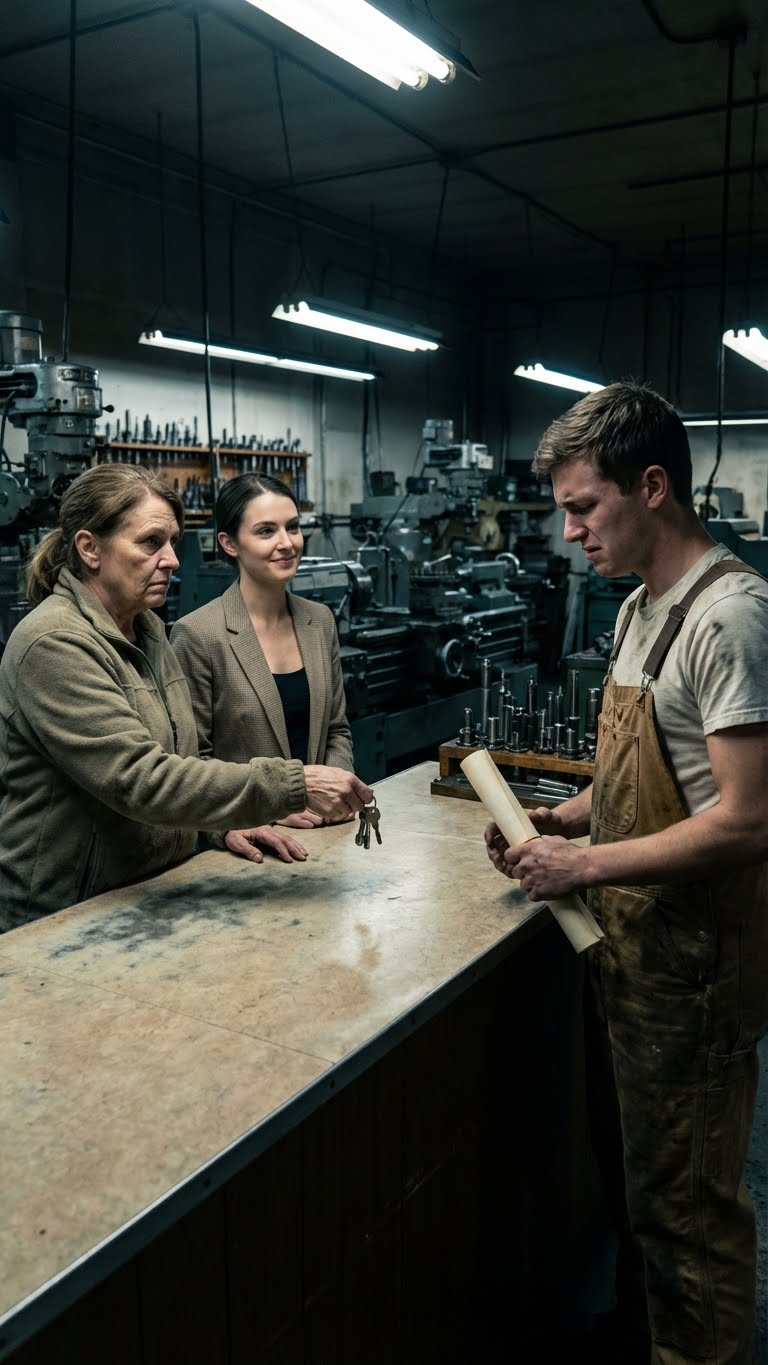
The theft of my future did not arrive with a scream or the dramatic flourishes of a legal summons; it arrived with the rhythmic, metallic clatter of brass hitting a laminate counter.
I remember the sunlight of that afternoon vividly. It was filtered through the grime-streaked windows of Holloway Precision Works, casting long, amber fingers across the lathes and the heavy workbenches I had called home for a decade. I was still wearing my graduation shirt, the stiff collar chafing against my neck, a lingering reminder of the ceremony I had just attended. I had a degree now—a testament to four years of midnight oil, grueling exams, and the crushing weight of student debt. I thought the parchment in my bag was a bridge to equality. I was wrong.
My sister, Elena, walked into the shop with a gait that suggested she already owned the air we breathed. She wasn’t carrying grease-stained invoices or a broken component; she was clutching a new set of keys. They were heavy, polished to a mirror sheen, and attached to a leather fob embossed with the family crest. She set them on the counter like a conqueror planting a flag.
My mother, Martha, was already there, her face glowing with a pride she had never once directed toward a mechanical drawing of mine. My father, Arthur, stood in the shadow of the industrial press, his hands folded behind his back, his gaze fixed on a point somewhere near his boots.
“We didn’t want to spoil your big day,” my mother began, her voice airy, as she slid the keys across the counter toward Elena. “But we’ve made the decision. Elena will be taking over the directorship officially. The business needs a visionary now.”
I waited for the second half of the revelation. I waited for my name to be uttered—for the “and” that would signify my role as her partner, the technical backbone to her administrative front. The silence that followed was thick, suffocating, and smelled of stale coffee and cooling metal.
When I finally found my voice, it sounded small even to my own ears. “And what does that mean for me? After ten years of sixty-hour weeks? After the degree I just earned to help us modernize?”
Martha smiled, the kind of indulgent, pitying expression one offers a child who has failed to understand a simple riddle. She reached out and patted my hand—the hand that was currently stained with the indelible ink of a leaking hydraulic line.
“Darling, you’ve always been so wonderful with your hands,” she whispered. “But the business… it requires a certain kind of brain. No drama, no heat. You’ll keep doing what you’re best at. Fixing things. Let Elena handle the thinking.”
The words landed with the precision of a scalpel. They didn’t just hurt; they redefined me. In their eyes, I wasn’t an engineer or a successor. I was a high-functioning tool, an extension of the machinery I maintained.
As I looked at the polished brass of the keys, I realized the locks had been changed on more than just the front door.
Growing up in the Holloway household meant learning early that there were two castes: the architects and the laborers. Elena was the golden child of the classroom. My parents framed her essays on economic theory like they were holy relics. They marveled at her “strategic mind” when she successfully negotiated a later bedtime.
I, meanwhile, was the one who quieted the rattles in the vents. I was the one who spent my Saturdays in the belly of the shop, learning the language of friction and torque under my father’s silent tutelage. Arthur was a man of few words, and for years, I mistook his silence for a shared bond. When I’d spend twelve hours rebuilding a seized motor, he’d clap my shoulder and mutter, “Good work.”
I thought those two words were a down payment on a legacy. I thought his calloused palm against my shoulder was a promise that one day, this kingdom of iron and oil would be mine to lead.
Instead, I became a ghost in the machinery. At family dinners, the conversation was a closed circuit between my parents and Elena. They spoke of Expansion Strategies, Brand Identity, and Market Positioning. I would sit there, passing the salt, refilling water glasses, my skin still tingling from the vibration of the shop floor. Whenever I tried to contribute a thought on how we could improve our throughput or reduce waste, Martha would cut me off with a gentle, “Let’s keep the shop talk for the shop, dear. Let your sister focus on the big picture.”
Despite the sting of the graduation betrayal, I went back to work the next morning. I arrived at 5:00 AM, the cold air of the shop biting through my coveralls. I told myself that loyalty was a currency that eventually had to be honored. If I worked harder, if I became indispensable, they would have to see the “brain” behind the “hands.”
But the atmosphere had shifted. Elena didn’t just take the title; she began to colonize the space. She brought in Modernization Consultants—men in slim-fit suits who looked at the grease on my forehead as if it were a contagious disease. They stood in the middle of my workspace, pointing at machines they didn’t understand, discussing “optimization” while I was trying to hear the tell-tale whine of a failing bearing.
“We need to move the assembly line,” Elena announced one afternoon, her voice echoing through the vaulted ceiling. She didn’t consult the floor plans I had meticulously drawn. She didn’t ask about the load-bearing requirements of the concrete.
“The vibration from the heavy presses will destabilize the precision lathes if you move them there,” I said, wiping my hands on a rag.
Elena didn’t even turn around. She continued pointing for the benefit of her consultants. “He handles the physical stuff,” she told them, her tone dismissive. “I’ll explain the overarching strategy for the floor flow later.”
The consultants nodded, scribbling in their digital tablets. I was no longer a person to them. I was furniture that happened to speak.
I tightened a bolt on the lathe—a bolt that didn’t need tightening—just to feel the resistance of something I could still control.
By the third month of Elena’s reign, the cracks began to show, though they were invisible to those who didn’t know the heartbeat of the shop. She had canceled our contracts with the Local Steel Suppliers I had known since childhood, opting instead for a cheaper, high-volume distributor from out of state.
“Efficiency is about margins, not friendships,” she had snapped during a meeting where I was relegated to standing against the back wall.
The new steel was brittle. I could feel it the moment the drill bit touched the surface. I brought a sample to my father’s office, the metal cool and unforgiving in my hand.
“Dad, this batch is sub-standard. If we use this for the Vanguard Logistics order, the structural integrity won’t hold under heat.”
Arthur looked at the sample, then up at the door to ensure Martha wasn’t lurking in the hall. “Elena says the specs are within the acceptable variance, kid. She’s looking at the bottom line. We have to trust the leadership.”
Leadership. The word tasted like ash.
A week later, a lead technician from Vanguard Logistics—our biggest client and the foundation of the Holloway legacy—came by for a spot check. He was a man named Harlan, an old-school engineer who could smell a faulty weld from fifty paces. He walked past Elena’s glass-walled office and came straight to my bench.
“Something’s off with the resonance on these housings,” Harlan said, skipping the pleasantries. “What changed?”
Before I could answer, before I could explain the metallurgical failure of the new steel, Elena was there. She glided across the shop floor, her heels clicking like a metronome of impending disaster.
“Harlan! So good to see you,” she chirped, physically stepping between us. “My brother was just about to tell you how we’ve optimized the cooling process. Let’s go to the conference room; I have some incredible data visualizations to show you regarding our new throughput speeds.”
Harlan looked at me, his eyes searching mine. He knew. He had dealt with “visionaries” before. I stayed silent, the heat of a dozen unspoken warnings burning in my throat. I watched them walk away, Elena’s hand on his arm, her “brain” leading him toward a beautiful lie.
That night, I stayed until 2:00 AM. I didn’t get paid for it. No one asked me to do it. I rebuilt the Vanguard prototype from a hidden stash of the old, high-quality steel I had scavenged from the scrap bin. I worked until my vision blurred, my fingers bleeding from the fine-grit sanding required for a perfect seal. I did it to save the family name. I did it because, despite everything, I still believed that being the “hands” meant being the savior.
The next morning, the prototype sat on the display table, flawless. Elena walked in, saw it, and smiled at the client.
“I told my team to stay late and polish the ‘vision’ I had for this piece,” she said.
She didn’t look at me. Not once.
As the client signed the extension, I realized that in this house, the hands did the work, but the shadow took the credit.
The breaking point arrived on a Tuesday. There was nothing atmospheric about it—no thunder, no dramatic lighting. Just the hum of the overhead fans and the low-volume drone of a classic rock station on the radio.
The shop was half-empty, the air heavy with the smell of ozone and cutting fluid. My father walked over to my bench around 5:30 PM. He looked tired. The skin under his eyes was sagging, and his shoulders, once broad and unyielding, seemed to be collapsing inward.
“We have a backlog on the Southwest Pipeline fittings,” he said, his voice a low gravel. “Elena overpromised the delivery date. I need you to pull an all-nighter, kid. Just for a bit. To get us over the hump.”
I stopped what I was doing. I looked down at my hands. They were a map of my life. There were scars from a slipped wrench when I was nineteen. There were deep-seated stains of blackened oil that no amount of industrial soap could ever fully erase. My nails were jagged, my knuckles swollen.
I looked at Arthur. I saw a man who had traded his son’s soul for a quiet life with his wife and daughter.
“No,” I said.
The word felt foreign in my mouth. It was a small syllable, but it carried the weight of a decade of resentment. Arthur blinked, his mouth opening slightly as if he had misunderstood.
“Excuse me?”
“I said no, Dad. My shift ends at six. I’m going home.”
“But the deadline—”
“The deadline was set by the ‘brain’ of this operation,” I said, my voice rising just enough to cut through the shop noise. “If she’s the visionary, let her envision a way to weld steel at 3:00 AM. I’m done being the extension of your tools.”
I didn’t wait for a rebuttal. I didn’t look at the office where Elena was undoubtedly “branding” something on her laptop. I turned off my station, wiped down my tools with a meticulousness that felt like a funeral rite, and walked out.
I didn’t come in on Wednesday. Or Thursday.
My phone became a buzzing insect on my kitchen counter. Martha called six times, her voicemails transitioning from confused to indignant to hysterical. Elena sent a text: Your unprofessionalism is jeopardizing the Holloway legacy. Get back here or don’t bother coming back at all.
I didn’t bother. I spent the days in my small apartment, watching the way the sunlight hit the linoleum. I washed my hands until the skin was raw, but for the first time in ten years, they didn’t smell like the shop. They smelled like nothing. And nothing was the most beautiful scent I had ever known.
On Friday, the buzzing stopped. The silence that followed was far more terrifying than the noise.
The silence lasted exactly one week.
It was broken by my father’s voice, but it wasn’t the voice of the man who clapped my shoulder. It was the voice of a man who was watching his world burn.
“We have a problem,” Arthur said when I finally picked up. His voice was brittle, cracking like dry parchment. “Harlan… he’s pulling the Vanguard contract. He says the latest shipment of housings failed the stress test. He’s threatening to sue for breach of contract.”
I leaned against my sink, closing my eyes. I could see the failure in my mind’s eye. The brittle steel, the rushed welds, the lack of the “hands” that knew how to compensate for the metal’s weaknesses.
“Elena tried to fix it,” Arthur continued, a desperate edge to his words. “She hired a new lead tech, someone with ‘high-level certifications,’ but they can’t figure out why the seals are popping. Harlan won’t talk to her anymore. He won’t talk to the consultants. He said… he said he only trusts the man who built the prototype.”
I listened to the sound of my father’s breathing. In the background, I could hear Martha crying and Elena shouting at someone on another line. The Holloway “vision” was colliding with the cold, hard reality of physics.
“We need you to come in,” Arthur pleaded. “I’ll give you whatever you want. A raise. A title. Just come back and talk to Harlan.”
I looked at my hands. The stains were finally fading, the skin turning a healthy, unscarred pink.
“I’m not part of the business, Dad. Remember? I don’t have the ‘brain’ for it. I’m just good with my hands.”
“Don’t do this,” he whispered. “This is our legacy. Everything I built.”
“You didn’t build it alone,” I said, my voice devoid of heat. “But you decided I was a tool you could use and then put away in a drawer. I’m not a tool, Dad. And I’m not coming back.”
I hung up.
The news reached me through the industry grapevine over the next few months. Vanguard Logistics didn’t just walk; they took three other major clients with them. The lawsuit was settled out of court, but it gutted the company’s reserves. Holloway Precision Works didn’t vanish overnight, but it shrank. The expansion was canceled. The consultants vanished. Elena had to move out of her glass office and actually answer the phones.
I found work at a firm called Sterling Dynamics. It was a smaller shop, twenty miles away. There was no family history there, no heavy weight of “legacy” to carry. On my first day, the owner, a woman who had started as a machinist herself, handed me a set of blueprints for a specialized aerospace component.
“I heard you’re the best at complex seals,” she said, looking me in the eye. “What do you think of this design? My brain tells me it’s solid, but I need your brain to tell me if it’s actually buildable.”
I looked at the prints. I felt the old familiar hum of problem-solving ignite in my chest.
“The tolerance on the third flange is too tight for the alloy you’ve specified,” I said, pointing to the drawing. “If we adjust the thermal treatment, we can get the seal, but we need to rethink the housing.”
She smiled and handed me a set of keys. They weren’t polished brass. They were simple, silver, and slightly worn.
“Good. Get to work. I’ll be in my office if you need to argue about the physics.”
I realized then that recognition doesn’t come from a clap on the shoulder; it comes from being seen as a mind that happens to have hands.
Six months later, Martha insisted on a family gathering for Arthur’s birthday. I tried to decline, but the guilt-tripping was a Holloway specialty that even I couldn’t entirely ignore.
I arrived late. The house felt smaller than I remembered. The air was thick with a performative normalcy that made my skin itch. Martha greeted me with a brittle smile, her eyes scanning me for signs of bitterness. Elena sat on the sofa, her laptop conspicuously absent. She looked diminished, the sharp edges of her ambition softened by the reality of a struggling balance sheet.
“So,” Elena said, swirling a glass of wine. “I hear you’re at Sterling now. How is the… physical work going?”
She still couldn’t help herself. The dig was reflex, a muscle memory of a hierarchy that no longer existed.
“It’s excellent,” I said, pouring myself a drink. “I’ve been promoted to Lead Systems Designer. I spend about half my time at the CAD station and the other half on the floor. It turns out my brain and my hands work quite well together when they’re allowed to talk to each other.”
Elena’s face tightened. My mother quickly cut in, her voice frantic. “Well, we’re just so glad you’re stable. It’s a shame, really, that the market shifted so much for us. Arthur says it was just a bad cycle.”
I looked at Arthur. He wouldn’t meet my eye. He knew it wasn’t a cycle. He knew it was a heart failure. He had let the heart of the business walk out the door because he was too afraid to tell his wife she was wrong.
I didn’t stay for cake. I didn’t need a confrontation, and I certainly didn’t need their validation. As I stood by the window, looking out at the car I had bought with my own salary—a car I maintained with my own hands and my own knowledge—I felt a profound sense of distance.
I left the house while they were still discussing “pivot strategies” for a business that was already a ghost.
Now, when I think about the Holloway shop, it feels like a dream I had in another life. My hands still carry the memories—the way a certain wrench feels, the specific hum of a well-oiled lathe—but they don’t ache with the weight of being undervalued.
I work. I solve problems. I am compensated for my mind and my labor in equal measure. At the end of each day, I walk to my car, the evening air cool against my skin. I reach into my pocket and pull out my keys. They aren’t an inheritance, and they aren’t a symbol of a stolen legacy.
They are mine.
And for the first time in my life, I know exactly what they unlock.
The final chapter of the Holloway saga didn’t happen at the shop; it happened at a small coffee shop three towns over.
Arthur reached out to me, nearly a year after I had left. He asked to meet away from Martha, away from the shadow of the dying business. When he sat down across from me, he looked like a man who had finally stopped fighting the tide.
“We’re selling, kid,” he said, his voice barely a whisper. “Midwest Engineering made an offer. It’s essentially for the equipment and the building. The Holloway name won’t be on the door anymore.”
I felt a twinge of sadness, but it was fleeting. “What will Elena do?”
“She’s looking for a corporate job. Something in marketing, I think. She… she doesn’t want to talk about the shop. She says it was a ‘learning experience.’”
Arthur reached into his pocket and pulled out an old, grease-stained envelope. He pushed it across the table toward me.
“I found this in the safe,” he said. “It was your grandfather’s original partnership agreement. I should have looked at it years ago.”
I opened the envelope. Inside was a handwritten document, dated 1952. It wasn’t about visionary branding or market positioning. It was a simple list of values. At the very top, in bold, jagged script, were the words: A mind that cannot build is a house without a foundation. A hand that cannot think is a hammer without a soul.
My father looked at me, his eyes brimming with a late, useless regret. “I forgot the foundation, kid. I let the house fall down because I was too busy looking at the roof.”
“I know, Dad,” I said. “But I’ve built my own foundation now.”
I left him there with his coffee and his ghosts. I drove back to my own life, back to a place where my worth was calculated in the elegance of my designs and the strength of my builds.
I am a Holloway, but I am no longer a tool. I am the architect of my own silence, and the builder of my own future.
And as I turned the key in my own front door that night, the sound wasn’t the clatter of brass on a counter. It was the solid, certain click of a lock opening for the person who truly held the key.