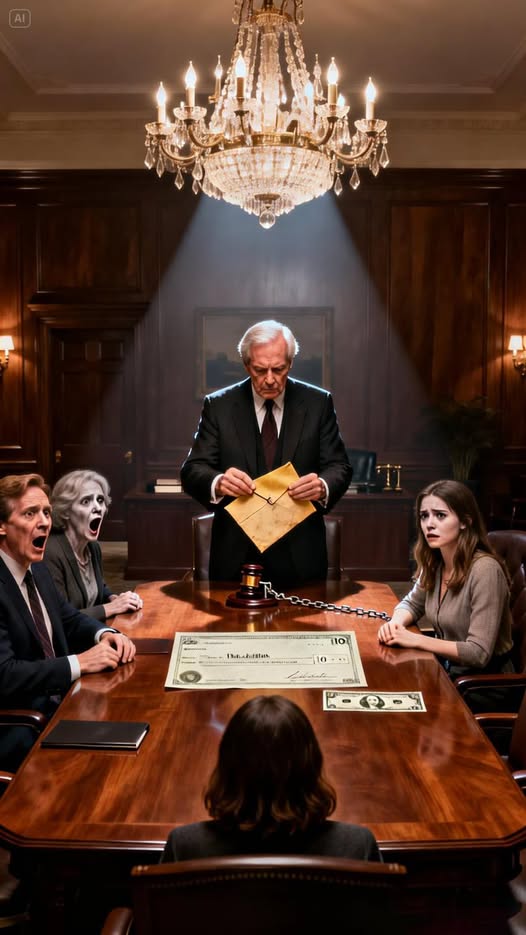
At the reading of the will, the silence was polished to a high sheen, much like the mahogany table we sat around. My parents wore their grief like expensive, ill-fitting couture—visible, performative, and entirely uncomfortable.
The lawyer, a man whose jowls seemed to weigh down his face, slid a check across the surface. It stopped in front of my sister, Vanessa. The sum was visible even from where I sat: $10,000,000.
My mother’s smile was instant, a reflex of avarice. My father exhaled a breath he seemed to have been holding for forty years. Then, in a synchronized movement that felt rehearsed, they turned to me.
“Go earn your own,” my mother said. Her voice was light, airy, as if she were suggesting I pick up a quart of milk rather than dismissing my existence in the family lineage.
I didn’t cry. I didn’t flinch. I had spent twenty-six years building an immunity to their dismissal. I just stared at the wood grain, pretending the thumping in my ears wasn’t my own pulse frantically trying to escape.
“We’re done here,” Vanessa said, reaching for the check. Her nails were manicured a violent shade of crimson.
“Not quite,” a voice interrupted.
It wasn’t the primary attorney. It was an older man in a charcoal suit sitting in the corner, someone I had assumed was a paralegal or a witness. He stood up, his joints popping in the quiet room.
“There is one more document,” he said. He reached into his briefcase and produced a worn, yellowed envelope. I recognized the handwriting instantly. It was blocky, neat, with a distinct leftward slant. Grandpa.
My mother’s smile fractured. My father’s fingers twitched against his thigh. Vanessa’s eyes narrowed into slits.
“That envelope,” the man said, placing it in the center of the table like a grenade, “contains the codicil to the estate. And it changes everything.”
The storm didn’t start with thunder. It started with the rustle of paper.
The instructions in the envelope were specific: The final portion of the will could only be read at the homestead.
So, I found myself driving down a road I hadn’t seen in over a year. The ranch on the outskirts of Charleston used to be my sanctuary. Now, the wind whipping through the open window carried the heavy, humid weight of secrets.
I hadn’t been back since the spring before my grandfather, Walter, passed. It is a strange alchemy how something so familiar can feel so foreign. The gravel crunched under my boots as I stepped out of my sedan. The wind chimes on the porch—once the soundtrack of summer afternoons spent brewing sun tea—now sounded hollow. They were tinny echoes of something lost.
I hesitated before knocking. The white paint on the door had chipped, revealing the gray wood beneath. The magnolia trees still leaned a little too far east, bowing to the Atlantic winds.
When the door creaked open, I half-expected silence. Instead, I got a serrated edge.
“So, you finally decided to show up.”
My grandmother’s voice hadn’t changed. It was still sharp enough to cut glass. Her arms were crossed over her chest, a barrier of floral print and bone. Her jaw was set like granite.
I stood frozen on the welcome mat, searching her face for warmth, relief, even confusion. I found only a glacial cold.
“Grandma, what’s going on?” I asked, stepping closer. “Why are you looking at me like that?”
“They told me you were too busy,” she spat. “They said you didn’t want to be bothered. That you had a ‘new life’ in the city and we were just baggage.”
Her voice wavered, then hardened into steel. “Your grandfather called for you, Clare. Every day on his deathbed. He asked for you until his voice gave out.”
I swallowed. My throat felt like it was filled with sand. “That’s… that’s not true. I tried to call. I came by in March. Vanessa was here. She met me at the gate and said no one was home, that you were at the hospital and no visitors were allowed.”
Grandma’s eyes narrowed. “We were here. We were always here. Walter died in his own bed.”
There was a long, painful pause. The air between us vibrated with the collision of two different realities.
Then she turned and disappeared into the house without a word.
I followed her in. The air inside was thicker, smelling of lavender and old paper. The house felt like it was holding its breath. She walked to the kitchen counter and picked up a worn leather address book.
“This is the number he kept calling,” she said, thrusting it toward me.
I looked at the page. Grandpa’s handwriting. Clare.
But the digits following the name were wrong.
“Grandma,” I whispered, tracing the ink. “This isn’t my number. Not even close. I’ve had the same cell since college.”
She stared at the notepad, her brows knitting together in a roadmap of confusion. “They told us you changed it. They said you didn’t want to be tracked down. That you were ashamed of us.”
“No,” I said, backing toward the wall as the world tilted. “They lied to you. They cut me off from you on purpose.”
Her hands began to tremble. She sank slowly into the worn floral armchair beside the fireplace, looking suddenly fragile.
“They told me the funeral was at noon,” I whispered, the memory a jagged shard in my chest. “I got to the church, and it was empty. The janitor told me everyone had left.”
She looked up, her face draining of color. “The funeral was at 9:00 a.m.,” she said softly. “They told everyone you didn’t show up. They said you didn’t care.”
My breath hitched. I would never have missed his funeral. I had sat in my car in the empty church parking lot for three hours, weeping, thinking I had simply gotten the time wrong, that I was the failure they always said I was.
For a moment, the room was quiet. Too quiet.
Then I sank down next to her, clutching her hand like I was five years old again. “I didn’t know,” I choked out. “I didn’t even know he was dying until it was too late.”
Her voice softened, her hand brushing my hair. “We know the truth now. That’s what matters.”
We sat there for a long time. The old clock on the mantle ticked louder than I remembered, marking the passing of the time we had lost. Outside, the wind picked up, brushing dry leaves across the porch like restless memories.
Finally, Grandma stood up. Her hands shook slightly, but there was a fire ignited behind her eyes that I hadn’t seen in years.
“I’m calling them,” she said.
“Calling who?”
She didn’t answer at first. She went to the old rotary phone on the kitchen wall—the one Grandpa refused to replace because he liked the weight of the receiver—and began dialing. Each click of the dial felt deliberate, loaded, like punctuation to a sentence she had waited too long to write.
“Betty,” she said when the line connected. Her voice was cold, clipped. “I need you, Jacob, and Vanessa. Here. Now.”
A muffled protest came through the receiver.
“No,” Grandma cut them off. “It can’t wait. Be here in an hour.”
She hung up without saying goodbye. Then she turned to me. “The lawyer is on his way, too.”
“Grandpa’s lawyer?”
She nodded. “Your grandfather left instructions. He made it clear they were to be read only with everyone present. He suspected, Clare. Toward the end… he suspected.”
For the next hour, I sat at the small kitchen table, tracing my finger along the grain of the wood. This was the table where Grandpa used to sip his morning coffee while reading the scientific journals I mailed him from college. It was the place where he first asked about my bee communication study. The place where I once told him I wanted to study plant memory, and he didn’t laugh.
The doorbell rang.
Grandma placed a hand on my shoulder. “Stay here. I’ll call you when it’s time.”
From the kitchen, I could hear them arrive.
My mother’s voice, overly sweet, like syrup masking medicine. “Oh my goodness, Margaret. It smells exactly the same in here.”
My father’s tone, measured and impatient. “I thought this was handled already.”
Vanessa’s dismissive sigh. “Seriously? This couldn’t have waited until after the estate finishes processing?”
Then, silence. And Grandma’s voice, colder than the grave. “Please sit down. Mr. Harold Keane is here. He will be reading Walter’s final instructions.”
They didn’t know I was there. They thought they were coming to collect the scraps.
“Clare,” Grandma called out. “Come in now.”
I stood. My heart hammered against my ribs. As I stepped through the kitchen doorway into the living room, three heads turned in my direction.
My mother’s smile froze into a rictus of shock. My father’s jaw tightened until a muscle jumped in his cheek. Vanessa’s face went pale, her mouth opening slightly with no sound coming out.
The air in the room snapped like static electricity. They weren’t just surprised to see me. They were terrified.
I kept my back straight. If they expected me to cower, they were going to be disappointed. Grandma gestured to an empty armchair across from them. I sat down, crossing my legs.
Mr. Keane, the lawyer, gave me a quick nod. He opened his leather briefcase and pulled out a thick manila envelope.
“This,” he began, “is the last will and testament of Walter R. Whitman, recorded and sealed per his request. In addition to the official documents, he has included a handwritten letter to be read aloud.”
No one spoke.
“To my wife, Margaret Whitman,” Keane read. “I leave our family ranch, the house, and sufficient funds for her comfort and care. She knows where the rest is.”
Grandma didn’t blink.
“To my granddaughter, Clare Whitman.”
The room tightened. I felt the oxygen leave it.
“I leave the Whitman Research Annex located at 317 Laurel Creek Road, including all laboratory equipment, funding accounts, active research patents, and intellectual property currently filed under Whitman Innovation.”
A gasp. It wasn’t mine. My mother’s eyes darted to Vanessa.
“And finally,” Keane continued, “the remainder of my estate—financial holdings, stocks, and retirement funds—shall be divided equally between my two granddaughters, Clare and Vanessa Whitman.”
There it was. A bomb, quiet and elegant.
Vanessa shot to her feet. Her chair scraped the floor with a screech.
“What?” she spat. “He gave her the Annex? The entire facility?” Her voice cracked, raw and ugly. “That’s insane! You told me…” She pointed a trembling finger at our parents. “You said it would all be mine. You said if I just kept visiting him, if I smiled and played nice, that everything would come to me!”
My father looked at the floor. My mother looked at the wall.
Mr. Keane raised one hand. “There is more. Mr. Whitman wrote a personal letter to Clare.”
Vanessa let out a bitter laugh. “Of course he did.”
Grandma handed the lawyer a folded letter from the drawer next to her. “He wrote this the week before he died. He made me promise.”
Mr. Keane unfolded the paper. Grandpa’s handwriting filled the page.
“To my dearest Clare,” Keane read.
“If this is being read, I am no longer by your side. But my belief in you remains, stronger than ever.”
The words hit me like a physical embrace.
“You were always the quiet one, the observer. The one who asked ‘why’ when others didn’t care to know. You built your own truth in a family that never learned to honor yours.”
Vanessa slumped back into her chair. Mom’s fingers twisted in her lap.
“I saw how you clutched that little notebook when you were seven, tracking how long it took raindrops to fill a glass. I saw how your face lit up when you discovered patterns, while everyone else only saw distractions.”
My chest tightened. I still had that notebook.
“Vanessa was easier for them,” the letter continued. “She sparkled in all the ways they understood. But you, Clare, you glowed in ways they couldn’t translate. And instead of learning your language, they shut you out.”
Vanessa shifted, looking physically ill.
“I don’t blame her entirely. She played the part they handed her. But you wrote your own role. And that takes courage. I remember the day you won your first science fair and asked me to hide the trophy. You said, ‘Maybe if I don’t show it, they’ll stop looking at me like I’m someone else’s child.’ That broke my heart, Clare.”
A low, painful exhale escaped from my father.
“You deserved celebration, not invisibility. And while I can’t undo the damage, I can give you something that is entirely yours. A place to build freely. Without apology. Without their shadows.”
Mr. Keane folded the letter. The silence that followed wasn’t empty; it was loaded with decades of resentment.
I cleared my throat. “I remember that science fair,” I said softly. “Mom didn’t come. She was at Vanessa’s dress rehearsal.”
“Clare, this isn’t the time,” Dad said, his voice weak.
“No,” I said, sharpening my tone. “It is the only time. Because all I ever got from you was, ‘Why can’t you be more like your sister?’” I turned to Vanessa. “And you? Every time I tried to be proud of something, you turned it into a threat.”
“I worked for what I got,” Vanessa scoffed, though her eyes were wet.
“You mean you visited Grandpa when it was convenient,” I countered. “You smiled when told. You performed.”
“And you disappeared!” she shouted.
“I was cut off!” I snapped, standing up. “You told Grandma I changed my number. You gave Grandpa a fake line so I never got his calls. That isn’t distance, Vanessa. That is erasure.”
“Enough!” my mother cried. “We were trying to protect the family dynamic!”
“This family,” Grandma cut in, her voice slicing through the noise, “has been living a lie. And I let it happen for far too long.”
She looked at her son—my father—with profound disappointment. “I watched you turn a blind eye to Clare’s pain. I believed you when you said she didn’t care. I should have known better.”
“Look,” Dad said, shifting. “Clare got her education. Her lab camps. That wasn’t free.”
“No,” I said. “It wasn’t. But you didn’t pay for it. Grandpa did. Every cent. You didn’t even know where I went half the time.”
“Why should you get anything?” Vanessa whispered, her face twisted. “Just because you’re a sad little genius in a lab coat?”
I smiled, just slightly. “No. I get something because I earned his love honestly. That’s the one thing you never understood. Love isn’t a transaction.”
Grandma stood up. She walked to the center of the room.
“I regret that Walter left you anything,” she said to Vanessa. “You may have played the role, but it was never love. It was an investment strategy. And I am ashamed I didn’t see it sooner.”
She pointed to the door. “Leave. You are not welcome here.”
“Mom, please,” my mother gasped.
“Out,” Grandma said. “Now.”
They didn’t move at first. Then Vanessa grabbed her bag and stormed out, her heels hitting the wood like gunshots. My parents followed, stunned, muttering about legal challenges that we all knew wouldn’t hold up.
The door clicked shut behind them. No slamming. Just finality.
I stood there, rooted in place. The room was quiet now. Not tense. Just free.
Grandma walked past me and sat down slowly on the sofa. “They’ll come back,” I whispered.
“Maybe,” she replied. “But this time, we don’t have to let them in.”
The next morning, I went to see it.
The Annex didn’t look like a laboratory. It looked like a converted barn nestled at the far end of a dusty road off Laurel Creek. It had wide beams, a tin roof, and double doors that looked like they belonged on a horse stable.
But inside? Inside was magic.
The space had been completely renovated. Glass panels lined the east wall, flooding the room with morning light. Tables were arranged with untouched equipment—microscopes, centrifuges, data tablets, a 3D printer still wrapped in plastic.
In the center of the room stood a workbench. On top of it sat my childhood notebook. The one with the torn pages and messy diagrams of honeybee communication.
My knees almost gave out. Grandpa hadn’t just built me a lab. He had built me a home for my mind.
I moved into the Annex full-time. I recruited two grad students, Tara and Micah, friends from university who shared my stubborn hope that science could solve problems without losing its humanity.
We started small. A local grant for micro-irrigation. A partnership with a farming co-op to test sustainable crop rotations. We failed. We burned equipment. We cried over rejected proposals.
But we showed up every day.
One afternoon, I found myself alone in the Annex. I reached into my bag and pulled out Grandpa’s letter. I whispered the line into the empty room: You wrote your own role.
That night, I wrote a new proposal. Not for crops, but for people.
We called it the Little Scientist Initiative.
It was a program for rural schools with outdated textbooks. We gave each kid a leather-bound notebook—a replica of mine—with Grandpa’s words stamped on the first page: Write the things they don’t understand. One day, the world will.
That fall, a shy girl named Amber, barely thirteen, showed me pages of bee behavior observations she’d done on her own. Her grammar was wild, but her mind was brilliant.
“You actually read it?” she whispered when I handed it back with notes.
“Of course I did,” I said. And in that moment, I understood. This wasn’t about replacing what I lost. It was about planting something new in better soil.
The email came three years after the will reading.
It was from a lawyer representing Vanessa Whitman. Subject: Request for Visit.
I braced for a fight. Another challenge to the will. But when Vanessa arrived, I barely recognized her.
Gone were the designer heels and the perfect blowout. She wore no makeup. Her navy coat was too big for her shoulders. She walked into the main lobby slowly, like she was afraid to take up space.
I stood beside Grandpa’s portrait above the reception desk. She paused when she saw it.
“He always knew who you were,” she said quietly. “Even when I didn’t. Especially when I didn’t.”
I nodded.
“I’d like to see it,” she said. “The lab. The work. What you’ve done.”
I gave her the tour. We walked through the greenhouse complexes, the crop development rooms, the student display wall. She asked simple, honest questions. How do you fund this? What is this device?
When we reached the community garden, she stopped. Children were harvesting lettuce. A father was testing soil moisture.
Vanessa turned to me. Her voice broke.
“I don’t expect you to forgive me,” she said. “I just… I wanted to see what he built for you. And what you built with it.”
She didn’t cry, but her hands wouldn’t stop moving, tugging at her sleeves.
I let her stay. No lectures. No retaliation.
We don’t talk often. But twice a year, Vanessa volunteers for the science camp. She helps students with presentation skills—how to explain complicated data in plain English, how to stand with confidence. The kids call her Coach V.
At the end of her first summer, she handed me a folder. “I wrote a communication guide for the shy kids,” she said, almost embarrassed. “Thought it might help.”
It wasn’t perfect. But it was thoughtful. And for the first time in my life, I saw a version of my sister that didn’t scare me.
It has been six years since the will reading. Six years since the door slammed on my parents.
I haven’t spoken to them. Sometimes their names appear in emails I don’t open—charity press releases from Florida where they retired early. I don’t hate them. But I don’t miss them.
The Annex has grown into a research campus. We’ve developed drought-resistant seeds that feed thousands. We’ve partnered with universities from Kenya to Brazil.
Last month, I stood on a stage in San Francisco accepting a national grant for climate innovation. I wore a navy blue suit and Grandpa’s pocket watch tucked inside the breast pocket—the one Grandma gave me last year.
Inside the lid is a tiny photo of me at age ten, standing next to my honeybee display, grinning. He carried it with him every day, Grandma had said.
Now it sits on my desk, catching the morning light.
Some days I talk to him. When an experiment fails. When a kid wins a scholarship. When I remember how close I came to believing I didn’t matter.
He never let me disappear. Not really.
Legacy isn’t a monument. It’s a map. It’s built from choices and kindness and tiny anchors left behind for someone to follow when the world tries to erase them.
These days, Grandma lives in a small apartment connected to my house. She’s slower now, but sharp as ever. We drink coffee in the sunroom, and she tells me stories about him. How he believed soil could remember kindness. How he always knew I would come back.
Some evenings, I walk to the far end of the Annex fields, past the solar arrays, to the old wooden bench Grandpa built.
From there, I can see the stars. Real ones. Not the glow-in-the-dark stickers I stuck on my ceiling when I was nine. But they still make me think of that girl I once was. The one who kept asking “why” even when no one cared to answer. The one he believed in.
And on nights like that, when the wind moves just right through the magnolia leaves, I swear I can hear his voice.
Write the things they don’t understand. One day, the world will.
And now, finally, it does.