He almost turned around at the front door, convinced that any second someone would step out and explain there had been a misunderstanding. The house was too clean, too quiet, too full of light to belong to someone like him—someone who had spent the last few years living in survival mode, measuring life in overdue bills and sleepless nights. But no one came. Instead, the door creaked open and sunlight spilled across bare floors, warming the walls as if the house itself had been waiting.
He stood there longer than necessary, breathing in the stillness. For the first time in years, his chest didn’t feel tight. It felt… open.
On the kitchen counter sat a single envelope. His name, written carefully, as if whoever had written it wanted to be absolutely sure it reached the right hands. His fingers shook as he opened it. Inside was a letter from Margaret, the woman who had sold him the secondhand washing machine that started all of this.
She wrote about her late sister. About how she and her husband had tried for years to have children. About the nursery they had painted and repainted, hoping one day it wouldn’t feel foolish. About how, when her sister knew she was dying, she made one request: that the house go to someone still fighting to hold their family together. Someone who needed stability more than square footage. Someone who hadn’t given up.
Margaret wrote that when she met him in the thrift store—tired eyes, apologetic smile, counting cash twice before handing it over—she recognized something. Not desperation. Determination. The kind that keeps people standing long after they should have collapsed.
He lowered himself into a chair and read the letter again, slower this time. The weight that had lived in his chest for so long loosened, just a little. Enough to let air in.
It had started weeks earlier with a washing machine that didn’t work.
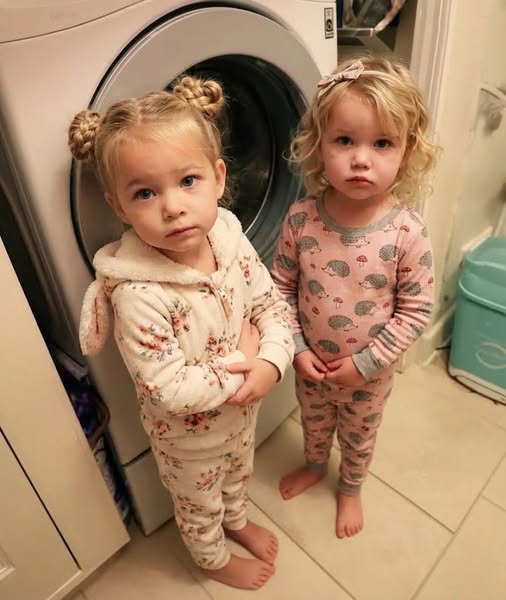
He’d bought it because it was cheap. Because his old one had finally died and laundromats were eating up time he didn’t have. Because when you’re caring for an aging parent and raising twin girls on a single income, you don’t shop for perfect—you shop for possible.
When the machine refused to spin, he didn’t even get angry. He just sighed and grabbed his tools, ready to try one more fix before admitting defeat. That’s when he heard it: a metallic clink, something loose rattling inside.
Behind a panel, taped carefully to the inner frame, was a small cloth pouch. Inside it, a set of house keys and a folded note with Margaret’s phone number.
When he called, expecting confusion or apology, she simply said, “I was hoping you’d find those.”
The conversation that followed changed everything.
Six months later, the house is no longer quiet.
Twin dresses hang from chair backs, waiting for tomorrow’s school day. Crayons roll freely across the kitchen table, mingling with homework sheets and half-finished drawings of stick-figure families with oversized smiles. The refrigerator hums softly, covered in magnets and artwork that would mean nothing to anyone else but feels priceless to him.
Down the hall, his mother rests in a room filled with afternoon light. She sleeps better now. So does he. The constant fear—of eviction, of medical emergencies, of not being enough—has eased into something manageable. Not gone. Just quieter.
In the evenings, when the day finally releases its grip, he lights the fireplace and sits on the floor while Bella and Lily giggle beside him. They tell stories that make no sense, inventing worlds where houses choose their families and broken things hide secrets. He listens, fully present, and thinks about how close he came to missing this version of life.
He thinks about the thrift store. About the washer that didn’t spin. About the stranger who saw more than a transaction and decided to act.
In a world obsessed with hustle and self-made success, this story doesn’t fit neatly into motivational slogans. There was no sudden promotion, no viral fundraiser, no overnight wealth. Just a chain of small decisions rooted in empathy. Just someone choosing to pass forward what they could no longer use. Just a man willing to keep going even when the math didn’t work.
The house itself feels like proof that kindness doesn’t have to be loud to be transformative. It doesn’t announce itself. It doesn’t demand recognition. It simply changes lives quietly, permanently.
He still fixes things on weekends. Old habits die hard. But now, when something breaks, he doesn’t feel panic first. He feels confidence. He knows that stability exists. That help can arrive in unexpected forms. That miracles don’t always glow—they sometimes rattle.
At night, after the girls are asleep and the house settles into its gentle creaks, he walks through the rooms once more. Not because he’s afraid something will disappear, but because he wants to remember how far they’ve come. How a secondhand appliance became a turning point. How keys hidden in steel led to doors opening that he never imagined walking through.
He keeps the pouch in a drawer by the bed. Not as a good-luck charm, but as a reminder.
Sometimes the things that don’t work are carrying exactly what you need. Sometimes the help you’re praying for doesn’t look like help at all. And sometimes, the world changes not because everything finally goes right—but because one person decides to be generous in a moment no one else will ever see.