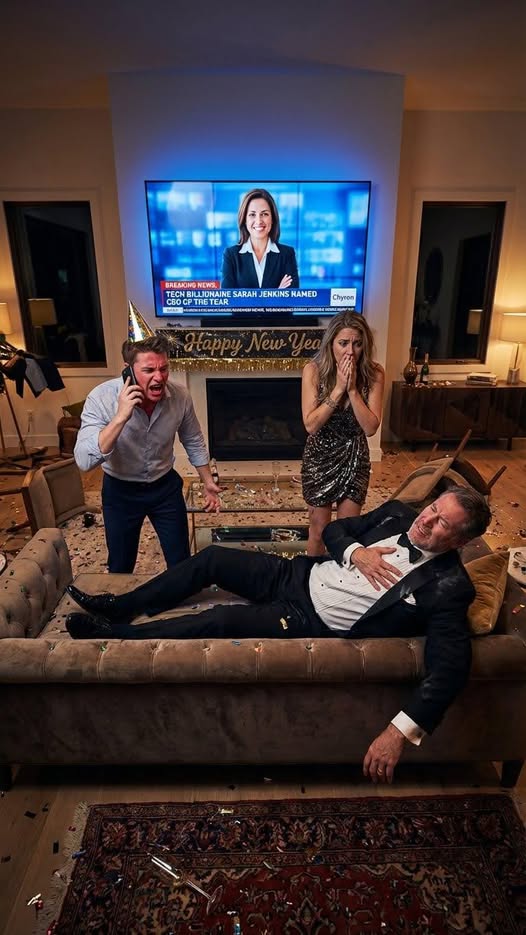
I am Norah Townsend, twenty-nine years old, and three days ago, my family formally requested that I cease to exist.
“You’ll just make everyone uncomfortable,” my mother had said, her voice smooth, polished, and final, the same tone she used to decline a caterer who didn’t meet the Greenwich standard. “It’s better if you don’t come to New Year’s Eve.”
So, I spent the dying hours of December 31st, 2024, alone in my five-hundred-square-foot studio apartment in Cambridge. The heating unit rattled in the corner, a stark contrast to the crystal-and-mahogany silence of the Townsend estate. Through my frosted window, I watched strangers on the street below—couples huddled in coats, groups of students passing bottles of cheap wine—celebrating the passage of time. Meanwhile, two hours south in Connecticut, my family was toasting champagne in a mansion with actual Doric columns, relieved that their “difficult” daughter wasn’t there to ruin the aesthetic.
At exactly 12:01 a.m., the silence of my apartment was shattered.
My phone vibrated against the coffee table, a violent, angry buzz. The caller ID flashed: RYAN.
I let it ring three times. On the fourth, I picked up.
“Norah?” His voice, usually so effortlessly charming, was trembling. In the background, I could hear a cacophony—shattered glass, raised voices, the shrill edge of hysteria. “Norah, what did you do? Dad just saw the news and he’s… he’s not breathing right. Mom is screaming. What the hell did you do?”
“Happy New Year, Ryan,” I said, my voice steady.
“The news,” he choked out. “The valuation. The article. You… you destroyed us.”
The news he was referring to was the launch of Neural Thread, Inc., which had gone public at the stroke of midnight. The valuation had opened at 2.1 billion dollars, making me one of the youngest female tech billionaires in American history. But the money wasn’t the shock that had caused the air to leave the room in Greenwich.
It was the Forbes interview that went live at the same moment.
It was a meticulously cited exposé featuring three years of emails, patent filings, and audio recordings proving that my brother, the golden heir, had tried to steal my life’s work.
Before I tell you how the empire fell, I need to take you back to when the cracks first appeared. If you are reading this, you likely know what it feels like to be erased. This story is for you.
The Townsend family wasn’t just wealthy; we were legacy. We were “old money” from Greenwich, Connecticut, the kind of wealth that whispered rather than shouted. It came with a forty-year-old medical device company, Townsend Industries, and the unspoken expectation that you knew which fork to use for the fish course before you could read.
My brother, Ryan, was groomed for the throne. Five years my senior, he was the architectural ideal of a CEO: tall, effortlessly charming, the kind of man who could walk into a boardroom and make every person feel like the most important vacancy in his schedule. He wore Tom Ford suits as if they were second skin. He played golf with senators. He was everything our parents wanted in an heir.
I was the glitch in the code.
I preferred Python to polo. I viewed social hierarchies as inefficient algorithms. When I was accepted into MIT for computer science, my parents smiled for the photo op, but I heard my mother whisper to a friend at the country club, “It’s a phase, darling. She’ll grow out of the computer thing and do something practical.”
I graduated top of my class, specializing in AI-driven medical diagnostics. My family didn’t attend the ceremony.
“Ryan has a charity golf tournament,” my mother had explained over the phone, her voice light. “He needs us there for networking, sweetie. You understand, don’t you? It’s for the business.”
I understood. I understood when I moved into a cramped apartment with two roommates while Ryan was gifted a penthouse in Back Bay. I understood when family dinners transformed into strategy sessions for Townsend Industries, where they discussed quarterly reports while I pushed peas around a Wedgewood plate, silent and invisible.
I learned the family theorem early: In the Townsend equation, brilliance was less valuable than charm, innovation was less valuable than tradition, and I was infinitely less valuable than Ryan.
I just didn’t realize how disposable I was until March 2022.
I was on the brink of something revolutionary. My two co-founders and I had developed a neural network architecture capable of analyzing medical imaging data with speed and accuracy that made current market standards look like abacuses. It was early detection for diseases that usually killed patients before doctors even knew what to look for. We called it Neural Thread.
Then came the call.
“Norah, we need to talk about Ryan.” My mother’s voice had that serrated edge, the one that signaled a command, not a request. “Townsend Industries is having a difficult quarter. The investors are restless. Your brother is under enormous pressure. You need to help.”
I tried to explain that I was in a critical development phase. That my startup was fragile.
“Startup?” She said the word like it was something she’d stepped in. “Norah, startups are for people with nothing to lose. You have a legacy. You have a duty. Ryan needs support, and you’re sitting in that little apartment playing with computers.”
The implication was clear: My work was a hobby. Ryan’s work was the world.
But I had learned something at MIT that my mother’s social graces never covered: Protect your IP.
Before I drove to Greenwich, I met with James Kirby, a lawyer who specialized in intellectual property for tech startups. We sat in a bakery in Cambridge, the smell of flour and yeast heavy in the air, my laptop open between us.
“If anyone tries to claim this,” James said, sliding a patent application across the scratched wooden table, “we need a paper trail that even the best corporate sharks can’t chew through.”
I filed the patent on March 15th, 2022. Every line of code, every algorithmic iteration, was timestamped and legally mine. I didn’t plan to use it against them. I just wanted insurance.
I agreed to consult. Family obligation, my mother called it.
I drove down to the Townsend Industries headquarters in Stamford, a glass monolith with our family name in brushed steel above the entrance. Ryan’s office was on the top floor, a corner suite with a view of the Sound.
“Norah!” He hugged me. It felt like a politician hugging a constituent. “Thanks for coming. This means everything.”
I explained the basic concepts of integrating AI into their legacy diagnostic devices. I was careful—I didn’t give him the core source code, but I gave him enough to build a framework. He took notes on a yellow legal pad, nodding with the enthusiasm of a man who sees a lifeline.
“This is exactly what we need,” he said. “Investors are going to love this.”
Two weeks later, he invited me to a pitch meeting with a venture capital firm from Boston. I sat in the back of the conference room, sinking into a leather chair that cost more than my car, while Ryan stood at the head of the walnut table.
He clicked a remote, and a slide appeared on the screen.
“Townsend Industries: Pioneering the Future of AI Diagnostics.”
He proceeded to present my ideas. My research. My framework. He used the specific terminology I had coined in my thesis.
“We are positioned to revolutionize early diagnostics,” he declared, flashing that million-dollar smile.
One of the investors, a silver-haired man with a Patek Philippe watch, glanced at me in the back. “And who is this?”
Ryan didn’t miss a beat. “That’s my sister, Norah. She’s been acting as an assistant on some of the technical research.”
Assistant.
After the meeting, Ryan handed me a document. “Just a standard NDA,” he said, casually. “To protect the family business. You understand.”
I read it. It was a Non-Disclosure Agreement covering all proprietary information related to Townsend Industries.
“This protects me too, right?” I asked.
“Of course,” he smiled, and his eyes were void of anything resembling guilt. “We’re family, Norah. We protect each other.”
I signed it. Because I was stupid. Because I still believed that shared DNA meant shared loyalty.
The erasure happened slowly, then all at once. By Thanksgiving 2023, I was a ghost at the table. The dining room was a spread from Architectural Digest, filled with twelve guests—business partners and hospital donors.
My mother introduced Ryan to the table. “CEO of Townsend Industries,” she beamed. “We are so proud of what he is building.”
Then she gestured to me, her voice dropping ten degrees in warmth. “And this is our daughter, Norah. She works in… technology.”
“Technology?” a guest asked. “What kind?”
I opened my mouth, but Ryan interrupted. “Norah is still figuring out her path,” he laughed lightly, pouring wine for the man next to him. “She’s very introverted. Brilliant with computers, but you know…” He made a vague, dismissive gesture. “Not great with people.”
The table laughed. It was polite, dismissive laughter. I felt the heat rise in my cheeks, staring at the perfectly carved turkey I couldn’t stomach. I was being edited out of reality, reduced to a footnote in Ryan’s biography.
June 2024. The breaking point.
Ryan called an emergency meeting. When I arrived at his office, the atmosphere was pressurized. He was standing by the window, staring out at the grey water of the Sound.
“We need the full algorithm, Norah,” he said without turning around.
I blinked. “Excuse me?”
He turned. His face was drawn, tense. “The AI diagnostic tool. The core code you’ve been working on. We need it for Townsend Industries. Investors are pulling back. We need a breakthrough. This could save the company.”
“Ryan, that isn’t Townsend work. That is my startup. That belongs to Neural Thread.”
“Your startup?” He laughed, a harsh, barking sound. “Norah, you’ve been consulting for us. You signed an NDA. Everything you’ve worked on in relation to our business belongs to the company.”
“That is not how NDAs work.”
“Don’t tell me how they work!” he shouted, slamming his hand on the desk. “I am trying to save our family’s legacy! Don’t you care about that?”
The door opened. My mother walked in, heels clicking on the hardwood like gunshots. She sat in one of the leather chairs, crossing her legs elegantly.
“Norah,” she said. “Your brother is right. You signed an agreement. You have a legal obligation.”
“The NDA covers Townsend proprietary info,” I said, my voice shaking but firm. “It does not cover my personal projects.”
“Personal projects you developed while consulting for us,” Ryan shot back. “Conflict of interest.”
My mother’s expression was ice. “Norah, don’t make this a legal issue. Family doesn’t sue family. Give Ryan the algorithm, and we can all move forward.”
I looked between them. My brother, desperate and greedy. My mother, cold and calculating. They didn’t see a daughter or a sister. They saw a resource to be stripped.
“No,” I said.
Ryan’s face flushed a deep, ugly red. “Careful, Norah. You don’t want to make this ugly.”
I stood up. “I think we’re past that.”
I left the room. But not before I reached into my pocket and pressed the “stop” button on the voice memo app I had been running since I walked in. Massachusetts is a one-party consent state. Connecticut is two-party, but crimes committed during the conversation act as an exception in the court of public opinion.
After that meeting, the invitations stopped. No more Sunday dinners. No more emails. I saw the family gatherings on Ryan’s Instagram—photos of my parents, Ryan, his girlfriend, laughing, toasting.
“Great night with the family,” the caption read.
I tried calling my father once. “Dad, why am I being shut out?”
“Norah,” he sighed, sounding weary. “Your mother and Ryan are under a lot of stress. Maybe it’s better if you give everyone some space. You refused to help your brother. After everything this family has given you…”
“Given me?” I whispered. “You didn’t come to my graduation. You haven’t asked about my work in five years. What exactly have you given me?”
Silence. Then, “I think you should apologize.”
He hung up.
I sat in my car outside the MIT campus, watching students walk by, and realized the truth. I hadn’t just been erased. I had been replaced by a version of myself that suited their narrative: the ungrateful, socially awkward failure.
December 20th, 2024.
“Norah,” my mother said when she called. “I wanted to let you know that Christmas this year is going to be family only.”
“I am family,” I said.
“We’re suggesting it might be better if you didn’t come. Ryan is bringing important clients. We need the atmosphere to be positive. You make people uncomfortable, Norah. Your energy is… heavy.”
“You’re uninviting me from Christmas.”
“I’m giving you an out. Take it gracefully.”
I hung up. I looked at the tiny, fake tree in the corner of my apartment. I looked at the empty calendar for December 31st.
Then, I opened my laptop.
There was an email waiting from Forbes.
Subject: IPO Feature Request.
Miss Townsend, we understand Neural Thread is preparing to go public… We’d like to feature you in our 30 Under 30 series…
I replied: Yes. And I have a story you are going to want to hear.
For three weeks, the journalist verified everything. The patent documents from March 2022. The email chains where Ryan asked for the code. The recording of the threats. The testimony of Dr. Elena Martinez, my MIT mentor. The legal analysis from James Kirby showing the NDA was toothless against pre-existing IP.
I was building a bomb.
On December 28th, my mother called one last time. “Ryan is hosting New Year’s Eve. Just to be clear—don’t come. For everyone’s sake.”
“Don’t worry,” I said. “I won’t be there.”
December 31st, 11:55 p.m.
I sat in the dark, refreshing the Forbes homepage. On my TV, the ball was dropping in Times Square. On my phone, Ryan’s Instagram story showed the Townsend mansion lit up like a resort. My mother in Armani. My father in a tuxedo. Ryan raising a glass, the king of the world.
11:59 p.m.
My cursor hovered over the refresh button.
Midnight.
Fireworks exploded on the screen.
I hit refresh.
The article went live.
NEURAL THREAD INC. GOES PUBLIC AT $2.1B VALUATION. FOUNDER REVEALS ATTEMPTED IP THEFT BY TOWNSEND INDUSTRIES CEO.
The sub-headline: Emails and Recordings Show Ryan Townsend Attempted to Claim Sister’s Billion-Dollar Algorithm.
Twitter exploded instantly. The hashtag #NeuralThread began to trend. The TechCrunch companion piece dropped at 12:01.
My phone was silent for exactly sixty seconds.
Then it rang.
“Hello, Ryan.”
“What did you do?” he screamed. “Dad isn’t breathing! Mom is screaming! What did you do?”
“I went public, Ryan. I documented the truth.”
“You… you published our private emails? You recorded us? That’s defamation!”
“It’s documentation,” I said calmly. “The patent dates don’t lie. March 2022. Four months before your investor pitch. You called me your assistant. You tried to steal my life’s work. Did you think I would just vanish?”
“You’ve killed this company!” he sobbed. “Investors are calling. They’re pulling out. Do you understand what you’ve done?”
“I didn’t kill the company, Ryan. You did that when you built it on a foundation of theft.”
I hung up.
My mother called next. “You are unforgivable,” she hissed. “You have humiliated this family.”
“I haven’t been part of your family for years,” I said. “You made sure of that. Enjoy the party, Mom.”
I didn’t sleep. By morning, the avalanche had begun.
247 missed calls. 512 emails.
At 10:00 a.m., Ryan held a press conference. I watched it live on YouTube, coffee cooling in my hand. He looked terrible—rumpled suit, red eyes.
“My sister is going through a difficult time,” he read from a prepared statement. “Her allegations are baseless. We have always supported her.”
A journalist raised her hand. “Mr. Townsend, how do you explain the patent filing from March 2022, four months before you presented the technology as your own?”
Ryan froze. “Coincidence. Great minds… overlap.”
“And the email where you explicitly asked for her ‘source code’?”
“Context,” he stammered. “It was… out of context.”
“And the recording where you threatened legal action if she didn’t hand it over?”
“That press conference is over!” he shouted, and walked out.
The clip went viral within the hour. CEO Meltdown trended on TikTok.
By 4:00 p.m., the Board of Directors of Townsend Industries issued a statement. Ryan Townsend has been suspended pending an independent investigation.
My father called me the next day.
“Norah.” His voice sounded like it was coming from a very old man.
“Dad.”
“I knew,” he whispered. “I suspected the technology wasn’t his. I knew you were the brilliant one. And I said nothing because… because I was a coward. I wanted peace more than I wanted justice.”
“You let them erase me,” I said, feeling the tears finally come.
“I know. I failed you. I am so sorry.”
“I’m glad you called,” I said. “But sorry doesn’t fix it.”
Two days later, a partner from a venture capital firm, Riverside Capital, contacted me via LinkedIn.
Miss Townsend, after reading the Forbes article, I realized something. In 2023, your brother pitched us an ‘exclusive in-house AI’. We passed, but I kept the deck. It looks identical to your patent.
He attached the file.
It wasn’t just similar. It was a copy-paste job. Ryan hadn’t just tried to use it for Townsend Industries; he had tried to sell my algorithm to outside investors for personal profit.
I sent the deck to Forbes.
When that second article hit—“New Evidence: Ryan Townsend Attempted to Sell Sister’s IP to Third Parties”—it was the kill shot.
Boston Medical Center canceled a $15 million contract. The stock plummeted 28%.
Ryan resigned before he could be fired. My father stepped in as interim CEO to try and salvage the wreckage.
Six weeks later, I stood backstage at the Women in Tech Summit in Boston.
The organizer had emailed me: Your story is exactly what our community needs to hear. Please, come speak.
I was terrified. I didn’t want to be the “drama” girl. I wanted to be the CEO. But Dr. Martinez had told me, “Silence protects abusers. Your voice gives permission to others to speak.”
I walked onto the stage. 1,200 faces looked up at me.
“For most of my life,” I began, my voice echoing in the hall, “I was told I made people uncomfortable. I was told to shrink. To be quieter. To let the ‘real’ business people handle things.”
I paused. The room was deadly silent.
“When my family tried to take my work, I had two choices: Stay silent to keep the peace, or speak up to keep my integrity. I chose integrity. Not because I wanted to hurt them, but because I refused to disappear.”
The ovation was thunderous.
After the speech, I checked my phone. Hundreds of messages. Women who had filed complaints against bosses stealing credit. Young girls declaring computer science majors despite their parents’ wishes.
You gave me permission to exist, one message read.
I moved to San Francisco in March 2025. I needed an ocean between me and Greenwich. I bought a small apartment near Dolores Park with bay windows and no columns.
In June, Neural Thread announced a $50 million partnership with Johns Hopkins. We were saving lives. Real lives.
My father visited once. We had dinner. He is trying. He is in therapy. He asks about my code. He doesn’t mention Mom, and I don’t ask. I hear she spends a lot of time in the Hamptons now, avoiding the Greenwich social scene where she is no longer the queen bee.
Ryan sent me one email. An apology. I lost my way, he wrote. I hope one day you can forgive me.
I didn’t reply. Forgiveness is a gift, and I’m not in the business of giving away my assets for free anymore.
December 31st, 2025.
One year later.
My apartment in San Francisco was crowded. My team—ten brilliant, chaotic, wonderful engineers—was debating the physics of Interstellar while eating Thai takeout.
At 11:59 p.m., we stood by the window looking out at the city lights.
“To Norah,” my co-founder said, raising a paper cup of champagne. “The woman who refused to vanish.”
We clinked cups.
I thought about the girl sitting alone in the cold Cambridge apartment exactly one year ago. I thought about the family that had toasted to a lie. I thought about the firestorm I had ignited.
People ask me if I regret it. If the loss of my family was worth the billion-dollar valuation.
But that’s the wrong calculation.
I didn’t lose my family. They lost me when they chose reputation over relationship. They lost me when they decided I was currency rather than kin.
As the fireworks exploded over the Bay, painting the sky in gold and violet, I finally understood the value of what I had done. I hadn’t just saved my company. I had saved myself.
And looking around at the faces of the people who actually respected me, I realized something else.
I wasn’t uncomfortable anymore.
I was just finally, undeniably, here.

