The call to end my final deployment arrived with the sudden, jarring finality of a gavel strike. One moment, I was reviewing perimeter security protocols in the dusty, sun-bleached operations room of our base in Kandahar. The next, I was packing my duffel bag, folding my fatigues with the muscle memory of forty years in the service.
I was leaving behind the rhythmic structure of military life, the only world I had known since I was eighteen. In the inside pocket of my jacket, the cool metal of my father’s antique pocket watch pressed against my ribs. He had given it to me before my first tour, whispering, “Always come home, Shirley.”
I had returned, time and again. But this return was different. Colonel Shirley Grant was officially retiring, and I hadn’t told a soul—not even my son, Mark.
The overnight flight to Miami was a blur of engine hum and sleepless anticipation. I stared out at the Atlantic, a vast expanse of ink below, wondering if Mark would be at his architecture firm or still asleep when I arrived. I hadn’t seen him in nearly two years. Our lives seemed to orbit different suns, always pulling in opposite directions. But I pictured his smile—the way his hazel eyes crinkled at the corners, a mirror image of his late father—and that image was the fuel that carried me through the turbulence.
By the time the taxi navigated the streets of Naples, the Florida humidity was already rising like steam from a kettle. “Naples,” I had told the driver, giving him the address of the quiet, upscale neighborhood Mark had moved to five years ago.
As we turned onto his street, the tightness in my chest, which I had attributed to jet lag, sharpened into dread. The neighborhood was pristine, a manicured collection of pastel stucco and emerald lawns.
Except for one.
Mark’s house stood out like a fresh wound. The grass was a wild, knee-high tangle choking the stone path. The mailbox listed drunkenly to the side, vomiting a stream of sun-yellowed envelopes onto the driveway. The cheerful blue paint, which I had helped him choose over a video call, was peeling in long, sunburned strips. It didn’t look lived in. It looked abandoned.
I stepped out of the taxi, the heat instantly biting at my neck. Before I could reach the front door, a voice called out from across the street.
“Colonel Grant? Is that you?”
Mrs. Evelyn Wilson, Mark’s neighbor, stood in her driveway clutching a watering can. Even from twenty yards away, I saw the blood drain from her face.
“Hello, Evelyn,” I said, forcing a smile I didn’t feel. “I thought I’d surprise Mark.”
She set the watering can down, her hands wringing the hem of her gardening apron. “Oh, Shirley,” she whispered, the use of my first name sounding foreign and alarmingly intimate. “You don’t know, do you?”
My hand went instinctively to the pocket watch. “Know what, Mrs. Wilson?”
She glanced nervously at Mark’s silent house, then lowered her voice. “Mark has been in the ICU for two weeks. They took him by ambulance in the middle of the night. It was… it was bad.”
The world tilted on its axis. “And Jennifer?” I asked, naming the woman Mark had married three years ago after a whirlwind romance.
Mrs. Wilson’s face hardened, a look of pure disgust replacing her pity. “She’s been on a yacht in the Keys. Posting pictures on Facebook—parties, shopping sprees, champagne toasts. All while Mark has been…” She couldn’t finish the sentence.
“Where is he?” My voice was steel now.
“Naples General,” she said. “Fifth floor.”
I don’t remember the taxi ride to the hospital. I only remember the sharp scent of antiseptic and the way the elevator seemed to crawl upward, defying the urgency pounding in my veins.
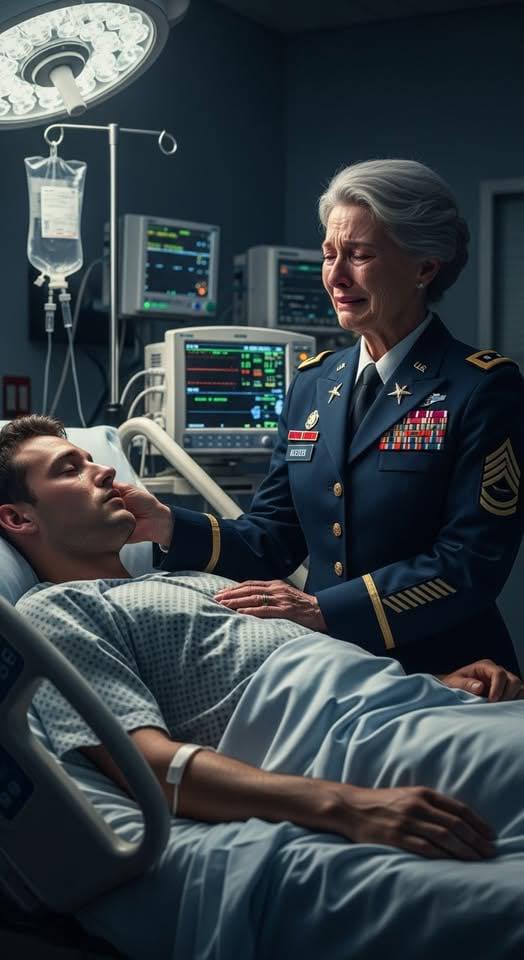
Room 512 was quiet, save for the rhythmic, mechanical breathing of a ventilator.
My son lay on the bed, but he was barely recognizable. His frame, once broad and athletic like his father’s, was skeletal. His skin was the color of parchment. A roadmap of tubes and wires tethered him to the machines that hummed with artificial life.
A doctor in a white coat turned from the monitors. He looked exhausted. “Dr. Thomas Reynolds,” he introduced himself. “Are you family?”
“I’m his mother,” I managed, my voice cracking. “What happened?”
“Advanced gastric cancer,” Dr. Reynolds said, his tone professional but heavy with regret. “It metastasized to the liver and lymph nodes. By the time he came in, he was septic.” He paused. “He’s been here two weeks. You are his first visitor.”
I moved to the bedside, taking Mark’s hand. It was cold. “Has his wife been notified?”
“Repeatedly,” Reynolds said, his jaw tightening. “Mrs. Grant answered the first day, said she was out of town and would get here when she could. Since then, straight to voicemail.”
Mark’s eyelids fluttered. Slowly, painfully, they opened. The hazel eyes were dim, clouded by medication, but they found mine.
“Mom?” The word was a ghost of a sound.
“I’m here, Mark,” I whispered, gripping his fragile fingers. “I’m right here.”
“I wanted to call… my phone…” He trailed off, his breathing hitching.
“Don’t worry about that. I’ve got you.”
A moment of clarity seemed to pierce the fog. He squeezed my hand with surprising strength. “I love you, Mom.”
Before I could respond, the monitor’s steady rhythm shattered into a single, piercing tone.
“Code Blue! Room 512!”
I was ushered into the hallway. I stood with my back against the cold wall, listening to the flurry of commands, the sounds of compressions, the desperate attempt to restart a heart that had been broken long before it stopped beating.
When Dr. Reynolds stepped out ten minutes later, the silence was absolute.
“I’m sorry, Colonel,” he said softly.
I clutched the pocket watch in my hand, the metal biting into my skin. I had survived forty years of war, only to arrive home ten minutes too late.
The hospital handed me a clear plastic bag containing Mark’s effects: his wallet, a watch I’d given him, and a dead phone. No wedding ring.
I returned to Mark’s house with a singular, cold purpose. The grief was there, a tidal wave waiting to crash, but I held it back behind a dam of military discipline. First, I needed to secure the perimeter.
Inside, the house smelled of stale air and neglect. The living room was dim, curtains drawn against the truth. On the coffee table sat a half-empty bottle of scotch and a glass with lipstick stains on the rim. The mantle, once filled with photos of us, was bare.
I moved to the kitchen. A tower of unopened mail leaned against the wall—utility shut-off warnings, overdue mortgage notices, maxed-out credit card statements.
I picked up a framed photo lying face down on the counter. It was their wedding photo. Jennifer, sleek and predatory in designer silk, smiling a smile that didn’t reach her eyes.
I went to Mark’s home office. Papers were scattered across the floor like autumn leaves. I found a stack of receipts near the printer.
Key West Yacht Charter: $75,000. Dated three days after Mark was admitted to the ICU.
Cartier Miami: $48,000.
Oceanfront Resort: $12,000.
The dates aligned perfectly with his dying days. While my son lay alone, terrified and in pain, she was burning through his life savings.
I sat in his chair, fury rising like bile. I found his laptop charger and plugged in his computer. Thankfully, he used the same password he’d used since high school—his father’s service number.
I accessed his email. Buried in the archive was a folder labeled Jen Background. I opened it.
Mark had hired a private investigator three months ago. The report was damning. Jennifer was a grifter. She had two previous husbands, both wealthy, both older, both dead of “natural causes” shortly after the marriage, leaving her with substantial settlements. Mark had found out.
There was a digital note attached to the file: Confronted Jen about the Aspen charges. She denied it. Said I’m paranoid. Said the cancer medication is making me hallucinate. Maybe she’s right?
She had gaslighted him. She had convinced a dying man he was losing his mind so she could rob him blind.
I needed to charge Mark’s phone. As it booted up, a barrage of text messages flooded in. Most were spam or work alerts. But there was a screenshot in his photos gallery. It was a text conversation between Jennifer and a contact named “Alicia.”
Jennifer: How much longer does he have? The Riviera awaits.
Alicia: Just wait it out. Once he’s gone, the payout is huge.
Jennifer: Already moving funds to the offshore account. He’s too weak to notice.
The timestamp was five weeks ago.
I set the phone down. My hands were steady. This wasn’t a domestic dispute. This was a hostile extraction of resources.
I needed reinforcements. I dialed Colonel Richard Hayes, my former commanding officer who now worked in military financial administration in Tampa.
“Shirley?” he answered on the second ring. “You’re stateside?”
“Mark is dead, Richard,” I said, my voice flat. “And his wife is looting the estate. I need a forensic accountant and a JAG lawyer, and I need them yesterday.”
“I’m on my way,” he said.
By the next morning, I had a war room set up on Mark’s dining table. Richard arrived with Edward Martinez, a ruthless estate attorney who hated fraudsters more than he liked money.
“We have a problem,” Martinez said, reviewing the files. “She’s the widow. Without a will stating otherwise, she inherits everything. The house, the accounts, the insurance.”
“Mark was thorough,” I said. “Check the basement.”
I had found an email draft Mark never sent. It simply said: Mom, check the utility room. Behind the panel.
I led them downstairs. Behind a false electrical panel in the utility room, we found a small fireproof safe. Inside was a USB drive and a hardcopy document.
It was a Last Will and Testament, notarized and dated two weeks before he went into the hospital. It explicitly disinherited Jennifer, citing infidelity and financial abuse, and left the bulk of his estate to a charitable trust, with me as the executor.
There was also a video file on the drive. I clicked play.
Mark’s gaunt face filled the screen. “Mom, if you’re watching this… I messed up. She’s not who I thought she was. She’s stealing everything. But I won’t let her win. I’ve gathered the evidence. I love you. Always have.”
I wiped a single tear from my cheek. “Edward,” I said, turning to the lawyer. “Lock it down.”
“I’ll file an emergency injunction to freeze the assets immediately,” Martinez said, typing furiously on his phone. “She won’t be able to buy a stick of gum by noon.”
My phone rang. The screen flashed: Jennifer.
I answered on speaker.
“Where is my money?” she screamed, no preamble, no grief. “My cards are declined. The bank says the accounts are frozen. Fix it, Shirley.”
“Hello, Jennifer,” I said calmly. “Enjoying the weather in the Keys?”
“I am his wife! I have rights! I own that house, I own his money!”
“Did you ever love him?” I asked. “Even for a second?”
She laughed, a sharp, ugly sound. “Love is for people who can’t afford better options. Mark was a stepping stone. Now stop playing games or I will sue you into the ground.”
“You should know,” I said, “that I have his phone. And the investigator’s report. And the new will.”
The line went dead silent.
“That’s a lie,” she whispered.
“The police are on their way to the marina, Jennifer,” I lied smoothly. “I’d suggest you don’t run. It makes you look guilty.”
I hung up.
The injunction worked. Jennifer’s funds were frozen. She was forced to return to Naples, not out of duty, but out of desperation.
She showed up at the house two days later. I watched her from the window as she stormed up the walkway, looking disheveled, her designer sunglasses hiding what I assumed were eyes red from rage, not crying.
She pounded on the door. I opened it, leaving the security chain on.
“Let me in,” she hissed. “I live here.”
“Not anymore,” I said. “I changed the locks yesterday.”
“We can make a deal,” she said, her tone shifting instantly from aggression to manipulation. “Look, Shirley, I know we got off on the wrong foot. I was grieving in my own way. The yacht… that was Mark’s idea. He wanted me to be happy.”
“Mark died alone calling my name,” I said. “Save the performance.”
“I want half,” she bargained. “Give me half the life insurance and the house, and I’ll walk away. You can keep his pathetic little trinkets.”
“I have a better offer,” I said. “Come back tomorrow at 2:00 PM. We can discuss a settlement. Bring your lawyer.”
Her eyes lit up. Greed is a blinder. “Fine. 2:00 PM.”
As she walked away, I called Detective James Morales, a contact Martinez had in the Financial Crimes Unit.
“She’s coming tomorrow,” I told him. “She’s desperate. She’ll talk.”
“We’ll be listening,” Morales promised.
The next afternoon, the house was wired. Microphones in the plant pots, cameras in the bookshelves. Morales and his team were in a van down the street.
Jennifer arrived alone. “My lawyer couldn’t make it,” she lied. “We can handle this, right?”
I poured her tea. I played the part of the tired, grieving mother who just wanted the fighting to stop.
“It’s just so much money,” I sighed, looking at a fake bank statement I had left on the table. “I don’t know how to manage it.”
Jennifer picked up the paper, her eyes scanning the zeros. “I can help you, Shirley. I managed Mark’s finances for years.”
“Is that why the accounts were empty?” I asked innocently.
“I had to move money around,” she said, lowering her voice. “To protect it. Mark was… mentally unstable at the end. He was spending wildly. I moved it offshore to keep it safe for us.”
“And the medical care?” I pressed. “The doctor said he missed treatments.”
“He wanted to give up,” she shrugged. “I just… respected his wishes. I may have withheld a few appointments, but only because he was suffering. It was mercy.”
Bingo.
“Mercy,” I repeated. “Or murder?”
She stood up, her face twisting. “Call it what you want. He was dying anyway. I just sped up the process so I could get my payout. Now sign the check, old woman.”
“I don’t think I will,” I said, my voice hardening.
“What?”
“I think you should look out the window.”
She turned. Three police cruisers were pulling into the driveway, lights flashing silently.
Jennifer spun back to me, her face a mask of horror. “You… you set me up.”
“I’m a Colonel,” I said, standing tall. “We specialize in ambushes.”
Jennifer was arrested on charges of Grand Theft, Fraud, and Exploitation of a Vulnerable Adult. With the recording of her admission regarding the medical appointments, the DA added charges of Negligent Homicide. She was denied bail.
The legal battle was short. Martinez decimated her defense. She took a plea deal: twenty-five years in federal prison.
Three days later, we held Mark’s funeral. The chapel was full—not of Jennifer’s socialite friends, but of Mark’s colleagues, neighbors like Mrs. Wilson, and a group of teenagers I didn’t recognize.
After the service, a tall man approached me. “David Foster,” he said, shaking my hand. “I run the Foster Architecture Mentorship Program. These kids… Mark taught them. He volunteered every week to teach underprivileged teens how to design homes.”
One of the students, a girl named Maya, stepped forward. “He believed in us,” she said. “He told us we could build anything.”
I realized then that while Jennifer had stolen Mark’s money, she hadn’t touched his legacy.
In the weeks that followed, I found myself without a mission. The house was quiet. Justice had been served, but it felt hollow.
Then, Dr. Chen, Mark’s oncologist who I had met during the investigation, called me.
“Colonel Grant,” she said. “I know this is unorthodox. But Mark spoke of you often. He said you needed a purpose.”
“I’m retired, Doctor.”
“I have a patient,” she continued. “His name is Ethan. He’s eight years old. Acute Lymphoblastic Leukemia. He’s in the foster system, but they can’t find a placement that can handle his medical needs. He’s obsessed with space and the military.”
I hesitated. I was sixty years old. I was tired.
“Just come meet him,” she urged.
I went to the pediatric ward the next day. Ethan was a small thing, pale and fragile, wearing a NASA t-shirt three sizes too big. He was sitting in a wheelchair, reading a book about the Apollo missions.
“I heard you jumped out of planes,” he said, looking up at me with eyes that held too much knowledge of pain.
“Seventeen times,” I confirmed.
“Did you ever go to space?”
“No. But I know a lot about courage. And I hear you have the Right Stuff.”
He smiled, and for a second, I saw Mark. Not the face, but the spirit. The resilience.
I visited every day for a month. We read books. We planned missions to Mars. I learned his medications, his schedule, his fears.
When Dr. Chen told me the state was looking to move him to a group facility, I made a decision. I had a house. I had a pension. And I had a lot of time.
Martinez helped me navigate the legalities. My background check was spotless.
Three months after Mark’s death, I brought Ethan home.
We turned Mark’s old office into a galaxy. I painted the ceiling black and stuck glow-in-the-dark stars in the exact configuration of the Orion constellation.
Ethan’s recovery was slow. There were bad days—days of nausea and fear. But there were good days. Days we spent at the newly dedicated Mark Grant Center for Architectural Education, which I had funded using the recovered assets from Mark’s estate.
Ethan loved the center. He would sit with David Foster, drawing moon bases and rocket launch pads.
One evening, six months later, we walked down to the beach at sunset. Ethan was stronger now, his hair growing back in soft fuzz.
I carried a small wooden frame with a photo of Mark.
“Is that him?” Ethan asked.
“Yes. This is Mark.”
“He looks nice,” Ethan said. “I think he’d like that you gave me his room.”
“He would have loved it,” I said, my voice thick.
We found a spot where the tide kissed the sand. I placed the frame down, pressing it into the soft earth. Ethan found a smooth white stone and placed it beside the photo to anchor it.
“He’s not gone, is he?” Ethan asked, looking out at the horizon.
“No,” I said. “As long as we remember him, he’s here.”
I stood there, the ocean breeze cooling the Florida heat. I had come home to a tragedy, but I had found a future. I had lost a son, but I had found a boy who needed a mother.
Jennifer was in a cell. Mark was at peace. And I had a new mission.
“Ready to go home, Colonel?” Ethan asked, slipping his small hand into mine.
I squeezed his hand, feeling the pulse of life, strong and steady.
“Yes, Ethan,” I said. “Mission accomplished. Let’s go home.”
If you’ve ever had to fight for the people you love, or if you’ve found hope in the darkest places, let me know in the comments. And remember, sometimes the end of one story is just the beginning of another.