The sterile, clinical scent of the hospital had become a suffocating weight, a sensory trigger that reminded me of my greatest failure every time I drew breath. My three-year-old son, Lucas, was unrecognizable. Where there had once been soft cheeks and a quick, dimpled smile, there was now a landscape of thick bandages, weeping skin, and the structural wreckage of third-degree burns. Every time I stepped into his room, I felt my spirit fracture. The guilt was not a quiet hum; it was a deafening roar that told me I was no longer fit to be his mother.
The nightmare had begun on a Tuesday at 3:00 AM, the kind of hour where the world is supposed to be silent and safe. An electrical fault in the apartment below ours had turned our building into a tinderbox. By the time the alarms shrieked, the hallway was a tunnel of orange fury and black soot. My husband, Marcus, acted with the instinctive precision of a protector, grabbing our five-year-old daughter, Emma, and charging through the smoke. I grabbed Lucas, pulling his small, warm body against mine. But as we reached the threshold, the world collapsed. A support beam, wreathed in flames, thundered down from the ceiling. In that split second of primal, blinding terror, I did the unthinkable. To shield my own face from the searing heat, I let go. I dropped my son directly into the fire.
Those thirty seconds defined the end of my life as I knew it. A firefighter eventually breached the window and pulled us from the inferno, but for Lucas, the damage was done. He had been engulfed for nearly half a minute—an eternity for a child’s fragile skin. Marcus and Emma escaped with minor injuries, and while my hands were scorched from a belated attempt to reach back into the flames, Lucas was the one paying the ultimate price. He was burned over sixty percent of his body.
The weeks that followed were a blur of medically induced comas, skin grafts, and the constant, rhythmic beeping of monitors. When the doctors finally brought him back to consciousness, the silence of the coma was replaced by a sound far worse: his screaming. He screamed from the agony of his healing nerves, but he also screamed from the confusion of his new reality. He saw the way people looked at him—the pity, the horror, the averted eyes. Most devastatingly, he saw that look in me. I tried to mask it, but children possess a terrifying intuition. One afternoon, his voice muffled by the gauze covering his jaw, he asked, “Mommy, why do you look scared of me? Am I a monster now?”
That question was the final blow. I fled the room, collapsing in the hallway in a fit of hyperventilation. I couldn’t do it. I was convinced that my presence was a poison to him, a constant reminder of the mother who had dropped him to save herself. I began to withdraw, visiting less and less, convinced that I was doing him a favor by staying away. I told myself he needed the professionals, not a coward who couldn’t bear to look at the consequences of her own panic. Five weeks passed, and the distance between us became a canyon.
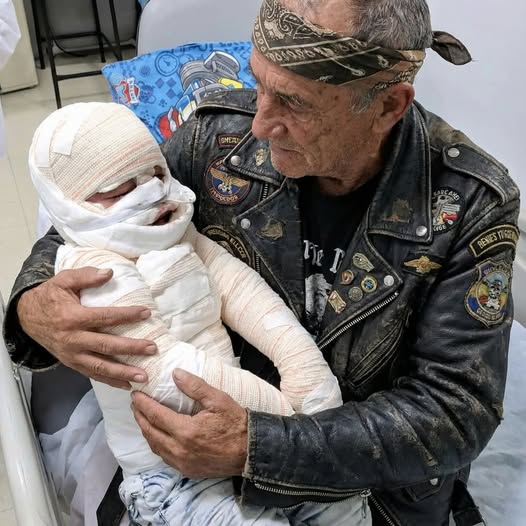
Everything changed on an ordinary Tuesday when Marcus returned from the hospital with a look of stunned disbelief. He told me a stranger had visited Lucas—a man in his seventies, a biker clad in worn leather and covered in tattoos. This man had simply walked into the room and asked to hold our son. I was defensive and fearful, but Marcus quieted me. He said the nurses had watched them; the man had sat for two hours, cradling Lucas with a comfort and ease that I had been unable to provide. Most importantly, Lucas had laughed.
Driven by a mixture of jealousy, suspicion, and a desperate need for answers, I went to the hospital the next day. I stopped at the doorway of Lucas’s room and froze. There sat the biker—a man named Robert Sullivan—with my son curled in his lap. Robert was telling a story about a rabbit and a motorcycle, his gravelly voice filled with a warmth that seemed to fill the sterile room. When he looked up and saw me, he didn’t offer a judgment. He simply said six words that pierced through my defensive shell: “You must be his mama.”
In that moment, I felt like an imposter. I walked in, trembling, and asked why he was there. Robert didn’t answer with a lecture; instead, he removed his bandana. The left side of his head was a map of ancient, silvered scars—burns from a house fire sixty-two years ago. He told me his story: how his own mother couldn’t bear to look at him, how she had eventually abandoned him because her own guilt was a weight she couldn’t carry. He had spent half a century believing he was a monster, not realizing that his mother hadn’t run from his face—she had run from her own reflection in his eyes.
“She thought I’d be better off without a mother who felt guilty every time she looked at me,” Robert said softly, his hand resting on Lucas’s bandaged head. “She was wrong. I needed her every single day. Her leaving broke me worse than any fire ever could.”
I broke down then, admitting the truth I had buried: that I had dropped him. I expected Robert to recoil, but he didn’t. He told me that Lucas didn’t need a perfect mother; he needed a mother who showed up. He needed to know that he was loved not in spite of his scars, but through them. When Lucas reached out his small, bandaged hand and whispered, “I don’t want you to go away, Mommy,” the wall I had built out of shame finally crumbled. I took my son from Robert’s arms and held him, promising him—and myself—that I would never run again.
Robert became a fixture in our lives over the next few months. He was there for every surgery and every painful dressing change. He reframed Lucas’s identity, teaching him that he wasn’t a victim, but a “little warrior” whose scars were marks of a battle won. Robert had been visiting burn units for thirty years, ensuring that no child felt the isolation he had endured as a boy. He gave Lucas a vision of a future—a life where he could grow old, ride a motorcycle, and be a person of substance and joy regardless of his appearance.
When Lucas was finally discharged, Robert didn’t disappear. He became our “honorary grandpa,” a role we eventually made legal. Today, two years later, Lucas is a thriving five-year-old. His face is different, yes, and the world still stares, but he moves through that world with a confidence that was forged in the fire and tempered by Robert’s wisdom. Every Sunday, Robert joins us for dinner, his leather vest a symbol of the protection and strength he brought into our lives.
I realize now that I was on the verge of repeating a cycle of trauma that would have haunted Lucas forever. I was ready to abandon him because I couldn’t forgive myself. But a stranger who had lived through the same hell walked in and reminded me that love is not the absence of pain; it is the courage to stay present within it. Robert Sullivan saved my son, but in many ways, he saved me too. He taught me that family isn’t defined by the mistakes we make in the dark, but by the way we hold each other when we finally step back into the light.