The Silent Ledger
Chapter 1: The Church Bells
I was standing at the church doors when the contractor called.
I wore a black dress, the same one I had worn to my husband’s funeral exactly one year ago. My two sons, Leo and Sam, gripped my hands like anchors, their palms warm and sticky. The bells above us were already warming their throats, a deep, resonant hum vibrating through the heavy oak doors. It was the anniversary mass. A day for remembrance. A day for peace.
I remember thinking that grief had trained my heart to survive anything. I thought I was unbreakable.
Then I answered the phone.
“Mrs. Gable?” the contractor’s voice crackled, breathless and urgent. “Ma’am, I need you to come down here. To the office. Now.”
“We’re about to walk into mass, Mr. Tate,” I said, keeping my voice low. “Can this wait?”
“No, ma’am. It can’t.” His voice dropped, losing its professional cadence. “You need to see what we found. But don’t come alone. Bring your two sons.”
I froze. The church bells began to toll, loud and demanding. “Why?”
“Because they need to see it too. Before the police get here.”
I didn’t ask anything else. I hung up the phone, turned my boys around, and walked away from the sanctuary. I already knew the past never stays buried. It waits like a blade left where someone meant to come back for it.
A year earlier, I buried my husband, Arthur, with a calm that confused people. They mistook it for strength. It was control. Control is what you cling to when the ground gives way beneath your feet.
We met young. He smelled like ink and ambition. An office stacked with ledgers and framed ethics. He said honesty was cheaper than lies. I believed him because I needed to. Because belief is how love works in the beginning. It edits reality until it fits the narrative you crave.
We built a life with clean lines. Two boys, a small but prestigious accounting firm, a church pew we filled every Sunday. He worked late. I trusted early. That trust was the first mistake.
The signs came quietly, like dust settling in an unused room. Missing files. A locked drawer where there used to be a pen cup. Calls he took outside, rain or not, his voice hushed and urgent. I cataloged it all without comment. Grief had already taught me how to observe without bleeding.
The evidence arrived the way truth usually does—accidentally. An email forwarded to the wrong account. My name misspelled. A shell company called Agape Holdings. My husband’s signature used where it didn’t belong.
He wasn’t cheating. It was worse.
He was stealing. From clients. From partners. From the very church he prayed in every Sunday.
And when I followed the paper trail far enough, I found the partner who benefited most. His best friend. Godfather to our sons. The man who stood beside me at the funeral, held my hand, and called my husband a saint.
Marcus Vance.
The night my husband died of a sudden heart attack, he wasn’t sick. He was running. He had packed a bag. He had a ticket to Belize in his pocket. He died of fear as much as failure.
I didn’t scream. I didn’t confront. I did what I do best. I planned.
I hired a forensic accountant under the guise of “estate cleanup.” I let the church elders believe I was a grieving widow seeking closure. I fed Marcus exactly what he wanted: access, sympathy, time. I played the role of the helpless woman while I documented every move he made to cover his tracks.
A year passed. The office sat untouched, sacred, rotten.
Then I hired Mr. Tate’s renovation company to sell it. “Clean slate,” they said.
That’s when the wall came down.
Chapter 2: The Safe Behind the Wall
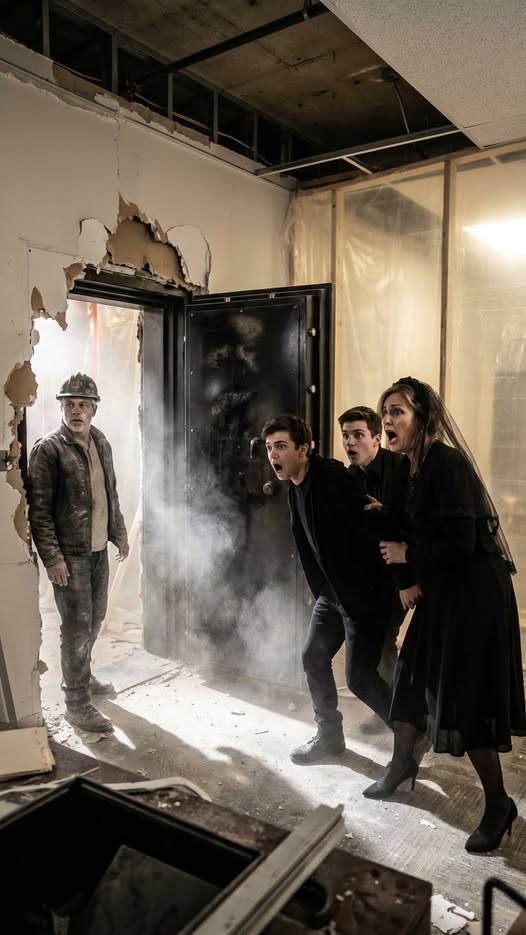
The office smelled of drywall dust and old secrets. Mr. Tate met us at the door, his face pale beneath the grime. He led us past the reception desk, past Arthur’s old office, to a small storage room in the back.
The drywall had been torn away, exposing the wooden studs. And there, nestled between the beams, was a heavy steel safe. It wasn’t modern. It was old, black iron, with a dial that looked like it belonged in a bank vault.
“We found it when we pulled the shelving down,” Mr. Tate said quietly. “It wasn’t on the blueprints.”
“Open it,” I said.
“It was already unlocked, ma’am. Just… cracked open.”
I stepped forward. Leo and Sam, ten and twelve years old, stood silently behind me. They knew something was wrong. Children always know.
I pulled the heavy door open.
Inside, there was no cash. No gold. Just stacks of leather-bound ledgers, three external hard drives, original contracts with wet ink signatures, and a single envelope.
The envelope had my name on it in Arthur’s precise, architectural script.
Sarah.
I opened it. My hands didn’t shake. I was past shaking.
Inside was a handwritten note.
If you find this, I failed. I tried to fix it, Sarah. I tried to pay it back. But Marcus wouldn’t let me. He has leverage. He threatened the boys. I’m keeping these records as insurance. If anything happens to me, give this to the police. Don’t trust Marcus. He isn’t who we thought he was.
I read the truth aloud to my sons. Not the sanitized version. The real one.
Their father wasn’t a saint. He was a man who got trapped. He had planned to expose it all. He’d hidden the evidence to protect them. He died before he could finish the job.
Mr. Tate watched in silence, his cap in his hands.
“What do you want to do, Mrs. Gable?” he asked.
I looked at the ledgers. I opened one. It was a detailed accounting of every stolen dollar. Millions. Siphoned from the church building fund, from elderly clients’ retirement accounts, from the city’s charity grants. And every transaction was authorized by Marcus Vance.
The church bells had stopped ringing blocks away. The silence in the room was heavy, suffocating.
I pulled out my phone. I didn’t call the police. Not yet.
I made one last call to Marcus.
“Sarah?” he answered on the second ring, his voice smooth and comforting. “Where were you? We missed you at mass.”
“I’m at the office, Marcus,” I said. My voice was steady. “I’m ready to sell. The renovation team is here. I need your advice on some… structural issues they found.”
“Of course,” he said instantly. The greed in his voice was subtle, but I heard it. He wanted to make sure the building was sold so the past could be bulldozed. “I’ll be there in twenty minutes.”
I hung up. I turned to Mr. Tate.
“Leave the wall open,” I said. “And set up a camera.”
Chapter 3: The Godfather
Marcus arrived confident, wearing a tailored suit and, I noticed with a jolt of nausea, my husband’s vintage Omega watch. He had “inherited” it, he claimed, because Arthur wanted him to have it. I had let him take it. It was just a watch. Now, it looked like a shackle.
He walked into the back room, smiling that benevolent smile that had fooled the entire congregation.
“Sarah,” he said, opening his arms. “Boys. What’s this about structural—”
He stopped.
He saw the hole in the wall. He saw the open safe. He saw the ledgers stacked on the desk.
The color drained from his face in increments. First, a pale gray. Then, a sickly white.
“What is this?” he whispered.
I sat behind Arthur’s old desk. I didn’t invite him to sit.
“It’s the insurance policy, Marcus,” I said.
He looked at the ledgers. He recognized them. He took a step forward, his hands twitching.
“Those… those are old files, Sarah. Arthur was confused near the end. He was making things up.”
“Is that right?” I picked up the hard drive. “Because this drive contains emails between you and the offshore accounts in the Caymans. It contains the threat you sent him three days before he died. ‘Fix the books or I fix your family.’ Is that Arthur being confused?”
Marcus looked at my sons. He looked at Leo and Sam, his godchildren, who were watching him with eyes that had suddenly grown very old.
“Boys,” Marcus said, his voice cracking. “Go wait in the car. Your mother and I need to talk.”
“They stay,” I said. “They need to know who their godfather really is.”
Marcus’s face twisted. The benevolent mask fell away, revealing the rat beneath.
“You don’t understand,” he hissed. “I did this for the firm. For Arthur! We were going under. I saved us!”
“You stole from the church,” Sam said. His voice was small, but clear. “Dad wrote it down. You stole from God.”
Marcus flinched as if struck.
“Sarah,” he pleaded, stepping closer to the desk. “Think about what this will do. The scandal. It will ruin Arthur’s memory. People will think he was part of it.”
“He was part of it,” I said. “But he tried to stop it. And you killed him for it.”
“I didn’t touch him!”
“You stressed his heart until it exploded. You chased him into an early grave.”
I stood up. I slid the ledgers across the desk toward him.
“Here,” I said.
He reached for them, hope flaring in his eyes. He thought I was giving them to him. He thought I was protecting the family name.
“Take a good look,” I said. “Because these are copies.”
He froze.
“The originals are with the District Attorney,” I lied. They weren’t yet. But they would be in an hour. “The hard drive has been uploaded to the cloud. And the church elders… they’re meeting me here in thirty minutes.”
Marcus stared at me. The realization hit him like a physical blow. There was no way out. No deal to be made.
“You could stop this,” he whispered. “We could split it. There’s enough left. Sarah, please.”
I smiled for the first time in a year. It felt like breaking glass.
“I already did,” I said.
Chapter 4: The Surgical Fallout
The trial was efficient. The fallout was surgical.
I handed everything to the authorities that afternoon. The police arrived while Marcus was still sitting in that chair, staring at the empty safe. They led him out in handcuffs past a crowd of onlookers who had gathered when they saw the flashing lights.
He lost his firm. He lost his reputation. He lost his place in the pew.
The church recovered every stolen dollar. It took time—seizing his assets, selling his home, draining his hidden accounts—but they got it back.
Arthur’s name was cleared. Not as a saint—I made sure of that. I didn’t want my sons to worship a lie. His name was cleared as a man who made a terrible mistake, got caught in a spider’s web, and tried to cut his way out too late. He was human. That was better than a saint.
I sold the office building. Mr. Tate finished the renovation, erasing the secret room, sealing the past behind fresh drywall and paint. I donated the proceeds to a fund for victims of financial fraud.
My sons sleep better now. They know the truth. They know that their father loved them enough to leave a map, even if he couldn’t walk the path himself.
And so do I.
I still go to church. I sit where I always did, three rows back on the left. The bells still ring. But now, when I hear them, I don’t hear a funeral toll. I hear a warning.
Justice doesn’t always roar. It doesn’t always kick down the door with guns blazing. Sometimes it waits a year. Sometimes it sits quietly in a wall safe, gathering dust and interest. It waits until you think the worst is behind you, until you think you’ve gotten away with it.
And then it calls you. It calls you right when you’re walking into church, and reminds you that the dead don’t stay silent. They just choose the right moment to speak.