I woke up to a silence so heavy it felt like a burial shroud.
Usually, the mornings in our apartment were a predictable cacophony of domesticity. Kao would be in the kitchen, a whirlwind of unnecessary noise—clattering porcelain, slamming cabinet doors with his heavy-handed indifference, the sharp click-hiss of the electric kettle. But today, the air was thick, almost tangible in its stillness.
I turned my head. The other half of the bed was already cold, the comforter neatly tucked back as if he had never been there at all. That was the first sign. Kao never tucked in the comforter.
Pulling on my robe, I walked into the hallway, my bare feet hitting the cold hardwood. In the kitchen, Kao sat hunched over the table, his face illuminated by the sickly blue glow of his phone. A half-drunk mug of coffee stood before him, a skin forming over the surface. On a small plate sat a sandwich with a single, aggressive bite taken out of it.
He didn’t even raise his eyes when I entered.
“Good morning,” I said, my voice sounding brittle even to my own ears.
“Mhm,” he grunted.
Eight years of marriage had taught me that “Mhm” was the ceiling of his morning emotional availability. I reached into the cabinet for my mug—the light blue one with the chipped handle. I kept meaning to throw it away, but there was something about its imperfection that felt familiar. It was like us: broken, but still holding on out of habit.
Outside the window, a fine October rain drizzled, the drops crawling down the glass like tears on a face that had forgotten how to cry.
“Mama’s moving in,” Kao said suddenly. He still didn’t look up from the screen.
The mug nearly slipped from my fingers. I felt a visceral tightening under my ribs, an unpleasant ache that I knew all too well. “How do you mean, moving in?”
“Just like that. Her roof is leaking. She’s starting renovations, and it’s impossible to live there. She’s going to stay with us for a while.”
“For how long, Kao?”
He finally raised his eyes, looking at me with a cold, flat stare, as if I were the one being unreasonable. “Until the roof is fixed. A month, maybe two. You don’t mind, do you? She’s my mother.”
It wasn’t a question. It was a declaration of a fait accompli. Mother Orliana, the woman who looked me up and down at every holiday dinner as if she were inspecting a piece of gristle at the butcher shop. The woman who found fault in the way I breathed, the way I dressed, and the “loudness” of a voice I had spent years trying to whisper.
“The spare room?” I asked, my voice barely audible. “The one we were turning into the office?”
I looked at the corner where a flat box sat—a desk I had bought with my last bonus, waiting to be assembled. It was my small dream, a space for my own thoughts.
“I’ll swing by this evening and pick her up,” Kao said, ignoring the question of the office entirely. He finished his coffee and shoved his phone into his pocket. He left without a goodbye, the door slamming behind him, leaving me alone with the chipped mug and the rain.
I stood in the center of the kitchen, watching the flat box in the corner, and I felt the first tremor of a landslide that would eventually bury us all.
The whole day at the office felt like a fever dream. I moved through reports and meetings on autopilot, the words of my boss drifting over me like static. At lunch, I found myself in the grocery store, staring at a row of poultry.
Did Mother Orliana like chicken? She had once told me my roasted chicken was “dry enough to kindle a fire.” Perhaps pork chops? I stood there, clutching the handle of the red plastic basket, and suddenly, a wave of white-hot anger surged through me. Why was I catering to a woman who viewed me as a seasonal inconvenience?
But I suppressed it. I was a master of suppression. I bought the chicken, the red potatoes, and the green beans. I would be the perfect daughter-in-law. I would endure.
Exactly at 7:00 PM, the doorbell rang. It wasn’t a ring; it was a summons.
On the doorstep stood Mother Orliana. She was short, stout, crowned with a stiff gray bouffant that looked like it could deflect bullets. Her lips were compressed into a thin, permanent line of disapproval. Behind her loomed Kao, looking like a pack mule with two massive suitcases and a cardboard box.
“Hello, Vesper,” she said, stepping past me before I could even offer a greeting. She peeled off her dark blue coat and handed it to me without looking, the way one hands a coat to a servant.
“Hello, Mother Orliana. Please, come in.”
She walked deep into the apartment, her eyes scanning the baseboards for dust. Kao silently dragged the luggage into the spare room—my office. I felt the air in the apartment turn thick, the oxygen seemingly being sucked out by her presence.
“Well, show me where I’ll be living,” she commanded.
I led her into the room. She looked at the sofa, the old wardrobe, and then pointed a stubby finger at the flat box in the corner. “What is this trash?”
“It’s a desk, Mother Orliana. I was going to—”
“Take it out,” she snapped at Kao. “I need space for my vanity. I’m not here for long, but I won’t live in a warehouse.”
Kao obediently grabbed the box—my dream, still in its packaging—and dragged it toward the hallway closet. He didn’t look at me once.
Dinner was an exercise in psychological warfare. We sat at the table I had covered with my best white embroidered cloth, the one I saved for holidays. I had hoped it would serve as a peace offering.
Mother Orliana chewed a piece of chicken slowly, her eyes fixed on mine. “It’s a bit dry, Vesper. Next time, try baking it in foil. And you’ve oversalted the potatoes. Kao is used to proper food. I raised him on excellence.”
I gripped my fork so hard my knuckles turned white. “I’ll keep that in mind.”
“Do you know how to cook at all?” she asked, setting her silverware down with a clinical clink. “Or is your head too full of office nonsense to remember how to be a wife?”
Kao stayed silent. He chewed his food and stared at his plate as if it contained the secrets of the universe. He heard her. He knew what she was doing. And he chose the TV over his wife’s dignity.
That night, as I lay in bed listening to the stranger in the next room opening my cabinets and marking her territory, I realized that the man snoring beside me was no longer my husband. He was merely his mother’s son.
By the fourth day, the occupation turned into an offensive.
I returned from work to find the apartment smelling not of my lemon-scented candles, but of Mother Orliana’s heavy, cloying perfume and fried onions. I walked into the kitchen and froze.
Every cabinet was open. My mugs—the ones I kept on the top shelf for easy reach—had been moved to the bottom. The pots were lined up by size, largest to smallest, like a military formation. My spice rack had been purged.
“Mother Orliana?” I called out.
She emerged from the living room, wiping her hands on a rag. “Ah, you’re here. I tidied up. Your kitchen was a disaster, honestly. No order. Now everything makes sense.”
“Mother Orliana, it was convenient for me the way it was.”
She grimaced, her lip curling. “That isn’t convenient; that is disorder. You are the lady of the house—nominally, at least. You should keep track of such things. Kao grew up in a home of order. To come home to this… mugs wherever… dust on the cabinets…”
“I wiped those cabinets yesterday,” I said, my voice rising a half-octave.
“Poorly, then. I went over them today. Look at the dirt.” She showed me the rag. It was clean. It was blindingly, insultingly clean. “But I suppose you’re too busy with your ‘career’ to let the house go.”
When Kao returned, I tried to talk to him. We stood in the kitchen as I heated up the greasy roast his mother had made.
“Kao, your mother rearranged the entire kitchen today. It’s my space. Can you please ask her to stop?”
He didn’t even lift his eyes from his phone. “So what? She’s elderly, Vesper. She needs to occupy herself. Stop being dramatic.”
“Dramatic? She’s erasing me from my own home!”
“She’s my mother,” he repeated, the phrase acting as a shield against any accountability. “She raised me alone. Can you really not tolerate her for a few weeks?”
The next day, it was my house shoes. The soft gray ones with the felt soles that I had worn for three years. They were gone. I searched the entryway, under the closet, the shelves.
“Mother Orliana, have you seen my slippers?”
She sat in the living room, knitting something out of beige yarn. She smiled innocently. “I saw them. I threw them away.”
“You… what?”
“They were shameful, Vesper. Worn out. Tattered. If guests came over, what would they think of us? I put them in the trash bin.”
I ran to the kitchen and opened the bin. There they were, at the bottom, smeared with coffee grounds and grease. I felt something snap inside me—a small, quiet break, like a hair-line fracture in a dam.
I messaged Kao: Your mother threw away my slippers. This is unbearable.
His reply came thirty minutes later: Buy new ones. Don’t make a mountain out of a molehill.
I threw the phone onto the bed and stared at the ceiling. I hadn’t cried in three years, but now the tears were hot and bitter. I wasn’t crying over slippers. I was crying because I had become invisible in my own life.
The invasion was complete. I was a ghost in my own hallways, haunted by a woman who wanted my throne and a man who had already forgotten I sat on it.
The second week was a blur of commanded chores and constant critique. Mother Orliana now ordered me to iron her clothes, to cook specific meals, and to clean her room while she watched her “programs.”
“You are the daughter-in-law,” she would say. “You are obligated to help.”
Kao looked right through me. He had retreated into a shell of silence so thick it was as if he had ossified.
One morning, as I was buttoning my blouse for work, she came out with an iron. “Vesper, show me how you iron Kao’s shirts. He’s going to work looking like he slept in a hedge.”
“Mother Orliana, I’m running late—”
“Show me!” she barked.
I took the shirt, my hands shaking. I ran the iron over the collar.
“Not like that!” She snatched the iron from my hand, her face contorted. “The collar from the inside first, then the outside! You’re just doing it slap-dash. You’re a disgrace to him.”
I threw the shirt on the board and walked out, my heart hammering against my ribs like a trapped bird.
That evening, the tension finally reached its flashpoint. Kao was late—as always. We were sitting at the dinner table, the three of us. The air was charged, the silence vibrating with unspoken resentment.
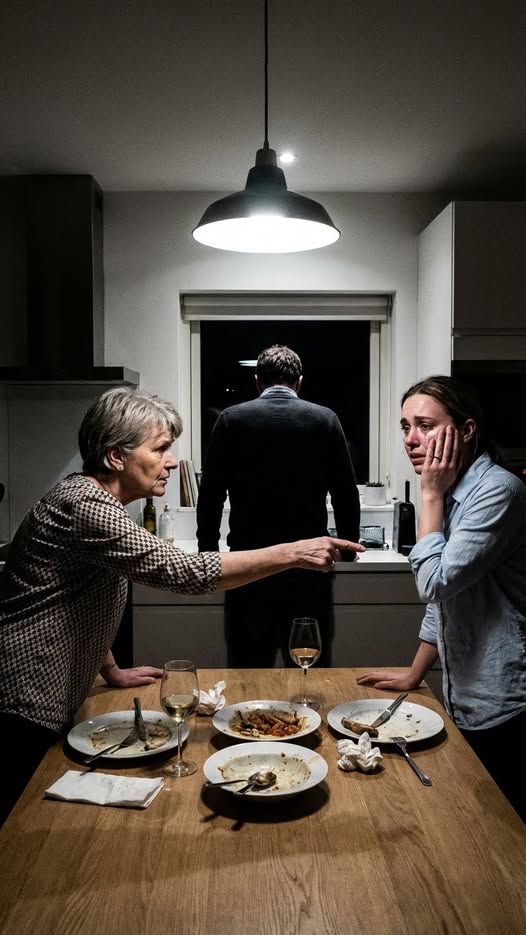
“I was thinking,” Mother Orliana began, setting her fork down. “Vesper, you should spend less time at the office. The house has gone to seed. You should go on maternity leave. Give birth to a child and sit at home as is proper.”
“I’m not pregnant, Mother Orliana.”
“Well, get pregnant then! Why are you dragging it out? Kao is a good man. He’ll provide. You’re twenty-nine—your clock is ticking, girl. A few more years and you’ll be a dry husk.”
“That is none of your business,” I said, my voice low and dangerous.
Mother Orliana jumped up, her face turning a mottled red. “How dare you? Kao is my son! Everything he does is my business!”
“No, it isn’t! And I am not your servant!”
Mother Orliana swung her arm. It wasn’t a push; it was a sharp, stinging slap that echoed through the kitchen. My head jerked to the side. The world went silent for a heartbeat. I felt the heat blooming on my cheek, the metallic tang of blood where my tooth had caught my lip.
I turned to Kao. My husband. My protector. He was looking at his plate.
“Kao?” I whispered. “She hit me.”
He didn’t look up. He didn’t move. He just sighed, a sound of profound annoyance. “Get off my back, Vesper. Y’all figure it out yourselves. I’m tired.”
In that moment, the fracture in the dam finally burst. It wasn’t a snap; it was a cold, clinical ignition. The woman who endured, the woman who whispered, the woman who apologized for existing… she died in that kitchen.
I walked out of the room without a word. I went into the bedroom, locked the door, and took out my phone. I didn’t cry. I opened my notes app and began to write a list. A step-by-step plan for a coup.
The next morning, I was a different person. I made breakfast with a smile that didn’t reach my eyes. I poured Kao’s coffee. He looked at me with surprise, perhaps thinking I had finally been “broken” into submission.
“I have a good mood today,” I told him.
He left for work. Mother Orliana went to the bathroom to begin her two-hour beauty ritual. I stayed in the kitchen and made three phone calls.
The first was to a locksmith. “I need the locks changed today. 10:00 AM. Emergency.”
The second was to Auntie Inez. Inez was Orliana’s cousin, but they hadn’t spoken in fifteen years—not since Orliana had “managed” the inheritance of their grandmother’s summer house while Inez was in the hospital. Inez was a woman who knew where the bodies were buried because she had helped dig the holes.
“Inez? It’s Vesper. Kao’s wife. I’m having a small tea party today at 2:00. I think you’ll find the conversation very… enlightening.”
The third was to Miss Birdie, our neighbor. Miss Birdie was the apartment building’s primary news outlet. If something happened on the fourth floor, the first floor knew about it by dinner. She loved a good “get-together.”
At 10:00 AM, the locksmith arrived. While Mother Orliana was humming in her room, suspecting nothing, the tumblers of our lives were being rearranged.
“What is this?” she asked, coming out just as the locksmith was finishing.
“The lock was jamming,” I said smoothly. “I didn’t want us to get stuck outside.”
She shrugged and went back to her knitting.
By 2:00 PM, the table was set. Tea, cookies, fine china. The white embroidered cloth was back. Exactly on time, the doorbell rang.
I opened it to find Auntie Inez—plump, ruddy-faced, with eyes that sparkled with a predatory curiosity. Behind her was Miss Birdie, already leaning in to catch a scent of scandal.
“Come in, ladies. Please.”
Mother Orliana came out of her room, froze on the threshold, and turned a shade of white I hadn’t known was possible. “You? What are you doing here?”
“Vesper invited me for tea,” Inez said, her voice dripping with artificial sweetness.
Mother Orliana turned to me, her eyes narrowed into slits. “What are you plotting, girl?”
I smiled. It was a cold, sharp thing. “Nothing special. I just want everyone to know what a wonderful mother-in-law you’ve been.”
I reached into my pocket and took out my phone.
The room went silent as I navigated to a voice recording I had made the night before. I had started it the moment I saw the rage in Orliana’s eyes at dinner. I hit play.
The speaker hissed for a second, and then Mother Orliana’s voice poured out—mean, shrill, and unmistakable.
“Don’t you dare talk back to me! I am the elder in this house! You’re a disgrace to him!”
Then, the sharp, wet crack of the slap.
The room gasped. Miss Birdie pressed a hand to her mouth, her eyes wide. Auntie Inez leaned forward, her expression hardening into a look of pure, ancient vengeance.
Then came my voice, broken and small: “Kao? She hit me.”
And finally, the husband’s response, echoing through the kitchen with the weight of a thousand betrayals: “Get off my back. Y’all figure it out yourselves.”
I turned off the phone. The silence that followed was deafening. Mother Orliana stood trembling, her lips purple, her hands clutching her cardigan as if she could shield herself from the truth.
“Orliana,” Inez said, standing up slowly. “You hit her. You actually laid hands on your daughter-in-law. You always were a bully, but this? This is a new low, even for the woman who stole a summer house from a sick woman.”
“I didn’t steal anything!” Orliana flared. “And she drove me to it! She’s rude, she’s—”
“I was rude because I asked you to stop throwing away my clothes and rearranging my life?” I asked, my voice now a calm, steady blade.
I walked into the hallway and dragged out the three suitcases and the box. I shoved them toward the door.
“What are you doing?” Orliana shrieked.
“You’re moving out. Now.”
“You can’t kick me out! This is Kao’s apartment!”
“The lease is in both our names,” I said. “And as of ten minutes ago, the lock has been changed. I have the new key. Kao will get his when he gets home. You? You won’t be getting one at all.”
I took the new key out of my pocket and placed it on the dresser. “One for me. One for Kao. Zero for you.”
Inez stepped between us as Orliana raised her hand again. “Careful, Orliana. The police are only a three-digit call away, and I’m a very reliable witness. Miss Birdie here is already planning the headline for the next building meeting, aren’t you?”
“Oh, you bet I am,” Miss Birdie whispered, her phone already out.
Mother Orliana looked around at the three of us. She saw Inez’s triumph, Birdie’s judgment, and my absolute, unshakeable resolve. She realized, for the first time in her life, that her son was not there to hide behind.
She grabbed one of the suitcases and rushed toward the door without looking back. Inez picked up the second, and Miss Birdie, with a look of high drama, grabbed the box.
The door opened. Mother Orliana stepped onto the landing, turned around, and spat, “You’ll regret this! You’ll be alone! Kao will never forgive you!”
“Maybe,” I said. “But at least I’ll be alone in my own house.”
I closed the door. I turned the deadbolt. Click.
A minute later, a massive crash sounded from the stairwell. I threw open the door to see Mother Orliana sprawled on the landing, her suitcase open, her sensible beige undergarments scattered across the concrete. She had tripped in her haste to flee.
“Does it hurt?” I asked from the top of the stairs, my voice cool and detached.
The apartment felt cavernous. For the first time in two weeks, the air was clean. The smell of fried onions and old perfume was being slowly replaced by the scent of the rain-washed evening.
I sat at the kitchen table and brewed a fresh pot of tea. No embroidery. No holiday tablecloth. Just the wood and the chipped mug.
At 6:30 PM, the door handle rattled. Then it rattled again, more violently.
I walked to the door and opened it. Kao stood there, his face a mask of confusion and growing irritation. “The key doesn’t work. What did you do?”
I handed him the new key. “I changed the locks.”
“Why?”
“Because your mother doesn’t live here anymore.”
He pushed past me, his eyes darting to the spare room. It was empty. The boxes were gone. He turned back to me, his jaw clenched. “She called me, Vesper. She’s at Inez’s, crying. She said you pushed her down the stairs. She said you humiliated her in front of the whole building.”
“She tripped,” I said. “And as for the humiliation, she earned every bit of it. Did you like the recording I sent to your work email?”
He froze. “What?”
“I sent the recording of the slap to you, to your sister, and to your mother’s pastor. I wanted everyone to have the same context you had when you told me to ‘figure it out.’”
Kao slumped onto a kitchen chair. He looked small. He looked like the coward I had finally realized he was. “How could you do that? To my own family?”
“How could you let your mother strike your wife and then go watch a talk show?” I shot back. “We’ve been married eight years, Kao. I’ve been quiet. I’ve been convenient. I’ve been invisible. But that ended last night.”
“You’ve changed,” he muttered.
“I grew a spine. It’s a bit late, I know.” I sat opposite him. “So, here is the final audit of our marriage. I am staying in this apartment. Your mother is never crossing this threshold again. You have two choices. You can stay here, but things will never go back to the way they were. You will protect me. You will hear me. Or, you can go to Inez’s and help your mother with her leaky roof.”
Kao looked at the new key in his hand. He looked at the kitchen—the cabinets I had already begun to move back to their original places.
“I don’t want to leave,” he whispered.
“Then prove it. Stop being a son and start being a husband.”
He looked into my eyes, and for the first time in years, he didn’t look through me. He saw me. He saw the bruise on my lip and the steel in my gaze.
“I’m sorry,” he said. It was the first real thing he had said in a decade.
“Don’t tell me,” I replied. “Show me. Now, help me move the desk back into the office. I have a report to finish.”
Two months later, the first snow of the season began to fall. Large, heavy flakes covered the gray courtyard of our building, turning the world into a clean, white slate.
I sat at my desk—assembled, finally—in my office. The apartment was quiet, but it was a different kind of quiet. It was a peace that had been fought for and won.
Mother Orliana had moved to her sister’s house in another city. The shame of the recording had been too much for her “church-pillar” reputation to survive in this neighborhood. She texted Kao once a week, but the messages remained on his phone, unanswered in my presence.
Kao was trying. He chopped the vegetables. He ironed his own shirts. He spoke up when something felt wrong. It wasn’t a fairy tale, but it was a marriage. It was two people trying to glue the fragments together.
I looked out the window at the snow. I had learned that the most dangerous thing you can do is stay silent in the face of your own erasure. I had learned that a home isn’t a place where you endure; it’s a place where you are seen.
My phone vibrated. A message from Inez: She’s still complaining about the salt in the potatoes over there. Some things never change. Stay strong, Vesper.
I smiled and put the phone away. I reached for my light blue mug—the one with the chipped handle. It still worked. It still held the heat.
The coup was over. The kingdom was mine. And for the first time in my life, I knew exactly what my voice was worth.

