The rain didn’t just fall; it punished the earth. It hammered against the windshield of my Range Rover with the rhythmic violence of a thousand tiny fists, blurring the world into streaks of neon and charcoal. I gripped the leather steering wheel until my knuckles turned white, a strange, premonitory tension tightening between my shoulder blades.
I had driven six hours straight from the capital, fueled by caffeine and the childish excitement of a surprise visit. I hadn’t told them I was coming. I wanted to see the look on my mother’s face when I walked through the door of the colonial-style house I had bought them three years ago. It was my crowning achievement—the brick-and-mortar proof that Miguel, the son who left to build an empire, hadn’t forgotten where he came from.
I turned the corner onto Maple Street. The wipers slashed back and forth, fighting a losing battle against the deluge.
My foot hovered over the brake. Then, it slammed down.
The house—their house—was dark. Not the cozy, sleeping dark of 11:00 PM, but a hollow, abandoned blackness. The windows were unblinking eyes, devoid of curtains.
But that wasn’t what stopped my heart.
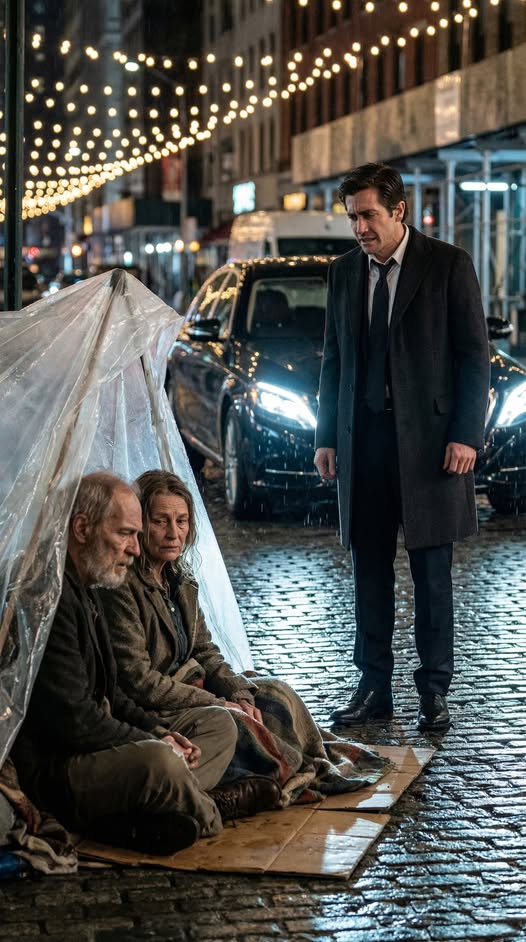
Across the street, huddled under the flimsy canvas awning of a closed bakery, were two figures. They looked like piles of discarded laundry in the dim streetlamp glow. A shopping cart sat beside them, covered with a black garbage bag that whipped furiously in the wind.
I didn’t park. I abandoned the car in the middle of the street, the door open, the engine running.
The rain soaked me instantly, ruining my Italian suit, but the cold I felt had nothing to do with the weather. I ran toward them, my boots splashing through puddles that looked like oil slicks.
“Mom? Dad?”
The figures stirred. The smaller one looked up. My mother’s face was a map of devastation, pale and streaked with water that might have been rain or tears. She was shivering so violently that her teeth chattered an audible rhythm. My father, a man I had once thought invincible, looked shrunken, his arm wrapped protectively around a plastic bin.
“Miguel?” he rasped, his voice cracking. He didn’t sound relieved. He sounded terrified.
“What are you doing?” I shouted over the roar of the storm, dropping to my knees on the wet pavement. “Where are your keys? Why aren’t you inside?”
My mother looked toward the house—the house I paid for, the house that was supposed to be their sanctuary. A “For Sale” sign, crooked and beaten by the wind, stood in the front yard. But it had a sticker slapped across it: SOLD.
“We couldn’t call you,” my mother sobbed, clutching something to her chest. I realized with a jolt it was the framed photo of my university graduation. The glass was cracked. “He said you would be so angry. He said you authorized it.”
“Who?” I demanded, grabbing my father’s ice-cold shoulders. “Who said that?”
The thunder clapped, shaking the ground beneath us, but the silence that followed my father’s whisper was louder than the storm.
“Jorge,” he said. “Your brother made us sign.”
The name hung in the air like a knife, severing the last thread of my naive reality.
“Get in the car,” I commanded. My voice was low, unrecognizable to my own ears. It was the voice of a stranger. “Now.”
As I helped them into the backseat, shielding them from the downpour, I looked back at the house one last time. A light flickered on in the master bedroom window. A silhouette moved behind the blinds.
Someone was in there.
The drive to the Grand Hotel was a blur of silent fury. The only sound was the heater blasting at full capacity and the soft, stifled weeping from the backseat. I didn’t ask questions yet. I couldn’t. I was afraid that if I opened my mouth, I would scream until my throat bled.
I checked them into the Presidential Suite. The concierge looked at my soaked suit and my parents’ disheveled appearance with disdain, until I slapped my Black Card on the marble counter. The look vanished. Money has a way of silencing judgment, a lesson I had learned well.
Upstairs, I ordered soup, hot chocolate, and warm towels. I watched my mother stare at the king-size bed with a heartbreaking mixture of awe and guilt, as if she were dirtying the linens just by looking at them.
Only when they were wrapped in thick terry-cloth robes, holding steaming mugs with trembling hands, did I sit down across from them.
“Tell me,” I said. “From the beginning. And do not protect him.”
My father took a deep breath, staring into his cocoa. “It started three months ago. Jorge came over. He looked worried. Sick with worry, he said.”
I clenched my jaw. Jorge was an actor who had never made it to the stage; he played the role of the dutiful son while I was the distant provider.
“He told us you were in trouble, Miguel,” my mother interjected, her eyes wide. “He said the government was coming for your assets. Something about… taxes?”
“A tax lien,” my father clarified. “He said the house was in danger of being seized because it was bought with your money. He said we needed to transfer the title to a ‘trust’ temporarily. Just to hide it. To save you.”
I closed my eyes. It was a lie so simple, so tailored to their fears, that it was brilliant. My parents didn’t understand corporate law or asset forfeiture. They only understood that their son was in trouble, and they would do anything to help.
“He brought papers,” my father continued, his voice trembling with shame. “He said you were too busy to explain, that you were embarrassed. He told us to sign a power of attorney. He said it was just for administration.”
“We signed,” my mother whispered, tears spilling onto her robe. “We didn’t read it. It was Jorge. He’s our son too.”
I stood up and walked to the window, looking out at the rain-lashed city. The betrayal wasn’t just the theft. It was the weaponization of their love for me. Jorge had used their desire to protect me as the knife to stab them in the back.
“It wasn’t for administration,” I said, my reflection in the glass looking ghostly pale. “It was a full power of attorney. He transferred the deed to himself, didn’t he?”
“He sold it,” my father said. “To a developer. But… but the developer let him stay. We don’t understand.”
“I do.”
The pieces fell into place with sickening clarity. Jorge hadn’t sold it to a developer. He had “sold” it to a shell company or a proxy, likely putting the cash in an offshore account, and then kept the property to live in or flip later. He had evicted his own parents to claim the inheritance he felt he was owed while they were still alive.
“He gave us five hundred dollars,” my mother said, her voice barely audible. “He told us to find a motel. He said if we called you, the police would find you. That we had to stay invisible.”
That was the final blow. He hadn’t just stolen their home; he had severed their lifeline. He had isolated them with fear.
I turned back to them. “You are safe here. No one is coming for me. There is no tax problem. I am going to fix this.”
“Miguel, please,” my mother pleaded, reaching for my hand. “Don’t go there. He… he has changed. He’s not the boy we raised.”
“Neither am I,” I replied.
I grabbed my car keys. The cold rage inside me had calcified into something harder, sharper. I wasn’t going as a brother. I was going as a catastrophe.
“Lock the door,” I told them. “I’ll be back.”
I drove back to the house. The rain had slowed to a drizzle, but the streets were slick and dangerous. I didn’t care.
When I pulled into the driveway—my driveway—I saw a sleek sports car parked where my father’s old sedan used to be. The lights were blazing now. A party? A celebration of his victory?
I didn’t ring the doorbell. I still had my key—the spare I had kept for emergencies. I prayed he hadn’t changed the locks yet.
The key slid in. It turned.
I pushed the door open and stepped into the foyer. The smell hit me instantly—expensive Cuban cigars and stale scotch. The warm, scent of my mother’s lavender potpourri was gone, replaced by the musk of arrogance.
“Pizza’s here!” a voice shouted from the living room.
I walked in. Jorge was lounging on the leather recliner I had bought for my father’s bad back. He was wearing a silk robe, a glass of amber liquid balanced on his knee. The TV was blaring a football game.
He froze when he saw me. The glass slipped from his knee, bouncing on the carpet, splashing scotch everywhere.
“Miguel?” He scrambled to stand up, his face cycling through shock, fear, and finally, a plastic, stretched smile. “Brother! What… what a surprise! Why didn’t you call? I would have—”
“Sit down,” I said.
The command was soft, but it carried the weight of the last three hours. He didn’t sit. He backed away, putting the coffee table between us.
“Look, I know what this looks like,” he started, his hands raising in a defensive posture. “Mom and Dad… they were getting confused. Senile, really. I had to intervene. The house was too much work for them. I was handling it.”
“I found them on the street, Jorge.”
I took a step forward. He took a step back.
“Under the bakery awning. In the rain. With a garbage bag for shelter.”
“They chose that!” he snapped, his facade cracking, revealing the ugly envy underneath. “I offered them a studio apartment! Way out on 45th Street, sure, but it was a roof! They were too proud to take it. That’s not on me!”
“You made them sign a fraudulent power of attorney. You lied about my taxes. You terrorized them.”
“I took what was mine!” he screamed, the mask falling away completely. His face twisted into a snarl. “You think you’re a saint, don’t you? Mr. Big Shot CEO. You throw money at them and disappear for months. Who was here? Me! Who drove them to the doctors? Me! But who gets the house? Who gets the praise? Miguel, Miguel, Miguel.”
He laughed, a bitter, jagged sound. “I didn’t steal it. I earned it. It was my commission for dealing with them while you were out playing tycoon.”
I looked around the room. He had already begun redecorating. My mother’s paintings were gone, replaced by generic modern art. He had erased them.
“You have 24 hours,” I said. My voice was eerily calm, contrasting with the violence pounding in my veins.
“Or what? You’ll hit me?” He sneered. “The papers are legal, brother. Notarized. I own this place. You can’t touch me.”
I reached into my pocket and pulled out my phone. I tapped the screen and held it up.
“I’ve been recording since I walked in,” I lied. “But that doesn’t matter. What matters is that I have the best forensic accountants and lawyers in the country on retainer. By tomorrow morning, they will file charges for elder abuse, aggravated fraud, and embezzlement.”
I took another step. He was backed against the wall now.
“I will bury you, Jorge. I will spend every cent of my fortune to ensure you rot in a cell. I will audit every year of your life. I will make you famous, brother. The whole world will know you threw our parents into the gutter.”
His face drained of color. The arrogance evaporated, leaving behind a terrified, small man.
“Unless?” he whispered.
“Unless you sign it back. All of it. The house. The money you siphoned from their accounts. Every penny.”
He swallowed hard. “And if I do?”
I walked right up to him, close enough to smell the fear sweating off him.
“If you do,” I said, leaning down to his ear, “I won’t send you to prison. But you will leave this city. And if I ever see your face near them again…”
I let the threat hang there, unfinished. It was more terrifying that way.
“You have until 8:00 AM. My lawyer is flying in tonight.”
I turned to leave, disgust rising in my throat like bile.
“Wait,” he called out, his voice trembling. “They… they won’t forgive you for putting me in jail. They love me.”
I stopped at the door, my hand on the frame.
“They loved the son they thought you were,” I said without turning around. “That man is dead.”
The signing the next morning was a sterile, suffocating affair.
We met in a conference room at the hotel. My lawyer, a shark named Sarah Jenkins who ate fraudsters for breakfast, sat at the head of the table. Jorge sat opposite me, looking disheveled and sleepless. He hadn’t shaved.
He signed page after page. The quitclaim deed. The restitution agreement. The confession of judgment. He signed away his coup d’état with a cheap ballpoint pen.
My parents weren’t there. I wouldn’t let them see him like this—or rather, I wouldn’t let him see them. He didn’t deserve their gaze.
When the last signature was dried, Sarah gathered the documents. “It’s done. The title is reverting to Miguel Bennett pending transfer back to the parents.”
Jorge stood up, looking at me with wet, red eyes. He looked like he wanted to say something—an apology, a plea, maybe one last insult.
“Get out,” I said.
He left. I watched him walk through the lobby and out the revolving doors. He looked smaller than I had ever seen him. I felt no triumph. No joy. Just a hollow exhaustion.
I went upstairs to the suite. My parents were sitting by the window, watching the city dry out under a weak sun.
“It’s over,” I told them. “The house is yours again.”
I expected relief. I expected smiles.
Instead, my mother looked down at her hands. “We can’t go back there, Miguel.”
I paused. “Why? It’s your home. I can hire a crew to clean it, remove everything he touched. We can repaint.”
“No,” my father said, shaking his head slowly. “It’s not home anymore. Every time we walk through that door, we will see him. We will remember the night the lights went out. We will remember waiting in the rain.”
He looked at me, his eyes full of a wisdom that broke my heart. “A house is just walls, son. Home is where you feel safe. That place… it’s full of ghosts now.”
They were right. I had fought so hard to reclaim the territory that I hadn’t realized the land was salted. The victory was legal, but the emotional loss was total.
“Okay,” I said, kneeling beside them. “Then we sell it. We sell it to strangers who don’t know the history. And we find something else. Something better.”
“But the money…” my mother started.
“It’s not about the money, Mom. It never was.”
I hugged them both, holding on tight, trying to transfer my strength into their frail bodies. But as I held them, I realized something terrifying.
Jorge was gone, but the damage he did wasn’t just to a bank account. He had broken their trust in the world. They flinched when the room service waiter knocked on the door. They double-checked the locks.
Restoring the money was the easy part. How the hell was I going to restore their peace?
The recovery was a slow, agonizing crawl.
We sold the colonial house. I took a loss on it just to get rid of it quickly. I didn’t care.
We looked at a dozen places. My parents were terrified of everything. Too big. Too isolated. Too expensive. They felt like burdens, constantly apologizing for “causing trouble.”
Finally, we found it. A ground-floor condo in a gated community called The Oaks. It had 24-hour security—a guard at the gate who smiled and waved. It was smaller, manageable, with no stairs to hurt my father’s back.
But the selling point wasn’t the granite countertops or the location.
It was the community. Neighbors sat on their porches. People walked dogs and said hello. It wasn’t a fortress of isolation; it was a village.
I bought it cash. I put it in a trust that Jorge could never touch, with legally binding clauses that required three independent signatures to sell.
But the real work happened in the quiet moments.
I stopped being just the financier. I started staying over. I learned to cook my mother’s arroz con pollo, badly, just to make her laugh. We went to family therapy—something my father initially scoffed at, but eventually came to need.
We talked about Jorge. We cried about him. We mourned him as if he had died, because, in a way, he had. The brother I played catch with, the son they swaddled—he was gone, consumed by the monster of envy.
One evening, six months later, I was sitting on their small patio. The sun was setting, painting the sky in bruised purples and oranges. My father was watering his new rose bushes—he had named one “Resilience.”
He put the hose down and sat beside me.
“You know,” he said, wiping his hands on a rag. “I used to think I failed as a father. Because of him.”
“Dad, no…”
“Let me finish.” He looked me in the eye. “I thought I failed because one of my sons turned out… rotten. But then I look at you. You didn’t just give us money, Miguel. You gave us your time. You gave us your protection. You fought for us when we were too weak to fight.”
He reached out and squeezed my knee. His grip was stronger than it had been in years.
“A child comes from your blood,” he said softly. “But a true son comes from the heart. Jorge… he had our blood. But you? You have our heart.”
I looked away, blinking back tears. That validation was worth more than every company I had ever built.
It has been a year since the night of the rain.
I visit every other weekend now. My business partners complain that I’m distracted, that I’m not “hungry” enough anymore. Let them complain. I’ve learned that hunger for success is a poor substitute for the nourishment of connection.
My parents are happy. Cautious, yes. They still get anxious if they see an official-looking envelope in the mail, but the panic is fading.
We never heard from Jorge again. Rumor has it he moved west, chasing some get-rich-quick scheme. I don’t look for him. I don’t wish him harm, but I don’t wish him well. I feel nothing for him but a distant pity. He lives in a prison of his own making—a prison where everyone is a mark, and no one is family.
I sat in my parents’ living room yesterday. The walls are lined with framed photos—no longer stuffed in plastic bags, but proudly displayed. There’s a new one in the center: the three of us, standing in front of the condo, squinting in the sunlight.
The secret that pushed them into the street wasn’t complicated. It was the toxic mix of one man’s envy and two parents’ blind love. Jorge didn’t want the house. He wanted to hurt me through them. He wanted to prove that even the “successful son” could fail at the only thing that matters: protecting his own.
But he was wrong.
Because that night, under the unrelenting rain, I didn’t just rescue my parents.
I rescued myself.
I learned that the greatest success isn’t found in offshore accounts or magazine covers. It’s found in the sound of a key turning in a lock, knowing that the people on the other side are safe. It is found in the ability to stand between the people you love and the storm, and to say, “Not today.”
The only inheritance worth building isn’t real estate. It’s peace.
And even if you have to walk through mud, rain, and betrayal to find it… it is worth every step.