The morning mist at Ridge View Naval Training Base carried the sharp tang of salt air and the heavy, invisible weight of impending judgment. Long before the sun crested the horizon, the rhythmic pounding of boots against wet asphalt served as the heartbeat of the facility. Among the sea of uniform fatigues and shaved heads walked a woman who seemed to occupy a different frequency. Ria Maddox moved with a calculated grace, her presence at the specialized combat training facility a mystery to both the instructors and the recruits. She carried no rank on her collar and no unit patch on her shoulder, looking like a blank slate in a world defined by status. To the casual observer, she appeared to be an administrative transfer or perhaps a “diversity placement” in the latest naval recruitment cycle. However, Ria was actually a high-level operative with strategic military intelligence clearance, sent by the Pentagon to evaluate the cultural health and leadership readiness of the next generation of sailors under live, unscripted conditions.
Among the recruits, Damon Ror stood out as a classic example of toxic authority. A former collegiate athlete with a neck like a tree trunk and an ego to match, Ror had spent the first few weeks of training establishing a hierarchy based on physical intimidation and vocal dominance. He viewed the arrival of this silent, rankless woman as an affront to the elite military standards he believed he embodied. Throughout the day, Ror and his inner circle—Stevens, Miller, and Pike—monitored Ria’s performance, waiting for her to falter. They saw her execute flawless push-ups and navigate the obstacle course with an efficiency that suggested advanced tactical training, yet they mistook her quiet professionalism for arrogance. By the time the fog rolled in for the night navigation exercises, the tension had reached a breaking point. Ror decided that he needed to “correct” the power dynamic, unaware that he was attempting to intimidate a veteran of clandestine special operations.
The confrontation happened forty feet above the ground, on the rain-slicked rooftop of the administration building. The recruits were tasked with calling out bearings, a fundamental exercise in situational awareness and navigation precision. As the fog swallowed the base below, Ror and his crew cornered Ria near the ledge. The dialogue was short and poisoned. Ror didn’t see a fellow sailor; he saw an obstacle to his own perceived greatness. With a snarl of “Die, b*tch,” he drove his palms into her chest, the collective weight of his group forcing her backward. Ria’s boots hit the lip of the concrete, dust crumbled into the void, and the world disappeared beneath her. Instinct, forged through years of high-stakes survival training, took over. Her fingers caught the ledge, her body swinging into the empty air, arms yanking in their sockets as she hung suspended in the gray abyss.
As she dangled there, her right hand began to slip from the moisture-slicked concrete. Above her, Ror peered over the edge, a twisted grin of “alpha” dominance masking a burgeoning realization of the horror he had just unleashed. He didn’t offer a hand; instead, he tapped his boot against her bruised knuckles, testing her mental resilience and physical limits. “Grip strength won’t save you now,” he hissed. But Ria Maddox was not a standard recruit. She had survived blackout landings in combat zones and sustained high-G turns in fighter jets. She focused on her breathing—the rhythmic, controlled inhale of an operative in a crisis management scenario. Finding a tiny protrusion in the drainage system with her boot, she leveraged her weight, her muscles screaming as she began a grueling, vertical ascent. With a guttural exhale of pure willpower, she hauled herself over the ledge, rolling onto the rooftop with bloodied palms and a gaze that remained terrifyingly neutral. The recruits scattered like cowards in the face of her silence, unable to process a woman who could stare down death without a scream.
Ria didn’t file a complaint; she simply bandaged her hands and returned to the formation. She understood that in the world of special operations procurement and defense logistics, results mattered more than grievances. However, the world wasn’t finished with Ridge View that night. A low, rhythmic thrumming began to shake the ground—the unmistakable sound of a heavy-lift helicopter cutting through the fog. This wasn’t a standard transport; it was a high-tech bird marked with the insignia of the Naval Special Warfare Command. The rotor wash sent grit flying and forced the recruits into a squinting huddle. As the engines spooled down, the side door slid open to reveal Rear Admiral Grant Hail, a legendary figure in the SEAL community and a top-tier strategist for the Department of Defense.
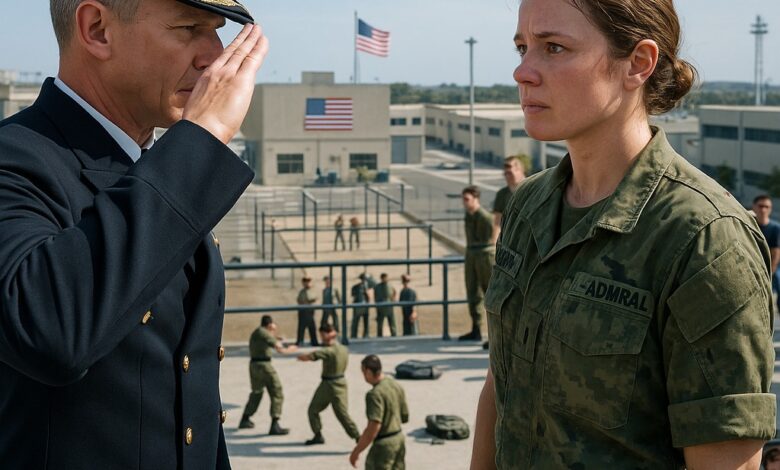
The Admiral descended the stairs with the speed of a man used to rapid response deployments. His eyes ignored the base commander and the trembling instructors, sweeping the courtyard until they locked onto the bruised, bandaged woman standing at the edge of the formation. “Lieutenant Maddox,” he barked, his voice carrying the authority of four stars and decades of executive military leadership. A shockwave of confusion hit the recruits. Lieutenant? The woman they had pushed off a roof was a commissioned officer with a service record sealed by national security protocols. The Admiral marched toward her, his eyes flicking to her bloodied gauze and the rooftop above. He didn’t need a briefing to know what had happened; his years in tactical intelligence allowed him to read the scene in seconds.
In a gesture that silenced the entire base, the Admiral stepped back, snapped his boots together, and delivered a razor-sharp, regulation salute to the Lieutenant. It was a recognition of her exceptional service and her successful completion of a high-level evaluation mission. “The Pentagon needs your presence for an immediate briefing on emerging defense technologies,” Hail stated, his voice loud enough for Ror to hear. “Transports are inbound. You’re wheels-up in thirty minutes.” Ria returned the salute with her good arm, her posture a masterclass in professional military conduct. As she walked toward the helicopter, she passed Ror, who looked as though he had seen a ghost. His future in the Navy, along with his dreams of officer candidate school, had effectively evaporated in the heat of that rotor wash.
Inside the secure briefing room, the Admiral looked at Ria with the weary respect of a mentor. “They tried to break you,” he murmured, noting the physical therapy she would likely need for her shoulder. “They failed, sir,” she replied, her voice as steady as it had been on the ledge. The mission had been a success; the “diversity placement” had proven that true leadership isn’t about the volume of one’s voice, but the depth of one’s operational integrity. As the helicopter lifted off, banking toward Washington D.C., Ria looked down at the shrinking lights of the base. She had been sent to observe, but she had ended up teaching a masterclass in resilient leadership—a lesson that would be whispered in the barracks of Ridge View for decades to come. The Navy SEAL Admiral hadn’t just saluted a subordinate; he had saluted a warrior who understood that the greatest strength is found in the silence between the shoves.