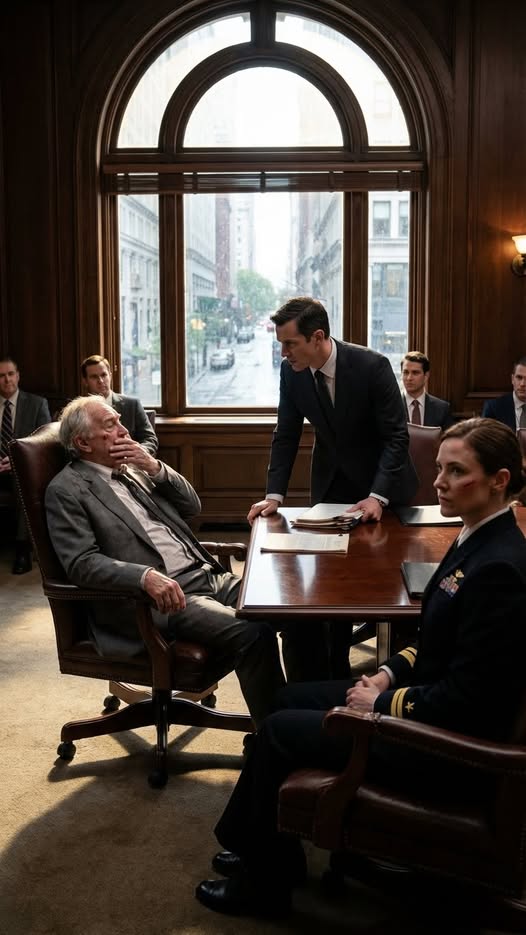
The silence in the conference room of Harper & Dunn was not peaceful; it was the suffocating quiet of a held breath before a car crash. I was still rubbing the stinging red welt on my cheek, the heat of the impact radiating through my jaw, when the lawyer, Mr. Callahan, closed the heavy leather binder with a deliberate, final thud.
Forty pairs of eyes—aunts, cousins, distant relatives who only appeared when money was in the water—were frozen. The grandfather clock in the corner ticked methodically, each second slicing through the tension like a razor. My father, Richard Morgan, stood over me, his chest heaving, his hand still half-raised, the ghost of the violence he had just inflicted hanging in the air.
He looked triumphant. He looked like a king who had just disciplined an unruly subject.
But then Callahan looked up. He didn’t look at me. He looked straight at my father, his eyes cold and hard as flint. He didn’t shout. He didn’t call security. He simply asked one quiet question that sucked the oxygen right out of the room.
“Do you know who actually owns that fourteen-million-dollar mansion you live in, Mr. Morgan?”
The words landed like a thunderclap.
My father’s mouth fell open, a grotesque caricature of shock. My brother, Eric, blinked rapidly, his smug grin dissolving into confusion like sugar in hot water. And for one long, delicious second, not even the dust motes dared to move.
“What are you talking about?” my father stammered, his bravado flickering. “It’s my house. I’ve lived there for forty years. It’s the Morgan legacy.”
Callahan leaned forward, interlacing his fingers. “And yet,” he said, his voice smooth as a serrated blade, “your father, the late Walter Morgan, left very specific instructions regarding that property. Instructions executed over a decade ago.”
The color drained from my father’s face, leaving it the shade of old parchment. He sank slowly back into his chair, the leather creaking under his weight.
I lowered my hand from my cheek. The pain was still there, throbbing in time with my heartbeat, but suddenly, it didn’t matter. The dynamic in the room had shifted tectonically. This wasn’t just about money anymore. This was about truth. And the truth, it seemed, had been buried in a shallow grave for a long, long time.
Callahan reopened the binder. “Shall we continue?”
The morning had started deceptively quietly. I had pulled my rental car into the gravel lot of the law firm, the sound of tires crunching on stone the only disruption to the autumn stillness. I had flown in from Virginia the night before, straight from base, still wearing my Navy service khakis—blazer, slacks, low heels—because I hadn’t possessed the energy or the wardrobe to change into civilian mourning clothes.
When I walked into the conference room, I felt that old, familiar punch in the gut. My father sat at the head of the table like a monarch on a throne. Eric sat beside him, draped in a brand-new suit that I knew, with mathematical certainty, he hadn’t paid for.
“Look who finally decided to show,” Dad had muttered, not bothering to stand.
“Thank you for coming, Lieutenant,” Callahan had said, emphasizing my rank.
“She ain’t on duty now,” Dad scoffed, waving a dismissive hand. “No need to go dressing her up with titles. She’s just Sarah.”
I had taken my seat, keeping my face impassive. I was trained for high-pressure environments, for storms at sea and bridge command during critical maneuvers. I could handle a grumpy old man. Or so I thought.
The reading had begun predictably. Small bequests to cousins. A charity donation. And then, the assets my father cared about.
“The penthouse on Brookside Avenue,” Callahan had read, “valued at 5.8 million dollars…”
“That goes to Eric,” Dad interrupted, pointing a finger at me without looking my way. “She’s signing her portion over to him. We discussed it.”
We had discussed no such thing.
“I’m not signing anything,” I had said softly.
That was when the explosion happened. The shouting. The accusation that I was selfish, ungrateful, an absentee daughter who chose the ocean over her family. And then, the slap. Sharp, hot, humiliating.
But now, sitting in the aftermath of Callahan’s question, the humiliation evaporated. I looked at my father, really looked at him, and for the first time in my life, I didn’t see a giant. I saw a man standing on a trapdoor that had just been unlatched.
“The Morgan Estate,” Callahan read, his voice ringing with authority, “is not part of this probate because it is not part of the estate.”
“Impossible,” Dad whispered.
“The deed,” Callahan continued, “was transferred thirteen years ago. Into a living trust.”
He turned the page, and his eyes met mine.
“The sole beneficiary and trustee of that trust… is Lieutenant Sarah Morgan.”
Chapter 2: The Admiral’s Strategy
The meeting ended in a chaotic murmur. My father stormed out, legs stiff, looking like he was trying to outwalk a heart attack. Eric trailed behind him, casting a look of pure venom in my direction. My relatives filed out, avoiding eye contact as if I were radioactive.
When the heavy oak door finally clicked shut, Callahan exhaled a long breath and removed his glasses.
“You okay, Lieutenant?” he asked gently.
“I’ve taken harder hits,” I said, though my voice sounded thinner than I wanted it to. “Thirteen years? I was barely out of high school. Why would Granddad do that?”
Callahan smiled, a genuine, crinkling expression that transformed his stern face. “Because Walter was a very observant man. He saw things people thought they were hiding.”
He slid a second folder across the polished table.
“He knew your father viewed the world as a hierarchy,” Callahan explained. “Someone always has to be above, someone below. He knew Richard saw you as ‘below.’ But your grandfather? He saw you as the only one standing on your own two feet.”
I opened the folder. It wasn’t just the mansion.
There were rental properties. A duplex in Mill Creek. Three single-family homes near Lakeview. A storage business on Route 9.
“He kept these quiet,” I whispered, scanning the documents.
“He invested privately,” Callahan nodded. “He wanted these assets to go to the person who cared about the family name, not the person who only cared about the family wallet. He transferred the mansion to you the day you graduated boot camp. He said, ‘She knows how to defend a position. She’ll need a fortress.’”
My eyes stung. I remembered the letters I sent Granddad from the ship. The photos of me in my dress whites. The way he was the only one who asked about my rank, my responsibilities, my life. To Dad, the Navy was a rebellious phase. To Granddad, it was a calling.
“There’s more,” Callahan said, his voice dropping an octave. “And this is the part where you need to be a soldier, Sarah.”
He opened a section of the file labeled Liabilities.
“Your father believes he owns that house. He has believed it for forty years. Because of that belief, he has acted… recklessly.”
I looked at the papers he pointed to. Lines of credit. Second mortgages. Personal loans.
“He took out loans against the mansion?” I asked, my stomach churning. “How? He doesn’t own it.”
“He committed fraud,” Callahan said bluntly. “He forged signatures. He utilized loopholes. He leveraged a property that legally belonged to you to fund Eric’s failed startups and his own lifestyle. If the banks find out the collateral was never his to offer, he’s not just broke, Sarah. He’s looking at prison time.”
I leaned back, the leather chair groaning. Prison. My father was a bully, a narcissist, and a fool. But did I want him in a cell?
“Why didn’t Granddad stop him?”
“He paid off the debts quietly for years,” Callahan said. “To protect the family name. But he stopped two years ago. He told me, ‘Richard needs to learn to swim, or he needs to sink. But he won’t drag Sarah down with him.’”
Callahan leaned forward. “The house is legally impenetrable. It’s in a trust. The creditors can’t touch it to pay your father’s debts. But your father… he is exposed. And now that you are the Trustee, you have to decide whether to shield him or let the storm hit.”
I stood up and walked to the window. The sky outside was a bruised purple, heavy with rain.
“He slapped me,” I murmured. “In front of everyone.”
“He did,” Callahan agreed. “Because he felt his control slipping. Now, he knows it’s gone.”
I turned back to the lawyer. “I need to go to the house.”
“Are you sure that’s wise?”
“It’s my house, Mr. Callahan,” I said, straightening my blazer. “I think it’s time I inspected my property.”
Chapter 3: The Inspection
The driveway to the Morgan Estate was lined with ancient maples, their leaves turning the color of dried blood. I parked my rental car next to my father’s oversized truck. The house loomed ahead—a Georgian revival masterpiece that looked impressive from the street but revealed its scars up close.
As I walked up the steps, I noticed the peeling paint on the columns. The overgrown ivy choking the brickwork. The yellowing patches on the lawn. Dad liked to live like a king, but kings have treasuries. Dad only had credit.
I used the key Callahan had given me. It slid into the lock smoothly.
The foyer smelled of expensive cologne masking the scent of mildew. It was quiet, but it was the silence of a bomb that hadn’t detonated yet.
I walked into the den. It was a disaster zone. Boxes were stacked everywhere, overflowing with paperwork. Unpaid bills. Final notices. It looked like the headquarters of a failing campaign.
I picked up a document from the coffee table. Foreclosure Notice Pending.
He was months behind on utilities. Years behind on property taxes. He had been borrowing from Peter to pay Paul, and then borrowing from Paul to buy Eric a new car.
“What are you doing here?”
I turned. Eric was standing in the doorway to the kitchen, a half-eaten sandwich in his hand. He looked less smug now. He looked like a child who had been caught playing with matches.
“I’m checking the mail,” I said calmly. “It seems to be piling up.”
“You need to leave,” Eric sneered, stepping closer. “Dad’s furious. If he sees you, he might do more than slap you this time.”
“He can try,” I said, my voice steady. “But I wouldn’t recommend it.”
The front door slammed open. Heavy footsteps thundered down the hall. My father burst into the room, his face a mottled red mask of rage.
“You,” he spat. “You ungrateful, manipulative little witch. You tricked him. You tricked a dying old man!”
“Granddad transferred the deed thirteen years ago, Dad,” I said, holding my ground. “He wasn’t dying. He was protecting his legacy from exactly this.” I gestured to the pile of overdue notices.
“This is my house!” he roared, slamming his fist onto the table. The pile of papers jumped. “I raised you here. I fed you. And this is how you repay me? By stealing my home?”
“I didn’t steal it,” I said. “I saved it. If Granddad had left it to you, the bank would have foreclosed on it six months ago. You’re drowning, Dad. You have over eight hundred thousand dollars in debt secured by fraud.”
The word fraud hung in the air like smoke.
Dad froze. His eyes darted to Eric, then back to me. The rage didn’t leave his face, but fear crept in behind it.
“You don’t know what you’re talking about,” he hissed.
“I have the loan documents,” I said, pulling copies from my bag. “I see the signatures. I see the dates. You leveraged a property you didn’t own. That’s a felony.”
Eric dropped his sandwich onto a plate with a clatter. “Dad? Is that true?”
“Shut up, Eric!” Dad snapped. He turned back to me, his chest heaving. “So what? You going to call the cops? You going to send your own father to jail? Is that what the Navy taught you? To betray your blood?”
“The Navy taught me honor,” I said, my voice dropping to a dangerous whisper. “It taught me that a leader eats last. A leader protects his crew. You? You sacrificed everyone to feed your own ego. You belittled me my entire life because I didn’t need you. You spoiled Eric until he was useless because his dependence made you feel powerful.”
“I gave Eric opportunities!” Dad shouted.
“You gave him a handicap!” I countered. “Look at him. He’s twenty-seven years old and he can’t even stand up straight when things get hard. You didn’t raise a son; you raised a shadow.”
Eric flinched, looking down at his feet.
“Get out,” Dad whispered, shaking. “Get out of my house.”
“No,” I said.
I took a step forward.
“I’m not leaving. Because this isn’t your house. It’s mine. And we are going to have a very different conversation about who stays and who goes.”
Chapter 4: The Terms of Surrender
For a moment, I thought he might hit me again. His hands clenched into fists at his sides. But something in my posture—the way I stood with my feet shoulder-width apart, chin up, eyes locked on his—stopped him. He was a bully, and bullies only strike when they sense weakness. I was offering him none.
He collapsed onto the sofa, the fight draining out of him all at once. He put his head in his hands.
“I don’t know who I am without this house,” he whispered. It was the first honest thing he had said in decades.
I looked at him—a small, terrified man in a room full of debt. The anger I had carried for years, the resentment over the soccer games he missed, the graduation he mocked, the achievements he ignored… it didn’t disappear, but it changed. It lost its heat. It turned into pity.
I pulled a chair from the dining set and sat opposite him. Eric remained standing, hovering awkwardly by the door frame.
“I’m not going to throw you out,” I said.
Dad looked up, eyes wet. “What?”
“I’m not you, Dad,” I said. “I don’t punish people just because I have the power to do it.”
I laid the folder on the table.
“But things are going to change. Drastically.”
“What do you want?” Eric asked, his voice sullen but cautious.
“First,” I said, looking at my father, “no more loans. No more lines of credit. I am freezing the assets. You will not spend a dime of equity from this property. If you do, I will hand these fraud documents to the District Attorney myself.”
Dad nodded slowly. He knew I meant it.
“Second,” I turned to Eric. “You get a job. A real one. Not a ‘venture,’ not an ‘idea.’ A job with a W-2 and a boss who isn’t Dad. You pay rent. Market rate. If you can’t afford it, I will help you find an apartment you can afford.”
“Rent?” Eric scoffed. “In my own house?”
“In my house,” I corrected. “And yes. It’s time you learned what stability actually costs.”
“And third,” I looked back at Dad. “You go to financial counseling. I’ve already found a firm. You attend every session. You untangle this mess. If you stick to the plan, I won’t press charges regarding the fraudulent loans. We will work out a payment plan with the banks. I will use the rental income from Granddad’s other properties to help stop the bleeding, but you have to stop holding the knife.”
Dad stared at me. He looked baffled. “Why?” he asked. “After everything I said… after yesterday… why help me?”
“Because Granddad believed in this family,” I said, my throat tightening. “He believed it could be better. He skipped a generation to save it. I’m just following orders.”
Dad looked down at his hands. “He trusted you more than me.”
“He trusted me to handle you,” I said.
Silence stretched between us. The grandfather clock in the hall ticked, just as it had in the lawyer’s office.
“I’m sorry,” Dad whispered. The words sounded foreign in his mouth, rusty and unused. “About the slap. About… a lot of things. I was scared. You were always so strong. I didn’t know how to father a child who didn’t need me.”
“I did need you,” I said softly. “I just didn’t need your money. I needed your pride.”
He looked away, shame coloring his cheeks.
“I’ll try,” he said. “I’ll do the counseling.”
“I guess I can look at the auto shop,” Eric muttered, scuffing his shoe on the floor. “They’re hiring.”
It wasn’t a fairy tale ending. The air didn’t suddenly sparkle. The debt was still there. The emotional scars were deep and jagged. But the war was over. The treaty had been signed.
Epilogue: The Architect
Six weeks later, on Thanksgiving Day, I stood on the balcony of the Morgan Estate, looking out over the lawn. It was greener now. I had hired a new landscaping crew and paid them in advance.
The house was full of noise. My mom, who had been quietly supportive through the transition, was in the kitchen laughing with my aunt. Eric was outside, surprisingly, raking leaves. He had been working at the auto shop for a month. He hated the grease, but he liked the paycheck. He walked taller now.
Dad was in the dining room, setting the table. He moved slower these days, with less swagger, but there was a calmness to him I hadn’t seen before. He wasn’t the king of the castle anymore; he was just a resident. And strangely, being stripped of the crown seemed to have relieved him of a burden he never admitted he was carrying.
I held a mug of hot cider, the steam warming my face.
I thought about Granddad. I thought about the envelope with the $500 he gave me for boot camp. I thought about the secrets he kept and the plans he made, watching from his window as his family drifted toward an iceberg, quietly building a lifeboat for me so I could save them all.
I wasn’t just the owner of a mansion. I was the architect of a new foundation.
Dad stepped out onto the balcony. He hesitated, then stood beside me. We watched the sunset in silence for a long time.
“It looks good,” he said, gesturing to the yard. “You did a good job with the landscapers.”
“Thanks,” I said.
He turned to me. He didn’t hug me—we weren’t there yet, maybe we never would be—but he met my eyes with a clarity that was new.
“You’re a good officer, Sarah,” he said gruffly. “Granddad was right. You were made for it.”
It wasn’t an apology for the past, not entirely. But it was an acknowledgement of the present. And for the first time, it didn’t feel like he was handing out approval from a pedestal. It felt like he was offering respect from eye level.
“Come on,” I said, gesturing back toward the warmth of the house. “Dinner’s ready.”
I walked back inside, leaving the door open for him. The house didn’t feel like a museum anymore, or a fortress, or a lie. It felt, for the very first time, like home.
Healing isn’t a straight line. It’s a series of difficult conversations, set boundaries, and uncomfortable truths. But standing there at the head of the table that night, looking at my imperfect, messy, recovering family, I realized that the most valuable thing Granddad left me wasn’t the fourteen million dollars.
It was the permission to lead.
And I intended to lead us somewhere better.