It started with pure panic, the kind that creeps into your chest when the world suddenly goes quiet and wrong all at once.
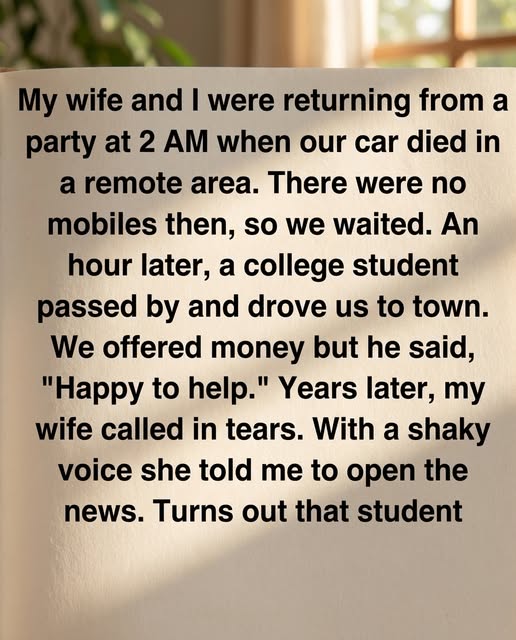
Two in the morning. A dead car on a stretch of road so empty it felt erased from the map. No cell signal. No passing traffic. No plan. Just darkness pressing in from all sides and the thin whistle of wind moving through fields we couldn’t see. We stood there listening to our own breathing, realizing how vulnerable we were, how quickly control can disappear.
Fear does strange things in moments like that. Your mind races ahead to worst-case scenarios. You imagine how long it would take for someone to notice you were missing. You wonder how many people have stood in that same darkness before you and what happened to them.
Then, without warning, headlights appeared.
A single pair, cutting cleanly through the black, slow and deliberate. Not speeding. Not swerving. Just approaching like they belonged there. The car pulled over, and a man stepped out, tall, calm, completely unhurried. He asked if we were okay, not loudly, not suspiciously. Just a simple question spoken like help was the most natural thing in the world.
He offered warmth first. Then solutions.
He checked the car, confirmed what we already feared, and suggested a ride to the nearest town. His voice never changed. No pressure. No edge. Just steady reassurance in a moment where we desperately needed it. Against every warning you’re taught, we trusted him. We got in his car. We let a stranger help us at two in the morning on an empty road.
He drove us miles out of his way, talking gently, asking where we were headed, sharing just enough to feel human without asking for anything in return. When we reached safety, he dropped us off, smiled, waved, and left before we even thought to ask for his full name.
That was it. No dramatic ending. No lingering connection. Just a quiet kindness that carried us out of fear and back into normal life.
Years passed.
Life did what it always does. Jobs changed. Addresses changed. The memory of that night slowly faded, tucked away into the mental drawer labeled “unexplainable moments.” It stayed there as a story we told occasionally, usually framed as luck. Right place. Right time. A decent stranger.
Until one evening, the television changed everything.
A news segment came on, one of those human-interest stories that breaks up the usual flood of political news, global conflict, and economic anxiety. The anchor spoke about a man receiving a major international humanitarian award, recognizing decades of work in crisis relief, poverty reduction, and disaster response.
Then they showed his face.
Older now. Lines around his eyes. The same calm expression. The same unmistakable presence.
We froze.
It was him.
The stranger from the road.
The report went on to describe his life: decades spent helping people in war zones, refugee camps, disaster sites, and forgotten communities. Stories of sacrifice, leadership, and unwavering commitment to human dignity. The kind of achievements that generate high-impact headlines, global recognition, and long-term media coverage.
We sat there stunned, realizing that the night we’d remembered as random luck was anything but random.
That ride wasn’t an exception in his life. It was a pattern.
For him, stopping to help stranded strangers wasn’t a heroic act. It was simply who he was, whether cameras were present or not. The world was celebrating him now with awards, speeches, and glowing headlines, but years earlier, he had been the same man on a dark road, offering quiet help with no audience at all.
Weeks later, something unexpected happened.
A letter arrived.
Handwritten. Simple. Addressed carefully.
He remembered us.
He wrote about that night, how he often thought about the people he met briefly and wondered where life took them. He said our trust stayed with him, that the way we accepted help without suspicion reminded him why he did what he did. Not for recognition. Not for legacy. But because, sometimes, goodness needs cooperation to complete its work.
Reading that letter closed a loop we didn’t even know was open.
It reframed everything.
Kindness, we realized, isn’t transactional. It doesn’t demand immediate gratitude, viral validation, or social media applause. Some acts of compassion ripple forward quietly, intersecting lives years later in ways you could never predict.
We started noticing the small crossroads that usually pass unseen: the person struggling with groceries on a curb, the coworker carrying silent stress, the neighbor whose smile doesn’t quite reach their eyes. Those moments rarely make headlines. They don’t trend. They don’t generate clicks or ad revenue or high-traffic keywords.
But they matter.
In a world obsessed with breaking news, celebrity scandals, and viral outrage, kindness operates on a slower, deeper frequency. It doesn’t shout. It waits. It accumulates.
That night taught us that grace often travels the long way around. It moves through years, miles, and strangers, waiting patiently for the right moment to reveal its full shape. What felt like a small mercy on a dark road turned out to be a glimpse into a life devoted to lifting others, long before global recognition ever arrived.
The world saw a humanitarian leader receiving awards. We saw the same man who once pulled over without hesitation, offering help when it mattered most.
And that’s the part no headline can fully capture.
Every act of kindness leaves a trace. Some fade quickly. Others circle back when you least expect them. But none of them disappear. They wait, quietly, until the light finds them again.
That’s what we learned from a stranger at two in the morning—and from the headline we never expected to see.