I wasn’t looking for anything meaningful that morning. I’d stopped at the flea market out of habit, wandering between folding tables piled with old books, chipped mugs, and things people no longer had space for in their lives. That’s when I saw the shoes.
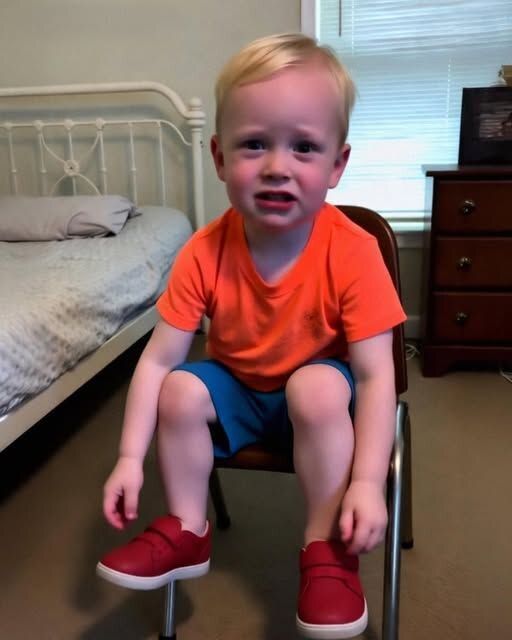
They were tiny. Blue sneakers, scuffed at the toes, with Velcro straps worn soft from use. I picked them up without thinking, smiling at how small they were, imagining a child running through puddles, dragging his feet, refusing to come inside. Five dollars, the tag said. I almost put them back.
Then something fell out.
A folded piece of paper slipped from inside one shoe and landed in my palm. It was thin, creased many times, the ink slightly faded as if it had been opened and closed over and over. I unfolded it slowly, not yet understanding what I was about to read.
“These shoes belonged to my son, Jacob. He was four when cancer took him. My husband left when the bills became too much. I’ve lost everything. If you’re reading this, please remember that he lived. That I was his mother. And that I loved him more than life itself. — Anna.”
By the time I finished, my hands were trembling. The noise of the market faded, replaced by a heavy stillness that pressed against my chest. This wasn’t just a note. It was a goodbye that had never been answered. A mother’s last proof that her child had existed.
I stood there longer than I should have, staring at those shoes like they were sacred. I paid the vendor, barely hearing her say thank you, and walked back to my car with my throat tight and my heart aching for someone I had never met.
For days, I couldn’t let it go.
I kept rereading the letter, wondering who Anna was, where she was now, whether she was still alive. I thought about the moment she must have written it, sitting alone, folding that paper with shaking hands, tucking it into her son’s shoe like a message in a bottle. I couldn’t shake the feeling that I wasn’t meant to find it by accident.
So I went back.
When I returned to the flea market the next weekend, the vendor recognized me immediately. She looked at the shoes in my hands and nodded, her expression softening.
“Oh, those,” she said quietly. “A man sold them. Said his neighbor, Anna, was moving away. Didn’t want to take boxes of children’s things.”
That was all I needed.
I started searching that night. Community boards. Old posts. Local directories. It felt intrusive at first, like I was crossing a line, but something deeper kept pushing me forward. If Anna had written that letter hoping someone would remember her son, then maybe remembering also meant finding her.
A week later, I found a listing that made my breath catch. Anna Collins. Late thirties. Same town. Only a few miles away.
Her house was small and worn, the kind of place that looks tired from holding too much sorrow. The yard was overgrown, the windows dark. I stood on the porch longer than necessary, wondering if I was about to make a terrible mistake.
When the door opened, I saw grief immediately. Not loud grief. The quiet kind that settles into the face and never quite leaves. Her eyes were guarded, her posture stiff, like someone who had learned to expect nothing good.
“Anna?” I asked gently.
She hesitated. “Who’s asking?”
I held out the letter.
The moment she saw it, everything changed. Her breath caught sharply, her hand flew to her mouth, and her knees buckled as if the ground had shifted beneath her. I reached out without thinking, steadying her as tears spilled down her face.
“I wrote this,” she whispered. “On the day I didn’t want to live anymore.”
We stood there on her porch, strangers bound by a child who had lived and died and left behind a piece of paper that refused to stay silent.
Inside her house, the air was heavy but warm. Photos of a little boy lined one shelf. Jacob. Bright-eyed. Grinning. Alive in every frame. Anna clutched the letter like it was proof she hadn’t imagined her own life.
She talked. Slowly at first, then all at once. About hospital rooms and monitors that never stopped beeping. About learning medical words no parent should have to know. About watching her marriage fracture under pressure until one day her husband packed a bag and didn’t come back. About the silence that followed her son’s death, so loud it felt like it might crush her.
She told me she’d sold most of Jacob’s things because seeing them hurt too much. The shoes were the last. She’d written the note because she was terrified he would disappear completely, reduced to nothing more than dust and paperwork.
“I just wanted someone to know he was here,” she said. “That I was his mother.”
I told her about my own life. About raising my son alone. About the exhaustion that settles into your bones when you’re strong for too long. About how easy it is to feel invisible when you’re just trying to survive.
Something shifted between us that day. Not magically. Not all at once. But enough.
We started meeting for coffee. Then walks. Then long conversations that stretched into evenings. Anna talked about Jacob—how he loved dinosaurs, how he called her “Supermom,” how he used to fall asleep with his hand wrapped around her finger. I talked about my son, about the fear and joy that coexist in motherhood.
One afternoon, she looked at me with something new in her eyes. Not happiness. But resolve.
“You kept going,” she said. “After everything.”
“So can you,” I replied. And this time, she believed it.
She began volunteering at a local support group for grieving parents. She cleaned her yard. She opened her windows. Small steps, but real ones. Healing didn’t erase her pain, but it gave it somewhere to rest.
The shoes are still with me. Clean now. Resting on a shelf with Jacob’s name written on a small card beside them. Not hidden. Not forgotten.
That five-dollar purchase didn’t just bring a story to light. It stitched two broken places together. It reminded one mother that her child mattered, and another that compassion doesn’t always arrive with grand gestures. Sometimes it comes folded inside a shoe, waiting for the right hands to find it.
Jacob lived. Anna is still here. And because of something so small, both of those truths are finally being carried forward.