“Mom, look, we need to be honest. You’re becoming a real burden. Maybe it’s time you figured out your own life.”
I didn’t flinch. I didn’t cry. I simply smiled, a tight, polite curving of the lips, and quietly finished washing the ceramic coffee cup in the sink. The warm water ran over my arthritic knuckles, soothing the ache that had settled there—not from age, but from the tension of living in a house where the air was thick with resentment.
“You’re right, David,” I said softly, placing the cup in the drying rack with deliberate care. “It is time.”
My son, standing there in his crisp dress shirt, looked relieved. He checked his watch, grabbed his car keys, and muttered something about a late meeting before rushing out the door. He had no idea that as he backed his SUV out of the driveway, the gears of a machine he couldn’t see were already turning. He didn’t know that the “burden” in his kitchen was checking the time, not to track his return, but to coordinate the arrival of a moving crew.
And he certainly didn’t know that in less than a month, he would be standing outside the wrought-iron gates of my new $2.3 million mansion on Rainbow Row in Charleston, begging me to save him from financial ruin.
But to understand the sweetness of that victory, you have to understand the bitterness of the fall.
My world didn’t end with a bang; it eroded, grain by grain. It started four years ago in Scottsdale, Arizona. When my husband, Robert, died after a brutal, eight-month war with pancreatic cancer, I thought the grief would be the thing that killed me. I was wrong. It was the math.
Robert had been the captain of our financial ship for forty-five years. I was the teacher, the nurturer, the one who made the house a home. I trusted him implicitly. I had no idea that in his desperation to stay alive, to stay with me, he had drained everything. The experimental treatments, the out-of-network specialists, the round-the-clock care—it had all been put on credit, leveraged against our future.
When the dust settled, I was left with a silence in the house that was deafening, and a debt of $180,000 that was screaming.
I remember sitting at my kitchen table, the late afternoon sun highlighting dust motes dancing in the air, surrounded by a fortress of manila envelopes. My teacher’s pension was $1,800 a month. The mortgage was $2,400. I was drowning in dry land.
That was when David swooped in. My only child. My golden boy. He was a successful software engineer living in a split-level dream home in suburban Phoenix with his wife, Sarah, and my two grandchildren, Emma and Jake.
“Mom, this is ridiculous,” David had said, pacing my living room, gesturing wildly. “Sell the house. Stop bleeding money. Come live with us. Sarah and I have talked about it. We want you there. Family takes care of family.”
I resisted. I valued my independence. But Sarah had been just as insistent. “Margaret, please. I’m drowning with the kids and work. Having you there would be a blessing. We need you.”
Need. That was the word that broke me.
We sold the house quickly. After the bank took its pound of flesh, and the medical vultures took theirs, and the funeral costs were settled, I was left with a single cashier’s check for $127,000. It was the sum total of my life’s work.
The day I moved into their beige guest room, I sat them down at the dining table. My hands shook slightly as I slid two envelopes across the polished wood.
“This is $75,000 for Emma and Jake’s college fund,” I said, my voice steady. “And this is $45,000 to help with the household expenses. I will not be a leech.”
Sarah wept. She actually wept. David hugged me so hard I felt my ribs creak. “Mom, you didn’t have to. But thank you. You have a home here forever.”
Forever, it turned out, lasted exactly eighteen months.
The erosion began subtly. At first, I was the beloved grandmother. I was up at 5:30 AM making pancakes. I was the chauffeur for soccer practice. I was the live-in babysitter who allowed David and Sarah to rediscover their social lives.
But familiarity breeds contempt, and dependence breeds resentment.
The “thank yous” dried up. The requests became demands. Then, the exclusion started. Sarah began cooking dinner for four, leaving me to scramble eggs for myself. David stopped asking about my day, treating me like a piece of furniture that had been placed inconveniently in the hallway.
The children were the hardest part. Children are mirrors; they reflect the attitudes of their parents. Emma, once my shadow, began closing her door. Jake, my sweet boy, started pulling away from my hugs.
“Mommy says I don’t need help,” Jake told me one evening when I tried to tie his shoes. “Mommy says I need to be independent.”
I heard the echo of Sarah’s voice in his words. Mommy says Grandma is in the way.
The breaking point wasn’t a shout, but a whisper. It was a Thursday night in October. I had gone to the kitchen for water and heard them in the living room. The television was low, but their voices carried through the open floor plan.
“I’m just saying, David, it’s suffocating,” Sarah hissed. “I can’t discipline my own kids without her watching. I can’t walk around my own house in my underwear. It doesn’t feel like our home anymore.”
“I know, honey,” David replied, his voice weary. “But she gave us the money. We can’t just kick her out.”
“She gave us that money almost two years ago,” Sarah shot back. “Does that buy her a lifetime pass? She’s sixty-seven, David. She could live another twenty years. Are we going to do this for twenty years?”
I stood in the dark hallway, the water glass sweating in my hand, feeling a coldness spreading through my chest that had nothing to do with the air conditioning. I wasn’t a mother to them anymore. I was a transaction that had expired.
They wanted me gone. They just didn’t have the courage to say it.
So, they started the campaign of misery. The “accidental” exclusions from family outings. The pointed brochures for senior living centers left on the counter. The way Sarah would wrinkle her nose when I cooked my “old fashioned” recipes, like my famous meatloaf, claiming it was “too salty” and ordering pizza for everyone else while my food went cold.
They thought I was trapped. They thought I had nowhere to go.
They were wrong. Because six months prior, while folding their laundry and being invisible, I had answered a phone call that changed the trajectory of history.
“Mrs. Carter? This is William Hutchinson, attorney at law, calling from Charleston, South Carolina.”
I had almost hung up, thinking it was a telemarketer. But William Hutchinson wasn’t selling anything. He was delivering a ghost.
My Great Aunt Eleanor. A woman I had met twice. A recluse who had watched our family from a distance, judging us silently. She had passed away at ninety-four.
“Mrs. Whitmore left very specific instructions,” Mr. Hutchinson had said, his voice rich with Southern gentility. “She wanted her estate to go to the one member of the family who understood the value of sacrifice. She kept tabs on everyone, Mrs. Carter. She knew about Robert. She knew you sold your home. She knew you gave the proceeds to your son.”
I had gripped the phone, my heart hammering against my ribs. “I don’t understand.”
“You are the sole beneficiary, Margaret. The estate includes the family seat on Rainbow Row, fully restored. Plus her investment portfolio.”
“How much?” I whispered.
“$6.2 million, Mrs. Carter. Give or take the market fluctuations.”
I had sat on the edge of my twin bed in that beige guest room, the numbers swirling in my head. I was rich. Not comfortable—wealthy. I could have bought David’s house five times over. I could have cleared their debts with a signature.
I almost told them. That night, at dinner, I almost spilled it all. But then Sarah made a comment about how “expensive” my prescription copays were getting, and David sighed the sigh of a martyr.
I realized then: If I told them, I would never know the truth. They would love the money, not the mother.
So, I stayed. I kept the secret. I flew to Charleston under the guise of visiting an old teaching friend. I met Mr. Hutchinson. I saw the house—a yellow Georgian masterpiece with a garden that smelled of jasmine and old money. I set up the accounts. I hired Grace, a housekeeper who felt more like a sister.
And then I went back to Phoenix. I went back to the twin bed and the cold hostility. I waited. I watched. I wanted to see how far they would push me. I wanted to see if there was any love left that wasn’t tied to a dollar sign.
There wasn’t.
And that brings us back to this morning. The “burden” comment. It was the final permission slip I needed.
As soon as David’s car disappeared, I moved with the precision of a military operation. I called the movers I had placed on standby weeks ago. “Today,” I said. “Everything goes.”
Then I called the bank. Or rather, I called my private investigator, who had dug up the dirty little secret of David’s finances. You see, when I gave them that $127,000, they didn’t invest it. They paid off credit cards and then immediately took out a Home Equity Line of Credit (HELOC) for $127,000 to “renovate.”
Crucially, to qualify for that loan, they had listed me as a household member. My pension was a factor in their debt-to-income ratio. There was a clause in their contract—Section 12.3. Material Change in Household Status.
If I left, the house of cards would fall.
I packed my bags. I didn’t leave a mess. I left the room spotless. Empty. Just like their promises.
On the kitchen counter, I left a single envelope. Inside was a letter, my attorney’s business card, and the key to the house.
At 2:00 PM, the moving truck pulled away. At 4:00 PM, my first-class flight to Charleston departed. As the plane banked over the desert, leaving the brown sprawl of Phoenix behind, I ordered a glass of champagne.
The burden had been lifted. But the weight was about to crash down on someone else.
I was sitting in my library in Charleston three days later, reading Jane Austen and listening to the fountain in the courtyard, when my phone rang. I didn’t answer. I let it go to voicemail.
Then it rang again. And again.
Finally, I picked up. “Hello, David.”
“Mom!” His voice was high, tight with panic. “Where are you? We came home and your room is empty. The kids are confused. Sarah is freaking out.”
“I’m figuring out my own life, David. Just like you asked.”
“Mom, stop playing games. Where are you?”
“I’m in South Carolina.”
“South… what? Why?”
“It doesn’t matter. I’m settled. I’m safe. And I’m no longer a burden to you.”
“Mom, listen, you have to come back. Right now.”
“I don’t think so.”
“No, you don’t understand!” He was shouting now. “The bank called. They did an audit or something. They know you moved out. They’re calling the loan, Mom! The HELOC. They say because the ‘household composition’ changed, we don’t qualify for the terms anymore. They want the full $127,000 in thirty days or they foreclose!”
“Oh,” I said, sipping my tea. “That sounds like a terrible inconvenience.”
The silence on the line was heavy. “Inconvenience? Mom, we’re going to lose the house. We don’t have that money. We spent it on the kitchen and the pool and…”
“And Sarah’s new car,” I added.
“Yes! No! It doesn’t matter. We need you to come back. Just on paper. Just come back so we can fix the loan.”
“David,” I said, my voice hardening. “For two years, you treated me like an intruder. You trained my grandchildren to ignore me. You ate dinner while I sat in the other room. You made it very clear that I was affecting your ‘lifestyle.’ Well, now you have your lifestyle back. It’s just going to cost you.”
“Mom, please. Think of Emma and Jake.”
“I am thinking of them. I’m thinking they deserve parents who know how to manage their lives without using their grandmother as a financial crutch. Read the letter on the counter, David. Call Mr. Hutchinson if you need to reach me. But do not expect me to return.”
I hung up. Then I turned off the phone.
My hand was trembling, just a little. It goes against every instinct of a mother to let her child fall. But sometimes, you have to let them hit the bottom so they can learn how to stand.
It took them three weeks to break.
During those weeks, Mr. Hutchinson gave me updates. David had tried to refinance—rejected. Sarah had tried to get a second job—not enough. They were drowning. The foreclosure notice was posted on the door I used to walk through.
Then, David showed up.
I saw him from the upstairs window. He looked ten years older. He was standing on the sidewalk of Rainbow Row, looking up at my house with a mixture of awe and horror. He was wearing the same wrinkled suit he’d worn to work the day I left.
Grace opened the door. “Mr. Carter,” she said coolly. “Your mother is in the garden.”
He walked through the house like a sleepwalker. He saw the crystal chandeliers, the oil paintings, the sheer scale of the wealth I had been sitting on while he complained about the price of extra groceries.
I was pruning my roses. I didn’t look up until he was three feet away.
“Mom,” he croaked.
“Hello, David.”
“This… this is yours?”
“It is.”
“You… you had this the whole time? For the last year?”
“Eighteen months, actually.”
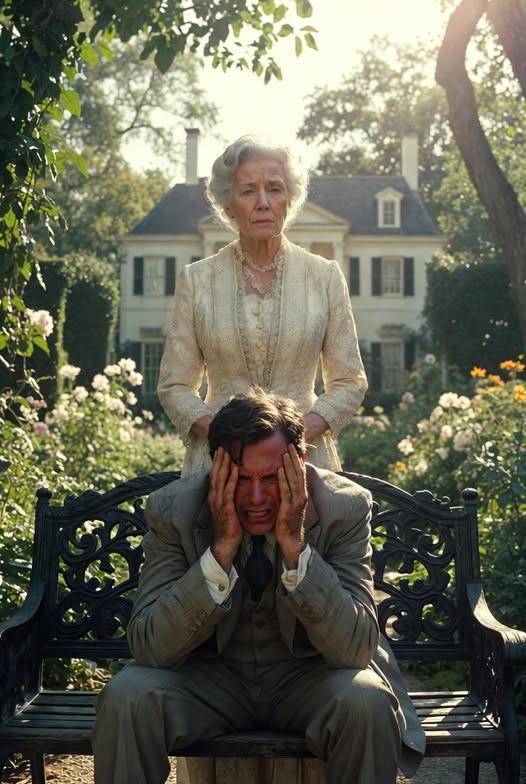
He sank onto a garden bench, burying his face in his hands. He wept. Not the polite crying of a funeral, but the ugly, gasping sobs of a man whose reality has shattered. “Why?” he managed to say. “Why didn’t you help us? You could have written a check and saved us.”
I put down my shears and sat opposite him. “I did help you, David. I gave you my life savings. I gave you my time. I gave you my love. And in return, you gave me a corner of a guest room and a daily dose of shame.”
He looked up, his eyes red. “We were stressed. We didn’t know.”
“You didn’t know I was rich,” I corrected him. “If you had known I was worth millions, would you have treated me differently?”
He opened his mouth to lie, then stopped. He looked around the garden, then back at me. The truth hung between us, sharp as a blade.
“Yes,” he whispered. “We would have.”
“That,” I said softly, “is why I couldn’t save you. Because you didn’t love me. You loved what I could provide. And when I stopped providing enough, I became a burden.”
“I’m sorry,” he said. “I am so, so sorry. We lost the house, Mom. It’s gone. We have to be out by Friday. We have nothing.”
“You have your jobs. You have your health. You have your children.”
“We have nowhere to go.”
This was the moment. The precipice. I could write a check. I could buy them a new house in Phoenix. I could smooth it all over.
But I loved him too much to do that.
“I have a proposition,” I said.
David looked up, a spark of hope in his eyes.
“I own three rental properties here in Charleston,” I said. “Small, two-bedroom cottages. Nothing fancy. But safe.”
He nodded, waiting.
“You and Sarah can move here. You can rent one of the cottages. I will charge you fair market rent. You will find jobs. You will pay your own bills. You will struggle, David. You will learn what it means to actually figure out your own life.”
“And the kids?”
“The kids will see their grandmother whenever they want. But you? You and Sarah? You are not allowed in this house until you earn your way back into my life.”
He stared at me. “Earn it? How?”
“By showing me respect. By proving that you value me as a person, not an ATM. By raising those children to be better than you were.”
“And if we don’t?”
“Then I evict you,” I said simply. “And I leave everything—this house, the money, the legacy—to a cat shelter.”
David looked at me for a long time. He saw the steel beneath the cardigan. Finally, he nodded. “Okay. We’ll do it.”
The first year was hell for them.
They moved into the cottage. It was cramped. They had one car. David worked IT support for a local school district—a massive pay cut. Sarah worked at a bakery. They were tired. They were broke.
But they were real.
I kept my word. I didn’t invite them to the mansion. I met the grandchildren at the park. I watched Emma and Jake blossom away from the toxicity of their parents’ greed. They loved Charleston. They loved the history. They loved that Grandma was “the lady with the big yellow house,” but they learned that Grandma wasn’t a pushover.
Slowly, the ice began to thaw.
It started with a birthday card from Sarah. No request for money, just a sincere apology written in shaky handwriting. Then, David came over to fix my wi-fi, and refused to take payment, and didn’t stay for dinner because he “didn’t want to intrude.”
He was learning boundaries. He was learning respect.
The turning point came two years later. I fell ill—a bad bout of pneumonia. I was in the hospital for three days.
When I woke up, David was in the chair next to my bed. He was asleep, his head resting on the plastic rail. He looked exhausted.
“David,” I rasped.
He jerked awake. “Mom! You’re up. Do you need water? Nurse!”
“What are you doing here?” I asked. “You’ll miss work.”
“It doesn’t matter,” he said, pouring me a cup of water with shaking hands. “I’m not leaving until you’re okay.”
“I haven’t changed my will, you know,” I said, testing him. “You still don’t get the money.”
He smiled, a tired, genuine smile I hadn’t seen since he was a boy. “I don’t care about the money, Mom. I really don’t. I just want you to be around to see Emma graduate.”
I looked at him. I saw the lines on his face, the callous on his thumb from working on the cottage. He was a man now. A real man, not the boy who hid behind his wife’s ambition.
“Okay,” I whispered. “Okay.”
Five years have passed since the “meatloaf incident.”
Tonight, the dining room of the house on Rainbow Row is full. The crystal chandelier casts a warm glow over the table. David is laughing at a joke Mr. Hutchinson made. Sarah is helping Grace bring in the dessert—a chocolate soufflé that smells divine.
Emma is fifteen now, sketching in the corner, capturing the scene. Jake is telling me about his robotics club.
They live in a nice house now—one they bought themselves, with their own money, three streets over. They are not rich. They still worry about bills. But they are happy.
And me?
I am no longer a burden. I am the matriarch. I am the anchor.
As David raises his glass to toast, he catches my eye. There is no calculation in his gaze anymore. Just love. Hard-won, battle-tested love.
“To Mom,” he says, his voice thick with emotion. “For teaching us the hardest lesson, and giving us the greatest gift.”
I smile, sipping my Sancerre.
Sometimes, the greatest act of love isn’t giving your children everything they want. It’s taking away everything they think they need, so they can find out who they really are.
They thought they were kicking an old woman out of her guest room. They didn’t realize they were pushing her onto her throne.
And trust me, the view from here is spectacular.