MY SON CARRIED ME ONTO THE STAGE DURING HIS GRADUATION BECAUSE I COULDN’T WALK. THEN HE TOOK THE MICROPHONE AND SAID, “MOM, I HAVE SOMETHING FOR YOU.”
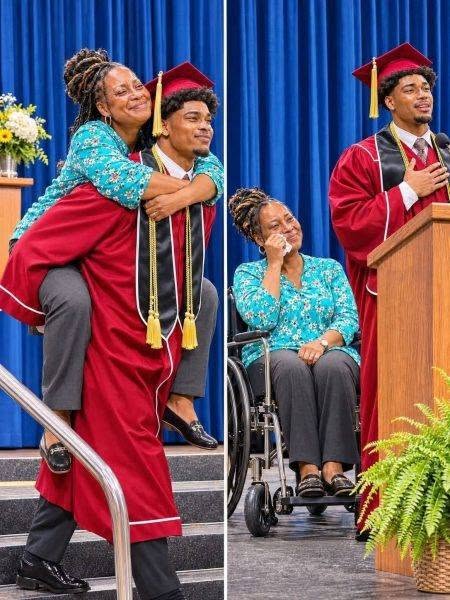
My eighteen-year-old son walked past his own diploma, knelt beside my wheelchair, and carried me up the auditorium stairs on his back, and I thought that was the most beautiful thing he could ever do for me.
Then he took the microphone and confessed, in front of six hundred people, to a secret he’d been keeping for two years, a secret that involved late-night shifts, a scholarship, and a hospital trial I had never applied for.
But the confession wasn’t the real surprise, because the man in the gray cap who stood up in the last row was the one person I’d promised myself I would never let near my son again.
CHAPTER 1: OUR DAY
When my
son, Tyler, was twelve, a semi-truck crossed the center line on Highway 9 in a sleet storm and turned my little car into something the firefighters had to cut open.
I don’t remember the crash. I remember waking up in a hospital bed in Rosemont County Medical Center, three days later, with my mouth full of cotton and a doctor standing at the foot of my bed with a clipboard and a sad face.
“Mrs. Callahan,” he said gently, “the damage to your spinal cord is at the T10 level. I’m very sorry. You’re not going to walk again.”
I remember thinking, That can’t be right. I have a twelve-year-old.
My husband, Rick, stayed for eleven days.
On the twelfth day, he stood at the foot of my bed with his car keys in his hand and said the words I would hear in my head for six years.
“Marla, this isn’t what I signed up for. I want a better life.”
Then he walked out of the room.
I lay there in a bed I couldn’t get out of, listening to his footsteps go down the hallway. And beside me, in a plastic chair, sat a skinny twelve-year-old boy in a hoodie, holding my hand so tight his knuckles were white.
A child. A child I was still completely responsible for.
God, I was terrified.
The first years were the hardest of my life.
I had to learn everything again. How to get from the bed to the wheelchair. How to cook on a stove I could barely reach. How to vacuum. How to do laundry. How to drive with hand controls. How to cry in the shower so my son wouldn’t hear.
Rick sent divorce papers from another state six months later. He didn’t contest custody. He didn’t ask to see Tyler. He didn’t send a single dollar of child support. After the first year, I stopped checking the mailbox for anything from him.
I helped Tyler with every single homework assignment at our kitchen table. I never missed a school concert, a science fair, a basketball game. I sat at the end of the bleachers in my chair and cheered louder than anybody.
I found a job doing medical billing from home. It didn’t pay much. We lived in a small rented house in Rosemont with a wooden ramp Tyler built himself, at fourteen, with lumber from the hardware store and a YouTube video. Money was always tight. But Tyler had what he needed.
I remember one night that first winter, when Tyler was thirteen. The power
went out in an ice storm. I couldn’t get out of bed by myself without the lift, and the lift needed electricity. Tyler sat on the floor beside my bed all night with a flashlight and a stack of comic books, reading to me out loud, doing all the voices, until the power came back at four in the morning.
“You don’t have to stay up, honey,” I kept saying.
“I’m not tired,” he kept saying.
He fell asleep sitting up against my nightstand at 3:30, the flashlight still on in his lap.
I lay there and watched him sleep and thought, I have to be better than this. For him. I have to.
He grew up fast. Too fast, maybe. He learned to cook at thirteen. He did the grocery shopping. He carried in the heavy things. He never once complained.
Two years ago, when he was sixteen, he started coming home late three nights a week.
“Study group,” he said. “For AP Chemistry. At Danny’s house.”
His grades stayed perfect. So I didn’t ask too many questions.
Last spring, he got a letter from Brightwater Institute of Technology, three states away. A full scholarship. Tuition, housing, everything. Engineering. The kind of letter you dream about.
He showed it to me at the kitchen table, then folded it up and put it in his backpack, and didn’t mention it again.
“We’ll talk about it later, Mom,” he said, whenever I brought it up.
Graduation was on a warm Saturday in June, in the auditorium at Rosemont High.
I wore my favorite blouse. Blue, with little yellow flowers. Tyler had bought it for me two Christmases ago with money from his “study group” job.
I didn’t know yet that there was no study group.
I got there an hour early, so I could find a spot for my wheelchair near the front, right by the stage stairs.
I could see Tyler in his navy cap and gown, whispering with his friends in the front rows. Six feet tall now. Broad shoulders. Rick’s dark hair. My stubborn chin.
I was so proud I couldn’t stop smiling.
When they finally called his name, Tyler James Callahan, I fumbled for my phone to record.
But Tyler didn’t walk up the stage stairs.
He turned around. He walked straight down the center aisle, past the front rows, past the principal, toward me.
He knelt beside my wheelchair.
“Mom,” he whispered. “I want you up there with me.”
I stared at him. “Oh, sweetheart. This is your day. How on
earth would I get up there?”
He smiled. That crooked smile he’s had since he was two.
“Then let’s make it our day.”
Before I could protest, he turned around, crouched down in front of my chair, and pulled my arms around his shoulders. He stood up slowly, with me on his back, my useless legs hanging against his sides.
And he carried me up the steps.
The auditorium went dead quiet.
Behind us, four of his friends, boys from the basketball team, picked up my empty wheelchair and carried it up onto the stage. They set it down right next to the podium.
Tyler lowered me into it like I was made of glass.
Then the principal, with tears in her eyes, handed him his diploma.
I sat there in front of six hundred people, crying and smiling at the
same time.
Then Tyler stepped up to the podium and took the microphone.
“Excuse me, everyone,” he said. “Sorry. There’s something important I need to say.”
The whole room went completely silent.
He turned and looked at me.
“Mom,” he said. “I have something for you.”
My heart started pounding.
“There’s something I’ve done that I haven’t told you about yet.”
I stared at him, completely confused.
“I can’t hide it anymore,” he said. “And I want to tell you in front of everyone. Because you deserve to have everyone hear it.”
People in the audience started looking at each other.
Nobody had any idea what was coming. Least of all me.
And in the very last row of the auditorium, near the back doors, a man in a gray baseball cap slowly stood up.
CHAPTER 2:
THE STUDY GROUP
I didn’t notice the man in the gray cap. Not then. I was looking at my son.
“For two years,” Tyler said into the microphone, “I’ve been lying to my mom. Three nights a week, I told her I was at a study group for AP Chemistry.” He swallowed. “There was no study group.”
A few people laughed nervously.
“I’ve been working at Brightway Rehabilitation Center on Fourth Street,” he said. “As an aide. Cleaning equipment. Helping patients in physical therapy. Six to ten p.m. Tuesdays, Thursdays, and Saturdays.” He looked at me. “I wanted to learn how spinal cord injuries work. Everything. I read every book they had. I asked every therapist a hundred questions.”
I couldn’t breathe.
“And last fall,” Tyler said, “one of the doctors at Brightway told me about a clinical trial at Rosemont University Hospital.
A new kind of therapy. Electrical stimulation of the spinal cord, combined with intensive rehab. For people with injuries exactly like my mom’s. Some of the patients in the first trial are standing again. A few are taking steps.”
The auditorium was silent.
“I applied for you, Mom,” Tyler said, his voice cracking. “Without telling you. I got your medical records. I filled out every form. I wrote the essay.” He reached into his gown and pulled out an envelope. “This came yesterday.”
He handed it to me.
I opened it with shaking hands.
Dear Ms. Callahan: We are pleased to inform you that you have been accepted into Phase II of the Rosemont University Spinal Restoration Trial. Treatment begins August 4th.
I couldn’t read the rest. My eyes were too blurry.
“There’s one more thing,” Tyler said. “The part I’m most scared
to tell you.”
He took a breath.
“The trial is here. In Rosemont. Eighteen months of therapy, five days a week. You can’t drive yourself every day. You’ll need someone with you.” He looked at me. “So I turned down the scholarship to Brightwater Tech. I’m going to Rosemont Community College instead. In the fall. So I can drive you.”
The audience gasped.
“Tyler, no,” I whispered.
“Mom. You carried me for six years,” he said into the microphone. “Every single day, from that wheelchair. Now it’s my turn to carry you.”
He turned back to the audience.
“Everybody here knows my mom,” he said. “She’s the lady at the end of the bleachers who cheers louder than anyone. She came to every game. Every concert. Every science fair. Even the one where my volcano exploded on the principal.” A ripple of laughter. “
She did my homework with me every single night at our kitchen table. She worked from home so she’d be there when I got off the bus. She never once told me she was scared.” His voice cracked. “But I heard her crying in the shower. Every night, the first year. She didn’t think I could hear.”
I put my hand over my mouth.
“I was twelve,” Tyler said. “I couldn’t do anything about it. I couldn’t fix anything. I just lay in my bed and listened.” He looked at me. “So I promised myself that someday I would. That’s what the job was for. That’s what all of it was for.”
Somebody in the audience started clapping. Then somebody else. Then the whole auditorium was on its feet, six hundred people, clapping and crying, while my son knelt beside my wheelchair on the stage and held
my hands.
I cried so hard I couldn’t speak.
But underneath the joy, something cold had started in my chest.
He’d turned down a full scholarship.
For me.
And there was one more thing. I’d worked in medical billing for six years. I knew exactly what experimental trials cost. Even when they were free, there were uninsured expenses. Travel. Equipment. Specialized braces. Thousands of dollars. Tens of thousands, sometimes.
Tyler made eleven dollars an hour, three nights a week.
As the applause went on, I looked out over the crowd. And for just a second, near the back doors, I saw a man in a gray baseball cap standing alone, not clapping, just watching the stage.
Then he turned and walked out.
After the ceremony, out on the lawn, people kept coming up to us. Teachers. Parents I’d never met. Tyler’s
basketball coach, who shook my hand so hard my wheelchair rolled backward. A grandmother in a lavender hat who bent down and kissed my cheek and said, “I’m going to remember that boy carrying you up those stairs for the rest of my life.”
Tyler stood beside my chair the whole time, his hand on my shoulder.
But every few minutes, I noticed him glance toward the parking lot. Toward the back of the auditorium. Like he was looking for someone.
“Who are you looking for, honey?”
“Nobody,” he said too quickly. “Just Danny’s mom. She said she’d take pictures.”
Danny’s mom was standing three feet away, taking pictures.
I didn’t push. It was his day. Our day.
On the drive home, he was quiet. When we pulled into the driveway, he sat in the car for a minute with his hands on the steering wheel.
“Mom,” he said. “Whatever happens, I want you to know I did all of this because I love you. All of it.”
“I know you did, sweetheart.”
He looked like he wanted to say something else. Then he got out of the car and came around to help me into my chair, and the moment passed.
CHAPTER 3: R. CALLAHAN
That night, after the graduation party, after the cake, after Tyler’s friends had gone home, I sat at the kitchen table with the trial acceptance letter and a cup of tea.
“Tyler,” I said. “Sit down.”
He sat.
“I’m so proud of you, I can’t even put it into words,” I said. “And I’m so grateful. I am. But you’re not turning down that scholarship.”
“Mom —”
“You’re not.” My voice shook. “I’ve spent six years making sure you
got everything you needed. I didn’t do it so you could give up the best thing that ever happened to you for me.”
“You are the best thing that ever happened to me,” he said.
“Tyler.”
“It’s already done, Mom. I emailed them in May.”
I put my face in my hands.
We argued for an hour. He wouldn’t budge. He’s as stubborn as I am. Finally, he went to bed, and I sat alone at the table and looked at the letter again.
At the bottom, in small print: Participants are responsible for approved travel, equipment, and supplemental therapy costs not covered by the study, estimated at $22,000. A deposit of $8,000 is due by July 1st.
“Tyler,” I called up the stairs. “Who paid the deposit?”
A long silence.
“It’s taken care of, Mom. Go to bed.”
&
nbsp;
On Monday, I called Danny’s mother, Joanne. I’d known her for ten years.
“Joanne, I have a strange question. The AP Chemistry study group. At your house. Tuesday, Thursday, and Saturday nights. Was it ever real?”
There was a pause on the line.
“Marla,” Joanne said slowly, “Danny never had a study group. And Tyler hasn’t been to our house on a weeknight since freshman year.” Another pause. “I thought you knew. About the job. Danny said Tyler worked at that rehab place. He said Tyler made him swear not to tell you.”
“Why would he hide a job from me?”
“I don’t know, honey,” Joanne said gently. “But I’ve watched that boy for ten years. Whatever he’s hiding, I’d bet my house it’s because he’s trying to protect you.”
That afternoon, I called the admissions office at Brightwater Institute of Technology. I
told them I was Tyler Callahan’s mother.
“Ah, yes,” said a kind voice. “We were so sorry to receive Tyler’s letter in May. He’s an extraordinary young man. We’ve held his file open, just in case. His father called last week, actually, asking us to do that.”
My blood went cold.
“His father?”
“Yes. A Mr. Callahan. He asked us not to close the file until August. He said he hoped Tyler might change his mind.” A pause. “Is something wrong, Ms. Callahan?”
I hung up without answering.
The next morning, while Tyler was at the store, I did something I’d never done before. I went into his room and opened his laptop.
His bank account was open in one tab. He’d left it logged in.
His balance was four hundred and twelve dollars. Two years of rehab-aide paychecks, spent on gas
and groceries and, I realized with a sick feeling, my blouse with the yellow flowers.
There was no eight thousand dollars.
There was an email in his inbox, from the Rosemont University trial coordinator. Dated June 2nd.
Hi Tyler, we’ve received the $8,000 deposit for your mother’s participation, wired from the account of R. Callahan. Thank you. We’ll see you both in August.
R. Callahan.
I sat on my son’s bed and stared at that name.
My husband’s name was Richard Callahan.
Rick.
The man who’d stood at the foot of my hospital bed six years ago with his car keys in his hand and said I want a better life.
I looked up. On Tyler’s bulletin board, between his acceptance letter and a picture of his basketball team, there was a photograph I’d never noticed before. It was taken
at Brightway. Tyler in his blue aide scrubs, standing next to a parallel bar, grinning. Beside him, with one arm around his shoulders, was a man in blue scrubs too. Older. Thinner. Gray at the temples.
He was wearing a gray baseball cap.
CHAPTER 4: THE MAN IN THE GRAY CAP
When Tyler came home with the groceries, I was sitting in my wheelchair in the middle of the living room, holding the photograph.
He saw it. He set the bags down very slowly.
“Mom,” he said.
“How long?”
He closed his eyes. “Two years.”
“Two years?”
“I didn’t go looking for him,” Tyler said quickly. “I swear. I just got a job at Brightway because I wanted to learn about spinal injuries. For you. And on my first day, the senior aide training me was…” He swallowed. “Him.”
“He didn’t know I was going to be there,” Tyler said. “He didn’t know who I was at first. I was sixteen. He hadn’t seen me since I was twelve. And then the supervisor said my last name, and he dropped a tray of equipment on the floor.”
“And you didn’t tell me.”
“He begged me not to,” Tyler said. “He said you’d never forgive him. He said you’d make me quit.” His voice cracked. “And I wanted to learn, Mom. He was the best aide there. He knew everything. Every machine. Every exercise. Patients asked for him by name.”
I thought about the Rick I’d married. Charming. Funny. Always the life of the party. Always a drink in his hand. Always promising he’d fix the leaky faucet tomorrow. The man who’d fainted at Tyler’s birth. The man who’d once called me
“He didn’t know I was going to be there,” Tyler said. “He didn’t know who I was at first. I was sixteen. He hadn’t seen me since I was twelve. And then the supervisor said my last name, and he dropped a tray of equipment on the floor.”
“And you didn’t tell me.”
“He begged me not to,” Tyler said. “He said you’d never forgive him. He said you’d make me quit.” His voice cracked. “And I wanted to learn, Mom. He was the best aide there. He knew everything. Every machine. Every exercise. Patients asked for him by name.”
I thought about the Rick I’d married. Charming. Funny. Always the life of the party. Always a drink in his hand. Always promising he’d fix the leaky faucet tomorrow. The man who’d fainted at Tyler’s birth. The man who’d once called me.