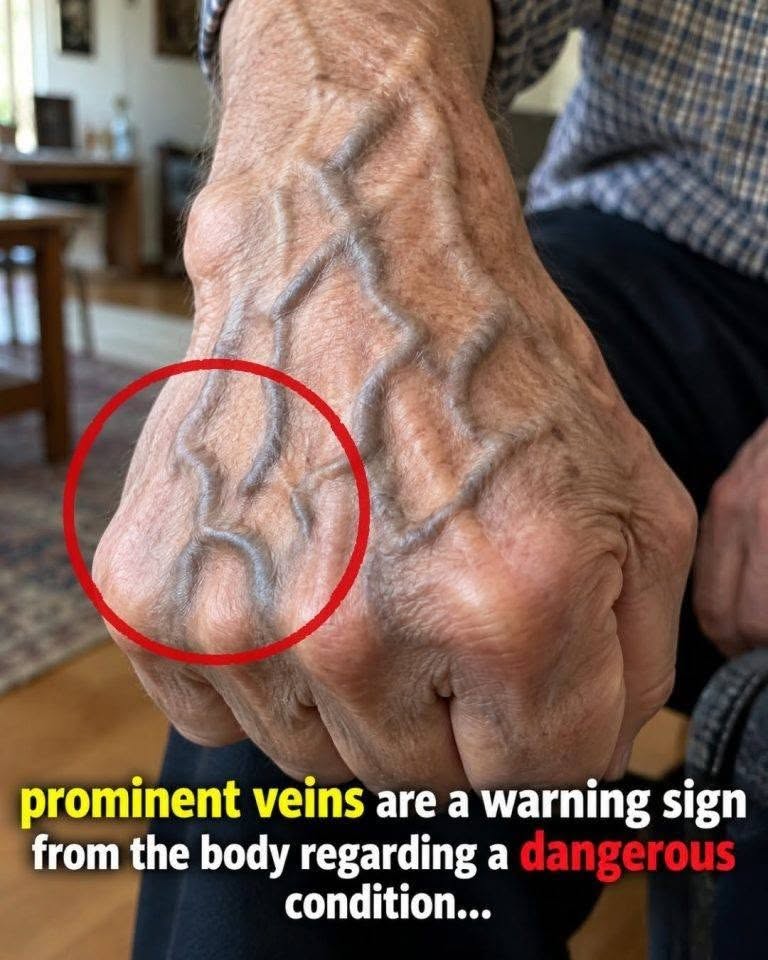
Those blue veins on the back of the hand are not just “getting older.” They can point to venous congestion, sluggish circulation, and in some cases the same pressure buildup that shows up as heavy legs, ankle swelling, night cramps, and those rope-like veins that twist across the skin like overfilled tubing.
By dinner, the hand looks thinner, the skin looks papery, and the veins stand out like cables under a shrinking wall. By bedtime, the legs feel heavy, the ankles hold a little puff, and the body acts
like blood is trying to climb a hill with a broken engine.
The ugly truth is simple: when circulation weakens, the system starts shouting through the skin. The veins don’t “appear” out of nowhere — they become visible because the tissue above them thins, the vessel walls lose tone, and blood has a harder time moving back where it belongs.
That is not decoration. That is a circulation alarm.
The Pressure Problem Nobody Puts on the Front Page
Think of your veins like soft garden hoses with tiny one-way gates.
When those gates weaken, blood doesn’t glide home cleanly; it pools, presses, and stretches the vessel until the blue map becomes impossible to ignore.
That’s why the back of the hand can look veiny while the feet and legs feel like they’ve been stuffed with wet sand. The same traffic jam that paints the skin blue can also leave you with tired calves, throbbing ankles, and that deep, dragging heaviness that makes stairs feel rude.
The first thing people notice is not always pain. It’s the odd little changes: rings fitting differently, hands looking bony, veins standing up after a warm shower, or legs that feel strangely full after a normal day on your feet.
The $100-billion wellness machine barely whispers about this because there’s no shiny bottle in it. Wall Street doesn’t build empires around the produce aisle.
What matters here is the Circulation Reset: raw biological fuel that helps the vessel lining stay flexible, helps blood move with less drag, and helps the whole return path
stop acting like a clogged drain.
Why the Legs Feel It First
When lower-body circulation starts to stall, the body pays the bill in the ankles and calves. Fluid settles, the skin feels tight, and by late afternoon your shoes can feel one size too honest.
It’s like a city sewer after a storm. The pipes are still there, but the flow is bad, the pressure rises, and everything downstream starts to swell.
After a few days of the right support, the shift shows up in little ways: less throbbing at the end of the day, less of that lead-weight feeling when you stand up, and a cleaner, lighter sensation in the lower legs.
That’s where circulation compounds do their work — not by “magic,” but by helping the body stop running on rusted machinery. They act like molecular brooms, sweeping away the sludge that slows the entire return route.
And once the flow improves, the skin often stops looking so strained. The veins may still be there, but they stop screaming for attention every time you move.
Why the Hands Tell a Different Story
On the hands, visible veins often arrive with thinning tissue and less cushioning under the skin. That makes the blue lines look sharper, but it also reveals how much support the circulation network has lost.
Picture a mattress after years of use: the padding is gone, the springs show through, and every ridge becomes obvious. The hand can tell the same story when the tissue above the veins loses its fullness and the
vessel walls stop holding shape.
For many people, this is the part that feels personal. You catch your hand in the light, see the veins branch across the knuckles, and suddenly the body looks older than it feels.
But the deeper issue is not vanity — it’s movement. When blood flow turns sluggish, the tissue gets less oxygen-rich circulation, less raw biological fuel, and less of the repair support it needs to stay resilient.
That’s why the hand can become a warning