Chapter 1: The Stone Doll
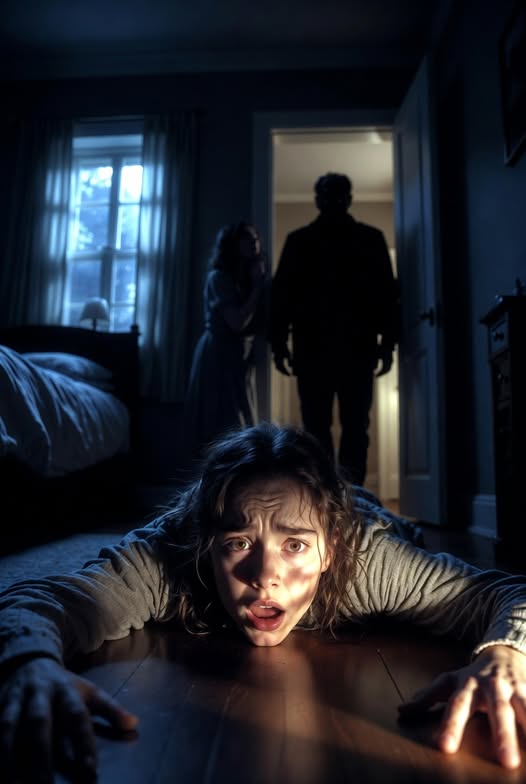
I couldn’t move. I couldn’t scream. I could only lie there in the suffocating darkness of my childhood bedroom, my body frozen like a corpse while my mind screamed for help.
The tea my sister, Lena, had brought me—the first kind gesture she had offered in years—had turned my muscles to stone. My fingers wouldn’t twitch. My lungs barely pulled air, shallow sips of oxygen that tasted of panic. But my ears? My ears worked perfectly. Cruelly so.
That was how I heard her footsteps pause at my door. That was how I heard her whisper to someone in the hallway, her voice trembling but determined.
“Just make it look natural.”
The door creaked open, the hinges groaning in the silence. Heavy footsteps crossed the threshold. A man’s silhouette blocked the faint, amber light spilling from the hall. He smelled of rain and cheap tobacco. He knelt beside my bed, the mattress dipping under his weight, and pressed two rough fingers to the hollow of my throat.
I waited for the pressure to increase. I waited for the squeeze that would end me. I waited for the darkness pulling at the edges of my consciousness to swallow me whole.
But he didn’t kill me.
He checked if I was alive. And when he stood up, his voice wasn’t cold or murderous. It was shaking.
“She’s still breathing,” he muttered, more to himself than anyone else. “This wasn’t supposed to happen like this. The dosage was too strong.”
Who was this man? And why did my sister need my death—or my silence—to look natural?
My name is April Martinez. I am thirty-six years old, and I work as a Senior Data Analyst for a consulting firm in Virginia. I have built a good life for myself: a stable career, a sun-drenched apartment filled with plants, and a retirement account that grows a little more each year.
None of my family knows any of this. I learned a long time ago that in the Martinez household, sharing my accomplishments only invited silence, or worse, comparisons to my younger sister.
To understand why I was lying paralyzed in that bed, let me take you back to the week before that terrible night.
I was sitting at my desk in Virginia, surrounded by spreadsheets, when a letter arrived from the IRS. It was thin, unassuming, and devastating. It claimed I had failed to report $85,000 in income from the previous year.
$85,000. I had never seen it. Never earned it. Never knew it existed.
I assumed it was an error. Identity theft, perhaps, or a clerical mistake. I planned to deal with it after I returned from Pennsylvania. My mother, Gloria, had just had knee surgery, and someone needed to help her recover. My father, Richard, certainly wasn’t going to do it; he viewed caretaking as “women’s work.” And my sister, Lena? Well, Lena hadn’t lifted a finger for anyone but herself in thirty-two years.
So, I requested two weeks off work and drove five hours north to the house I had spent eighteen years trying to escape.
I mentioned the IRS letter to my mother during a phone call before I left. Just casually. The way you mention an annoying errand you need to run.
“Probably just a glitch,” I had said. “I’ll sort it out when I get back.”
I didn’t notice the way her voice went tight. I didn’t hear the heavy pause before she abruptly changed the subject to her physical therapy schedule. I was too busy packing my suitcase.
I should have paid attention.
Growing up in that house, I was always the afterthought. My father made no secret of his preference for Lena. She was charming where I was quiet. She was bold where I was careful. She was “The Star,” and I was “The Spare.”
“Lena takes after me,” he would say at dinner, his chest puffed with pride as Lena recounted some trivial social victory. Then his eyes would slide to me, glazed with indifference. “April… I don’t know who she takes after.”
My mother never defended me. Gloria would sit there with her hands folded in her lap, her eyes fixed on her plate, holding something behind her expression that I could never quite name. Guilt? Fear? Complicity?
I spent years trying to earn the warmth she gave so freely to Lena. I never succeeded. The only person who ever saw me clearly was my grandmother, Eleanor. She died fifteen years ago, but before she passed, she gave me a small, rusted tin box with a strange instruction:
“Don’t open this in front of your father, April. Hide it. When you’re truly on your own, you’ll understand.”
I kept that box in the back of my closet in Virginia. I never opened it. I thought it was just a sentimental keepsake, a collection of old photos or recipes. I didn’t know it was a weapon.
When I arrived at my parents’ house, I expected the usual dynamic. I was right. I cooked. I cleaned. I helped my mother to the bathroom, changed her bandages, and managed her medication schedule.
Lena showed up twice in four days. Both times, she walked in with her phone already recording. She snapped photos of herself holding Mom’s hand, fluffing a pillow, looking concerned.
“Taking care of Mama,” her caption read, complete with a heart emoji.
She stayed for twenty minutes each visit before claiming she had “somewhere else to be.”
I said nothing. I had learned long ago that protesting only made me look petty. “You’re always so jealous of her,” Dad would say. So, I stayed silent.
On the fifth evening, something changed.
Lena came into my room. She wasn’t holding her phone. She was holding a steaming cup of herbal tea.
“You’ve been working so hard,” she said, her voice unusually soft, her eyes avoiding mine. “I made this for you. Chamomile. To help you sleep.”
I should have questioned it. Lena had never done anything kind for me without an audience. But I was exhausted—bone-tired from caregiving and years of being invisible.
I took the cup. I drank it.
Thirty minutes later, my body stopped obeying me.
Chapter 2: The Man in the Shadows
Through the crack in my door, I watched the scene unfold. I couldn’t turn my head. I couldn’t close my eyes. All I could do was lie there, staring at the ceiling fan, while the stranger stood over me.
Lena appeared in the doorway. Her voice was sharp, impatient.
“Is she out?”
“She’s breathing,” the man said, stepping back from the bed. “But barely. Lena, I didn’t sign up for this. You said she just needed to sleep. You didn’t say anything about overdosing her.”
“Keep your voice down,” Lena hissed. She stepped into the room, her heels clicking against the hardwood floor. She stopped near the foot of my bed, looking down at me with an expression that wasn’t hate, but something colder—necessity.
“Dad said she’s been stealing from them for years,” Lena whispered furiously. “Thousands of dollars. Did you know that? My own sister, taking money from our parents while pretending to be the responsible one.”
The accusation was so absurd that I would have laughed if my diaphragm wasn’t paralyzed. I had been financially independent since I was twenty-three. I paid for my own apartment, my own car, my own life. I hadn’t taken a dime from them.
But the man didn’t know that. He only knew what Lena had told him.
“After Friday,” Lena continued, her voice dropping to a determined growl, “she won’t be able to touch their money anymore. The court will make sure of that. And maybe then… maybe then Dad will finally see the truth. That I’m the one who protected this family. Not her.”
Her words revealed the jagged root of it all. This wasn’t just about money. This was about Dad. Lena had spent her entire life basking in his favoritism, and somewhere along the way, she had become terrified of losing it. She would do anything—even drug her own sister—to prove she was the “loyal” daughter.
The man shifted uncomfortably. “This feels like it’s going too far. What if she wakes up? What if she remembers?”
“She won’t remember anything,” Lena said dismissively. “The stuff you gave her causes confusion. Amnesia. By the time she’s coherent, it’ll be too late. Just do what you were hired to do and stop asking questions.”
Hired.
The word echoed in my paralyzed mind. This man wasn’t a friend. He wasn’t a random stranger. Someone had paid him to be here tonight.
They left my room. The door closed with a soft click, leaving me alone in the darkness.
My thoughts drifted, pulled by the drugs still coursing through my system. I found myself remembering my grandmother’s funeral fifteen years ago. The church had been filled with white lilies. Everyone cried—except my father.
I remembered watching him during the service. I had looked for grief. Instead, I saw relief. When the casket closed for the final time, Richard Martinez’s shoulders relaxed. He took a deep breath, like a man who had been holding tension for a long time and could finally let it go.
Now, lying paralyzed, I realized why.
Grandmother Eleanor had tried to warn me. “You’re the strongest one in this family, April,” she had told me from her hospital bed. “One day, you’ll understand why I’m giving this to you and not them.”
The box.
The paralysis began to fade just before dawn. It started with a prickling sensation in my fingertips, like pins and needles. Painful, but welcome. It meant I was coming back.
I heard footsteps in the hallway again. Lena.
I squeezed my eyes shut. I slowed my breathing.
“Still out,” she murmured from the doorway. Then she left.
When I was certain she was gone, I opened my eyes. The room was dim, lit only by the grey morning light filtering through the curtains. I turned my head slowly, testing my recovering muscles, and saw something on the floor beside my bed.
A card. Small, white, with dark lettering. It must have fallen from the man’s pocket when he knelt to check my pulse.
It took all my strength to reach down. My arm felt like lead. My fingers were clumsy. But I managed to grab it.
Marcus Webb – Private Investigator.
A PI. In my bedroom. In the middle of the night.
The “jealous sister” explanation I had been constructing suddenly felt incomplete. Lena was petty, yes. Selfish, yes. But she wasn’t sophisticated enough to hire a Private Investigator.
Just then, a car pulled into the driveway. A door slammed. Heavy, authoritative footsteps crossed the porch and entered the house.
My father’s voice cut through the morning quiet.
“Is it done?”
I didn’t hear the reply, but Dad spoke again.
“Good. The hearing is Friday. Make sure she stays sedated until then.” He paused, and his tone turned icy. “And remember: she’s been unstable for years. Everyone will believe it.”
The hearing is Friday.
I lay perfectly still, barely breathing. I had four days. Four days before my own father tried to have me declared mentally incompetent. Four days before I lost the right to control my own life.
Chapter 3: The Escape
I waited until the house fell completely quiet. Moving felt like swimming through thick mud, but I forced myself upright. I found my shoes. I grabbed my purse.
The hallway was a gauntlet of shadows. I crept past my parents’ bedroom, holding my breath. I crept past Lena’s room, where I could hear her soft snoring. Every creak of the floorboards sounded like a gunshot.
I slipped out the front door and into the cold morning air. My car was parked in the driveway. I prayed the engine wouldn’t roar too loudly. It turned over. I backed out, leaving the headlights off until I hit the main road.
I drove for twenty minutes before I felt safe enough to stop. I pulled into a dilapidated gas station with a payphone mounted on the wall. My hands were shaking so badly I dropped the coins twice.
I dialed the number on the card.
It rang four times.
“Webb,” a groggy voice answered.
“This is April Martinez,” I said. “You were in my bedroom last night. You checked my pulse. I need to know why.”
There was a long silence. Then, all traces of sleepiness vanished from his voice. “You’re coherent. How is that possible?”
“The drug wore off. I heard everything. Now tell me what’s going on, or I’m calling the police.”
“Don’t,” he said quickly. “Not yet. Listen to me. I wasn’t there to hurt you. I didn’t know what your sister was planning.”
“Who hired you?”
“Your father,” Marcus said. “Three weeks ago. He wanted me to find evidence that you were mentally unstable and financially irresponsible. He said he needed documentation for a court case.”
“What kind of court case?”
“Guardianship. He’s trying to have you declared incompetent so he can take control of your finances and your decisions. But April… here’s the thing. I couldn’t find any evidence against you.”
I leaned against the brick wall of the gas station, the cold seeping into my shoulder. “If you couldn’t find anything, why were you at the house?”
“I went there to warn you,” he said. “I figured something was wrong. Your father was too eager. But when I got there, your sister intercepted me. She introduced me to your mother as a friend. She said you had ‘suddenly fallen ill’ and asked me to check on you. I didn’t know about the drugging until I saw you lying there. By then, it was too late to do anything but play along so I could get out and figure out a plan.”
“He said I was stealing from them,” I whispered. “Lena said Dad showed her bank statements.”
“Signatures were forged,” Marcus said bluntly. “I traced them. Your father has been draining his own retirement accounts for three years—over $287,000—and funneling the money into hidden accounts under his name. He’s been framing you for it. He told Lena you were the thief to get her on his side.”
My knees nearly gave out. My father was the thief. Lena was the pawn.
“And the IRS letter?” I asked.
“That was the trigger. Your father has been using your identity for over a decade. Tax fraud. Credit applications. He took out a $150,000 mortgage in your name in 2019. The IRS letter was the first crack in his system. He knew if you investigated, you’d find everything. So he filed for guardianship two weeks ago as a preemptive strike.”
“But I never got a notice.”
“Because he listed your parents’ Pennsylvania address as your residence. He intercepted the court mail.”
Everything clicked. The “instability.” The “stealing.” It was all a narrative he had crafted to discredit me before I could expose him.
“Meet me in Virginia,” I told Marcus. “I have something that might explain everything.”
Chapter 4: The Will
I drove back to my apartment in Virginia, watching the rearview mirror the entire way. When I arrived, I went straight to the closet.
The tin box was heavy in my hands. I sat at my kitchen table and pried the rusted lid open.
Inside was a handwritten letter and a folded legal document.
My dear April, the letter read. Your father filed a false affidavit after I died, claiming I had no will. He stole your inheritance to cover his gambling debts. I couldn’t stop him before I passed, but I saved this copy. He made you invisible your whole life so you’d never question anything. But I see you, April. You deserve the truth.
The document was her original will. It left her estate—worth $400,000—specifically to me.
Marcus arrived an hour later. He examined the will with a magnifying glass.
“The original probate fraud was fifteen years ago,” he said. “Technically outside the statute of limitations. But… your father has been filing false tax returns using proceeds from that stolen inheritance every year since. That resets the clock. And the 2019 loan using stolen funds as collateral? That’s recent enough to prosecute.”
He looked up at me. “He built a house of cards on your back, April. And Friday is the day he plans to burn it down.”
We had four days.
We worked through the night. Marcus pulled records. I organized financial statements. We hired an attorney, Sandra Chen, a shark of a woman who specialized in fraud.
By Friday morning, we were ready.
I walked into the courthouse wearing a crisp navy suit. My hands were steady. My mind was clear. I had spent thirty-six years being invisible. Today, they would finally see me.
My father was already seated at the petitioner’s table. When I walked in, the color drained from his face. He looked like he had seen a ghost. He had expected me to be sedated in Pennsylvania, confused and helpless.
Instead, I took my seat at the respondent’s table, Sandra beside me.
The competency evaluation took less than an hour. I answered every question clearly. I recited my social security number, my investment portfolio details, my monthly budget. The evaluator looked confused as to why we were even there.
Then, Sandra stood up.
“Your Honor,” she said. “This petition is not only baseless; it is an instrument of fraud.”
She presented the evidence. The false address on the petition. The forged signatures. The identity theft.
The judge, a stern woman with no patience for games, looked at my father. “Mr. Martinez, this petition is dismissed with prejudice. Furthermore, I am referring this matter to the District Attorney’s office for immediate investigation.”
My father tried to speak, but his lawyer placed a hand on his arm, silencing him. He looked at me then—a look of pure, unadulterated hatred.
I stared back. I didn’t flinch.
Chapter 5: The Reckoning
We didn’t stop there. Over the next three weeks, Marcus and I built a criminal case that was airtight.
We obtained the security footage from my parents’ house—Marcus had noticed the cameras and subpoenaed the cloud storage. It showed Lena entering my room with the tea. It showed her searching through my purse.
We authenticated the will. We traced the wire transfers.
When we had everything, I made one final visit to my parents’ house. I didn’t warn them.
I walked into the living room. My father, mother, and Lena were there, huddled with their lawyer.
I dropped a thick folder onto the coffee table. It landed with a heavy thud.
“Transaction records. The authenticated will. Loan documents. And a digital recording of Dad ordering my sedation,” I said calmly.
Their lawyer picked up the folder. He read the first page. Then the second. He stood up abruptly.
“I need to excuse myself,” he said. “Richard, do not say another word.” He walked out.
My father tried to bluster. “You’ve always been unstable, April. No one will believe this.”
“The police are already on their way,” I said. “I called them ten minutes ago.”
Lena broke first.
“Dad told me you were stealing!” she screamed, tears streaming down her face. “He showed me the bank statements! He said you were waiting for them to die so you could take everything! I was trying to protect them!”
I looked at my sister. I didn’t see a monster. I saw a pathetic, desperate girl who had been molded into a weapon.
“He used us both, Lena,” I said. “The difference is, I learned to survive without him. You needed his love so badly you were willing to kill your own sister for it.”
My father turned on her. “You stupid girl! You couldn’t even handle a simple task! Three days! That’s all you had to do!”
My mother, Gloria, stood in the corner, trembling.
“I knew,” she whispered.
The room went silent.
“I knew about the will,” she said, covering her face. “He threatened me. He said he’d leave me with nothing. I was terrified of being alone. So I hid the letter in the box… hoping you’d find it.”
“You were a coward,” I told her. “You watched him destroy me for thirty-six years to save yourself.”
The sirens cut through the air.
They took my father out in handcuffs. He screamed that it was all a mistake, that I was crazy.
They read Lena her rights. She went quietly, looking back at me with eyes that finally understood the cost of her loyalty.
Epilogue: The Foundation
Six months later, the verdicts came down.
Richard Martinez was sentenced to twelve years in federal prison for fraud, identity theft, and conspiracy.
Lena received three years of probation and mandatory psychiatric counseling. The court acknowledged she had been manipulated, but as the judge said, “Being manipulated does not absolve you of the choice to harm another.”
My mother lost everything. The house was sold to pay restitution. She called me once, asking if she could stay with me.
“No,” I said. “You need to learn who you are without someone else making your decisions. That is your work now, not mine.”
I received $340,000 in restitution. I didn’t keep it. I used it to start the Eleanor Martinez Foundation. We provide legal resources and financial planning for women escaping familial financial abuse.
I bought a small cottage by a lake. It is quiet here. Peaceful.
Sometimes, people ask me if I forgive them.
I tell them this: Forgiveness isn’t the same as reconciliation. I have forgiven myself for believing I wasn’t enough. I have forgiven the little girl who tried so hard to be seen.
As for my family? I don’t hate them. I just don’t need them.
I sat on my porch this morning, drinking tea—Earl Grey, safe and warm—and watched the sun rise. I thought about the girl paralyzed in the dark. She thought it was the end. She didn’t know it was the beginning.
I am the strongest one in my family. Not because I never fell, but because when I finally understood why I kept falling, I stopped letting them push me down.
I see my own worth now. And that is enough.