The scar runs down the left side of my face like a river on a topographical map. It starts at my temple, jagged and silver, snaking down past my cheekbone and disappearing into the hollow of my neck.
For twenty-five years, I wore it as a badge of honor. It was the receipt for a life saved. But on a Tuesday afternoon, sitting in a bistro that smelled of roasted garlic and expensive indifference, my only son, Julian, told me it was the reason I couldn’t be seen at his wedding.
“It’s not that we don’t want you there, Mom,” Julian said, his voice dropping to that reasonable, patronizing register men use when they are about to shatter a woman’s heart. He picked at the linen napkin, refusing to meet my eyes. “It’s just… Isabella and I have a very specific vision. The venue, the lighting, the photography… it’s all curated. It’s about the aesthetic.”
I sat perfectly still. My tea had gone cold, a stagnant pool of Earl Grey reflecting the shock on my face. “The aesthetic,” I repeated. The word felt like a stone in my mouth. “You’re telling me I don’t fit the color scheme?”
“Don’t be dramatic,” he snapped, finally looking up. His eyes, usually so warm, were hard. Defensive. “This is going to be in Vogue online, Mom. The sponsors, the influencers… everything has to be perfect. And let’s be honest. Your… situation… it draws focus. People stare. It makes them uncomfortable.”
My hand instinctively went to my cheek, fingers tracing the ridge of the scar tissue. “This situation,” I whispered, “is the only reason you are sitting in this chair, Julian. It is the only reason you have lungs to breathe and skin that isn’t charred.”
He flinched. He knew the story. Everyone knew the story. The apartment fire when he was three. The way I had shielded his small body with my own, taking the falling beam, the heat, the agony, so he could come out without a scratch.
“I know, I know,” he waved a hand dismissively, as if swatting away a fly. “And I’m grateful. Obviously. But that was a long time ago. This is my future. Isabella thinks it would be better if you… didn’t sit in the front row. Or maybe, you know, just skipped the ceremony and came to the private dinner after? The one without the press?”
The air left the bistro. It wasn’t just a rejection; it was an erasure. My son, the boy I had scrubbed floors to educate, the man whose startup I had liquidated my retirement to fund, was ashamed of me. He was ashamed of the very evidence of my love for him.
“Isabella thinks,” I said slowly, testing the weight of his fiancée’s name. Isabella. A girl with hair like spun gold and a soul like a cash register. “And what do you think, Julian?”
He looked away, out the window where the world was still turning, oblivious to the fact that mine had just stopped. “I think she’s right. It’s one day, Mom. Can’t you just be selfless for one day?”
Selfless.
The word echoed in the chambers of my heart, bouncing off the walls of twenty years of sacrifice. I looked at him—really looked at him—and realized I wasn’t seeing my son. I was seeing a stranger in a bespoke suit I had paid for.
“I see,” I said. My voice didn’t shake. A cold, metallic calm had settled over me, a protective armor forged in the fires of absolute devastation. “If that is your decision.”
“It is,” he said, relief washing over his face. He reached for his wallet, likely to pay the bill with the credit card I paid off every month. “Thanks for understanding, Mom. You’re the best.”
I stood up before he could put the card down. “Don’t bother,” I said. “I’m leaving.”
I walked out of the restaurant, the bell above the door chiming a cheerful farewell. I walked until my legs burned, until the city lights blurred into streaks of neon. He thought I was ugly. He thought I was a blemish on his perfect life.
But Julian had forgotten one crucial detail. He had forgotten who held the strings to his beautiful, curated life. He had forgotten that beauty is subjective, but power? Power is absolute.
That night, I didn’t cry. Tears are for those who have hope, and mine had evaporated the moment Julian chose a photo opportunity over his mother. Instead, I went into my home office—a small, cluttered room filled with the paperwork of a life spent building a legacy—and I opened the safe.
I pulled out the ledger.
It wasn’t a digital spreadsheet. It was a physical book, bound in leather, where I kept track of the “loans” I had given Julian. The startup capital for his tech firm. The down payment on his penthouse. The engagement ring that sparkled on Isabella‘s finger, which cost more than my first house.
I had never asked for repayment. I had framed them as “investments in his future.” But looking at the numbers now, ink black and unforgiving, I realized I hadn’t been investing. I had been enabling.
I picked up the phone and dialed Mr. Sterling, my attorney and oldest friend.
“Martha?” his voice was rough with sleep. “It’s midnight. Is everything alright?”
“No, Arthur,” I said, staring at my reflection in the darkened window. The scar caught the moonlight, looking less like a wound and more like a lightning bolt. “I need you to audit the wedding contracts. The ones I signed as the guarantor.”
“The wedding is in three days,” Sterling said, fully awake now. “What are you looking for?”
“I want to know who owns the event,” I said. “I want to know if I’m a guest, or if I’m the landlord.”
The next morning, I drove to the venue. It was a sprawling estate called The Gilded Lily, an hour outside the city. It was magnificent—marble columns, manicured gardens, a ballroom that looked like Versailles.
I walked into the main hall. Florists were already setting up, carrying massive arrangements of white hydrangeas and orchids. It smelled of money and pretense.
“Excuse me, ma’am,” a young woman with a clipboard bustled over. She looked stressed. “Deliveries are in the back. We’re strictly closed to the public.”
“I’m not the public,” I said, my voice steady. “I’m Martha Vance.”
The woman froze. She looked down at her clipboard, then back at me, her eyes widening as they landed on my scar. She tried not to stare, but failed. “Oh. Mrs. Vance. Julian‘s… mother.”
“Yes,” I said. “I’m here to check on the preparations.”
She shifted uncomfortably. “Right. Well, Isabella is actually in the bridal suite right now with her mother. They’re doing the final walk-through.”
“Perfect,” I said.
I didn’t wait for her to announce me. I walked up the sweeping staircase, the sound of laughter drifting down from the second floor. I recognized Isabella‘s high, tinkling laugh.
“I mean, honestly,” Isabella was saying as I approached the open door. “It’s a blessing in disguise. If she came, where would we even put her? In the back? She looks like something out of a horror movie. It totally ruins the vibe of ‘Ethereal Elegance’.”
I stopped. My hand hovered over the doorframe.
“Julian was so soft about it,” another voice—her mother, Clarissa—chimed in. “I told him, ‘Darling, you can’t have a Phantom of the Opera situation at a black-tie event.’ Did he finally grow a spine?”
“He did,” Isabella giggled. “He told her she couldn’t come. Or, well, he ‘suggested’ she skip it. She got the hint. Thank God. Now we can use her seat for the Senator.”
“And the check cleared?” Clarissa asked.
“Oh, the check cleared weeks ago,” Isabella scoffed. “The old hag might be hideous, but her bank account is beautiful. She thinks she’s buying love. It’s pathetic, really.”
My heart didn’t break. It calcified. It turned into something hard and sharp, like a diamond.
I stepped into the doorway.
“The check,” I said, my voice cutting through their laughter like a guillotine blade, “can be cancelled.”
The room went silent. Isabella spun around, her face draining of color. Clarissa dropped the fabric swatch she was holding.
“Martha,” Isabella stammered, a fake smile plastered instantly onto her face. “We… we were just talking about you! How much we’re going to miss you!”
“I heard,” I said, walking into the room. I didn’t look away. I let them see the scar. I let them see the history they mocked. “Phantom of the Opera. Pathetic. Old hag.”
Isabella’s eyes darted to the door, looking for an escape. “You misunderstood. We were just… stressing. You know how weddings are.”
“I do know,” I said. “I’m paying for this one. Every flower. Every bottle of champagne. The dress you’re wearing right now.”
I looked at the dress. It was exquisite. Lace and silk, costing more than my car. I had signed the check for the deposit myself.
“You wouldn’t,” Isabella whispered, the realization dawning on her. “It’s in forty-eight hours. You can’t.”
“Watch me,” I said.
I turned to leave, but stopped. “Actually, no. I won’t cancel it.”
Isabella let out a breath she had been holding. “Oh, thank God. Martha, you really scared me. We can—”
“I won’t cancel it,” I repeated, turning back to face them with a smile that didn’t reach my eyes. “Because I paid for a party. And I intend to have one.”
I walked out, leaving them in a silence that was far more terrifying than any scream.
The next twenty-four hours were a blur of calculated movement. I met with Mr. Sterling. We reviewed the contracts for the venue, the catering, the band.
“Technically,” Sterling said, adjusting his glasses, “Since you are the sole signatory on the vendor contracts, you have creative control. Julian and Isabella are listed merely as the ‘honorees’.”
“Creative control,” I mused. “I like the sound of that.”
I went shopping. Not to the department stores where I usually bought my sensible pantsuits. I went to a designer atelier downtown.
“I need a dress,” I told the stylist, a man named Giovanni who looked at my scar not with disgust, but with an artist’s intrigue. “Something that says ‘Matriarch’. Something that says ‘I survived the fire, and I am the fire’.”
Giovanni smiled. “I have just the thing. Emerald green. Silk. Structural.”
When I put it on, I didn’t recognize myself. The scar was still there, stark against my skin, but the dress didn’t hide it. It framed it. It made me look like a warrior queen.
“Perfect,” I said.
My phone had been buzzing non-stop. Julian. Isabella. Even Isabella‘s father. I ignored them all. Let them sweat. Let them wonder if the checks would bounce. Let them realize that their “aesthetic” was built on a foundation of sand.
On the morning of the wedding, I sent a single text to Julian.
The wedding is on. I will see you there.
I arrived at The Gilded Lily just as the sun was beginning to set. The guests were arriving—a sea of tuxedos and designer gowns. I watched from my car for a moment, seeing the influencers posing by the fountain, the photographers snapping pictures. It was a spectacle of vanity.
And I was about to crash it.
I stepped out of the car. I wasn’t hiding. I wasn’t entering through the back. I walked up the main path, the gravel crunching under my heels.
The usher at the door, a young man with a headset, looked at his list. “Name?”
“Martha Vance,” I said.
He scanned the list. He frowned. “I… I don’t see you on the guest list, ma’am.”
Of course. They had removed me.
“Check the host list,” I said calmly.
He flipped a page. His eyes widened. “Oh. The owner of the contract. My apologies, Mrs. Vance. Please, right this way.”
He opened the velvet rope.
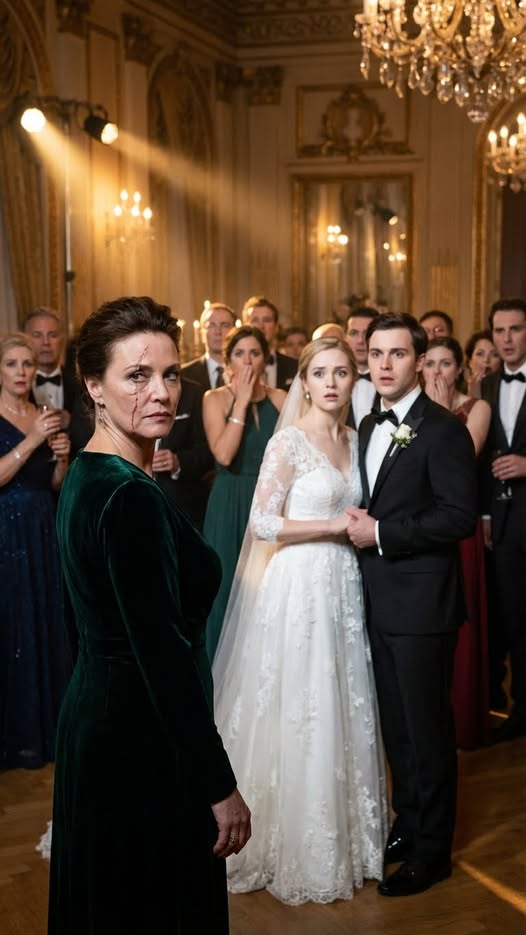
I walked into the ceremony space. The music had just started. The guests were seated. Julian stood at the altar, looking handsome and nervous. Isabella was just starting her walk down the aisle.
I didn’t sit in the back. I walked straight down the center aisle, just a few paces behind the bride.
Heads turned. Whispers erupted like wildfire. Who is that? Look at her face. Is that the mother? I thought she was dead/sick/estranged.
I walked with my head high. I felt the stares on my scar like physical touches, but they didn’t burn anymore. They fueled me.
I reached the front row—the row reserved for “immediate family,” which was currently empty on the groom’s side.
Julian saw me. His eyes nearly bulged out of his head. Isabella, halfway down the aisle, faltered in her step. She stared at me, her eyes darting daggers, but she couldn’t stop. The cameras were rolling. The aesthetic had to be maintained.
I took my seat in the front row. I crossed my legs. And I smiled.
The ceremony was excruciating. They exchanged vows that sounded like they had been written by a ChatGPT prompt—buzzwords about “partnership” and “building an empire” without a shred of genuine emotion. Julian couldn’t stop glancing at me. He looked terrified.
Good.
After the “I do’s,” the guests moved to the ballroom for the reception. This was where the real show would begin.
I sat at the head table. There was no place card for me, so I simply removed the card that said “Reserved for Senator Davis” and sat down. When the Senator arrived, I looked him in the eye and said, “I paid for the chair you’re standing next to. Find another.” He scurried away.
Julian and Isabella made their grand entrance. They did their first dance. They looked perfect. They looked hollow.
Then came the speeches. The Best Man told a frat story. The Maid of Honor cried about how Isabella was her “soul sister.”
Then, the DJ—who I had also paid—took the microphone.
“And now,” he boomed, “a few words from the woman who made this night possible. The mother of the groom, Martha Vance!”
Julian jumped up. “No,” he mouthed. He signaled frantically to the DJ to cut the mic. Isabella grabbed his arm, her nails digging into his suit.
But I was already at the podium. I took the microphone. The feedback squealed for a second, silencing the room.
“Good evening,” I said. My voice echoed through the vast, crystal-lit hall.
Hundreds of faces turned to me. I saw the curiosity, the judgment. I saw Isabella‘s mother hiding her face in her hands.
“My name is Martha,” I began. “And for those of you who don’t know me… well, that was by design. You see, my son Julian and his beautiful bride Isabella felt that my presence here tonight would disturb the… aesthetic.”
A gasp rippled through the room. Julian stood up, knocking his chair over. “Mom, don’t.”
“Sit down, Julian,” I said sharply. The command was so authoritative that he actually sat. Old habits die hard.
“They felt,” I continued, tracing the line of my scar with one finger, “that this face… this scar… was too ugly for Vogue. They felt it would distract from the beauty of the flowers and the silk.”
I looked out at the crowd.
“But I think it’s important you know where this scar came from. Twenty-five years ago, I walked into a burning building. The firefighters said it was suicide. But my three-year-old son was in his crib. I didn’t think about the aesthetic of fire. I didn’t think about my skin melting. I thought about him.”
The room was deadly silent. You could hear the ice melting in the glasses.
“I took the fire,” I said softly. “I took the pain. And I carried this scar for half my life, not as a deformity, but as a receipt. A proof of purchase for his life.”
I turned to look directly at Julian. He was weeping now, head in his hands. Isabella was staring straight ahead, her face a mask of fury.
“And how was I repaid?” I asked the room. “With an un-invitation. With a request to hide. Because my love wasn’t pretty enough for the photos.”
I reached into my clutch and pulled out the ledger. The leather book slammed onto the podium with a satisfying thud.
“But here is the other thing about ugliness,” I said. “It usually pays the bills. This wedding cost three hundred thousand dollars. The startup capital for Julian‘s company cost two hundred thousand. The penthouse down payment… another hundred.”
I opened the book.
“I have funded every aspect of this ‘perfect’ life. I bought the aesthetic.”
I looked at Isabella.
“And today, I am closing the account.”
I ripped the page out of the ledger.
“Mr. Sterling is in the back,” I pointed to the exit. “He has the paperwork. As of this moment, the venue is paid for—consider it my final gift. But the startup funding? The penthouse? The credit cards? They are frozen. Effective immediately.”
Isabella let out a shriek. “You can’t do that!”
“I can,” I said. “It’s my money. And I’m afraid I need it. I have some… aesthetic improvements to make to my own life. Perhaps a villa in Tuscany. I hear the light there is very forgiving.”
I dropped the microphone. It didn’t screech this time. It just landed with a heavy, final thud.
I walked off the stage. I didn’t look back at the sobbing groom or the screaming bride. I walked through the parted sea of stunned guests, past the expensive flowers, and out into the cool night air.
The fallout was immediate and catastrophic.
By the time I reached my car, my phone was blowing up. Julian sending text after text: Mom, please, we need to talk. Isabella is leaving. You ruined everything.
I turned the phone off.
I drove home, but not to the house I had shared with the ghosts of my sacrifices. I drove to a hotel—the Four Seasons. I booked the presidential suite.
I ordered room service. I sat on the balcony, watching the city lights.
For the first time in twenty-five years, I didn’t feel the weight of the scar. I felt light.
The next morning, Mr. Sterling called me.
“It’s a mess,” he said, sounding delighted. “Isabella‘s parents are threatening to sue, but they have no grounds. Julian is staying at a friend’s house because the locks on the penthouse were changed this morning. He’s asking for a meeting.”
“No meeting,” I said. “Tell him he can write me a letter. If I like the aesthetic of his handwriting, I might read it.”
“And the business?” Sterling asked.
“Sell my shares,” I said. “Liquidate my position. If he wants to run a company, let him find investors who like his face.”
Months passed.
I didn’t go to Tuscany. I went to Kyoto. I sat in Zen gardens. I learned to arrange flowers. I met people who didn’t speak my language, but who looked at my face and bowed with respect.
One afternoon, sitting in a tea house, I received a package from America. It was from Julian.
Inside was a single photograph. It was a picture of him, standing alone in a small apartment. He looked tired. He looked older. He wasn’t wearing a designer suit; he was wearing a t-shirt.
On the back, he had written: I’m sorry. I was the ugly one.
I stared at the photo for a long time. I traced his face with my finger, just as I had traced my own scar a thousand times.
I didn’t call him. Not yet. Forgiveness is expensive, and he hadn’t earned the capital yet.
I put the photo away and walked out into the garden. The cherry blossoms were falling, pink and white petals drifting onto the mossy stones.
A young girl, maybe five years old, ran past me. She stopped, staring up at my face. Her mother rushed over, looking embarrassed. “I’m so sorry,” the mother said. “She doesn’t mean to stare.”
I knelt down so I was eye-level with the girl. She reached out a tiny hand and touched the silver line on my cheek.
“Ouchie?” she asked.
“Yes,” I smiled. “A big ouchie. But it’s all better now.”
“It looks like lightning,” the girl whispered.
“It is,” I said. “It’s where the lightning struck, and I didn’t break.”
The girl smiled, then ran off to chase a butterfly.
I stood up, feeling the warmth of the sun on my face—both sides of it. I wasn’t a victim. I wasn’t a checkbook. I wasn’t a hidden secret.
I was Martha Vance. And for the first time in my life, I was beautiful.
Three years later.
The gallery opening was crowded. It was a small space in Chelsea, but the buzz was significant. The exhibit was titled Scars of Gold.
I stood in the center of the room. I was wearing a backless dress. My hair was swept up.
The centerpiece of the exhibit was a portrait. It was painted by a renowned artist I had met in my travels. It was a portrait of me.
The scar wasn’t hidden. It was painted in gold leaf, shimmering under the gallery lights. It looked like Kintsugi—the Japanese art of repairing broken pottery with gold, treating the breakage and repair as part of the history of an object, rather than something to disguise.
“It’s magnificent,” a voice said behind me.
I turned.
Julian stood there. He looked different. Humble. He was holding a pamphlet of the exhibit in hands that looked rougher, like they had been working.
“Hello, Julian,” I said.
“I saw the flyer,” he said. “I wanted to… I just wanted to see you.”
“Isabella?” I asked.
“Gone,” he said. “Long gone. As soon as the money dried up.” He looked at the painting, then at me. “I’m working at a non-profit now. Teaching kids to code. It’s… it’s good work. Honest.”
“I’m glad to hear that,” I said.
He hesitated. “Mom. You look…” He struggled for the word.
“I know how I look,” I said softly.
“You look happy,” he finished. Tears welled in his eyes. “And you were right. About everything.”
I looked at my son. I saw the regret etched into his features. I saw the boy I had saved from the fire.
“I am happy,” I said.
“Can we…” he started, then stopped. “Can I buy you a coffee? Maybe somewhere cheap? My treat.”
I looked at the gold scar in the painting. Then I looked at the invisible scars on my son.
“Coffee sounds good,” I said. “But pick somewhere with good lighting. I have nothing to hide.”
We walked out of the gallery together, into the bright, chaotic, beautiful street. The aesthetic was messy. It was imperfect. And it was exactly right.