Chapter 1: The Stain on the Silk
“YOU’RE NOT A BRIDESMAID, CASSIE. YOU’RE JUST A SCAR THAT WILL RUIN THE PHOTOS,” my sister hissed, her manicured finger pointing aggressively toward the service entrance. “Stay in the kitchen. Don’t let the Senator see you.”
She didn’t know that without those scars, her precious Senator wouldn’t be alive to attend her wedding.
I stood there, the polished marble of our family’s estate feeling colder than usual through the soles of my sensible flats. In my hands, I held a small, tissue-wrapped bundle—a hand-carved wooden bluejay. I had spent three months carving it, my damaged nerves making the fine detail work agonizing, but I wanted to give her something real. Something that wasn’t bought with a credit card I didn’t have.
Jessica snatched the seating chart from the console table, not even glancing at the gift. She looked radiant in her white rehearsal dress, a vision of carefully constructed perfection. But her eyes were hard, lacking any warmth.
“Cassie, listen to me,” she said, her voice dropping to a whisper that dripped with fake sympathy. “The lighting in the ballroom… it’s very bright. High-definition cameras. Senator Sterling is coming. This is the biggest day of my life. We can’t have… distractions.”
My mother, Linda, walked in then, scrolling furiously on her phone. She didn’t look up. She rarely looked at me these days. I think the sight of the grafts on my neck and the roped, burn-scarred tissue running down the left side of my face made her nauseous. To her, I wasn’t a survivor; I was a flawed accessory.
“It’s for the best, honey,” Linda chimed in, tapping out a text to the florist. “You don’t want people staring at your burns while they eat, do you? It’s unappetizing. It’s not ladylike to look like… that. Just help the catering staff in the back. You’re good with your hands. God knows we’re paying enough for the service; you might as well ensure they don’t mess up the canapés.”
My grip on the wooden bird tightened until I felt the sharp beak dig into my palm. The pain was grounding. “So I’m not a sister today?” I asked, my voice rasping slightly—smoke inhalation had taken a toll on my vocal cords, leaving my voice a husky shadow of what it used to be. “I’m staff?”
“You’re family,” Jessica smiled, a cold, practiced expression she had perfected for her social media feed. “But family makes sacrifices. Just stay in the kitchen. Please. For me.”
She turned her back, adjusting a flower arrangement that was already perfect. The dismissal was absolute.
I looked at the grand staircase, the chandeliers, the life I was born into but no longer fit. I was the ‘Mistake.’ The jagged edge in a world of smooth surfaces. I walked silently to the back entrance, the heavy kitchen door swinging shut behind me, cutting off the sound of laughter from the main hall. The air in the kitchen was thick with steam and the smell of roasting lamb, a sensory assault that briefly took me back to places I tried to forget—the smell of burning fuel and antiseptic.
As I tied on a spare, oversized apron found on a hook, covering my simple blouse, I heard the murmur of the arrival of the VIP guests through the thin walls. The heavy thud of luxury car doors closing. The polite applause. I scrubbed a pot, the steel wool biting into my skin. They didn’t know it yet, but the man walking through the front door—the guest of honor—was the only person on earth who knew the true story behind the face they were so desperate to hide.
Chapter 2: The Monster in the Apron
The humidity in the kitchen was stifling. Sweat began to bead on my forehead, stinging the sensitive, grafted skin around my temple. I kept my head down, focusing on the rhythm of the work. Scrub, rinse, dry. It was simple. It made sense. Unlike the war, or this family, dirty dishes had a clear solution.
The catering staff gave me a wide berth. They whispered in Spanish, glancing at my arms where the sleeves of my blouse were rolled up, revealing the map of melted skin that traced the path of the IED explosion. I didn’t blame them. I looked like something that had been broken and glued back together wrong.
The kitchen doors burst open with a violence that made the sous-chef jump.
Mike, my younger brother, stood there. He was out of breath, his tie crooked, looking frantic. He was the only one who had visited me in the burn ward. He was the only one who didn’t flinch.
“Where the hell have you been?” Mike demanded, scanning the room until his eyes locked on me. He froze. He looked at the apron. He looked at the half-washed champagne flutes in my hand.
“Take that apron off,” Mike said, his voice shaking with a low, dangerous tremor.
“It’s fine, Mike,” I muttered, turning back to the sink so he wouldn’t see the humiliation burning in my eyes. “Jessica said the Senator… she said the lighting…”
“To hell with the Senator!” Mike yelled, crossing the room in three long strides. He grabbed my arm, careful to avoid the tender spots. “You are my sister. You are a war hero. You are sitting at the head table or I am burning this whole damn place to the ground.”
He began dragging me toward the door. I resisted, my flats sliding on the greasy tile. “Mike, stop. It’s not worth it. I don’t want to ruin her day.”
“She ruined her own day when she decided to treat you like a leper!”
We crashed through the swing doors into the service hallway, right into Linda.
She gasped, dropping a stack of linen napkins. Her face, usually a mask of Botoxed calm, twisted into genuine panic. She threw her hands up as if to physically block our view of the foyer.
“Lower your voice!” she hissed, her eyes darting toward the guests visible through the archway. “Senator Sterling is in the foyer! Do you want to ruin your sister’s future? We are trying to secure a donation for the gallery! If that man sees her,” she pointed a manicured finger at me, shaking with rage, “he’ll think we’re low-class trash. She’s a monster, Mike! Look at her! No one wants to see a scarred woman at a wedding. It’s bad luck!”
The word hung in the air. Monster.
I froze. I had heard it in my head a thousand times. I had seen it in the eyes of children at the grocery store. But hearing it from the woman who gave birth to me? That was a different kind of shrapnel. It didn’t burn; it froze. It severed the last tether I had to this house.
Mike stopped pulling. He let go of my arm and stepped back, looking at our mother as if he were seeing a stranger.
“A monster,” Mike repeated, his voice eerily calm.
“Yes! Look at her face!” Linda pleaded, desperate now. “Just for tonight, Mike. Please.”
Mike reached up to his lapel. He ripped off the white rose boutonniere that marked him as a groomsman. The petals scattered on the floor. He threw the crushed stem into a nearby bin of trash.
“Fine,” Mike said. “If she’s a monster, then I’m not a guest.”
He walked over to a linen cart, grabbed a dish towel, and tucked it into his belt. He stood next to me, shoulder to shoulder. “I’m washing dishes too.”
Linda opened her mouth to scream, but the booming voice of the Master of Ceremonies echoed from the main hall.
“Ladies and Gentlemen, please welcome the man of the hour, a true American patriot, Senator Thomas Sterling!”
Applause erupted like thunder. Footsteps clicked on the marble, approaching the hallway where we stood. Linda turned pale, realizing the Senator was looking for a bathroom or a quiet place, and he was heading straight for us.
Chapter 3: The Leak
Linda shoved us back into the kitchen and slammed the door, leaning her back against it as if she could physically hold back the truth.
“Stay inside,” she breathed, her chest heaving. “Do not come out until the speeches are over.” She smoothed her hair, plastered a fake smile on her face, and slipped back out to the party.
Inside the kitchen, the atmosphere had shifted. The staff watched us with wide eyes. Mike picked up a sponge and started scrubbing a roasting pan, his jaw set so tight I thought his teeth might crack.
“You didn’t have to do that,” I said quietly, picking up another glass.
“Shut up, Cassie,” he said, not unkindly. “Just… shut up.”
I leaned against the stainless steel counter, closing my eyes. Through the gap in the service door, I could hear the muffled sounds of the reception. The clinking of crystal. The low hum of expensive conversation.
I moved closer to the crack in the door, needing to see him. Senator Sterling.
I saw him standing near the ice sculpture. He looked older than I remembered. His hair was silver now, and he walked with a slight cane—a remnant of the shrapnel that had taken part of his hip. The same explosion that had taken my face.
Jessica was hanging on his arm, laughing at something he hadn’t said. She was charming him, or trying to.
“You have a lovely home,” I heard Sterling say. His voice was deep, gravelly. He didn’t sound like a politician; he sounded tired. His eyes scanned the crowd, looking over the heads of the wealthy donors and socialites. He was looking for someone. “I was told your family has a history of service. Do you have a sibling who served?”
My heart slammed against my ribs.
Jessica stiffened. I saw her grip on her champagne glass tighten. “Oh, yes. Cassandra. Sadly, she… she has some mental struggles. PTSD, you know? It’s very tragic. She’s quite unstable.”
Sterling frowned. “Is she here?”
“No,” Jessica lied smoothly, her face the picture of sisterly concern. “She couldn’t be here today. She’s in a facility. A special home. It’s for the best. She can be… volatile.”
“I see,” Sterling said, his face darkening with evident disappointment. He swirled his wine, losing interest in the room. “That is unfortunate. I was hoping to meet her. I served with a woman from this town years ago. The bravest soldier I ever met. I owe her a debt I can never repay.”
“Well,” Linda swooped in, linking her arm through the Senator’s. “We prefer to focus on the happy couple! More champagne, Senator? The 1998 vintage is exquisite.”
Back in the kitchen, disaster struck.
A pipe under the industrial sink, rattling from the pressure of the high-volume usage, suddenly burst.
A jet of hot, greasy water sprayed across the room, hitting the floor with a wet slap. The drains, already clogged with food scraps, backed up instantly. Grey, murky water began to pool around our feet.
“Damn it!” the head chef shouted. “The main valve! We need to shut off the water!”
“Where is it?” Mike yelled, dropping the pan.
“In the hallway closet!” the chef screamed, pointing to the service door. “Near the ballroom entrance! Hurry, before it floods the dining room!”
Panic seized me. The hallway. The Senator.
“I’ll go,” Mike said, but he slipped on the wet tile, going down hard on his knee.
“Stay down!” I shouted, my training kicking in. Assess. Adapt. Overcome. I didn’t think about my face. I didn’t think about the dress code. I thought about the mission.
I shoved the kitchen doors open, bursting out into the hallway. I was wet, my apron stained with grease, my hair plastered to my forehead, accentuating the scars on my cheek.
I sprinted toward the utility closet, my flats squeaking on the polished floor. I wrenched the closet door open and cranked the rusted valve wheel with both hands, muscles screaming. The hissing of the water stopped.
I exhaled, leaning my forehead against the cool doorframe.
Then, the ballroom doors swung open.
Senator Sterling stepped out, phone in hand, looking for a quiet place to take a call.
He stopped.
I looked up.
We were five feet apart. The music from the ballroom spilled out, a cheerful jazz standard that felt grotesque in the silence between us.
He saw the wet apron. He saw the grease stains. And then, he looked at my face. He didn’t flinch. His eyes locked onto the burn patterns—the specific, jagged geography of a blast he had been at the center of.
He froze, his phone slipping from his fingers and hitting the carpet with a dull thud.
Chapter 4: The Kneel
Jessica appeared in the doorway a split second later, breathless. She saw the Senator staring at me. She saw me—disheveled, monstrous, ruining the aesthetic of her hallway.
“Oh my god!” she shrieked, rushing forward. She grabbed my wet arm, her nails digging into the graft. “I am so sorry, Senator! She escaped the kitchen! She’s the help—she’s sick! Get back inside, Cassie! Security!”
Linda was right behind her, pale as a ghost. “Get her out of here! I told you to stay in the back!”
I didn’t move. I couldn’t. I was locked in Sterling’s gaze.
“Don’t touch her!”
The voice didn’t sound like a Senator’s. It sounded like a Commanding Officer. It boomed off the marble walls, echoing with a ferocity that silenced the hallway and made the music inside seem to die away.
Jessica recoiled, releasing my arm as if burned. “Senator, I—”
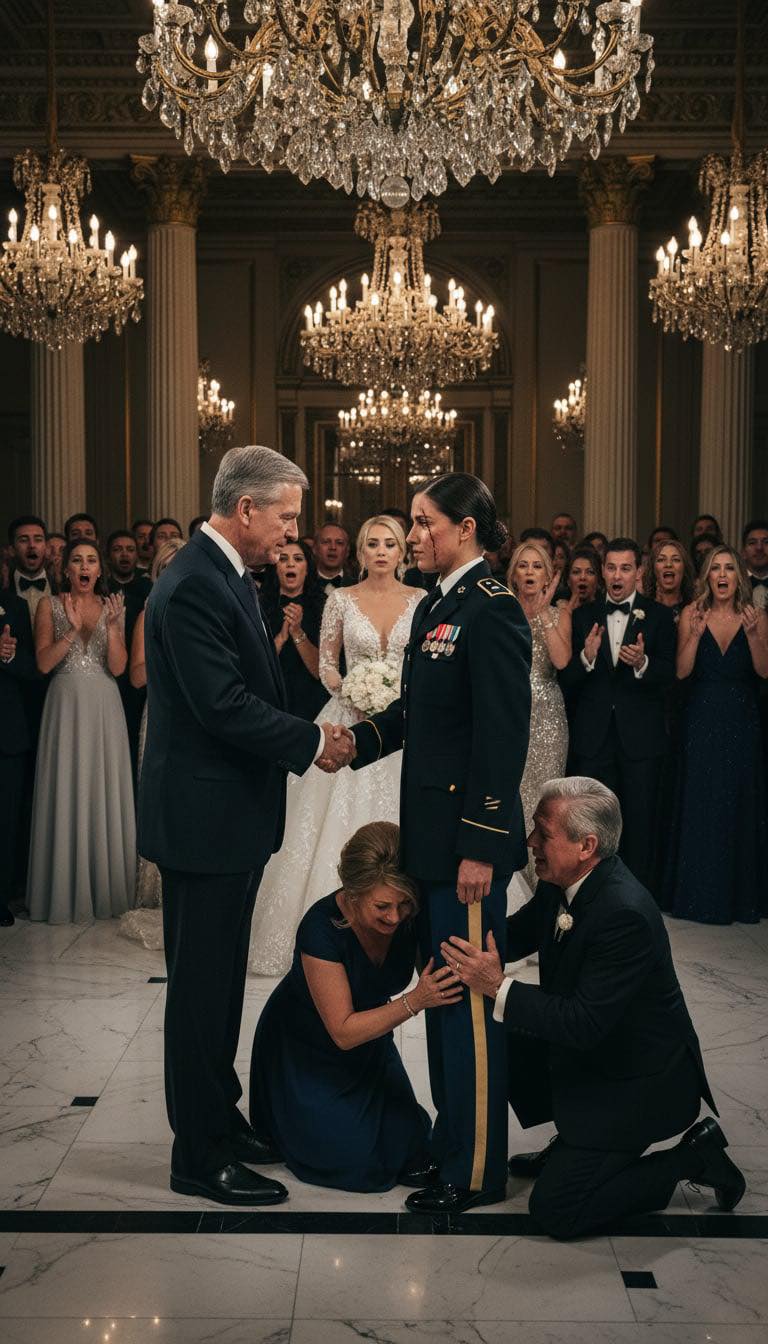
Senator Thomas Sterling, the man who was tipped to be the next Vice President, the man whose approval my family craved like oxygen, fell to his knees.
He didn’t collapse. He knelt. It was a movement of profound submission and reverence.
He reached out with a trembling hand and took my scarred, wet hand in his. He pressed my knuckles, the ones I had just used to scrub a roasting pan, against his forehead. He closed his eyes, and I saw a tear track through the deep lines of his face.
“Corporal,” Sterling whispered, his voice cracking. “I looked for you. For three years, I looked. The records were sealed… they said you were transferred…”
I looked down at the top of his head. My throat felt like it was filled with broken glass. “Senator… get up. Please. I’m just washing the dishes.”
Sterling raised his head. The look in his eyes changed. The sorrow evaporated, replaced by a cold, terrifying fury. He stood up slowly, using his cane, towering over my mother and sister.
The ballroom was silent now. Guests were crowding the doorway, whispering, watching.
Sterling turned to Jessica. He pointed his cane at her chest.
“You told me she was in a mental facility,” he said, his voice dangerously quiet.
“I… we…” Jessica stammered, her face crumbling. “We didn’t want to upset you. She looks… well, look at her. It’s a wedding.”
Sterling turned to Linda. “And you. You made the woman who carried me two miles through a burning oil field… wash your dishes?”
Linda opened her mouth, but no sound came out. She looked at the guests, realizing the narrative was slipping from her control.
“This woman,” Sterling addressed the crowd, his voice rising, projecting to the back of the room. “This woman took the full force of an IED blast to shield me. She is the reason I have a leg to stand on. She is the reason I am alive to breathe the air in this house. And you…” He turned back to my family, his disgust palpable. “You treat her like a dirty secret because she doesn’t fit your picture of ‘pretty’?”
He looked at me. “I thought you were dead, Cassie. I thought the fire took you.”
“I survived, Sir,” I said softly.
“Yes,” he said, placing a hand on my shoulder. “You did. But you shouldn’t have had to survive this.”
Sterling reached up to his lapel. He unpinned the heavy, white orchid “Guest of Honor” flower. With gentle hands, he pinned it onto the strap of my dirty, grease-stained apron.
He turned to the silent crowd of wealthy guests, the socialites, the donors.
“I cannot stay in a house that treats a hero like a servant.”
He looked at me, a question in his eyes. A lifeline.
“Leaving with me, soldier?”
Chapter 5: The Reflection in the Glass
The silence was shattered by the sound of a chair scraping against the floor inside the ballroom. Then another. The spell was broken.
“Wait! Senator!” Linda cried, chasing us as we walked toward the heavy oak front doors. “It was a misunderstanding! Cassie loves the kitchen! She wanted to help! We were protecting her!”
Sterling didn’t even break stride. He signaled his security detail—two large men in dark suits who stepped smoothly between my mother and us.
“Madam,” Sterling said, not looking back. “Your daughter is a lioness raised by hyenas. Do not speak to her again.”
We reached the foyer. Mike was there, holding his coat and my leather jacket. He handed it to me, covering the apron I hadn’t bothered to take off.
“I’m driving,” Mike said to me, nodding at the Senator. “I don’t think you want to ride in the limo just yet. We’ll follow you, Sir.”
Sterling nodded. “My driver knows the way. We’re going to my hotel. We have a lot to talk about, Corporal.”
As we walked out into the cool evening air, the exodus began. Following the Senator’s lead, the Mayor and his wife walked out. Then the bank president. The social validation my mother had spent twenty years building was evaporating in minutes.
From the doorway, Jessica screamed. It wasn’t a scream of sadness; it was a scream of narcissistic injury. She was tearing at her veil, destroying the perfect silk.
“Come back! The cake hasn’t been cut! Look at me! THIS IS MY DAY!”
I stopped at the passenger door of Mike’s truck. The Senator’s limousine was idling ahead, red taillights glowing in the dusk. I looked back at the house. It was huge, magnificent, and completely empty of anything that mattered.
I saw my reflection in the truck window. The scars were there. The twisted skin, the discoloration. But for the first time in three years, I didn’t feel the urge to hide. I looked myself in the eye.
“You okay, Cas?” Mike asked, starting the engine.
“Yeah,” I said, and I meant it. “I think I finally am.”
As we pulled onto the highway, putting distance between us and the estate, my phone buzzed in my pocket.
I pulled it out. A text from Jessica.
You ruined my life. You ugly bitch. You’re dead to me.
I stared at the screen. The letters blurred slightly. I felt the weight of the phone in my hand—the tether to the guilt, the obligation, the constant demands to be invisible.
I rolled down the window. The wind roared into the cabin, cold and cleansing.
“What are you doing?” Mike asked, glancing over.
I didn’t answer. I just held the phone out the window and let go.
I watched it tumble, bouncing once on the asphalt before shattering into a thousand pieces under the wheels of the traffic behind us.
Chapter 6: A Map of Survival
One Year Later.
The ballroom at the Grand Hyatt was packed. But this wasn’t a wedding. It was the annual Veterans’ Advocacy Gala.
I stood at the podium, gripping the edges of the wood. My hands were steady. I wore a tailored black gown that fit perfectly, sleeveless and bold. The scars on my arms and neck were visible under the stage lights. I hadn’t covered them with makeup. I hadn’t worn a high collar to hide.
In the front row, Mike sat next to Vice President Sterling. They were both smiling. Mike gave me a thumbs-up.
“I used to think my scars were a map of my pain,” I said into the microphone, my voice clear and strong. The room was so quiet you could hear a pin drop. “I was told they were unappetizing. That they made me a monster.”
I paused, looking out at the sea of faces—veterans, doctors, donors who actually cared.
“But I was wrong. These scars aren’t a map of pain. They are a map of survival. They are the receipt for a life saved. And you can never, ever be ashamed of surviving.”
Thunderous applause filled the room. It washed over me, warm and genuine.
Miles away, in a small, cluttered apartment in a bad part of town, I knew Jessica was watching. The scandal of the wedding had gone viral—someone had filmed the Senator’s exit. The family reputation had collapsed. Linda had moved to Florida to hide from the gossip. Jessica had lost her fiancé, her social standing, and her “perfect” life.
I imagined her sitting alone, the blue glow of a cracked phone screen illuminating her bitter face as she tapped ‘dislike’ on the livestream video. But the applause on the screen would drown out her bitterness. She was shouting into a void that no longer listened.
I stepped down from the podium. The gala began to mix and mingle.
A handsome man in a tuxedo approached me. He didn’t look at my dress or my shoes. He looked right at my face.
“That was an incredible speech, Cassie,” he said.
“Thank you,” I replied.
He reached up, his hand hovering near my face. “May I?”
I nodded.
He traced the line of the scar on my cheek with a gentle hand. His fingers were warm. He didn’t flinch. He traced the rough skin as if it were precious gold.
“It’s beautiful,” he said softly.
I smiled, a real smile that reached my eyes. I looked past him, out the floor-to-ceiling windows at the city lights of D.C. burning bright in the darkness.
“Yeah,” I said. “I think it is.”
I reached into my clutch for a mint and my fingers brushed against a piece of paper. It was a letter that had arrived at my office yesterday. Jessica Sterling (she had kept the name of the family she tried to marry into, pathetic really) was getting married again. A small ceremony. She wanted me there. To make amends, the note said. We’re family.
I pulled the envelope out. I looked at the man, then at the Vice President laughing with my brother.
“Excuse me one second,” I said.
I walked to the terrace door and stepped out into the night air. I pulled out my lighter, the old Zippo I’d carried since basic training. I flicked the wheel. The flame danced, orange and alive against the dark.
I held the corner of the envelope to the flame. It caught instantly. I watched the paper curl and blacken, the heavy cream cardstock turning to ash. I held it until the heat kissed my fingertips, then let the burning remnants flutter over the balcony railing, disappearing into the wind.
The story of the girl in the kitchen was over. The story of the woman had just begun.