The house on Maplewood Drive smelled of roasted turkey, sage stuffing, and the cloying, cinnamon-spiced scent of performative happiness. It was the smell of a magazine cover brought to life, a scent I had spent thirty-two years trying to scrub from my skin.
I stood on the front porch, the November wind biting through my wool coat, balancing my grandmother’s pecan pie in one hand. It was still warm, the lattice crust golden and fragile, smelling of caramelized sugar and the only genuine love I had ever known in this family.
I opened the door without knocking.
The noise hit me first—the clatter of silver against fine china, the crystalline laughter of aunts and cousins, the low rumble of uncles discussing football. Twenty-three people were gathered in the dining room. My mother, Diane, held court at the head of the table, her smile tight and practiced, like a wire trap waiting to snap.
I walked into the dining room, expecting the usual hush that accompanied my arrival—the pause where the family recalibrated to accommodate the “difficult” daughter. But today, the silence was different. It wasn’t awkward; it was absolute.
I scanned the long mahogany table, counting the place settings. Twenty-three chairs. Twenty-three name cards written in my sister Clarissa’s looping calligraphy.
There was no chair for me.
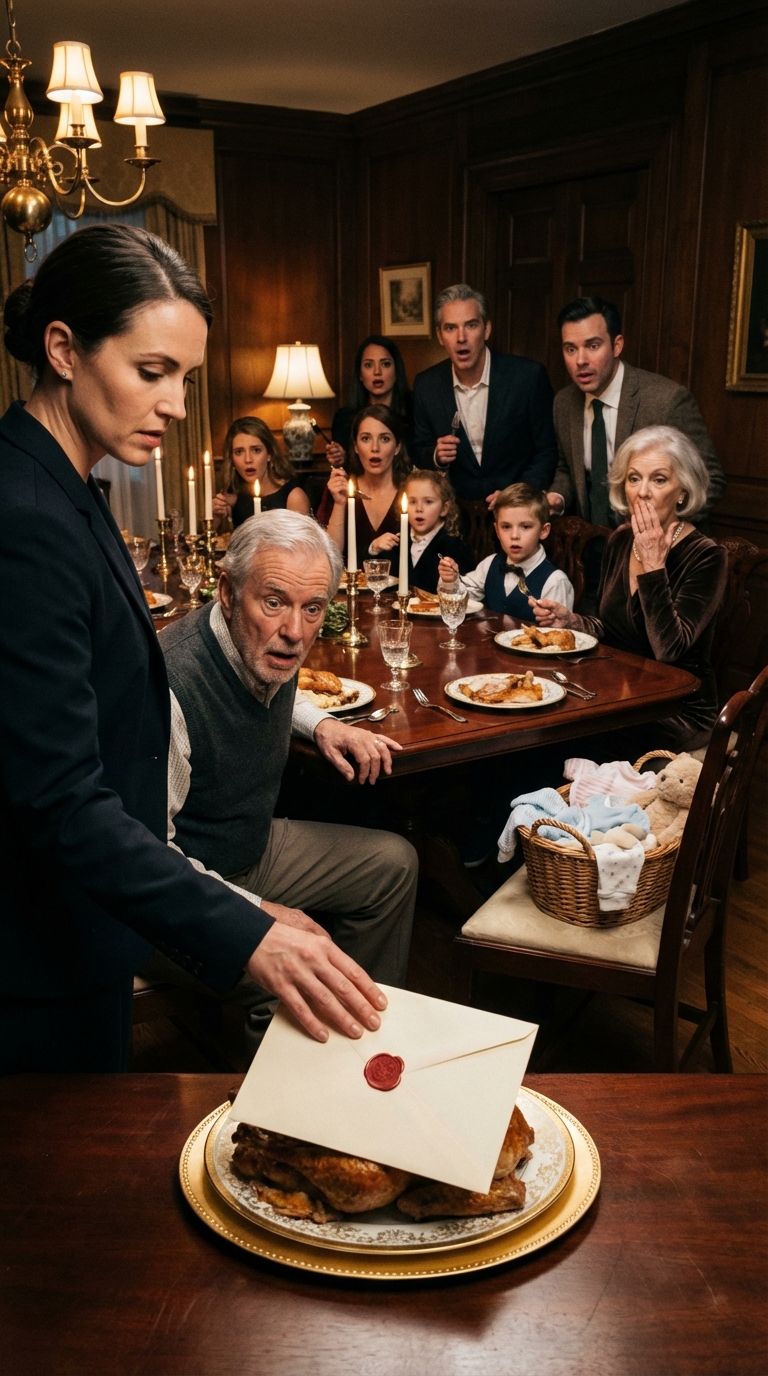
My spot, usually near the kitchen door where I could be summoned easily to refill water glasses, had been erased. In its place sat a high-end baby gift basket, wrapped in cellophane.
“You’re late,” my mother said, not looking up from her plate. She sliced her turkey with surgical precision.
“I’m ten minutes early,” I replied, my voice steady despite the thudding of my heart against my ribs. “Where is my seat?”
My father, Harold, stared into his wine glass, swirling the dark red liquid as if divining a future where he didn’t have to exist in this moment.
“We ran out of room, Regina,” my mother said, finally lifting her eyes. They were blue and flat, like a frozen lake. “You can eat in the kitchen after we’re finished. Honestly, with your attitude lately, it’s better this way.”
“My attitude?” I took a step closer. The pie felt heavy in my hands, a tangible anchor to the woman who was no longer here to defend me.
“There is simply no room at this table for disappointments,” she said.
The words hung in the air, suspended over the candied yams and the green bean casserole. A fork clattered onto a plate. My sister Clarissa, glowing with pregnancy and self-satisfaction, covered a giggle with a napkin.
In any other year, I would have crumbled. I would have retreated to the kitchen, eaten my cold turkey in silence, and washed the dishes while they toasted to their success. I would have internalized the shame, believing it was my rightful inheritance.
But this year was different. This year, I had a ghost on my side.
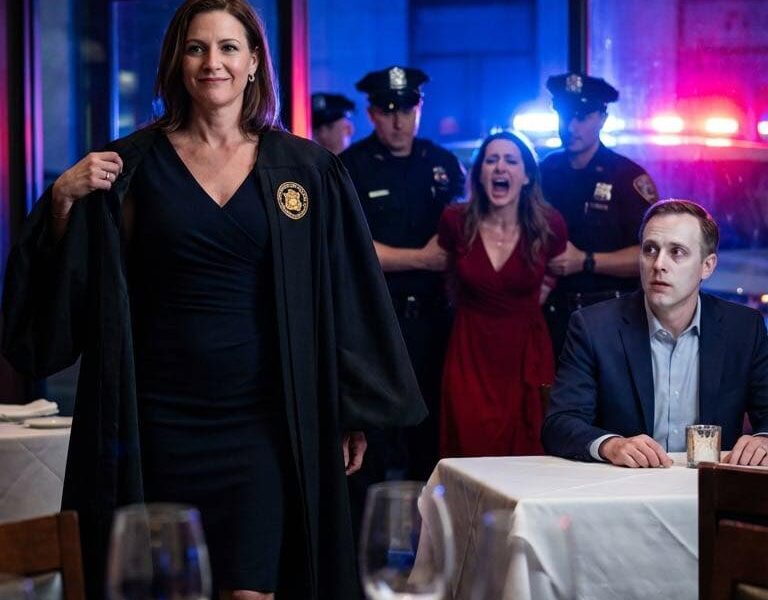
I didn’t cry. I didn’t scream. I simply walked to the head of the table, past the stunned faces of my aunts and uncles, and set the pie down next to the centerpiece. Then, I reached into my coat pocket and pulled out a thick, cream-colored envelope sealed with red wax.
I placed it gently on my father’s dinner plate, covering his untouched food.
“Happy Thanksgiving, Dad,” I said, my voice ringing clear in the silent room. “I finally understand why you hate me.”
Harold looked up, his face gray and slack. “Regina, what are you doing?”
“The DNA results inside answered the questions I’ve been asking my whole life,” I told him, looking around the table, meeting every pair of averted eyes. “But they also raised one bigger question. One that nobody in this room has the courage to answer.”
I leaned in, bracing my hands on the table.
“Open it.”
To understand why I burned my family to the ground that Thanksgiving, you have to go back six months, to the day Grandma Ruth died.
The funeral home smelled of lilies and floor polish, an antiseptic combination that tries to mask the scent of mortality. I arrived an hour early, just as Grandma Ruth had taught me. Early is on time. On time is late. I wanted to arrange the flowers, straighten the chairs, do something useful with the grief that was hollowing me out from the inside.
My mother was already there, clipboard in hand, directing the funeral staff like a general commanding troops on a battlefield.
“Regina.” She didn’t look up. “Stand by the entrance. Greet people as they arrive. Take their coats.”
“I thought I’d sit with the family,” I said. “Before the service starts.”
“The front row is for immediate family,” she said, checking off a box on her list. “People who were close to your grandmother. Clarissa is flying in from Boston. She’s distraught. She needs the space.”
I felt the words land like a slap. People who were close to her.
For the past five years, I was the one who drove Grandma Ruth to every cardiology appointment. I was the one who sat on her porch swing every Sunday, drinking sweet tea and listening to stories about her youth. I was the one who held her hand when the hospice nurse explained what “transitioning” meant, while Clarissa was busy posting “thoughts and prayers” from a brunch spot in Back Bay.
“Mom, I was the one holding her hand when she took her last breath,” I whispered.
She finally looked at me. It wasn’t anger in her eyes; it was something worse. Indifference. It was like looking at a stranger on a bus.
“You understand, don’t you? We need to present a united front. Clarissa is fragile right now.”
I understood. I always understood. I was the scaffolding; Clarissa was the cathedral.
The service was beautiful. My sister cried elegantly in the front row, dabbing her eyes with a monogrammed handkerchief while our mother held her. I stood in the back, near the guest book, watching my family grieve together without me.
Afterward, as the mourners filed out, a man in a gray suit approached me. He had kind eyes and a firm handshake.
“Miss Seaton? I’m David Morris, your grandmother’s attorney.”
“Yes?”
“Ruth left something specifically for you,” he said, lowering his voice. “But per her instructions, I cannot release it immediately. I need to verify some details. I will be in touch in six months.”
“Six months?” I frowned. “Why?”
“She wanted to give you time to grieve,” he said cryptically. “And she wanted to make sure you were ready.”
Ready for what?
The question haunted me for half a year. During those six months, the family estate was settled. Mom got the house on the lake. Clarissa got the jewelry collection and a substantial trust fund. I received a set of vintage teacups and a handwritten recipe book.
And then, three weeks before Thanksgiving, the call came.
“The waiting period is over, Regina,” David Morris said. “I have the envelope. Can you come to my office today?”
I drove there with a knot of dread in my stomach. When he handed me the package, it felt heavy. Not just physical weight—it felt burdened.
“Did she say what’s inside?” I asked.
David shook his head. “Only that you deserve the truth. And that she was sorry she wasn’t brave enough to give it to you while she was alive.”
I took the envelope home and placed it on my nightstand. It sat there for three days, a silent bomb waiting for a spark.
Five days before Thanksgiving, my mother called. We didn’t do phone calls. We did texts: Dinner at 6. Don’t be late. Bring ice.
“Regina,” her voice was clipped, efficient. “Thanksgiving is at our house this year. The whole family. Both sides.”
“Okay. I’ll make Grandma’s pecan pie.”
“Clarissa has an announcement,” she interrupted. “Something wonderful. It’s important that everything goes perfectly. Do you understand?”
“I understand, Mom. Don’t embarrass us. Don’t be yourself.”
“Just be there early to set the table.” Click.
I stared at the phone, the old, familiar shame washing over me. Then, my eyes drifted to the nightstand. The envelope was still there, sealed with red wax.
When you’re ready to know the truth.
Was I ready? I wasn’t sure. but I knew I couldn’t walk into that house again as the same person. I picked up the letter opener. My hands trembled as I broke the seal.
Inside were three items: a handwritten letter on Grandma’s stationery, a folded document with a medical laboratory letterhead, and a photocopy of a birth certificate with sections blacked out.
I read Grandma Ruth’s letter first.
My darling Regina,
I am so sorry. I have carried this secret for thirty-two years, and my silence is my greatest regret. I was afraid—afraid of destroying the family, afraid of what your mother would do, afraid of losing access to you. But you cannot go through the rest of your life thinking you are broken.
You are not Harold’s biological daughter.
I had my suspicions for years. The way your mother looked at you—not with love, but with guilt. The way Harold looked right through you. Two years ago, I stopped guessing. I took a hair sample from your brush and a sample from Harold’s water glass. I sent them to a private lab.
The results are enclosed. 0% probability. Harold Seaton is not your father.
I confronted your mother. She begged me on her knees. She said if Harold found out, he would leave her, and she would be destitute. She made me promise to stay silent. I kept that promise while I breathed, but I will not keep it from beyond the grave.
Your mother refuses to name your biological father. She guards that secret with her life. But you deserve to know that your exclusion isn’t because you aren’t good enough. It’s because you are the living proof of her sin.
I love you, Ruthie.
I dropped the letter. The room spun. I picked up the lab report. The numbers blurred through my tears, but the conclusion was stark: Probability of Paternity: 0.00%.
Thirty-two years.
The memories rearranged themselves in my mind like a kaleidoscope turning. The way Dad refused to attend my dance recitals but never missed Clarissa’s soccer games. The way Mom pulled me out of college to care for her during her cancer treatment, claiming Clarissa’s medical degree was “too important to interrupt,” while my future was expendable.
They had turned me into a servant in my own home not because I was less capable, but because I was a reminder.
I sat on the floor, the papers spread around me like evidence at a crime scene. I had two choices. I could burn the papers, go to dinner, sit in the kitchen, and pretend. Or I could go to war.
I looked at the blacked-out birth certificate. Someone had deliberately hidden the truth.
“No more,” I whispered to the empty room.
I photocopied the documents. I put the originals in my fireproof safe. I slid the copies into a fresh envelope. I wasn’t going to Thanksgiving for turkey. I was going for answers.
When I arrived at the house on Thanksgiving, I saw the cars lining the driveway. Mercedes, Lexus, BMW. The family success stories. I parked my ten-year-old sedan at the end of the street.
My aunt Margaret, Grandma Ruth’s younger sister, was smoking a cigarette on the back patio when I walked up the drive. She was the black sheep of the older generation, the only one who ever sent me birthday cards on time.
“Regina,” she exhaled smoke, looking me up and down. “You look like you’re heading to an execution.”
“Maybe I am,” I said. “Aunt Margaret, did you know?”
She froze. The ash from her cigarette fell onto her velvet shoe. She didn’t ask what I meant. She just looked at me with infinite sadness.
“Ruth told me,” she whispered. “Right before she died. She made me swear not to say anything until you got the envelope.”
“Who is he?” I asked. “Who is my real father?”
“I don’t know, honey. Only Diane knows that. And she’s spent thirty years burying it.” She grabbed my hand, her grip fierce. “Be careful in there. Your mother is cornered. Animals bite when they’re cornered.”
I went inside. The house was already full. Clarissa was holding court in the living room, one hand on her pregnant belly, the other holding a sparkling cider.
“Everyone!” she announced as I entered. “We have big news! We’ve decided on a name.”
The room hushed. My mother looked at Clarissa with adoring eyes—the look I had starved for my entire life.
“We’re going to name her Ruth,” Clarissa beamed. “After Grandma. Baby Ruth Seaton-Wells.”
The room erupted in applause. My mother dabbed at her eyes. “Oh, Clarissa, that is so touching. Mother would have been so honored.”
I felt the bile rise in my throat. Clarissa, who couldn’t be bothered to visit Grandma in hospice, was now claiming her name as a prop for her perfect life narrative.
“And,” Clarissa continued, turning toward me with a benevolence that felt like a pat on the head for a dog. “I want to thank my sister Regina. For always being… available. You know, every successful family needs someone behind the scenes. Someone steady. Someone useful.”
“Here, here!” Uncle Bob raised his glass. “To Regina! The foundation!”
Useful. Not smart. Not beautiful. Not loved. Useful. Like a mop. Like a doorstop.
My mother caught my eye and mouthed, Kitchen. Now.
I walked past them. Past the toasts. Past the lies. I went into the kitchen and picked up the pie.
“One more chance,” I told myself. “I will give them one more chance to treat me like a human being.”
I walked out with the pie. That was when I saw the table. That was when I saw the baby gift basket in my chair.
That was when the last thread of my loyalty snapped.
The dining room was silent now, save for the ticking of the grandfather clock. My father held the envelope I had dropped on his plate. His hands were shaking so hard the paper rattled.
“What is this?” Clarissa demanded, her voice shrill. “Regina, you are ruining my announcement!”
“Open it, Dad,” I said, ignoring her.
Harold tore the seal. He pulled out the papers. I watched his eyes scan the lines. I saw the moment the comprehension hit him. The color drained from his face, leaving him looking like aged parchment.
“Harold?” My mother’s voice wavered. “Harold, don’t read that. It’s nonsense. Regina is hysterical.”
“Zero percent,” Harold whispered.
“What?” Clarissa asked.
“Probability of paternity,” Harold looked up, his eyes wet and vacant. “Zero percent.”
A gasp rippled through the room. Aunt Barbara covered her mouth.
“That’s a lie!” My mother slammed her hand on the table, rattling the silverware. “She forged it! She’s always been jealous of Clarissa! She made this up to destroy us!”
“It’s on the lab letterhead, Diane,” Harold said, his voice gaining strength. “It’s signed by the geneticist. And… and there’s a letter from your mother.”
“Mother was senile!” Diane shrieked.
“Grandma Ruth wasn’t senile,” I said, my voice calm, terrifyingly calm. “She was the only honest person in this family. She took the samples. She ran the test. She knew you were punishing me for your affair.”
“Affair?” Clarissa looked from Mom to Dad. “Mom?”
“I did not have an affair!” Mom stood up, her chair screeching against the hardwood. “I made a mistake! One time! Thirty-three years ago! And I have paid for it every single day!”
“You paid for it?” I laughed, a harsh, jagged sound. “You? I’m the one who paid for it, Mom. I’m the one you pulled out of school. I’m the one you treated like a servant. You couldn’t stand looking at me because I have his face, don’t I? Whoever he is.”
“Stop it!” she screamed. “You are ungrateful! I put a roof over your head!”
“You put a roof over a secret!” Aunt Margaret stood up from the end of the table. “Enough, Diane. The girl knows.”
“You knew?” Mom whipped around to face her sister. “You traitor.”
“I knew you were abusing her,” Margaret said coldly. “Neglect is abuse, Diane. Erasing a child is abuse.”
My father stood up slowly. He looked at my mother, then at me.
“I suspected,” he said softly.
The room went deadly quiet.
“What?” I asked.
“When you were five,” Harold said, tears spilling onto his cheeks. “You needed stitches. The doctor mentioned your blood type. It didn’t match mine or Diane’s. I looked it up. I knew it was impossible.”
“And you said nothing?” I whispered. “For twenty-seven years?”
“I was a coward,” he admitted, looking down. “I didn’t want to lose my wife. I didn’t want to break up the home. So I… I just tried not to think about it. I detached.”
“You detached from me,” I said. “You let me think I wasn’t good enough for your love. But I wasn’t even playing the same game.”
“I’m sorry, Regina,” he sobbed.
“Sorry doesn’t give me my life back.” I turned to my mother. “Who is he?”
She clamped her jaw shut. “I will never tell you. I will take that name to the grave. You have done enough damage today.”
“Then I’ll find him myself,” I said. “DNA databases exist, Mom. You can’t hide him anymore.”
I looked around the table at the twenty-three silent relatives. The aunts who had judged me. The cousins who had mocked me.
“Enjoy your turkey,” I said. “And Clarissa? Don’t name that baby Ruth. You don’t deserve her name.”
I turned and walked out.
“Regina, wait!” Clarissa yelled. “You can’t just leave! This is my special day!”
I didn’t stop. I walked out the front door into the cold night. I left the pie on the table.
I drove for an hour with no destination, just putting miles between me and that house. My phone blew up with texts—Clarissa calling me selfish, Mom threatening legal action, Dad sending incoherent apologies. I blocked them all.
I pulled into a rest stop and sobbed until my chest ached. Not for the family I lost, but for the little girl who had tried so hard to please people who were committed to misunderstanding her.
A week later, Aunt Margaret texted me.
Your father filed for divorce. He moved into a hotel. Diane is spinning out. She’s telling everyone you’re mentally unstable, but nobody is buying it anymore. The DNA test was the nail in the coffin.
Two weeks later, Harold showed up at the bookstore where I worked. He looked ten years older. He didn’t ask for forgiveness. He handed me a manila envelope.
“I went through the attic,” he said, his voice raspy. “I found this in her old work files from the accounting firm. Summer of 1993.”
I opened the envelope. It was a photograph of a company picnic. My mother, young and laughing, standing next to a man with dark, curly hair and eyes that looked exactly like mine.
“His name was James Martin,” Harold said. “He was an architect. He transferred to London before you were born. I don’t think he ever knew.”
“Thank you,” I said. It was the only honest exchange we’d ever had.
I spent my 33rd birthday alone in a new studio apartment above a bakery. It smelled of yeast and sugar—a good smell. A clean smell. I had reenrolled in college. I was finally finishing my business degree.
I hired a private investigator to find James Martin.
Yesterday, the report came back. He is alive. He lives in Chicago. He never married.
I’m sitting at my small kitchen table—a table with only two chairs, but both of them are welcomed—staring at his phone number.
I haven’t called him yet. Maybe I will tomorrow. Maybe I won’t. For the first time in my life, the timeline belongs to me. I am not a disappointment. I am not a secret. I am Regina, and my seat at the table is wherever I choose to place it.
Epilogue
If there is one thing I learned from the wreckage of that Thanksgiving, it is this: You do not owe your silence to the people who hurt you.
I checked my phone one last time. A text from an unknown number.
Hello, Regina. My name is James. I received a letter from a private investigator. I think… I think we should talk.
I smiled, picked up my tea, and typed back.
I’m listening.